
CD9, also known as motility-related protein-1 (MRP-1), is a tetraspan family glycoprotein expressed by a variety of hematopoietic and epithelial cells. It forms homotypic associations as well as heterotypic associations with other tetraspan proteins, some integrins and MHC class II proteins. CD9 has been shown to modulate cellular adhesion, migration and proliferation.
Human CD9 Antibody (209306)
R&D Systems | Catalog # MAB1880

Scientific images may be resized, cropped, or adjusted for brightness or contrast for presentation purposes. These updates are limited to presentation and do not affect the underlying scientific interpretation of the data. Where available, additional source data may be provided upon request.
Key Product Details
Species Reactivity
Validated:
Human
Cited:
Human
Applications
Validated:
Flow Cytometry, CyTOF-ready
Cited:
Immunohistochemistry, Western Blot, Immunocytochemistry, Cell Selection, ELISA Capture, ELISA Detection, MACS
Label
Unconjugated
Antibody Source
Monoclonal Mouse IgG2B Clone # 209306
Loading...
Product Specifications
Immunogen
NS0 mouse myeloma cell line transfected with human CD9
Met1-Val228
Accession # P21926
Met1-Val228
Accession # P21926
Specificity
Detects human CD9 in direct ELISAs.
Clonality
Monoclonal
Host
Mouse
Isotype
IgG2B
Scientific Data Images for Human CD9 Antibody (209306)
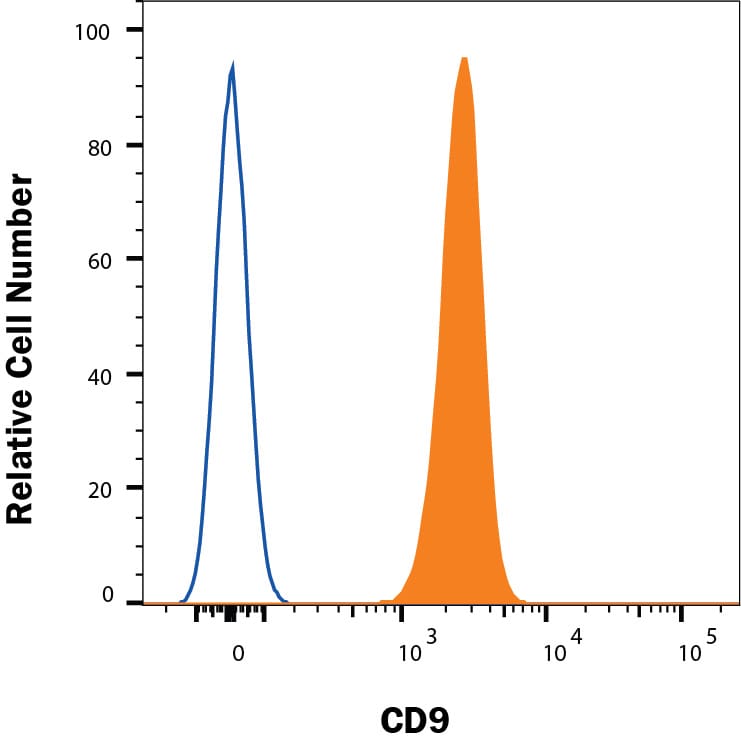
Detection of CD9 in Human Platelets by Flow Cytometry.
Human peripheral blood platelets were stained with Mouse Anti-Human CD9 Monoclonal Antibody (Catalog # MAB1880, filled histogram) or isotype control antibody (Catalog # MAB0041, open histogram) followed by anti-Mouse IgG PE-conjugated Secondary Antibody (F0102B). View our protocol for Staining Membrane-associated Proteins.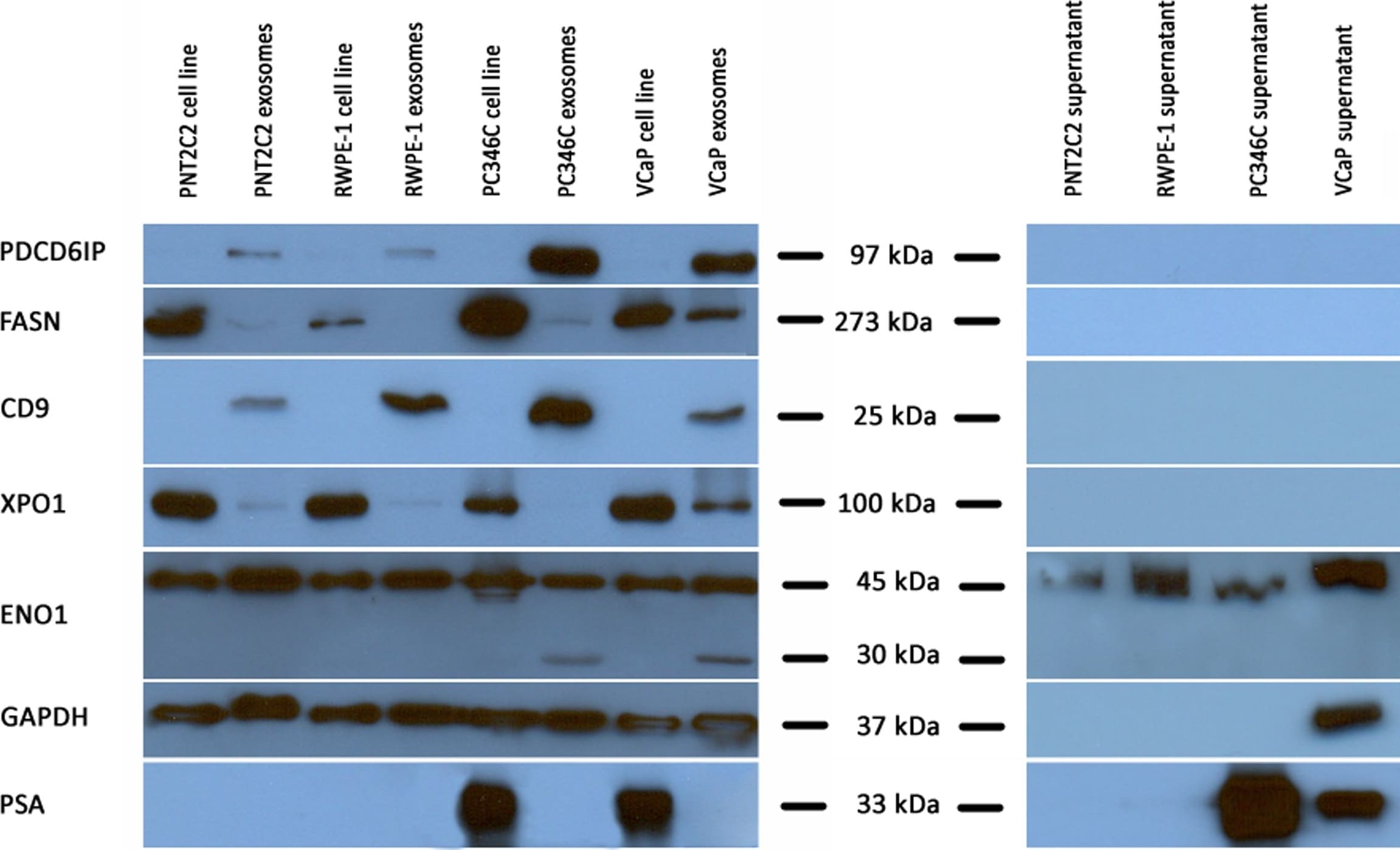
Detection of Human CD9 by Western Blot
Validation of protein expression by Western blotting.All four exosome samples and their corresponding cell lines were used for validation. Furthermore, supernatant from the pelleted exosomes was used as a control. The selected proteins FASN, XPO1, CD9 and PDCD6IP, were tested with ENO1 and GAPDH as controls. PSA was tested to confirm it is secreted through alternative secretion pathway and therefore not present within exosomes. The nearest protein marker (kDa) is indicated for each blot. Image collected and cropped by CiteAb from the following publication (https://pubmed.ncbi.nlm.nih.gov/24391718), licensed under a CC-BY license. Not internally tested by R&D Systems.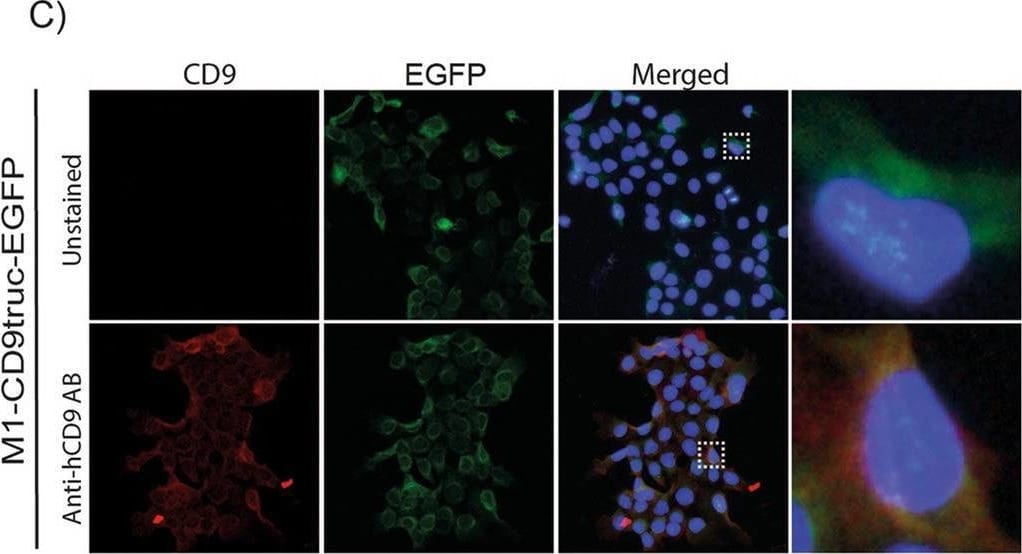
Detection of CD9 by Immunocytochemistry/ Immunofluorescence
Expression of EGFP & associated EV markers M1-CD9truc-EGFP & their conditioned medium. (A) Illustration of our EV reporter gene & protein. The CD9truc-EGFP coding sequence is driven by the CMV promoter & encodes a fusion protein consisting of the first 3 transmembrane domains of CD9 & EGFP, enabling genetic labeling & EV surface display of EGFP. (B) M1 stable transfected with CD9truc-EGFP are green fluorescent in contrast to non-transfected M1. Nuclei (blue) & GFP (green). n = 3, ×200 magnification (C) Immunofluorescence labeling of CD9 in M1-CD9truc-EGFP using Anti-hCD9 AB shows colocalization between CD9 (red), EGFP (green) & nuclei (blue). ×200 magnification (n = 3) (D) M1 stable transfected with CD9truc-EGFP expressing a band reacting with an anti-GFP antibody in & PEG-precipitated conditioned medium. Actin & Lamin A/C were detected in cell lysates only, & EVs markers ALIX & Flotillin were detected in conditioned medium from transfected & non-transfected M1 (n = 3). Full-length blots are shown in Supplementary Figure S2A-F. (E) Tunable resistive pulse sensing on conditioned medium from non-transfected M1 & stable transfected CD9truc-EGFP indicated that the size distribution of EVs is not affected the expression reporter proteins (n = 3). (F) Size-exclusion chromatography fractions of CD9truc-EGFP cell-conditioned medium showed full-length CD9truc-EGFP in fractions 1–3, while shedded EGFP was present in fractions 10–12 (n = 3). Full-length blots are shown in Supplementary Figure S2G. Below the WB, the protein concentration in each fraction is shown (G) Anti-GFP immunoprecipitation of conditioned medium co-isolates CD9truc-EGFP & EV markers ALIX & TSG101 only in M1 stable transfected with CD9truc-EGFP (n = 3). Full-length blots are shown in Supplementary Figure S3A-C. Image collected & cropped by CiteAb from the following open publication (https://pubmed.ncbi.nlm.nih.gov/35017633), licensed under a CC-BY license. Not internally tested by R&D Systems.Applications for Human CD9 Antibody (209306)
Application
Recommended Usage
CyTOF-ready
Ready to be labeled using established conjugation methods. No BSA or other carrier proteins that could interfere with conjugation.
Flow Cytometry
0.25 µg/106 cells
Sample: Human platelets
Sample: Human platelets
Flow Cytometry Panel Builder
Bio-Techne Knows Flow Cytometry
Save time and reduce costly mistakes by quickly finding compatible reagents using the Panel Builder Tool.
Advanced Features
- Spectra Viewer - Custom analysis of spectra from multiple fluorochromes
- Spillover Popups - Visualize the spectra of individual fluorochromes
- Antigen Density Selector - Match fluorochrome brightness with antigen density

Formulation, Preparation, and Storage
Purification
Protein A or G purified from hybridoma culture supernatant
Reconstitution
Reconstitute at 0.5 mg/mL in sterile PBS. For liquid material, refer to CoA for concentration.
Loading...
Formulation
Lyophilized from a 0.2 μm filtered solution in PBS and NaCl with Trehalose. See Certificate of Analysis for details.<br/>*Small pack size (-SP) is supplied either lyophilized or as a 0.2 µm filtered solution in PBS.
Shipping
Lyophilized product is shipped at ambient temperature. Liquid small pack size (-SP) is shipped with polar packs. Upon receipt, store immediately at the temperature recommended below.
Stability & Storage
Use a manual defrost freezer and avoid repeated freeze-thaw cycles.
- 12 months from date of receipt, -20 to -70 °C as supplied.
- 1 month, 2 to 8 °C under sterile conditions after reconstitution.
- 6 months, -20 to -70 °C under sterile conditions after reconstitution.
Calculators
Background: CD9
Alternate Names
CD9, DRAP-27, MIC3, p24, TSPAN29
Gene Symbol
CD9
UniProt
Additional CD9 Products
Product Documents for Human CD9 Antibody (209306)
Certificate of Analysis
To download a Certificate of Analysis, please enter a lot or batch number in the search box below.
Note: Certificate of Analysis not available for kit components.
Product Specific Notices for Human CD9 Antibody (209306)
For research use only
Related Research Areas
Citations for Human CD9 Antibody (209306)
 Powered by Bioz
Customer Reviews for Human CD9 Antibody (209306)
There are currently no reviews for this product. Be the first to review Human CD9 Antibody (209306) and earn rewards!
Have you used Human CD9 Antibody (209306)?
Submit a review and receive an Amazon gift card!
$25/€18/£15/$25CAN/¥2500 for a review with an image
$10/€7/£6/$10CAN/¥1110 for a review without an image
Submit a review
Protocols
Find general support by application which include: protocols, troubleshooting, illustrated assays, videos and webinars.
- 7-Amino Actinomycin D (7-AAD) Cell Viability Flow Cytometry Protocol
- Extracellular Membrane Flow Cytometry Protocol
- Flow Cytometry Protocol for Cell Surface Markers
- Flow Cytometry Protocol for Staining Membrane Associated Proteins
- Flow Cytometry Staining Protocols
- Flow Cytometry Troubleshooting Guide
- Intracellular Flow Cytometry Protocol Using Alcohol (Methanol)
- Intracellular Flow Cytometry Protocol Using Detergents
- Intracellular Nuclear Staining Flow Cytometry Protocol Using Detergents
- Intracellular Staining Flow Cytometry Protocol Using Alcohol Permeabilization
- Intracellular Staining Flow Cytometry Protocol Using Detergents to Permeabilize Cells
- Propidium Iodide Cell Viability Flow Cytometry Protocol
- Protocol for Liperfluo
- Protocol for the Characterization of Human Th22 Cells
- Protocol for the Characterization of Human Th9 Cells
- Protocol: Annexin V and PI Staining by Flow Cytometry
- Protocol: Annexin V and PI Staining for Apoptosis by Flow Cytometry
- Troubleshooting Guide: Fluorokine Flow Cytometry Kits
- View all Protocols, Troubleshooting, Illustrated assays and Webinars
Loading...