
CD97 is a 95‑100 kDa member of a protein group known as the LNB-TM7 protein family that evolved from genes of the secretin receptor superfamily (1‑3). Molecules in this family are unique hybrid structures consisting of EGF-like modules coupled to class B G-protein 7-transmembrane (TM) domains by a glycosylated (mucin) stalk. Human CD97 is synthesized as an 835 amino acid (aa) precursor that contains a 20 aa signal sequence, a 532 aa extracellular domain (ECD), a 238 aa “transmembrane” region that includes seven TM segments, and a 45 aa cytoplasmic tail (4). Within the 532 aa ECD, the first 236 aa contains five EGF-like domains, the C-terminal four of which bind calcium, and a juxtamembrane 296 aa RGD-containing mucin stalk (4, 5). The stalk is both glycosylated and proteolytically cleaved (at aa 530) to create a noncovalently linked 65‑70 kDa glycosylated extracellular alpha -subunit and a 28 kDa 7-TM membrane-bound beta -subunit (4). There are two known alternate splice forms in human. Isoform # 1 contains four EGF-like domains (domain # 1, 2, 3 and 5), while isoform # 2 contains three EGF-like domains (domain # 1, 2 and 5) (1, 4, 6). The ECD in isoform 1 is 60 kDa in size, while the ECD in isoform 2 is 55 kDa in size (native molecular weight). The five EGF-like domain region in human shares 55% aa sequence identity with that in mouse. Cells known to express CD97 include monocytes, macrophages, T cells, select B cells, dendritic cells and, potentially, vascular and visceral smooth muscle cells (1, 7). There are at least two ligands for CD97. One is chrondroitin sulfate that binds only to the full-length (five domain) form of CD97. Binding is dependent on the presence of EGF-like domain # 4 (3). The second ligand for CD97 is CD55, a GPI-linked cell surface molecule with short consensus repeats that regulates complement activation on cell surfaces (1, 5, 7). CD97 EGF-like domains # 1 and 2 bind CD55 while domain # 5 stabilizes the CD97 molecule. The shortest CD97 isoform shows the strongest binding to CD55 (7, 8).

Scientific images may be resized, cropped, or adjusted for brightness or contrast for presentation purposes. These updates are limited to presentation and do not affect the underlying scientific interpretation of the data. Where available, additional source data may be provided upon request.
Key Product Details
Species Reactivity
Applications
Label
Antibody Source
Product Specifications
Immunogen
Gln21-Gln398
Accession # NP_001775.2
Specificity
Clonality
Host
Isotype
Endotoxin Level
Scientific Data Images for Human CD97 Antibody (380905)
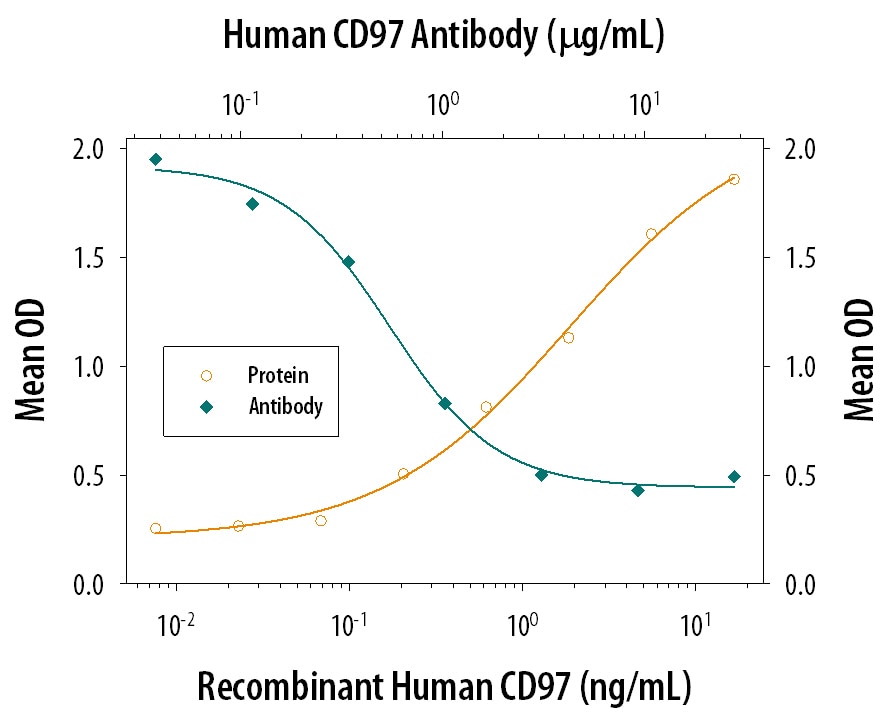
Cell Adhesion Mediated by CD97 and Neutralization by Human CD97 Antibody.
Recombinant Human CD97 (Catalog # 2529-CD), immobil-ized onto a microplate, supports the adhesion of human red blood cells in a dose-dependent manner (orange line). Adhesion elicited by Recombinant Human CD97 (4 µg/mL) is neutralized (green line) by increasing concentrations of Mouse Anti-Human CD97 Monoclonal Antibody (Catalog # MAB25291). The ND50 is typically 0.25-1.25 µg/mL.Applications for Human CD97 Antibody (380905)
Neutralization
Human CD97 Sandwich Immunoassay
Formulation, Preparation, and Storage
Purification
Reconstitution
Reconstitute at 0.5 mg/mL in sterile PBS. For liquid material, refer to CoA for concentration.
Formulation
Shipping
Stability & Storage
- 12 months from date of receipt, -20 to -70 °C as supplied.
- 1 month, 2 to 8 °C under sterile conditions after reconstitution.
- 6 months, -20 to -70 °C under sterile conditions after reconstitution.
Calculators
Background: CD97
References
- McKnight, A.J. and S. Gordon (1998) J. Leukoc. Biol. 63:271.
- Stacey, M. et al. (2000) Trends Biochem. Sci. 25:284.
- Stacey, M. et al. (2003) Blood 102:2916.
- Gray, J.X. et al. (1996) J. Immunol. 157:5438.
- Lin, H-H. et al. (2001) J. Biol. Chem. 276:24160.
- Hamann, J. et al. (1995) J. Immunol. 155:1942.
- Jaspars, L.H. et al. (2001) Tissue Antigens 57:325.
- Hamann, J. et al. (1996) J. Exp. Med. 184:1185.
Alternate Names
Gene Symbol
UniProt
Additional CD97 Products
Product Documents for Human CD97 Antibody (380905)
Certificate of Analysis
To download a Certificate of Analysis, please enter a lot or batch number in the search box below.
Note: Certificate of Analysis not available for kit components.
Product Specific Notices for Human CD97 Antibody (380905)
For research use only
Related Research Areas
Customer Reviews for Human CD97 Antibody (380905)
There are currently no reviews for this product. Be the first to review Human CD97 Antibody (380905) and earn rewards!
Have you used Human CD97 Antibody (380905)?
Submit a review and receive an Amazon gift card!
$25/€18/£15/$25CAN/¥2500 for a review with an image
$10/€7/£6/$10CAN/¥1110 for a review without an image
Submit a review