
DDR2, also known as TYR010 and TKT, is a widely expressed 130 kDa type I transmembrane glycoprotein belonging to the discoidin-like domain containing subfamily of receptor tyrosine kinases (1). Mature human DDR2 consists of a 378 amino acid (aa) extracellular domain (ECD) that includes the discoidin-like domain, a 22 aa transmembrane segment, and a 434 aa cytoplasmic domain that includes the kinase domain (2). Within the ECD, human DDR2 shares 53% aa sequence identity with DDR1 and 97% aa sequence identity with mouse DDR2. The discoidin-like domain mediates DDR2 interactions with collagens I, III, and X (3-5). Collagens II and V are less efficacious ligands (3). DDR2 selectively recognizes the triple helical structure of collagen compared to monomeric or denatured collagen (3, 5, 6). Within collagen II, the D2 period is required for DDR2 binding, and the D1 period is additionally required to trigger DDR2 autophosphorylation (6). The ECD of DDR2 exists as a non-covalent dimer in solution, and dimerization of the receptor greatly enhances collagen binding (4, 7). DDR2 interaction with collagen I inhibits collagen fibrillogenesis and alters collagen fiber morphology (7). Ligand binding induces DDR2 autophosphorylation in the cytoplasmic domain (3, 5, 8), which promotes associations with Shc and Src (9). In addition to the above mechanism, DDR2 exhibits a distinct interaction with collagen X. A region other than the discoidin-like domain of DDR2 recognizes the non-helical NC1 domain of collagen X, and this interaction does not lead to receptor autophosphorylation (5). Activation of DDR2 by collagen induces upregulation of MMP-1, -2, and -13 as well as DDR2 itself (3, 8, 10). DDR2 is implicated in collagenous matrix destruction and cell invasiveness (8, 10). DDR2 is also upregulated in several pathological conditions, including hepatic fibrosis following injury, rheumatoid and osteoarthritis, and smooth muscle cell hyperplasia (8, 10-12).

Key Product Details
Validated by
Biological Validation
Species Reactivity
Validated:
Human
Cited:
Human, Mouse
Applications
Validated:
Immunohistochemistry, Western Blot, Simple Western
Cited:
Western Blot, Immunocytochemistry, Immunoprecipitation
Label
Unconjugated
Antibody Source
Polyclonal Goat IgG
Loading...
Product Specifications
Immunogen
Mouse myeloma cell line NS0-derived recombinant human DDR2
Gln24-Arg399
Accession # Q16832
Gln24-Arg399
Accession # Q16832
Specificity
Detects human DDR2 in direct ELISAs and Western blots. In Western blots, approximately 5% cross-reactivity with recombinant human DDR1 is observed.
Clonality
Polyclonal
Host
Goat
Isotype
IgG
Scientific Data Images for Human DDR2 Antibody
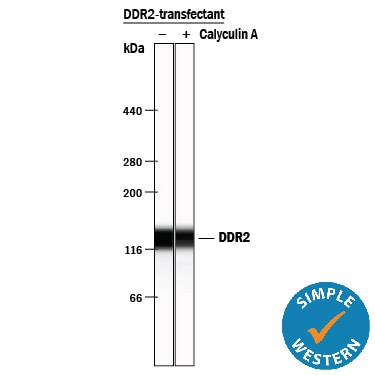
Detection of Human DDR2 by Simple WesternTM.
Simple Western lane view shows lysates of HEK293 human embryonic kidney cell line transfected with human DDR2 untreated (-) or treated (+) with Calyculin A for 10 minutes, loaded at 0.2 mg/mL. A specific band was detected for DDR2 at approximately 139 kDa (as indicated) using 2.5 µg/mL of Goat Anti-Human DDR2 Antigen Affinity-purified Polyclonal Antibody (Catalog # AF2538) followed by 1:50 dilution of HRP-conjugated Anti-Goat IgG Secondary Antibody (Catalog # HAF109). This experiment was conducted under reducing conditions and using the 12-230 kDa separation system.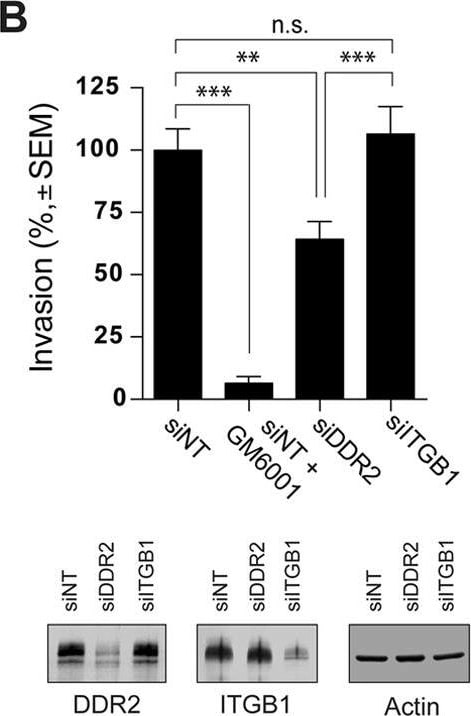
Detection of Human DDR2 by Knockdown Validated
Role of DDR2 in MT1-MMP-dependent collagen film degradation and collagen invasion.A, human RASF or HDF transfected with siNT, siRNA for DDR2 (siDDR2), or siRNA for beta 1 integrin (siITGB1) were subjected to collagen film degradation assay as described under “Experimental Procedures” (left panel). Conditioned media from this assay were analyzed by zymography. P, pro-MMP-2; A, active MMP-2. Scale bars, 270 μm. B, human RASF transfected with siNT, siRNA for DDR2, or siRNA for ITGB1 were subjected to Transwell collagen invasion assay as described under “Experimental Procedures” (upper panel). Levels of DDR2, ITGB1, and actin in transfected cells were analyzed by Western blotting (bottom panel). These are combined data of three independent experiments (n = 6 for each experiments). Error bars represent S.E. ***, p > 0.001; n.s., not significant. Image collected and cropped by CiteAb from the following publication (https://linkinghub.elsevier.com/retrieve/pii/S0021925820365789), licensed under a CC-BY license. Not internally tested by R&D Systems.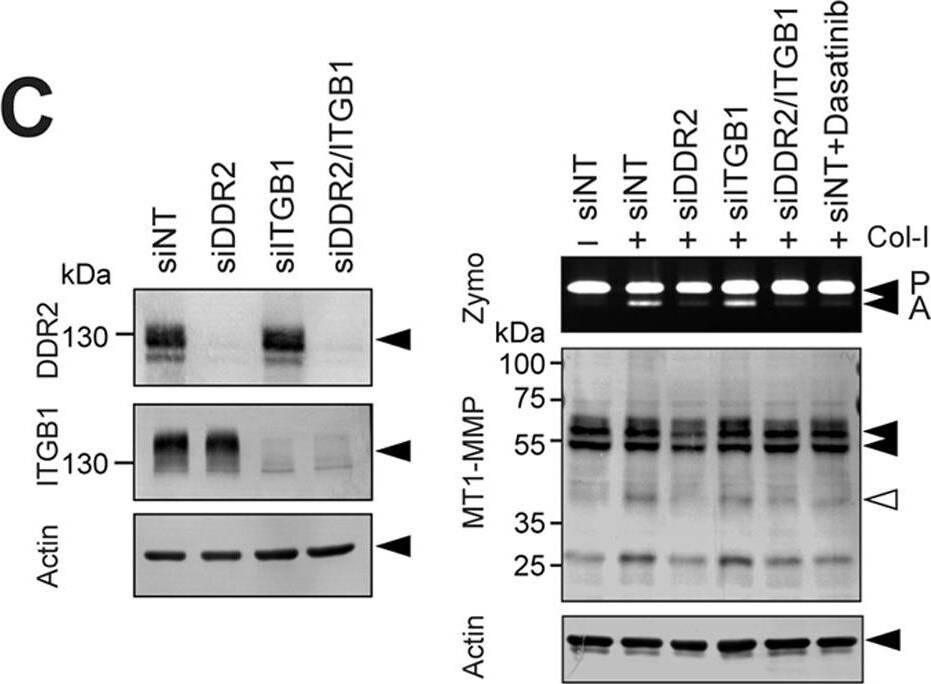
Detection of Human DDR2 by Western Blot
DDR2 but not integrins mediates collagen signaling to activate MT1-MMP functions in RASF.A, human RASF were stimulated with collagen I (Col-I) in the presence or absence of beta 1 integrin-inhibitory antibody (6S6) or -activating antibody (P4G11) for 24 h in serum-free medium. Conditioned media and cell lysates were analyzed as in A. B, cell lysates from HT1080 human fibrosarcoma cells, RASF, and HDF were analyzed for DDR1 and DDR2 expression by Western blotting. RASF and HDF express DDR2 but not DDR1, whereas HT1080 expresses both DDRs. C, RASF were transfected with siRNA for DDR2 (siDDR2), beta 1 integrin (siITGB1), and/or siNT as indicated. 48 h later, cell lysates were subjected to Western blotting analyses for DDR2, ITGB1, and actin (left panel). 48 h after siRNA transfection, cells were also stimulated with collagen I (100 μg/ml) and cultured for a further 72 h. siNT-transfected cells were also treated with dasatinib (Dasa; 100 nm). Conditioned media and cell lysates were analyzed as in A (right panel). D, RASF transfected with siNT, siRNA for DDR2, or siRNA for ITGB1 were stimulated with collagen II (Col-II) of human origin (100 μg/ml) and bovine origin (100 μg/ml) for 48 h. Conditioned media and cell lysates were analyzed as in A. E, RASF transfected with siNT, siRNA for DDR2, or siRNA for ITGB1 were subjected to F-gelatin film degradation assay as in D. Scale bars, 270 μm. P, pro-MMP-2; A, active MMP-2; Zymo, zymography. Image collected and cropped by CiteAb from the following publication (https://linkinghub.elsevier.com/retrieve/pii/S0021925820365789), licensed under a CC-BY license. Not internally tested by R&D Systems.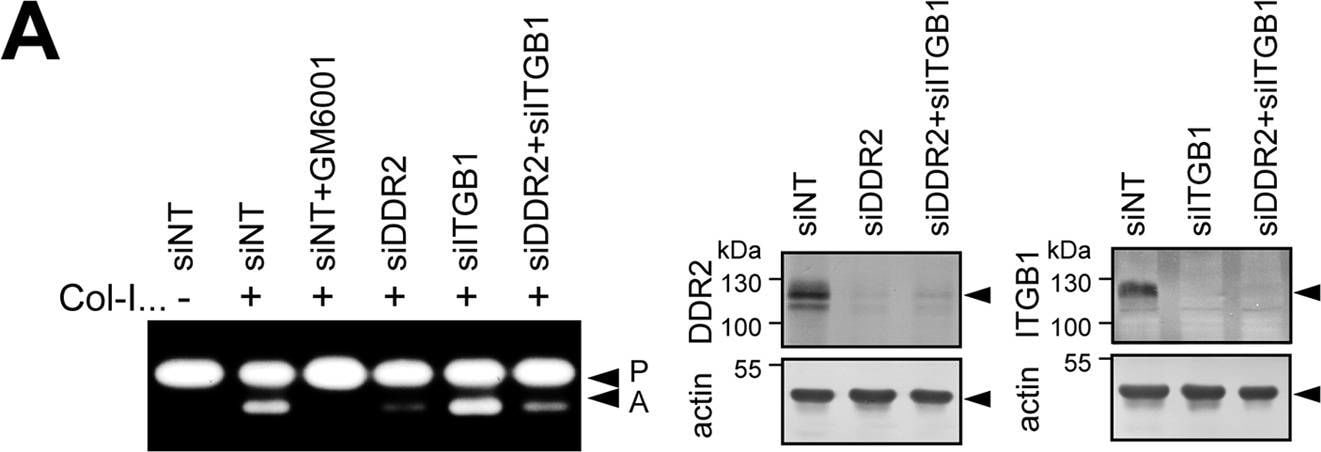
Detection of Human DDR2 by Knockdown Validated
DDR2 mediates collagen signaling to activate MT1-MMP functions in HDF.A, HDF were transfected with siRNA for DDR2 (siDDR2), siRNA for beta 1 integrin (siITGB1), and/or siNT as indicated. 48 h later, cell lysates were subjected to Western blotting analyses for DDR2, ITGB1, and actin (right panel).48 h after siRNA transfection, cells were further stimulated with collagen I (Col-I) (100 μg/ml) and cultured for a further 48 h. Conditioned media were analyzed by zymography. B, HDF transfected with siNT, siRNA for DDR2, or siRNA for ITGB1 were subjected to F-gelatin film degradation assay as in Fig. 2E. Scale bars, 270 μm. P, pro-MMP-2; A, active MMP-2. Image collected and cropped by CiteAb from the following publication (https://linkinghub.elsevier.com/retrieve/pii/S0021925820365789), licensed under a CC-BY license. Not internally tested by R&D Systems.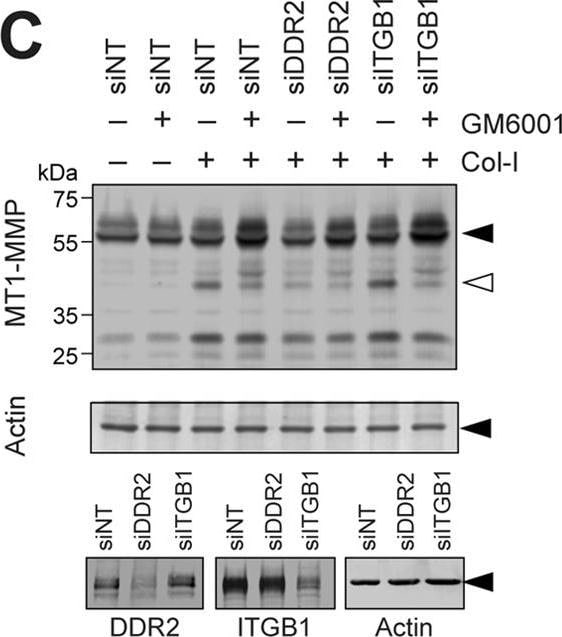
Detection of Human DDR2 by Knockdown Validated
Role of DDR2 in collagen-induced MT1-MMP gene expression.A, human RASF were stimulated with or without collagen I (Col-I) (open bars or closed bars, respectively) for 24 or 48 h, and the level of MT1-MMP gene expression was examined by qPCR (n = 6). ***, p > 0.001. B, RASF transfected with siNT, siRNA for DDR2 (siDDR2), or siRNA for beta 1 integrin (siITGB1) were stimulated with collagen (open bars). Error bars represent S.E. (n = 6). ***, p > 0.001; **, p > 0.01; n.s., not significant. C, RASF transfected with siNT, siRNA for DDR2, or siRNA for ITGB1 were stimulated with collagen I (100 μg/ml) in the presence or absence of GM6001for 72 h. Cell lysates were subjected to Western blotting analyses for MT1-MMP, actin, DDR2, and ITGB1. Cont, control. Image collected and cropped by CiteAb from the following publication (https://linkinghub.elsevier.com/retrieve/pii/S0021925820365789), licensed under a CC-BY license. Not internally tested by R&D Systems.
Detection of Human Human DDR2 Antibody by Western Blot
DDR2 receptor phosphorylation and in vitro kinase assay(A) Plots of relative DDR2 phosphorylation levels as a function of time after collagen stimulation. Temporal profiles of DDR2 sites show distinct responses to collagen stimulation. Measurements are expressed relative to the 24 h time point. (B) In vitro kinase assay measuring the incorporation of 32P into the Axltide substrate peptide. Equal amounts (750 nM) of Src and DDR2 were mixed together with 300 pM TDA in kinase assay buffer. Data represent the fold change relative to control (DDR2). (C) Immunoblot of total phosphotyrosine levels (using the 4G10 antibody) obtained from the in vitro kinase reaction showing increased phosphorylation levels that correlate with DDR2 kinase activity. Image collected and cropped by CiteAb from the following publication (https://pubmed.ncbi.nlm.nih.gov/23822953), licensed under a CC-BY license. Not internally tested by R&D Systems.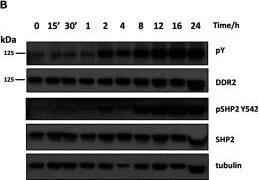
Detection of Human Human DDR2 Antibody by Western Blot
DDR2 phosphorylates SHP-2 in a temporal and kinase-dependent manner(A) SRM analysis of DDR2 activation loop (Tyr736 and Tyr740/Tyr741) and SHP-2 (Tyr62) phosphorylation at 0 and 24 h post-stimulation with collagen I (n=3). Values are means±S.E.M., **P<0.01 using paired Student's t test. Representative transitions are shown as indicated in Supplementary Table S3 (at http://www.biochemj.org/bj/454/bj4540501add.htm). (B) Immunoblot of DDR2 and SHP-2 (Tyr542) phosphorylation shows a temporal up-regulation of SHP-2 phosphorylation upon simulation with collagen. Phosphotyrosine (pY) is measured by the 4G10 antibody. (C) Immunoblot of kinase-dead DDR2 mutants (K608M and K608E) indicate that tyrosine phosphorylation of SHP-2 (Tyr542) is dependent on DDR2 kinase activity. EV, empty vector control. Image collected and cropped by CiteAb from the following publication (https://pubmed.ncbi.nlm.nih.gov/23822953), licensed under a CC-BY license. Not internally tested by R&D Systems.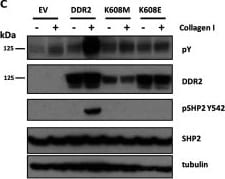
Detection of Human Human DDR2 Antibody by Western Blot
DDR2 phosphorylates SHP-2 in a temporal and kinase-dependent manner(A) SRM analysis of DDR2 activation loop (Tyr736 and Tyr740/Tyr741) and SHP-2 (Tyr62) phosphorylation at 0 and 24 h post-stimulation with collagen I (n=3). Values are means±S.E.M., **P<0.01 using paired Student's t test. Representative transitions are shown as indicated in Supplementary Table S3 (at http://www.biochemj.org/bj/454/bj4540501add.htm). (B) Immunoblot of DDR2 and SHP-2 (Tyr542) phosphorylation shows a temporal up-regulation of SHP-2 phosphorylation upon simulation with collagen. Phosphotyrosine (pY) is measured by the 4G10 antibody. (C) Immunoblot of kinase-dead DDR2 mutants (K608M and K608E) indicate that tyrosine phosphorylation of SHP-2 (Tyr542) is dependent on DDR2 kinase activity. EV, empty vector control. Image collected and cropped by CiteAb from the following publication (https://pubmed.ncbi.nlm.nih.gov/23822953), licensed under a CC-BY license. Not internally tested by R&D Systems.
Detection of Human Human DDR2 Antibody by Western Blot
Targeted proteomic profiling of lung SCC DDR2 mutants(A) Domain organization and location of DDR2 point mutations used in the present study. JM, juxtamembrane; TM, transmembrane domain. (B) Colony formation assay of DDR2 mutants grown in 3D collagen I gels (n=3). Values are means±S.E.M., statistical significance of wild-type and mutant DDR2 data compared with the empty vector control was performed by ANOVA with Dunnett's post-test where **P<0.01 and *P<0.05. (C) Immunoblot of mutant DDR2 cells after stimulation with collagen I for 24 h. Phosphotyrosine (pY) is measured by the pY100 antibody. (D) Normalized densitometry measurements of phosphotyrosine and phosphorylated SHP-2 blots (n=3). ***P<0.001 and **P<0.01. Normalization is performed relative to the loading control, tubulin. (E) SRM analysis of DDR2 receptor and SHP-2 phosphorylation in wild-type and lung SCC point mutations post activation with collagen I at 24 h (n=3). Values are means±S.E.M., statistical significance of mutant DDR2 phosphorylation data compared with wild-type DDR2 was performed by paired Student's t test where ***P<0.001 and *P<0.05. Representative transitions are shown as indicated in Supplementary Table S3 at http://www.biochemj.org/bj/454/bj4540501add.htm. Image collected and cropped by CiteAb from the following publication (https://pubmed.ncbi.nlm.nih.gov/23822953), licensed under a CC-BY license. Not internally tested by R&D Systems.Applications for Human DDR2 Antibody
Application
Recommended Usage
Immunohistochemistry
5-15 µg/mL
Sample: Immersion fixed paraffin-embedded sections of human kidney and lung
Sample: Immersion fixed paraffin-embedded sections of human kidney and lung
Simple Western
2.5 µg/mL
Sample: HEK293 human embryonic kidney cell line transfected with human DDR2 treated with Calyculin A
Sample: HEK293 human embryonic kidney cell line transfected with human DDR2 treated with Calyculin A
Western Blot
0.1 µg/mL
Sample: Recombinant Human DDR2 (Catalog # 2538-DR)
Sample: Recombinant Human DDR2 (Catalog # 2538-DR)
Reviewed Applications
Read 3 reviews rated 4.7 using AF2538 in the following applications:
Formulation, Preparation, and Storage
Purification
Antigen Affinity-purified
Reconstitution
Reconstitute at 0.2 mg/mL in sterile PBS. For liquid material, refer to CoA for concentration.
Loading...
Formulation
Lyophilized from a 0.2 μm filtered solution in PBS with Trehalose. *Small pack size (SP) is supplied either lyophilized or as a 0.2 µm filtered solution in PBS.
Shipping
Lyophilized product is shipped at ambient temperature. Liquid small pack size (-SP) is shipped with polar packs. Upon receipt, store immediately at the temperature recommended below.
Stability & Storage
Use a manual defrost freezer and avoid repeated freeze-thaw cycles.
- 12 months from date of receipt, -20 to -70 °C as supplied.
- 1 month, 2 to 8 °C under sterile conditions after reconstitution.
- 6 months, -20 to -70 °C under sterile conditions after reconstitution.
Calculators
Background: DDR2
References
- Vogel, W.F. et al. (2006) Cell. Signal. 18:1108.
- Karn, T. et al. (1993) Oncogene 8:3433.
- Vogel, W. et al. (1997) Mol. Cell 1:13.
- Leitinger, B. (2003) J. Biol. Chem. 278:16761.
- Leitinger, B. and A.P.L Kwan (2006) Matrix Biol. 25:355.
- Leitinger, B. et al. (2004) J. Mol. Biol. 344:993.
- Mihai, C. et al. (2006) J. Mol. Biol. 361:864.
- Olaso, E. et al. (2001) J. Clin. Invest. 108:1369.
- Ikeda, K. et al. (2002) J. Biol. Chem. 277:19206.
- Xu, L. et al. (2005) J. Biol. Chem. 280:548.
- Wang, J. et al. (2002) J. Autoimmun. 19:161.
- Ferri, N. et al. (2004) Am. J. Pathol. 164:1575.
Long Name
Discoidin Domain Receptor 2
Alternate Names
TKT, Trk3, Tyro-10
Gene Symbol
DDR2
UniProt
Additional DDR2 Products
Product Documents for Human DDR2 Antibody
Certificate of Analysis
To download a Certificate of Analysis, please enter a lot or batch number in the search box below.
Note: Certificate of Analysis not available for kit components.
Product Specific Notices for Human DDR2 Antibody
For research use only
Related Research Areas
Citations for Human DDR2 Antibody
 Powered by Bioz
Customer Reviews for Human DDR2 Antibody (3)
4.7 out of 5
3 Customer Ratings
Have you used Human DDR2 Antibody?
Submit a review and receive an Amazon gift card!
$25/€18/£15/$25CAN/¥2500 for a review with an image
$10/€7/£6/$10CAN/¥1110 for a review without an image
Submit a review
Showing
1
-
3 of
3 reviews
Showing All
Filter By:
-
Application: Western BlotSample Tested: See PMID 21335558Species: HumanVerified Customer | Posted 01/07/2015
-
Application: ImmunofluorescenceSample Tested: See PMID 23131558Species: HumanVerified Customer | Posted 01/07/2015
-
Application: Western BlotSample Tested: See PMID 21044884Species: HumanVerified Customer | Posted 01/07/2015
There are no reviews that match your criteria.
Protocols
Find general support by application which include: protocols, troubleshooting, illustrated assays, videos and webinars.
- Antigen Retrieval Protocol (PIER)
- Antigen Retrieval for Frozen Sections Protocol
- Appropriate Fixation of IHC/ICC Samples
- Cellular Response to Hypoxia Protocols
- Chromogenic IHC Staining of Formalin-Fixed Paraffin-Embedded (FFPE) Tissue Protocol
- Chromogenic Immunohistochemistry Staining of Frozen Tissue
- ClariTSA™ Fluorophore Kits
- Detection & Visualization of Antibody Binding
- Fluorescent IHC Staining of Frozen Tissue Protocol
- Graphic Protocol for Heat-induced Epitope Retrieval
- Graphic Protocol for the Preparation and Fluorescent IHC Staining of Frozen Tissue Sections
- Graphic Protocol for the Preparation and Fluorescent IHC Staining of Paraffin-embedded Tissue Sections
- Graphic Protocol for the Preparation of Gelatin-coated Slides for Histological Tissue Sections
- IHC Sample Preparation (Frozen sections vs Paraffin)
- Immunofluorescent IHC Staining of Formalin-Fixed Paraffin-Embedded (FFPE) Tissue Protocol
- Immunohistochemistry (IHC) and Immunocytochemistry (ICC) Protocols
- Immunohistochemistry Frozen Troubleshooting
- Immunohistochemistry Paraffin Troubleshooting
- Preparing Samples for IHC/ICC Experiments
- Preventing Non-Specific Staining (Non-Specific Binding)
- Primary Antibody Selection & Optimization
- Protocol for Heat-Induced Epitope Retrieval (HIER)
- Protocol for Making a 4% Formaldehyde Solution in PBS
- Protocol for VisUCyte™ HRP Polymer Detection Reagent
- Protocol for the Preparation & Fixation of Cells on Coverslips
- Protocol for the Preparation and Chromogenic IHC Staining of Frozen Tissue Sections
- Protocol for the Preparation and Chromogenic IHC Staining of Frozen Tissue Sections - Graphic
- Protocol for the Preparation and Chromogenic IHC Staining of Paraffin-embedded Tissue Sections
- Protocol for the Preparation and Chromogenic IHC Staining of Paraffin-embedded Tissue Sections - Graphic
- Protocol for the Preparation and Fluorescent IHC Staining of Frozen Tissue Sections
- Protocol for the Preparation and Fluorescent IHC Staining of Paraffin-embedded Tissue Sections
- Protocol for the Preparation of Gelatin-coated Slides for Histological Tissue Sections
- R&D Systems Quality Control Western Blot Protocol
- TUNEL and Active Caspase-3 Detection by IHC/ICC Protocol
- The Importance of IHC/ICC Controls
- Troubleshooting Guide: Immunohistochemistry
- Troubleshooting Guide: Western Blot Figures
- Western Blot Conditions
- Western Blot Protocol
- Western Blot Protocol for Cell Lysates
- Western Blot Troubleshooting
- Western Blot Troubleshooting Guide
- View all Protocols, Troubleshooting, Illustrated assays and Webinars
Loading...
Associated Pathways
