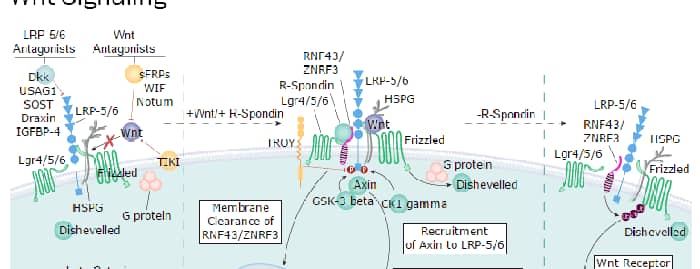
The Glypicans (glypiated proteoglycans) are a small multigene family of GPI-linked heparan sulfate (HS) proteoglycans that likely play a key role in embryonic morphogenesis (1, 2, 3, 4). There are currently six known mammalian Glypicans. They all share a common-sized protein core of 60‑70 kDa, an N-terminus which likely forms a compact globular domain, 14 conserved cysteines that form multiple intrachain disulfide bonds, and a number of C-terminal N- and O-linked carbohydrate attachment sites. Based on exon organization and the location of O-linked glycosylation sites, at least two subfamilies of Glypicans are known, with one subfamily containing Glypicans 1, 2, 4 and 6, and another subfamily containing Glypicans 3 and 5 (3, 5). Human Glypican 6 (GPC-6) is synthesized as a 554 amino acid (aa) preproprecursor that contains a 23 aa signal sequence, a 505 aa mature region and a 26 aa C-terminal prosegment (5, 6). There are four consecutive Ser-Gly repeats that serve as a heparin sulfate attachment site. GPC-6 is reported to be as large as 110 kDa in size. This translates into approximately 50 kDa of proteoglycan (5). Human to mouse, there is 97% aa identity over the entire GPC-6 molecule. Cells known to express GPC-6 are adult ovary and embryonic vascular and visceral smooth muscle, plus mesenchyme (embryonic connective tissue) in multiple organs (1, 5, 6). The function of GPC-6 is essentially unknown. As a Glypican family member, it may facilitate heparin-binding growth factor signaling and polyamine uptake into expressing cells (7, 8). In this regard, it would appear that GPC-6 with its attendant HS is downregulated by triiodothyronine during cartilage maturation, thus limiting the availability of sites for FGF sequestration and activity (9).
Human Glypican 6 Antibody
R&D Systems | Catalog # AF2845


Key Product Details
Species Reactivity
Validated:
Human
Cited:
Human, Mouse
Applications
Validated:
Western Blot, Flow Cytometry, CyTOF-ready
Cited:
Western Blot
Label
Unconjugated
Antibody Source
Polyclonal Goat IgG
Loading...
Product Specifications
Immunogen
Mouse myeloma cell line NS0-derived recombinant human Glypican 6
Asp24-Val527
Accession # Q9Y625
Asp24-Val527
Accession # Q9Y625
Specificity
Detects human Glypican 6 in direct ELISAs and Western blots.
Clonality
Polyclonal
Host
Goat
Isotype
IgG
Applications for Human Glypican 6 Antibody
Application
Recommended Usage
CyTOF-ready
Ready to be labeled using established conjugation methods. No BSA or other carrier proteins that could interfere with conjugation.
Flow Cytometry
2.5 µg/106 cells
Sample: HepG2 human hepatocellular carcinoma cell line
Sample: HepG2 human hepatocellular carcinoma cell line
Western Blot
0.1 µg/mL
Sample: Recombinant Human Glypican 6 (Catalog # 2845-GP)
Sample: Recombinant Human Glypican 6 (Catalog # 2845-GP)
Flow Cytometry Panel Builder
Bio-Techne Knows Flow Cytometry
Save time and reduce costly mistakes by quickly finding compatible reagents using the Panel Builder Tool.
Advanced Features
- Spectra Viewer - Custom analysis of spectra from multiple fluorochromes
- Spillover Popups - Visualize the spectra of individual fluorochromes
- Antigen Density Selector - Match fluorochrome brightness with antigen density

Formulation, Preparation, and Storage
Purification
Antigen Affinity-purified
Reconstitution
Reconstitute at 0.2 mg/mL in sterile PBS. For liquid material, refer to CoA for concentration.
Loading...
Formulation
Lyophilized from a 0.2 μm filtered solution in PBS with Trehalose. *Small pack size (SP) is supplied either lyophilized or as a 0.2 µm filtered solution in PBS.
Shipping
Lyophilized product is shipped at ambient temperature. Liquid small pack size (-SP) is shipped with polar packs. Upon receipt, store immediately at the temperature recommended below.
Stability & Storage
Use a manual defrost freezer and avoid repeated freeze-thaw cycles.
- 12 months from date of receipt, -20 to -70 °C as supplied.
- 1 month, 2 to 8 °C under sterile conditions after reconstitution.
- 6 months, -20 to -70 °C under sterile conditions after reconstitution.
Calculators
Background: Glypican 6
References
- Song, H.H. and J. Filmus (2002) Biochim. Biophys. Acta 1573:241.
- Filmus, J. (2001) Glycobiology 11:19R.
- De Cat, B. and G. David (2001) Semin. Cell Dev. Biol. 12:117.
- Filmus, J. (2003) Glycoconj. J. 19:319.
- Veugelers, M. et al. (1999) J. Biol. Chem. 274:26968.
- Paine-Saunders, S. et al. (1999) Genomics 57:455.
- Fransson, L-A. et al. (2004) Cell Mol. Life Sci. 61:1016.
- Fransson, L-A. (2003) Int. J. Biochem. Cell Biol. 35:125.
- Bassett, J.H.D. et al. (2006) Endocrinology 147:295.
Alternate Names
GPC6
Gene Symbol
GPC6
UniProt
Additional Glypican 6 Products
Product Documents for Human Glypican 6 Antibody
Certificate of Analysis
To download a Certificate of Analysis, please enter a lot or batch number in the search box below.
Note: Certificate of Analysis not available for kit components.
Product Specific Notices for Human Glypican 6 Antibody
For research use only
Related Research Areas
Citations for Human Glypican 6 Antibody
 Powered by Bioz
Customer Reviews for Human Glypican 6 Antibody
There are currently no reviews for this product. Be the first to review Human Glypican 6 Antibody and earn rewards!
Have you used Human Glypican 6 Antibody?
Submit a review and receive an Amazon gift card!
$25/€18/£15/$25CAN/¥2500 for a review with an image
$10/€7/£6/$10CAN/¥1110 for a review without an image
Submit a review
Protocols
Find general support by application which include: protocols, troubleshooting, illustrated assays, videos and webinars.
- 7-Amino Actinomycin D (7-AAD) Cell Viability Flow Cytometry Protocol
- Cellular Response to Hypoxia Protocols
- Extracellular Membrane Flow Cytometry Protocol
- Flow Cytometry Protocol for Cell Surface Markers
- Flow Cytometry Protocol for Staining Membrane Associated Proteins
- Flow Cytometry Staining Protocols
- Flow Cytometry Troubleshooting Guide
- Intracellular Flow Cytometry Protocol Using Alcohol (Methanol)
- Intracellular Flow Cytometry Protocol Using Detergents
- Intracellular Nuclear Staining Flow Cytometry Protocol Using Detergents
- Intracellular Staining Flow Cytometry Protocol Using Alcohol Permeabilization
- Intracellular Staining Flow Cytometry Protocol Using Detergents to Permeabilize Cells
- Propidium Iodide Cell Viability Flow Cytometry Protocol
- Protocol for Liperfluo
- Protocol for the Characterization of Human Th22 Cells
- Protocol for the Characterization of Human Th9 Cells
- Protocol: Annexin V and PI Staining by Flow Cytometry
- Protocol: Annexin V and PI Staining for Apoptosis by Flow Cytometry
- R&D Systems Quality Control Western Blot Protocol
- Troubleshooting Guide: Fluorokine Flow Cytometry Kits
- Troubleshooting Guide: Western Blot Figures
- Western Blot Conditions
- Western Blot Protocol
- Western Blot Protocol for Cell Lysates
- Western Blot Troubleshooting
- Western Blot Troubleshooting Guide
- View all Protocols, Troubleshooting, Illustrated assays and Webinars
Loading...
Associated Pathways