
HAPLN1 (also known as link protein and CRTL1) is a member of the hyaladherin family of hyaluronic acid (HA) binding proteins. Hyaluronan binding proteins are of two types; those with link modules, and those without. Link modules are 100 amino acid (aa) HA and protein-binding sequences that contain two alpha -helices and two antiparallel beta -sheets (1, 3). There are three categories of link module-containing proteins. “A” domain-type proteins contain one link module; “B” domain-type proteins contain one link module with an N- and C-terminal flanking region; and “C” domain-type proteins have an extended structure with one N-terminal V-type Ig-like domain followed by two link modules (2). The HAPLN family is a group of four C domain-type proteins that share approximately 50% aa identity (4). HAPLN1 is synthesized as a 354 aa precursor that contains a 15 aa signal sequence and a 339 aa mature region (4 - 6). It contains one Ig-like domain and two 95 aa link modules (6). It is variably glycosylated with a native molecular weight between 41 - 48 kDa (7, 8). Mature human HAPLN1 is 97%, 96%, 96%, 96%, and 96% aa identical to equine, porcine, rat, mouse and bovine HAPLN1, respectively. HAPLN1 contributes to extracellular matrix stability and flexibility (9). In cartilage, HALPN1 forms a ternary complex with HA and aggrecan. This creates a gel-like substance with remarkable resistance to deformation (3). In this complex, HA forms a linear backbone with perpendicularly attached aggrecan and HAPLN1. Aggrecan and HAPLN1 lie parallel to each other, while HA runs between the two HAPLN1 link modules (2, 3, 10). The Ig domain of HAPLN1 binds to aggrecan, while the two link modules of HAPLN1 bind to HA. Although HA and aggrecan will associate, the tendency is towards dissociation (2, 3, 8). HAPLN1 provides a stabilizing influence on HA-aggrecan associations, thus creating a long-lived ternary functional complex.


Key Product Details
Species Reactivity
Validated:
Human
Cited:
Human
Applications
Validated:
Western Blot
Cited:
Western Blot
Label
Unconjugated
Antibody Source
Monoclonal Mouse IgG2A Clone # 316119
Loading...
Product Specifications
Immunogen
Mouse myeloma cell line NS0-derived recombinant human HAPLN1
Asp16-Asn354
Accession # P10915
Asp16-Asn354
Accession # P10915
Specificity
Detects human HAPLN1 in direct ELISAs and Western blots. In direct ELISAs and Western blots, this antibody does not cross-react with recombinant human HAPLN4.
Clonality
Monoclonal
Host
Mouse
Isotype
IgG2A
Applications for Human HAPLN1 Antibody (316119)
Application
Recommended Usage
Western Blot
1 µg/mL
Sample: Recombinant Human HAPLN1 (Catalog # 2608-HP)
Sample: Recombinant Human HAPLN1 (Catalog # 2608-HP)
Reviewed Applications
Read 1 review rated 5 using MAB2608 in the following applications:
Formulation, Preparation, and Storage
Purification
Protein A or G purified from hybridoma culture supernatant
Reconstitution
Reconstitute at 0.5 mg/mL in sterile PBS. For liquid material, refer to CoA for concentration.
Loading...
Formulation
Lyophilized from a 0.2 μm filtered solution in PBS with Trehalose. *Small pack size (SP) is supplied either lyophilized or as a 0.2 µm filtered solution in PBS.
Shipping
Lyophilized product is shipped at ambient temperature. Liquid small pack size (-SP) is shipped with polar packs. Upon receipt, store immediately at the temperature recommended below.
Stability & Storage
Use a manual defrost freezer and avoid repeated freeze-thaw cycles.
- 12 months from date of receipt, -20 to -70 °C as supplied.
- 1 month, 2 to 8 °C under sterile conditions after reconstitution.
- 6 months, -20 to -70 °C under sterile conditions after reconstitution.
Calculators
Background: HAPLN1
References
- Day, A.J. and G.D. Prestwich (2002) J. Biol. Chem. 277:4585.
- Seyfried, N.T. et al. (2005) J. Biol. Chem. 280:5435.
- Matsumoto, K. et al. (2003) J. Biol. Chem. 278:41205.
- Spicer, A.P. et al. (2003) J. Biol. Chem. 278:21083.
- Dudhia, J. and T.E. Hardingham (1990) Nucleic Acids Res. 18:1292.
- Osborne-Lawrence, S.L. et al. (1990) Genomics 8:562.
- Roughley, P.J. et al. (1982) J. Biol. Chem. 257:11908.
- Shi, S. et al. (2004) J. Biol. Chem. 279:12060.
- Binette, F. et al. (1994) J. Biol. Chem. 269:19116.
- Perkins, S.J. et al. (1992) Biochem. J. 285:263.
Long Name
Hyaluronan and Proteoglycan Link Protein 1
Alternate Names
CRTL1
Entrez Gene IDs
1404 (Human)
Gene Symbol
HAPLN1
UniProt
Additional HAPLN1 Products
Product Documents for Human HAPLN1 Antibody (316119)
Certificate of Analysis
To download a Certificate of Analysis, please enter a lot or batch number in the search box below.
Note: Certificate of Analysis not available for kit components.
Product Specific Notices for Human HAPLN1 Antibody (316119)
For research use only
Related Research Areas
Citations for Human HAPLN1 Antibody (316119)
 Powered by Bioz
Customer Reviews for Human HAPLN1 Antibody (316119) (1)
5 out of 5
1 Customer Rating
Have you used Human HAPLN1 Antibody (316119)?
Submit a review and receive an Amazon gift card!
$25/€18/£15/$25CAN/¥2500 for a review with an image
$10/€7/£6/$10CAN/¥1110 for a review without an image
Submit a review
Customer Images
Showing
1
-
1 of
1 review
Showing All
Filter By:
-
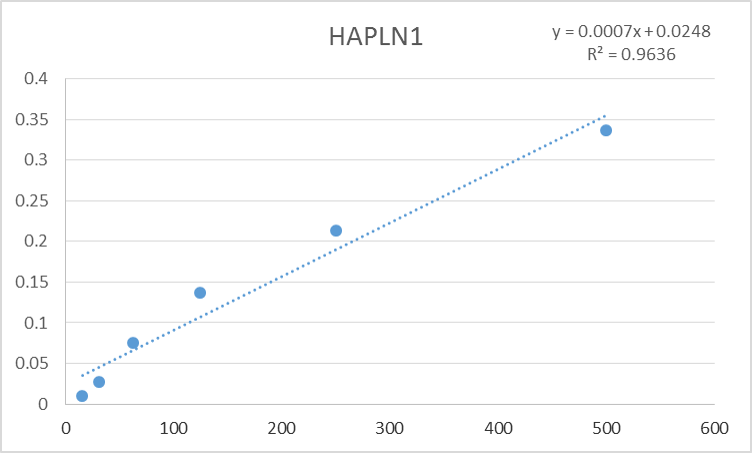
Application: ELISASample Tested: Media from cell linesSpecies: HumanVerified Customer | Posted 12/09/2015Standard curve for HAPLN1 ELISA

There are no reviews that match your criteria.
Protocols
Find general support by application which include: protocols, troubleshooting, illustrated assays, videos and webinars.
- Cellular Response to Hypoxia Protocols
- R&D Systems Quality Control Western Blot Protocol
- Troubleshooting Guide: Western Blot Figures
- Western Blot Conditions
- Western Blot Protocol
- Western Blot Protocol for Cell Lysates
- Western Blot Troubleshooting
- Western Blot Troubleshooting Guide
- View all Protocols, Troubleshooting, Illustrated assays and Webinars
Loading...
Associated Pathways
