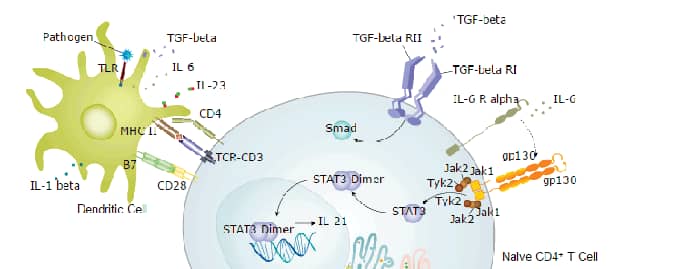
Interleukin-22 (IL-22), also known as IL-10-related T cell-derived inducible factor (IL-TIF) was initially identified as a gene induced by IL-9 in mouse T cells and mast cells. Human IL-22 cDNA encodes a 179 amino acid (aa) residue protein with a putative 33 aa signal peptide that is cleaved to generate a 147 aa mature protein that shares approximately 79% and 22% aa sequence identity with mouse IL-22 and human IL-10, respectively. The human IL-22 gene is localized to chromosome 12q15. Although it exists as a single copy gene in human and in many mouse strains, the mouse IL-22 gene is duplicated in some mouse strains including C57B1/6, FVB and 129. The two mouse genes designated IL-TIF alpha and IL-TIF beta, share greater than 98% sequence homology in their coding region. IL-22 has been shown to activate STAT1 and STAT3 in several hepatoma cell lines and upregulate the production of acute phase proteins. IL-22 is produced by normal T cells upon anti-CD3 stimulation in humans. Mouse IL-22 expression is also induced in various organs upon lipopolysaccharide injection, suggesting that IL-22 may be involved in inflammatory responses. The functional IL-22 receptor complex consists of two receptor subunits, IL-22 R (previously an orphan receptor named CRF2-9) and IL-10R beta (previously known as CRF2-4), belonging to the class II cytokine receptor family.
Human IL-22 Antibody (142928) [APC]
R&D Systems | Catalog # IC7821A

Scientific images may be resized, cropped, or adjusted for brightness or contrast for presentation purposes. These updates are limited to presentation and do not affect the underlying scientific interpretation of the data. Where available, additional source data may be provided upon request.
Key Product Details
Species Reactivity
Validated:
Cited:
Applications
Validated:
Cited:
Label
Antibody Source
Product Specifications
Immunogen
Ala34-Ile179
Accession # Q9GZX6
Specificity
Clonality
Host
Isotype
Scientific Data Images for Human IL-22 Antibody (142928) [APC]
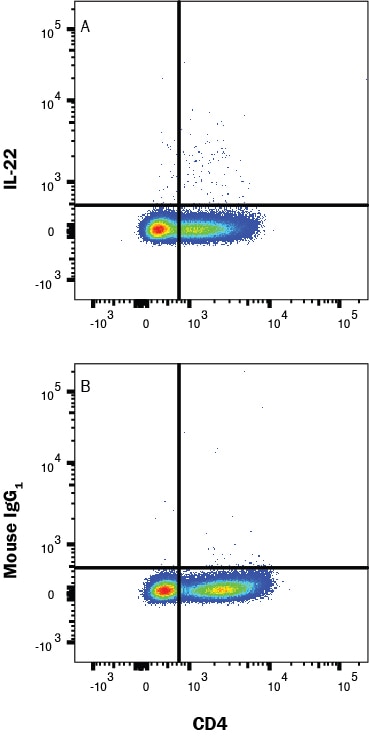
Detection of IL‑22 in PBMC treated with 20ng/mL PMA and 1ug/mL Calcium iono for 2 hours followed by 1ug/mL brefeldin A for 4 hours.
PBMC treated with 20ng/mL PMA and 1ug/mL Calcium iono for 2 hours followed by 1ug/mL brefeldin A for 4 hours were stained with Mouse Anti-Human CD4 Fluorescein‑conjugated Monoclonal Antibody (Catalog # FAB3791F) and either (A) Mouse Anti-Human IL‑22 APC Monoclonal Antibody (Catalog # IC7821A) or (B) isotype control antibody (Catalog # IC002A). To facilitate intracellular staining, cells were fixed with Flow Cytometry Fixation Buffer (Catalog # FC004) and permeabilized with Flow Cytometry Permeabilization/Wash Buffer I (Catalog # FC005). View our protocol for Staining Intracellular Molecules.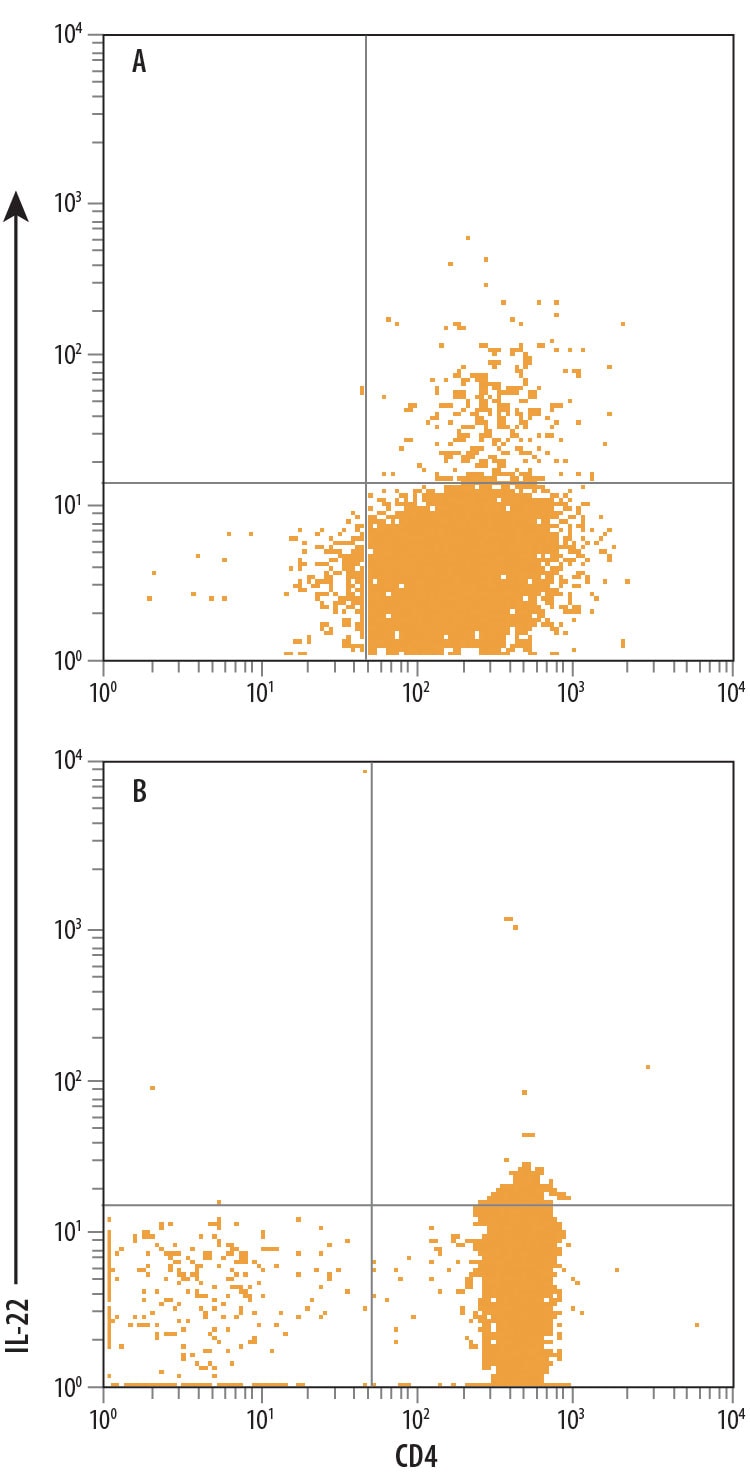
Detection of IL‑22 in Human PBMCs stimulated to induce Th17 Cells by Flow Cytometry.
CD4+Human peripheral blood mononuclear cells (PBMCs) either (A) stimulated to induce Th17 cells with 10 ug/mL Mouse Anti-Human CD3e Monoclonal Antibody (Catalog # MAB100), 5 ug/mL Mouse Anti-Human CD28 Monoclonal Antibody (Catalog # MAB342), 10 ng/mL Recombinant Human TGF-beta 1 (Catalog # 240-B), 20 ng/mL Recombinant Human IL-2 (Catalog # 202-IL), 20 ng/mL Recombinant Human IL-23 (Catalog # 1290-IL), 40 ng/mL Recombinant Human IL-6 (Catalog # 206-IL), and 10 ng/mL Recombinant Human IL-1 beta /IL-1F2 (Catalog # 201-LB) for 5 to 7 days, then re-stimulated with 50 ng/mL PMA and 200 ng/mL Calcium ionomycin for 2 to 4 hours or (B) resting CD4+PBMCs were stained with Mouse Anti-Human CD4 PE-conjugated Monoclonal Antibody (Catalog # FAB3791P) and Mouse Anti-Human IL-22 APC-conjugated Monoclonal Antibody (Catalog # IC7821A). Quadrant markers were set based on isotype control (Catalog # IC002A). To facilitate intracellular staining, cells were fixed with paraformaldehyde and permeabilized with saponin. View our protocol for Staining Intracellular Molecules.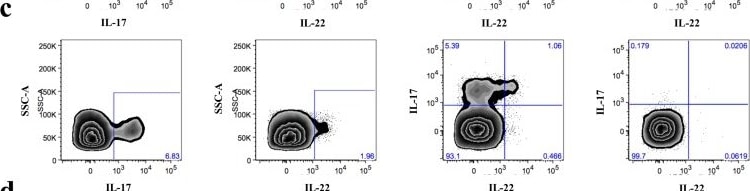
Detection of Human IL-22 by Flow Cytometry
Frequency of IL-17 and/or IL-22 expressing mucosal CD4+T cells decreases by progression of Fiebig stage.To quantify the expression of Il-17 and IL-22 in CD4+T cells, mucosal and peripheral mononuclear cells were stimulated for 5 hours with 40 ng/mL PMA and 1 µM Ionomycin. Gating strategy of sigmoid colon Th17 and Th22 CD4+T cells is shown for a FI subject (a) and representative flow cytometry plots including unstimulated controls (unstim) gated on CD4+T cells showing expression of IL-17 and/or IL-22 in FI (b), FIII (c) and FV (d) in the sigmoid colon. A decrease in the frequency of IL-17 (e), IL-22 (f), IL-17/IL-22 (g)-producing cells was seen as well as in the subpopulation of triple-cytokine producing (IL-2, IL-22, IFN gamma ) Th17 cells (h) from FI (black circle)/FII (red circle) to FIII and FIV (red square)/FV (black square). Frequency of single and double cytokine producing cells is calculated from percentage CD4+T cells, while triple-cytokine producing cells are calculated from percentage of CD4+IL17+T cells. All comparisons were made to FI/II: *p≤0.05, **p≤0.01 and ***p≤0.001. Image collected and cropped by CiteAb from the following publication (https://pubmed.ncbi.nlm.nih.gov/25503054), licensed under a CC-BY license. Not internally tested by R&D Systems.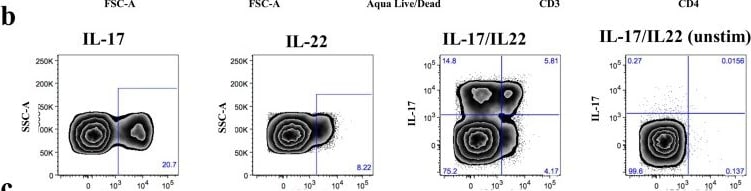
Detection of Human IL-22 by Flow Cytometry
Frequency of IL-17 and/or IL-22 expressing mucosal CD4+T cells decreases by progression of Fiebig stage.To quantify the expression of Il-17 and IL-22 in CD4+T cells, mucosal and peripheral mononuclear cells were stimulated for 5 hours with 40 ng/mL PMA and 1 µM Ionomycin. Gating strategy of sigmoid colon Th17 and Th22 CD4+T cells is shown for a FI subject (a) and representative flow cytometry plots including unstimulated controls (unstim) gated on CD4+T cells showing expression of IL-17 and/or IL-22 in FI (b), FIII (c) and FV (d) in the sigmoid colon. A decrease in the frequency of IL-17 (e), IL-22 (f), IL-17/IL-22 (g)-producing cells was seen as well as in the subpopulation of triple-cytokine producing (IL-2, IL-22, IFN gamma ) Th17 cells (h) from FI (black circle)/FII (red circle) to FIII and FIV (red square)/FV (black square). Frequency of single and double cytokine producing cells is calculated from percentage CD4+T cells, while triple-cytokine producing cells are calculated from percentage of CD4+IL17+T cells. All comparisons were made to FI/II: *p≤0.05, **p≤0.01 and ***p≤0.001. Image collected and cropped by CiteAb from the following publication (https://pubmed.ncbi.nlm.nih.gov/25503054), licensed under a CC-BY license. Not internally tested by R&D Systems.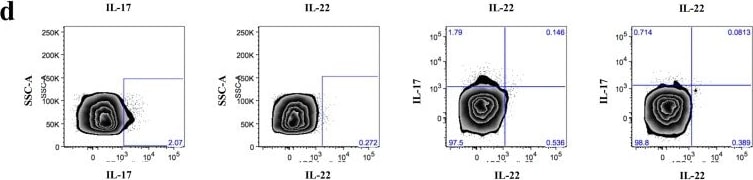
Detection of Human IL-22 by Flow Cytometry
Frequency of IL-17 and/or IL-22 expressing mucosal CD4+T cells decreases by progression of Fiebig stage.To quantify the expression of Il-17 and IL-22 in CD4+T cells, mucosal and peripheral mononuclear cells were stimulated for 5 hours with 40 ng/mL PMA and 1 µM Ionomycin. Gating strategy of sigmoid colon Th17 and Th22 CD4+T cells is shown for a FI subject (a) and representative flow cytometry plots including unstimulated controls (unstim) gated on CD4+T cells showing expression of IL-17 and/or IL-22 in FI (b), FIII (c) and FV (d) in the sigmoid colon. A decrease in the frequency of IL-17 (e), IL-22 (f), IL-17/IL-22 (g)-producing cells was seen as well as in the subpopulation of triple-cytokine producing (IL-2, IL-22, IFN gamma ) Th17 cells (h) from FI (black circle)/FII (red circle) to FIII and FIV (red square)/FV (black square). Frequency of single and double cytokine producing cells is calculated from percentage CD4+T cells, while triple-cytokine producing cells are calculated from percentage of CD4+IL17+T cells. All comparisons were made to FI/II: *p≤0.05, **p≤0.01 and ***p≤0.001. Image collected and cropped by CiteAb from the following publication (https://pubmed.ncbi.nlm.nih.gov/25503054), licensed under a CC-BY license. Not internally tested by R&D Systems.Applications for Human IL-22 Antibody (142928) [APC]
Intracellular Staining by Flow Cytometry
Sample: PBMC treated with 20ng/mL PMA and 1ug/mL Calcium iono for 2 hours followed by 1ug/mL brefeldin A for 4 hours.
CD4+ Human peripheral blood mononuclear cells (PBMCs) stimulated to induce Th17 cells with Mouse Anti-Human CD3 epsilon Monoclonal Antibody (Catalog # MAB100), Mouse Anti-Human CD28 Monoclonal Antibody (Catalog # MAB342), Recombinant Human TGF‑ beta 1 (Catalog # 240-B), Recombinant Human IL‑2 (Catalog # 202-IL), Recombinant Human IL‑23 (Catalog # 1290-IL), Recombinant Human IL‑6 (Catalog # 206-IL), and Recombinant Human IL‑1 beta /IL‑1F2 (Catalog # 201-LB), then re-stimulated with 50 ng/mL PMA and 200 ng/mL Calcium ionomycin, were fixed with paraformaldehyde and permeabilized with saponin.
Reviewed Applications
Read 10 reviews rated 3.8 using IC7821A in the following applications:
Spectra Viewer
Plan Your Experiments
Use our spectra viewer to interactively plan your experiments, assessing multiplexing options. View the excitation and emission spectra for our fluorescent dye range and other commonly used dyes.
Spectra Viewer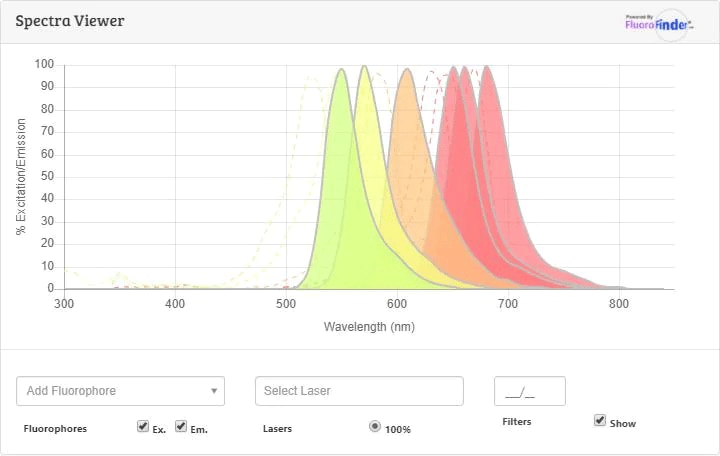
Flow Cytometry Panel Builder
Bio-Techne Knows Flow Cytometry
Save time and reduce costly mistakes by quickly finding compatible reagents using the Panel Builder Tool.
Advanced Features
- Spectra Viewer - Custom analysis of spectra from multiple fluorochromes
- Spillover Popups - Visualize the spectra of individual fluorochromes
- Antigen Density Selector - Match fluorochrome brightness with antigen density

Formulation, Preparation, and Storage
Purification
Formulation
Shipping
Stability & Storage
- 12 months from date of receipt, 2 to 8 °C as supplied.
Background: IL-22
References
- Dumoutier, L. et al. (2000) J. Immunol. 164:1814.
- Xie, M-H. et al. (2000) J. Biol. Chem. 275:31335.
- Dumoutier, L. et al. (2000) Proc. Natl. Acad. Sci. USA 97:10144.
- Kotenko, S.V. et al. (2001) J. Biol. Chem. 276:2725.
Long Name
Alternate Names
Gene Symbol
UniProt
Additional IL-22 Products
Product Documents for Human IL-22 Antibody (142928) [APC]
Certificate of Analysis
To download a Certificate of Analysis, please enter a lot or batch number in the search box below.
Note: Certificate of Analysis not available for kit components.
Product Specific Notices for Human IL-22 Antibody (142928) [APC]
For research use only
Related Research Areas
Citations for Human IL-22 Antibody (142928) [APC]
 Powered by Bioz
Customer Reviews for Human IL-22 Antibody (142928) [APC] (10)
Have you used Human IL-22 Antibody (142928) [APC]?
Submit a review and receive an Amazon gift card!
$25/€18/£15/$25CAN/¥2500 for a review with an image
$10/€7/£6/$10CAN/¥1110 for a review without an image
Submit a review
-
Application: Flow CytometrySample Tested: See PMID 20357258Species: MouseVerified Customer | Posted 01/28/2015
-
Application: Flow CytometrySample Tested: See PMID 20357258Species: MouseVerified Customer | Posted 01/28/2015
-
Application: Flow CytometrySample Tested: See PMID 24324435Species: HumanVerified Customer | Posted 01/28/2015
-
Application: Flow CytometrySample Tested: See PMID 24324435Species: HumanVerified Customer | Posted 01/28/2015
-
Application: Flow CytometrySample Tested: See PMID 21206487Species: HumanVerified Customer | Posted 01/28/2015
-
Application: Flow CytometrySample Tested: See PMID 21206487Species: HumanVerified Customer | Posted 01/28/2015
-
Application: Flow CytometrySample Tested: See PMID: 22795370Species: HumanVerified Customer | Posted 01/28/2015
-
Application: Flow CytometrySample Tested: See PMID: 22795370Species: HumanVerified Customer | Posted 01/28/2015
-
Application: Flow CytometrySample Tested: See PMID: 23174657Species: HumanVerified Customer | Posted 01/28/2015
-
Application: Flow CytometrySample Tested: See PMID: 23174657Species: HumanVerified Customer | Posted 01/28/2015
There are no reviews that match your criteria.
Protocols
Find general support by application which include: protocols, troubleshooting, illustrated assays, videos and webinars.
- 7-Amino Actinomycin D (7-AAD) Cell Viability Flow Cytometry Protocol
- Extracellular Membrane Flow Cytometry Protocol
- Flow Cytometry Protocol for Cell Surface Markers
- Flow Cytometry Protocol for Staining Membrane Associated Proteins
- Flow Cytometry Staining Protocols
- Flow Cytometry Troubleshooting Guide
- Intracellular Flow Cytometry Protocol Using Alcohol (Methanol)
- Intracellular Flow Cytometry Protocol Using Detergents
- Intracellular Nuclear Staining Flow Cytometry Protocol Using Detergents
- Intracellular Staining Flow Cytometry Protocol Using Alcohol Permeabilization
- Intracellular Staining Flow Cytometry Protocol Using Detergents to Permeabilize Cells
- Propidium Iodide Cell Viability Flow Cytometry Protocol
- Protocol for Liperfluo
- Protocol for the Characterization of Human Th22 Cells
- Protocol for the Characterization of Human Th9 Cells
- Protocol: Annexin V and PI Staining by Flow Cytometry
- Protocol: Annexin V and PI Staining for Apoptosis by Flow Cytometry
- Troubleshooting Guide: Fluorokine Flow Cytometry Kits
- View all Protocols, Troubleshooting, Illustrated assays and Webinars