
phospho-PLC-gamma 1 (Y783) Antibody (1016D)
R&D Systems | Catalog # MAB74542


Scientific images may be resized, cropped, or adjusted for brightness or contrast for presentation purposes. These updates are limited to presentation and do not affect the underlying scientific interpretation of the data. Where available, additional source data may be provided upon request.
Key Product Details
Validated by
Species Reactivity
Validated:
Cited:
Applications
Validated:
Cited:
Label
Antibody Source
Product Specifications
Immunogen
Accession # P19174
Specificity
Clonality
Host
Isotype
Scientific Data Images for phospho-PLC-gamma 1 (Y783) Antibody (1016D)
Phospho-PLC‑ gamma 1 (Y783) in A431 Human Cell Line.
PLC- gamma1 phosphorylated at Y783 was detected in immersion fixed A431 human epithelial carcinoma cell line treated with Recombinant Human EGF (Catalog # 236-EG) using Rabbit Anti-Human Phospho-PLC- gamma1 (Y783) Polyclonal Antibody (Catalog # MAB74542) at 3 µg/mL for 3 hours at room temperature. Cells were stained using the NorthernLights™ 557-conjugated Anti-Rabbit IgG Secondary Antibody (red; Catalog # NL004) and counterstained with DAPI (blue). Specific staining was localized to cytoplasm and plasma membranes. View our protocol for Fluorescent ICC Staining of Cells on Coverslips.
Detection of Mouse PLC-gamma 1 by Western Blot
Cathelicidin-dependent signaling in platelets. a–i LL-37 induced signaling in isolated human platelets. a–c Flow cytometry analysis of platelet P-selectin surface expression in the presence of a the calcium chelator BAPTA (n = 5) or a phospholipase C inhibitor (U-73122, n = 6), b pertussis or cholera toxin to inhibit G-protein signaling (n = 4), or c inhibitors of tyrosine kinases Src-family kinases (Dasatinib, n = 7) and Syk (R406, n = 5). d Representative western blots of phosphorylated Src-family kinase and phosphorylated Syk upon incubation of platelets with LL-37. Collagen was used as positive control for tyrosine kinase phosphorylation, beta -actin served as loading control. Images are representative of three independent blots. e–i Flow cytometry analysis of LL-37 platelet P-selectin surface expression in the presence of e STAT3 small molecule inhibitor (Stattic, n = 6), f GPVI antibody (HGP5C4, n = 9), g GPIIb/IIIa antibody (Abciximab or Tirofiban, n = 4), h formyl-peptid-receptor (FPR1 or FPR2) antibody, and i inhibitors against the purinergic P2X7-receptor (Boc-MLF 10, WRW4 or A438079, n = 4). j–l CRAMP-induced signaling in isolated mouse platelets. j P-selectin surface expression in the presence of a GPVI depleting antibody (JAQ1, n = 6). k P-selectin surface expression and l phospholipase C phosphorylation in platelet lysates from platelet-specific Syk-deficient mice and respective littermates after stimulation with CRAMP (flow cytometry: n = 10 Syk−/− and n = 5 Syk+/+ animals, western blot analysis n = 5 each). Graphs show mean and SEM. P-values were determined by unpaired (a, f, j–l) or paired (c, e, h) t-test Image collected and cropped by CiteAb from the following publication (https://pubmed.ncbi.nlm.nih.gov/29670076), licensed under a CC-BY license. Not internally tested by R&D Systems.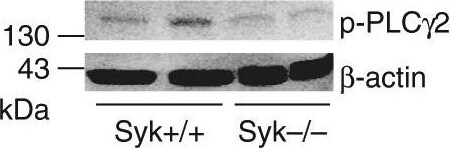
Detection of PLC-gamma 1 by Western Blot
Cathelicidin-dependent signaling in platelets. a–i LL-37 induced signaling in isolated human platelets. a–c Flow cytometry analysis of platelet P-selectin surface expression in the presence of a the calcium chelator BAPTA (n = 5) or a phospholipase C inhibitor (U-73122, n = 6), b pertussis or cholera toxin to inhibit G-protein signaling (n = 4), or c inhibitors of tyrosine kinases Src-family kinases (Dasatinib, n = 7) and Syk (R406, n = 5). d Representative western blots of phosphorylated Src-family kinase and phosphorylated Syk upon incubation of platelets with LL-37. Collagen was used as positive control for tyrosine kinase phosphorylation, beta -actin served as loading control. Images are representative of three independent blots. e–i Flow cytometry analysis of LL-37 platelet P-selectin surface expression in the presence of e STAT3 small molecule inhibitor (Stattic, n = 6), f GPVI antibody (HGP5C4, n = 9), g GPIIb/IIIa antibody (Abciximab or Tirofiban, n = 4), h formyl-peptid-receptor (FPR1 or FPR2) antibody, and i inhibitors against the purinergic P2X7-receptor (Boc-MLF 10, WRW4 or A438079, n = 4). j–l CRAMP-induced signaling in isolated mouse platelets. j P-selectin surface expression in the presence of a GPVI depleting antibody (JAQ1, n = 6). k P-selectin surface expression and l phospholipase C phosphorylation in platelet lysates from platelet-specific Syk-deficient mice and respective littermates after stimulation with CRAMP (flow cytometry: n = 10 Syk−/− and n = 5 Syk+/+ animals, western blot analysis n = 5 each). Graphs show mean and SEM. P-values were determined by unpaired (a, f, j–l) or paired (c, e, h) t-test. Image collected and cropped by CiteAb from the following open publication (https://www.nature.com/articles/s41467-018-03925-2), licensed under a CC-BY license. Not internally tested by R&D Systems.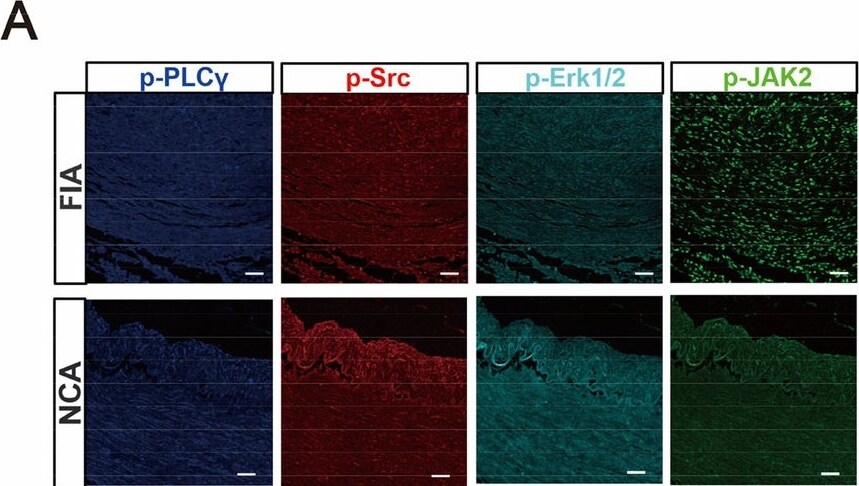
Detection of PLC-gamma 1 by Immunohistochemistry
The JAK2-STAT pathway serves as the major downstream signaling pathway of the mutated PDGFB. mIF demonstrate the important downstream signaling pathway markers of PDGFR beta (p-JAK, p-Src, p-Erk1/2 and p-PLC gamma ) in FIA sections and NCA sections (A). Scale bar, 100 μm. Statistical analysis is performed to compare the mean fluorescence intensity of different signal markers between NCAs (n = 4) and FIAs (n = 5) (C). The expression of p-STAT1 and p-STAT3, which are downstream of p-JAK2, is detected by mIF in FIAs and NCAs. Scale bar, 50 μm (B). Statistical analysis of mean fluorescence intensity of these marks between NCAs (n = 4) and FIAs (n = 5) (D). Western blotting displays the expression of the important downstream signal pathway markers of PDGFR beta (p-JAK2, p-Src, p-Erk1/2 and p-PLC gamma ) in the HBVSMCs underwent different treatment in vitro (E). Relative density (normalized to Control) of immunoblot bands from (E) corresponding to pPLC gamma, p-JAK2, p-Src, and p-ERK1/2 (n = 3) (F). 'n' represented the number of samples. Three random fields were selected for statistical analysis in each sample, and the average value represented the detection value of this marker in this sample. Tukey's multiple comparisons test is conducted to evaluate the statistical differences. ns, no significant; ***padj < 0.001, ****padj < 0.0001. Image collected and cropped by CiteAb from the following open publication (https://jbiomedsci.biomedcentral.com/articles/10.1186/s12929-024-01040-7), licensed under a CC-BY license. Not internally tested by R&D Systems.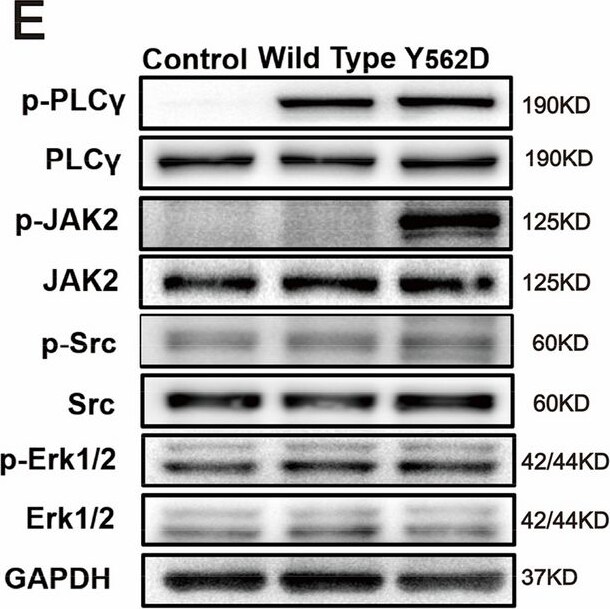
Detection of PLC-gamma 1 by Western Blot
The JAK2-STAT pathway serves as the major downstream signaling pathway of the mutated PDGFB. mIF demonstrate the important downstream signaling pathway markers of PDGFR beta (p-JAK, p-Src, p-Erk1/2 and p-PLC gamma ) in FIA sections and NCA sections (A). Scale bar, 100 μm. Statistical analysis is performed to compare the mean fluorescence intensity of different signal markers between NCAs (n = 4) and FIAs (n = 5) (C). The expression of p-STAT1 and p-STAT3, which are downstream of p-JAK2, is detected by mIF in FIAs and NCAs. Scale bar, 50 μm (B). Statistical analysis of mean fluorescence intensity of these marks between NCAs (n = 4) and FIAs (n = 5) (D). Western blotting displays the expression of the important downstream signal pathway markers of PDGFR beta (p-JAK2, p-Src, p-Erk1/2 and p-PLC gamma ) in the HBVSMCs underwent different treatment in vitro (E). Relative density (normalized to Control) of immunoblot bands from (E) corresponding to pPLC gamma, p-JAK2, p-Src, and p-ERK1/2 (n = 3) (F). 'n' represented the number of samples. Three random fields were selected for statistical analysis in each sample, and the average value represented the detection value of this marker in this sample. Tukey's multiple comparisons test is conducted to evaluate the statistical differences. ns, no significant; ***padj < 0.001, ****padj < 0.0001. Image collected and cropped by CiteAb from the following open publication (https://jbiomedsci.biomedcentral.com/articles/10.1186/s12929-024-01040-7), licensed under a CC-BY license. Not internally tested by R&D Systems.Applications for phospho-PLC-gamma 1 (Y783) Antibody (1016D)
Immunocytochemistry
Sample: Immersion fixed A431 human epithelial carcinoma cell line treated with Recombinant Human EGF (Catalog # 236-EG)
Formulation, Preparation, and Storage
Purification
Reconstitution
Reconstitute at 0.5 mg/mL in sterile PBS For liquid material, refer to CoA for concentration.
Formulation
Shipping
Stability & Storage
- 12 months from date of receipt, -20 to -70 °C as supplied.
- 1 month, 2 to 8 °C under sterile conditions after reconstitution.
- 6 months, -20 to -70 °C under sterile conditions after reconstitution.
Calculators
Background: PLC-gamma 1
Long Name
Alternate Names
Gene Symbol
UniProt
Additional PLC-gamma 1 Products
Product Documents for phospho-PLC-gamma 1 (Y783) Antibody (1016D)
Certificate of Analysis
To download a Certificate of Analysis, please enter a lot or batch number in the search box below.
Note: Certificate of Analysis not available for kit components.
Product Specific Notices for phospho-PLC-gamma 1 (Y783) Antibody (1016D)
For research use only
Related Research Areas
Citations for phospho-PLC-gamma 1 (Y783) Antibody (1016D)
 Powered by Bioz
Customer Reviews for phospho-PLC-gamma 1 (Y783) Antibody (1016D)
There are currently no reviews for this product. Be the first to review phospho-PLC-gamma 1 (Y783) Antibody (1016D) and earn rewards!
Have you used phospho-PLC-gamma 1 (Y783) Antibody (1016D)?
Submit a review and receive an Amazon gift card!
$25/€18/£15/$25CAN/¥2500 for a review with an image
$10/€7/£6/$10CAN/¥1110 for a review without an image
Submit a review
Protocols
Find general support by application which include: protocols, troubleshooting, illustrated assays, videos and webinars.
- Appropriate Fixation of IHC/ICC Samples
- Cellular Response to Hypoxia Protocols
- ClariTSA™ Fluorophore Kits
- Detection & Visualization of Antibody Binding
- ICC Cell Smear Protocol for Suspension Cells
- ICC Immunocytochemistry Protocol Videos
- ICC for Adherent Cells
- Immunocytochemistry (ICC) Protocol
- Immunocytochemistry Troubleshooting
- Immunofluorescence of Organoids Embedded in Cultrex Basement Membrane Extract
- Immunohistochemistry (IHC) and Immunocytochemistry (ICC) Protocols
- Preparing Samples for IHC/ICC Experiments
- Preventing Non-Specific Staining (Non-Specific Binding)
- Primary Antibody Selection & Optimization
- Protocol for VisUCyte™ HRP Polymer Detection Reagent
- Protocol for the Fluorescent ICC Staining of Cell Smears - Graphic
- Protocol for the Fluorescent ICC Staining of Cultured Cells on Coverslips - Graphic
- Protocol for the Preparation and Fluorescent ICC Staining of Cells on Coverslips
- Protocol for the Preparation and Fluorescent ICC Staining of Non-adherent Cells
- Protocol for the Preparation and Fluorescent ICC Staining of Stem Cells on Coverslips
- Protocol for the Preparation of a Cell Smear for Non-adherent Cell ICC - Graphic
- TUNEL and Active Caspase-3 Detection by IHC/ICC Protocol
- The Importance of IHC/ICC Controls
- View all Protocols, Troubleshooting, Illustrated assays and Webinars
Associated Pathways


