
The neurotrophins, including NGF, BDNF, NT-3, and NT-4/5 constitute a group of structurally related, secreted proteins that play an important role in the development and function of the nervous system. The biological activities of the neurotrophins are mediated by binding to the different members of the Trk family tyrosine kinase receptors. Three Trk family proteins, TrkA, TrkB, and TrkC, exhibiting different ligand specificities, have been identified. TrkA binds NGF, TrkB binds BDNF and NT-4/5 and TrkC binds NT-3. All Trk family proteins share a conserved complex subdomain organization consisting of a signal peptide, two cysteine-rich domains, a cluster of three leucine-rich motifs, and two immunoglobulin-like domains in the extracellular region, as well as an intracellular region that contains the tyrosine kinase domain. Natural splice variants of the different Trks, including TrkB variants lacking the first cysteine-rich domain, the first and second or all three of the leucine-rich motifs, or the tyrosine kinase domain, have been described. The role of the different extracellular subdomains of TrkB in mediating neurotrophin binding and discrimination is currently being investigated. At the protein sequence level, human and rat TrkB are greater than 90% identical and the proteins exhibit cross-species activity. TrkB is primarily expressed in the nervous system. However, low levels of TrkB expression have also been observed in a wide variety of tissues (pancreas, kidneys, ovary) outside the nervous system.

Scientific images may be resized, cropped, or adjusted for brightness or contrast for presentation purposes. These updates are limited to presentation and do not affect the underlying scientific interpretation of the data. Where available, additional source data may be provided upon request.
Key Product Details
Species Reactivity
Validated:
Cited:
Applications
Validated:
Cited:
Label
Antibody Source
Product Specifications
Immunogen
Specificity
Clonality
Host
Isotype
Scientific Data Images for TrkB Antibody
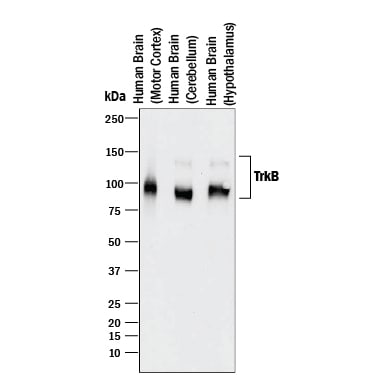
Detection of Human TrkB by Western Blot.
Western blot shows lysates of human brain (motor cortex) tissue, human brain (cerebellum) tissue, and human brain (hypothalamus) tissue. PVDF membrane was probed with 0.5 µg/mL of Goat Anti-Human/Mouse/Rat TrkB Antigen Affinity-purified Polyclonal Antibody (Catalog # AF397) followed by HRP-conjugated Anti-Goat IgG Secondary Antibody (HAF017). Specific bands were detected for TrkB at approximately 90-100 & 140 kDa (as indicated). This experiment was conducted under reducing conditions and using Immunoblot Buffer Group 1.
Detection of Human, Mouse, and Rat TrkB by Western Blot.
Western blot shows lysates of human brain (motor cortex) tissue, mouse brain (cortex) tissue, and rat brain (hippocampus) tissue. PVDF membrane was probed with 0.25 µg/mL of Goat Anti-Human/Mouse/Rat TrkB Antigen Affinity-purified Polyclonal Antibody (Catalog # AF397) followed by HRP-conjugated Anti-Goat IgG Secondary Antibody (HAF017). Specific bands were detected for TrkB at approximately 95 kDa and 145 kDa (as indicated). This experiment was conducted under reducing conditions and using Immunoblot Buffer Group 1.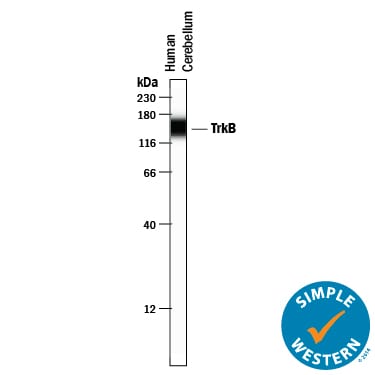
Detection of Human TrkB by Simple WesternTM.
Simple Western lane view shows lysates of human brain (cerebellum) tissue, loaded at 0.2 mg/mL. A specific band was detected for TrkB at approximately 162 kDa (as indicated) using 10 µg/mL of Goat Anti-Human/Mouse/Rat TrkB Antigen Affinity-purified Polyclonal Antibody (Catalog # AF397) followed by 1:50 dilution of HRP-conjugated Anti-Goat IgG Secondary Antibody (HAF109). This experiment was conducted under reducing conditions and using the 12-230 kDa separation system.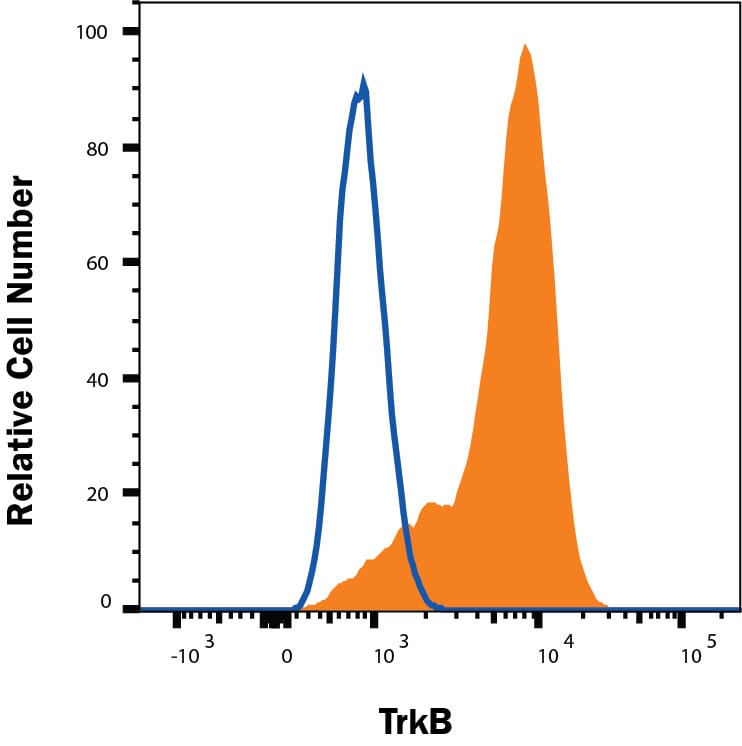
Detection of TrkB in Baf3 cells by Flow Cytometry.
Baf3 cells transfected with Human TrkB (filled histogram) vs Irrelevant transfectant (open histogram) were stained with Goat Anti-Human/Mouse/Rat TrkB Antigen Affinity-purified Polyclonal Antibody (Catalog # AF397) followed by Fluorescein-conjugated Anti-Goat IgG Secondary Antibody (Catalog # F0109). View our protocol for Staining Membrane-associated Proteins.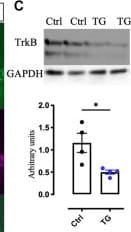
Detection of TrkB by Western Blot
Generation of conditional knockout mice, reporter expression and alteration of 5-HT and its metabolite in the transgenic mice. (A) An experimental scheme representing the time of injection, reporter assay, HPLC measurements and the duration when different behavioral battery tests were performed followed by molecular analysis. (B) Confirmation of Cre-recombination in the tDtomato reporter mice using immunohistochemistry with Tph2 antibody in tamoxifen injected and corn oil injected animals (N = 4). (C) Western blotting with TrkB monoclonal antibody on the mid-brain samples from the control and TG mice (N = 4). (D) (a) The total levels of 5-HT was measured by HPLC in naïve animal’s different brain regions such as the PFC, HC, and MB. The levels in TG mice were significantly upregulated in the PFC and MB. (b) The levels of 5HIAA did not change in these brain regions. (c) The 5HIAA/5-HT ratio was also measured in these regions. The ratio was significantly down regulated in the MB of the TG mice. (d) The levels of DA were significantly upregulated in the PFC and MB of the TG mice (N = 4). (E) q-RT PCR results of the transcripts Tph2 in the MB and Bdnf in the PFC was increased. The transcript for 5ht2b was reduced in the PFC of the TG mice. No change in Bdnf and 5ht2b transcripts in the HC was observed (N = 4). (F)In situ hybridization with Bdnf probe in the PFC of Ctrl and TG mice shows a robust expression (N = 3). Scale bar represents 100 μm, Student’s t-test, *p-value < 0.01, **p-value < 0.01. HPLC-High pressure liquid chromatography, 5-HT- Serotonin, 5HIAA- 5-Hydroxyindoleacetic acid, DA-Dopamine, PFC-pre-frontal cortex, HC-Hippocampus and MB-Mid-brain. Image collected and cropped by CiteAb from the following open publication (https://pubmed.ncbi.nlm.nih.gov/33935645), licensed under a CC-BY license. Not internally tested by R&D Systems.Applications for TrkB Antibody
CyTOF-ready
Flow Cytometry
Sample: Baf3 cells transfected with Human TrkB vs Irrelevant transfectant cells
Simple Western
Sample: Human brain (cerebellum) tissue
Western Blot
Sample: Human brain (motor cortex) tissue, human brain (cerebellum) tissue, and human brain (hypothalamus) tissue, mouse brain (cortex) tissue, and rat brain (hippocampus) tissue
Flow Cytometry Panel Builder
Bio-Techne Knows Flow Cytometry
Save time and reduce costly mistakes by quickly finding compatible reagents using the Panel Builder Tool.
Advanced Features
- Spectra Viewer - Custom analysis of spectra from multiple fluorochromes
- Spillover Popups - Visualize the spectra of individual fluorochromes
- Antigen Density Selector - Match fluorochrome brightness with antigen density

Formulation, Preparation, and Storage
Purification
Reconstitution
Reconstitute at 0.2 mg/mL in sterile PBS. For liquid material, refer to CoA for concentration.
Formulation
Shipping
Stability & Storage
- 12 months from date of receipt, -20 to -70 °C as supplied.
- 1 month, 2 to 8 °C under sterile conditions after reconstitution.
- 6 months, -20 to -70 °C under sterile conditions after reconstitution.
Calculators
Background: TrkB
References
- Ninkina, N. et al. (1997) J. Biol. Chem. 272:13019.
- Middlemas, D.S. et al. (1991) Mol. Cell Biol. 11:143.
- Soppet, D. et al. (1991) Cell 65:895.
Long Name
Alternate Names
Gene Symbol
Additional TrkB Products
Product Documents for TrkB Antibody
Certificate of Analysis
To download a Certificate of Analysis, please enter a lot or batch number in the search box below.
Note: Certificate of Analysis not available for kit components.
Product Specific Notices for TrkB Antibody
For research use only
Citations for TrkB Antibody
 Powered by Bioz
Customer Reviews for TrkB Antibody
There are currently no reviews for this product. Be the first to review TrkB Antibody and earn rewards!
Have you used TrkB Antibody?
Submit a review and receive an Amazon gift card!
$25/€18/£15/$25CAN/¥2500 for a review with an image
$10/€7/£6/$10CAN/¥1110 for a review without an image
Submit a review
Protocols
Find general support by application which include: protocols, troubleshooting, illustrated assays, videos and webinars.
- 7-Amino Actinomycin D (7-AAD) Cell Viability Flow Cytometry Protocol
- Cellular Response to Hypoxia Protocols
- Extracellular Membrane Flow Cytometry Protocol
- Flow Cytometry Protocol for Cell Surface Markers
- Flow Cytometry Protocol for Staining Membrane Associated Proteins
- Flow Cytometry Staining Protocols
- Flow Cytometry Troubleshooting Guide
- Intracellular Flow Cytometry Protocol Using Alcohol (Methanol)
- Intracellular Flow Cytometry Protocol Using Detergents
- Intracellular Nuclear Staining Flow Cytometry Protocol Using Detergents
- Intracellular Staining Flow Cytometry Protocol Using Alcohol Permeabilization
- Intracellular Staining Flow Cytometry Protocol Using Detergents to Permeabilize Cells
- Propidium Iodide Cell Viability Flow Cytometry Protocol
- Protocol for Liperfluo
- Protocol for the Characterization of Human Th22 Cells
- Protocol for the Characterization of Human Th9 Cells
- Protocol: Annexin V and PI Staining by Flow Cytometry
- Protocol: Annexin V and PI Staining for Apoptosis by Flow Cytometry
- R&D Systems Quality Control Western Blot Protocol
- Troubleshooting Guide: Fluorokine Flow Cytometry Kits
- Troubleshooting Guide: Western Blot Figures
- Western Blot Conditions
- Western Blot Protocol
- Western Blot Protocol for Cell Lysates
- Western Blot Troubleshooting
- Western Blot Troubleshooting Guide
- View all Protocols, Troubleshooting, Illustrated assays and Webinars
Associated Pathways

