

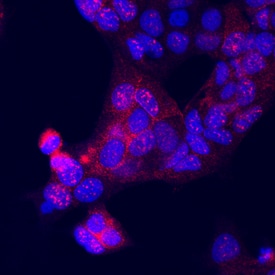
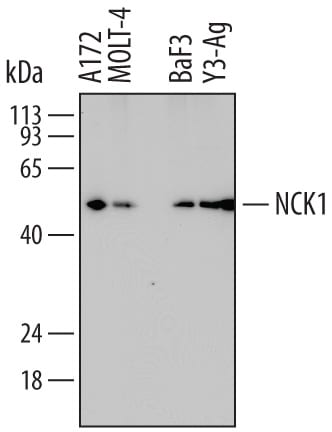
NCK1 (Non-catalytic region of tyrosine kinase 1; also Sh2/SH3 adaptor protein NCK-alpha ) is a 46-48 kDa member of the Nck family of adaptor proteins. NCK1 is ubiquitously expressed and may be found in both cytoplasm and nucleus. In the cytoplasm, it connects tyrosine kinases to actin reorganization which, in T cells, involves SLP-76 and VAV1. Upon DNA damage, NCK1 binds SOCS7 and is translocated into the nucleus where it participates in p53 phosphorylation and cell cycle arrest. Human NCK1 is 377 amino acids (aa) in length. It contains three N-terminal SH3 domains (aa 2-252) that mediate binding to Pro-rich regions of cytoplasmic proteins, and a C-terminal SH2 domain (aa 282-376) that binds to phosphorylated proteins or receptors. There are at least three utilized Ser, and one utilized Tyr phosphorylation sites. There are also three potential splice variants. One shows a 12 aa substitution for aa 1-76, a second possesses an 11 aa substitution for aa 77‑377, and a third contains a 37 aa substitution for aa 134-377. Full-length NCK1 shares 99% aa identity with mouse NCK1.
MAB7008 detects mouse and rat NCK1 in Western Blots. Cross-reactivity with mouse and rat samples in immunocytochemistry has not been tested.
 Powered by Bioz

