
Nectin-1 (designated CD111), also called PRR-1 (poliovirus receptor-related protein 1) or HVEC (herpesvirus entry mediator C), is a widely expressed 110 kDa type I transmembrane glycoprotein important in formation of adherens junctions and synapses. It is a member of the nectin family within the Ig superfamily (1, 2). The Latin word necto means “to connect”, indicating the role of nectins in Ca2+-independent cell-cell adhesion (2). Nectin-1 forms homodimers in cis, followed by interactions in trans with Nectin-1, -3 or -4 (2). The 517 amino acid (aa) human Nectin-1 isoform 1 contains a 30 aa signal sequence, a 325 aa extracellular domain (ECD), a 21 aa transmembrane segment (TM), and a 141 aa cytoplasmic region. Nectin ECDs contain three Ig-like domains: an N-terminal V-type that mediates ligand binding and two C2-type (3). Nectin-1, like other nectins, has a splice form (isoform 2 or HigR, 458 aa) with alternate TM and cytoplasmic sequences. Another, isoform 3, is a 352 aa secreted protein (4). The common region of mature human Nectin-1 (aa 31-334) shares 93%, 94%, 96% and 96% aa identity with mouse, rat, bovine and porcine Nectin-1, respectively. Nectin-1 binds viral glycoprotein D to mediate herpesvirus (but not poxvirus) entry into vaginal mucosa, sensory neurons and fibroblasts (4 - 7). In forming adherens junctions and synapses, nectins 1 and 3 initiate cell-cell interactions, recruiting alpha v beta 3 integrin extracellularly and cadherins intracellularly through afadin and other junctional proteins (2, 8 - 11). These interactions organize the cytoskeleton, strengthen attachment to basement membrane and promote further cell-cell connections. Nectin-1 also recognizes CD96 on NK cells (12). Deficiency of Nectin-1 can result in cleft lip/palate ectodermal dysplasia (13). Nectin-1 downregulation in epithelial cancers, mediated in part by ectodomain shedding, may contribute to invasiveness (14).
Human Nectin-1 Antibody (610835)
R&D Systems | Catalog # MAB2880

Scientific images may be resized, cropped, or adjusted for brightness or contrast for presentation purposes. These updates are limited to presentation and do not affect the underlying scientific interpretation of the data. Where available, additional source data may be provided upon request.
Key Product Details
Species Reactivity
Validated:
Cited:
Applications
Validated:
Cited:
Label
Antibody Source
Product Specifications
Immunogen
Gln31-Thr334
Accession # Q15223
Specificity
Clonality
Host
Isotype
Scientific Data Images for Human Nectin-1 Antibody (610835)
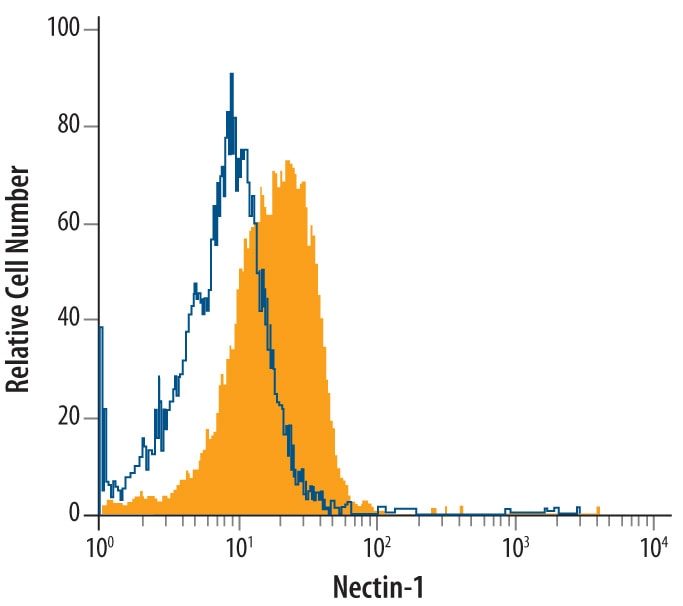
Detection of Nectin‑1 in U937 Human Cell Line by Flow Cytometry.
U937 human histiocytic lymphoma cell line was stained with Human Nectin-1 Monoclonal Antibody (Catalog # MAB2880, filled histogram) or isotype control antibody (Catalog # MAB003, open histogram), followed by Allophycocyanin-conjugated Anti-Mouse IgG F(ab')2Secondary Antibody (Catalog # F0101B).Applications for Human Nectin-1 Antibody (610835)
CyTOF-ready
Flow Cytometry
Sample: U937 human histiocytic lymphoma cell line
Reviewed Applications
Read 1 review rated 5 using MAB2880 in the following applications:
Flow Cytometry Panel Builder
Bio-Techne Knows Flow Cytometry
Save time and reduce costly mistakes by quickly finding compatible reagents using the Panel Builder Tool.
Advanced Features
- Spectra Viewer - Custom analysis of spectra from multiple fluorochromes
- Spillover Popups - Visualize the spectra of individual fluorochromes
- Antigen Density Selector - Match fluorochrome brightness with antigen density

Formulation, Preparation, and Storage
Purification
Reconstitution
Sterile PBS to a final concentration of 0.5 mg/mL. For liquid material, refer to CoA for concentration.
Formulation
Shipping
Stability & Storage
- 12 months from date of receipt, -20 to -70 °C as supplied.
- 1 month, 2 to 8 °C under sterile conditions after reconstitution.
- 6 months, -20 to -70 °C under sterile conditions after reconstitution.
Calculators
Background: Nectin-1
References
- Lopez, M. et al. (1995) Gene 155:261.
- Takai, Y. et al. (2008) Nat. Rev. Mol. Cell Biol. 9:603.
- Fabre, S. et al. (2002) J. Biol. Chem. 277:27006.
- Lopez, M. et al. (2001) J. Virol. 75:5684.
- Cocchi, F. et al. (1998) Proc. Natl. Acad. Sci. USA 95:15700.
- Linehan, M. M. et al. (2004) J. Virol. 78:2530.
- Simpson, S. A. et al. (2005) J. Neurovirol. 11:208.
- Mizoguchi, A. et al. (2002) J. Cell Biol. 156:555.
- Togashi, H. et al. (2006) J. Cell Biol. 174:141.
- Tachibana, K. et al. (2000) J. Cell Biol. 150:1161.
- Takai, Y. and H. Nakanishi (2003) J. Cell Science 116:17.
- Seth, S. et al. (2007) Biochem. Biophys. Res. Commun. 364:959.
- Suzuki, K. et al. (2000) Nat. Genet. 25:427.
- Tanaka, Y. et al. (2002) Biochem. Biophys. Res. Commun. 299:472.
Long Name
Alternate Names
Gene Symbol
UniProt
Additional Nectin-1 Products
Product Documents for Human Nectin-1 Antibody (610835)
Certificate of Analysis
To download a Certificate of Analysis, please enter a lot or batch number in the search box below.
Note: Certificate of Analysis not available for kit components.
Product Specific Notices for Human Nectin-1 Antibody (610835)
For research use only
Citations for Human Nectin-1 Antibody (610835)
 Powered by Bioz
Customer Reviews for Human Nectin-1 Antibody (610835) (1)
Have you used Human Nectin-1 Antibody (610835)?
Submit a review and receive an Amazon gift card!
$25/€18/£15/$25CAN/¥2500 for a review with an image
$10/€7/£6/$10CAN/¥1110 for a review without an image
Submit a review
Customer Images
-
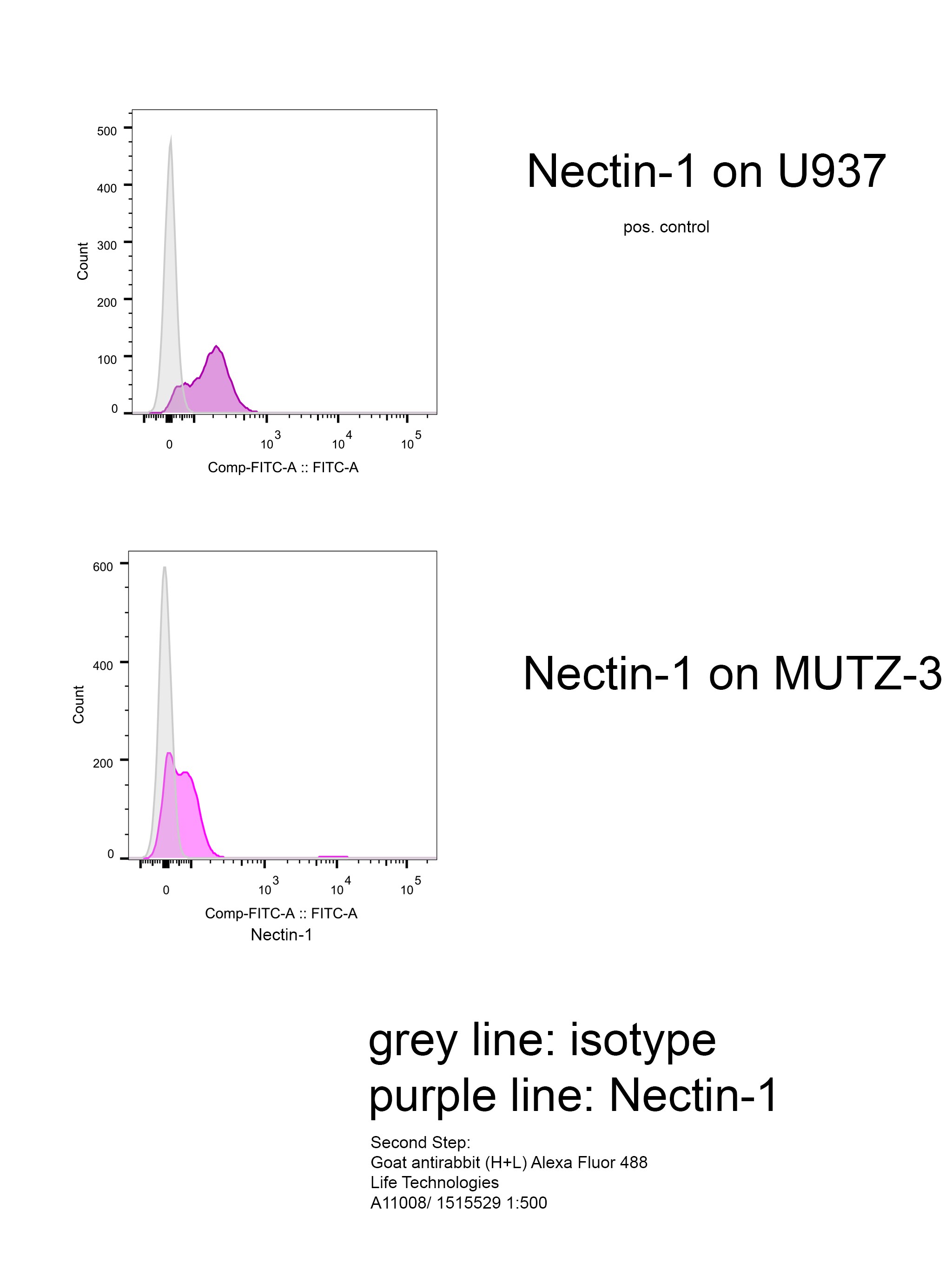
Application: Flow CytometrySample Tested: MUTZ-3 cell line and U937 human histiocytic lymphoma cell lineSpecies: HumanVerified Customer | Posted 12/08/2016second step antibody: Goat antirabbit (H+L) Alexa Fluor 488 A11008/ 1515529 1:500

There are no reviews that match your criteria.
Protocols
Find general support by application which include: protocols, troubleshooting, illustrated assays, videos and webinars.
- 7-Amino Actinomycin D (7-AAD) Cell Viability Flow Cytometry Protocol
- Extracellular Membrane Flow Cytometry Protocol
- Flow Cytometry Protocol for Cell Surface Markers
- Flow Cytometry Protocol for Staining Membrane Associated Proteins
- Flow Cytometry Staining Protocols
- Flow Cytometry Troubleshooting Guide
- Intracellular Flow Cytometry Protocol Using Alcohol (Methanol)
- Intracellular Flow Cytometry Protocol Using Detergents
- Intracellular Nuclear Staining Flow Cytometry Protocol Using Detergents
- Intracellular Staining Flow Cytometry Protocol Using Alcohol Permeabilization
- Intracellular Staining Flow Cytometry Protocol Using Detergents to Permeabilize Cells
- Propidium Iodide Cell Viability Flow Cytometry Protocol
- Protocol for Liperfluo
- Protocol for the Characterization of Human Th22 Cells
- Protocol for the Characterization of Human Th9 Cells
- Protocol: Annexin V and PI Staining by Flow Cytometry
- Protocol: Annexin V and PI Staining for Apoptosis by Flow Cytometry
- Troubleshooting Guide: Fluorokine Flow Cytometry Kits
- View all Protocols, Troubleshooting, Illustrated assays and Webinars