
NKX3.1 (Homeobox protein NK-3 homolog A) is a 32-38 kDa member of the NK-3 homeobox family of transcription factors. It is expressed in testis and prostatic epithelium, and appears to be regulated by both testosterone and estrogen (but not progesterone). NKX3.1 apparently promotes prostate gland development, and acts as a tumor suppressor/transcriptional repressor by interacting with HDAC-1 and increasing p53 acetylation and half-life. Human NKX3.1 is 234 amino acids (aa) in length. It contains a DNA binding homeodomain (aa 124-183) and phosphorylation sites at Ser185 and Ser196 that regulate protein turnover. There are four splice variants that show changes N-terminal to the homeobox domain. Deletions of aa 8-56, 13-87, 15-83 and 40-83 are all reported. Over aa 1-123, human NKX3.1 shares 50% aa identity with mouse NKX3.1.
Human NKX3.1 Antibody
R&D Systems | Catalog # AF6080

Scientific images may be resized, cropped, or adjusted for brightness or contrast for presentation purposes. These updates are limited to presentation and do not affect the underlying scientific interpretation of the data. Where available, additional source data may be provided upon request.
Key Product Details
Species Reactivity
Applications
Label
Antibody Source
Product Specifications
Immunogen
Met1-Pro123
Accession # Q99801
Specificity
Clonality
Host
Isotype
Scientific Data Images for Human NKX3.1 Antibody
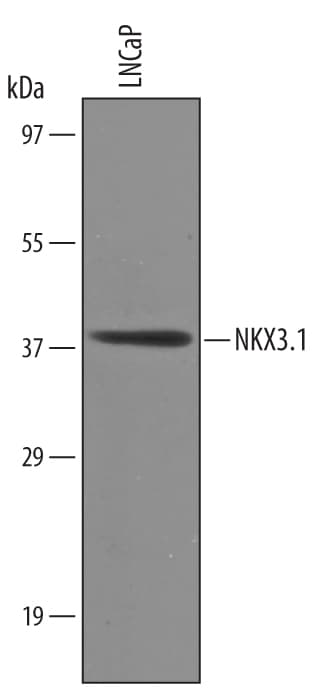
Detection of Human NKX3.1 by Western Blot.
Western blot shows lysates of LNCaP human prostate cancer cell line. PVDF Membrane was probed with 0.1 µg/mL of Goat Anti-Human NKX3.1 Antigen Affinity-purified Polyclonal Antibody (Catalog # AF6080) followed by HRP-conjugated Anti-Goat IgG Secondary Antibody (Catalog # HAF019). A specific band was detected for NKX3.1 at approximately 38 kDa (as indicated). This experiment was conducted under reducing conditions and using Immunoblot Buffer Group 8.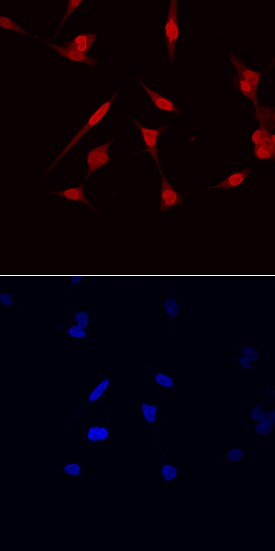
NKX3.1 in LNCaP Human Cell Line.
NKX3.1 was detected in immersion fixed LNCaP human prostate cancer cell line using Goat Anti-Human NKX3.1 Antigen Affinity-purified Polyclonal Antibody (Catalog # AF6080) at 10 µg/mL for 3 hours at room temperature. Cells were stained using the NorthernLights™ 557-conjugated Anti-Goat IgG Secondary Antibody (red; Catalog # NL001) and counterstained with DAPI (blue). Specific staining was localized to nuclei. View our protocol for Fluorescent ICC Staining of Cells on Coverslips.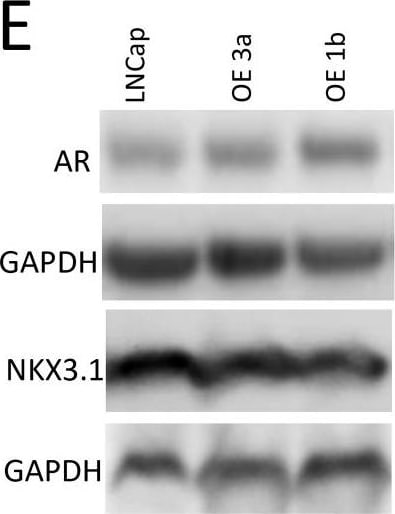
Detection of Human Human NKX3.1 Antibody by Western Blot
Activation of beta -catenin pathway in LNCaP cells overexpressing delta -catenin(A) Comparison of levels of delta -catenin in overexpressing LNCaP clones and other PCa cell lines. Full length protein is depicted by arrow. (B) Levels of catenin proteins in delta -catenin overexpressing LNCaP clone (designated as OE1b) are shown. Gradient loading of total protein for OE1b clone was used to illustrate an increase in expression of each protein (right panel). Quantification graphs showing protein levels normalized to GAPDH level (arbitrary units, a.u.) are at the bottom. (C) Characterization of nuclear (NE) and cytoplasmic (CE) levels of beta -catenin. Nuclear and cytoplasmic protein was isolated, beta -catenin was detected by Western blotting using specific antibody. TBP and GAPDH were used as loading control of nuclear and cytoplasmic protein respectively. Normalized level of beta -catenin in each compartment is shown at the bottom. (D and E) Characterization of levels of proteins, downstream targets of Wnt/ beta -catenin pathway (D), and androgen regulated genes AR and NKX3.1 (E) by Western blotting. Corresponding quantification is shown. Three clones (OE3a, OR1b, OE1c) overexpressing delta -catenin at various levels were examined. Total amount of 30ug of protein was used in each experiment, unless otherwise specified (in B). SDS-PAGE and Western blot conditions as in Figure 2. Image collected and cropped by CiteAb from the following publication (https://pubmed.ncbi.nlm.nih.gov/29849951), licensed under a CC-BY license. Not internally tested by R&D Systems.Applications for Human NKX3.1 Antibody
Immunocytochemistry
Sample: Immersion fixed LNCaP human prostate cancer cell line
Western Blot
Sample: LNCaP human prostate cancer cell line
Formulation, Preparation, and Storage
Purification
Reconstitution
Reconstitute at 0.2 mg/mL in sterile PBS. For liquid material, refer to CoA for concentration.
Formulation
Shipping
Stability & Storage
- 12 months from date of receipt, -20 to -70 °C as supplied.
- 1 month, 2 to 8 °C under sterile conditions after reconstitution.
- 6 months, -20 to -70 °C under sterile conditions after reconstitution.
Calculators
Background: NKX3.1
Long Name
Alternate Names
Gene Symbol
UniProt
Additional NKX3.1 Products
Product Documents for Human NKX3.1 Antibody
Certificate of Analysis
To download a Certificate of Analysis, please enter a lot or batch number in the search box below.
Note: Certificate of Analysis not available for kit components.
Product Specific Notices for Human NKX3.1 Antibody
For research use only
Related Research Areas
Citations for Human NKX3.1 Antibody
 Powered by Bioz
Customer Reviews for Human NKX3.1 Antibody
There are currently no reviews for this product. Be the first to review Human NKX3.1 Antibody and earn rewards!
Have you used Human NKX3.1 Antibody?
Submit a review and receive an Amazon gift card!
$25/€18/£15/$25CAN/¥2500 for a review with an image
$10/€7/£6/$10CAN/¥1110 for a review without an image
Submit a review
Protocols
Find general support by application which include: protocols, troubleshooting, illustrated assays, videos and webinars.
- Appropriate Fixation of IHC/ICC Samples
- Cellular Response to Hypoxia Protocols
- ClariTSA™ Fluorophore Kits
- Detection & Visualization of Antibody Binding
- ICC Cell Smear Protocol for Suspension Cells
- ICC Immunocytochemistry Protocol Videos
- ICC for Adherent Cells
- Immunocytochemistry (ICC) Protocol
- Immunocytochemistry Troubleshooting
- Immunofluorescence of Organoids Embedded in Cultrex Basement Membrane Extract
- Immunohistochemistry (IHC) and Immunocytochemistry (ICC) Protocols
- Preparing Samples for IHC/ICC Experiments
- Preventing Non-Specific Staining (Non-Specific Binding)
- Primary Antibody Selection & Optimization
- Protocol for VisUCyte™ HRP Polymer Detection Reagent
- Protocol for the Fluorescent ICC Staining of Cell Smears - Graphic
- Protocol for the Fluorescent ICC Staining of Cultured Cells on Coverslips - Graphic
- Protocol for the Preparation and Fluorescent ICC Staining of Cells on Coverslips
- Protocol for the Preparation and Fluorescent ICC Staining of Non-adherent Cells
- Protocol for the Preparation and Fluorescent ICC Staining of Stem Cells on Coverslips
- Protocol for the Preparation of a Cell Smear for Non-adherent Cell ICC - Graphic
- R&D Systems Quality Control Western Blot Protocol
- TUNEL and Active Caspase-3 Detection by IHC/ICC Protocol
- The Importance of IHC/ICC Controls
- Troubleshooting Guide: Western Blot Figures
- Western Blot Conditions
- Western Blot Protocol
- Western Blot Protocol for Cell Lysates
- Western Blot Troubleshooting
- Western Blot Troubleshooting Guide
- View all Protocols, Troubleshooting, Illustrated assays and Webinars