
Human P-Selectin/CD62P Antibody (9E1)
R&D Systems | Catalog # BBA30


Scientific images may be resized, cropped, or adjusted for brightness or contrast for presentation purposes. These updates are limited to presentation and do not affect the underlying scientific interpretation of the data. Where available, additional source data may be provided upon request.
Key Product Details
Species Reactivity
Validated:
Cited:
Applications
Validated:
Cited:
Label
Antibody Source
Product Specifications
Immunogen
Extracellular domain
Specificity
Clonality
Host
Isotype
Endotoxin Level
Scientific Data Images for Human P-Selectin/CD62P Antibody (9E1)
P-Selectin/CD62P in Human Breast Cancer Tissue.
P-Selectin/CD62P was detected in immersion fixed paraffin-embedded sections of human breast cancer tissue using 25 µg/mL Human P-Selectin/CD62P Monoclonal Antibody (Catalog # BBA30) overnight at 4 °C. Tissue was stained with the Anti-Mouse HRP-DAB Cell & Tissue Staining Kit (brown; Catalog # CTS002) and counterstained with hematoxylin (blue). View our protocol for Chromogenic IHC Staining of Paraffin-embedded Tissue Sections.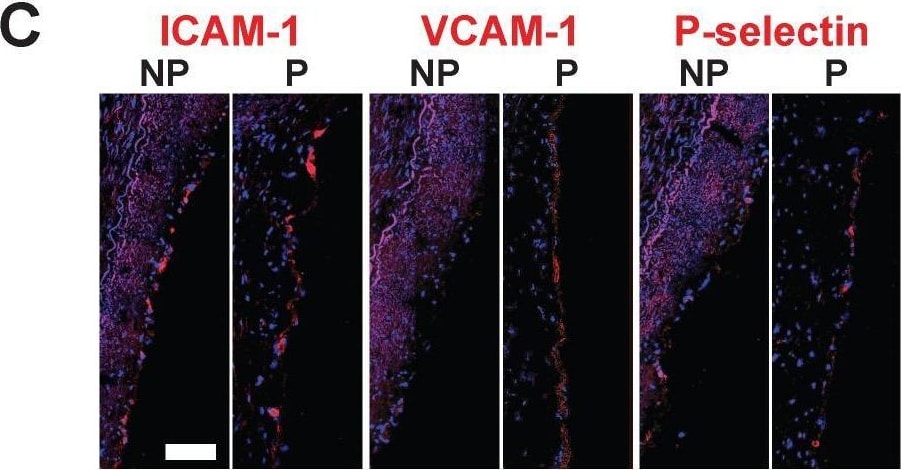
Detection of P-Selectin/CD62P by Immunohistochemistry
SERS-BFNP molecular imaging of atherosclerotic coronary arteries. A single human coronary artery was isolated from the heart of a patient undergoing heart transplantation surgery. The lumen of the artery segment was then injected with a mixture of anti-ICAM-1, anti-VCAM-1, anti-P-selectin, and isotype control BFNP, sutured closed, and incubated at 37 °C/5% CO2 for 12 h. Sutures were then removed and the artery segment was thoroughly washed prior to SERS spectroscopy and subsequent analysis of morphology, expression of adhesion molecules and SERS mapping. (B) Immunofluorescence staining for CD31, and expression of (C) ICAM-1, VCAM-1 and P-selectin are shown in red. Nuclei were counterstained using Hoechst 33342 (blue). Image collected and cropped by CiteAb from the following open publication (https://pubmed.ncbi.nlm.nih.gov/30613292), licensed under a CC-BY license. Not internally tested by R&D Systems.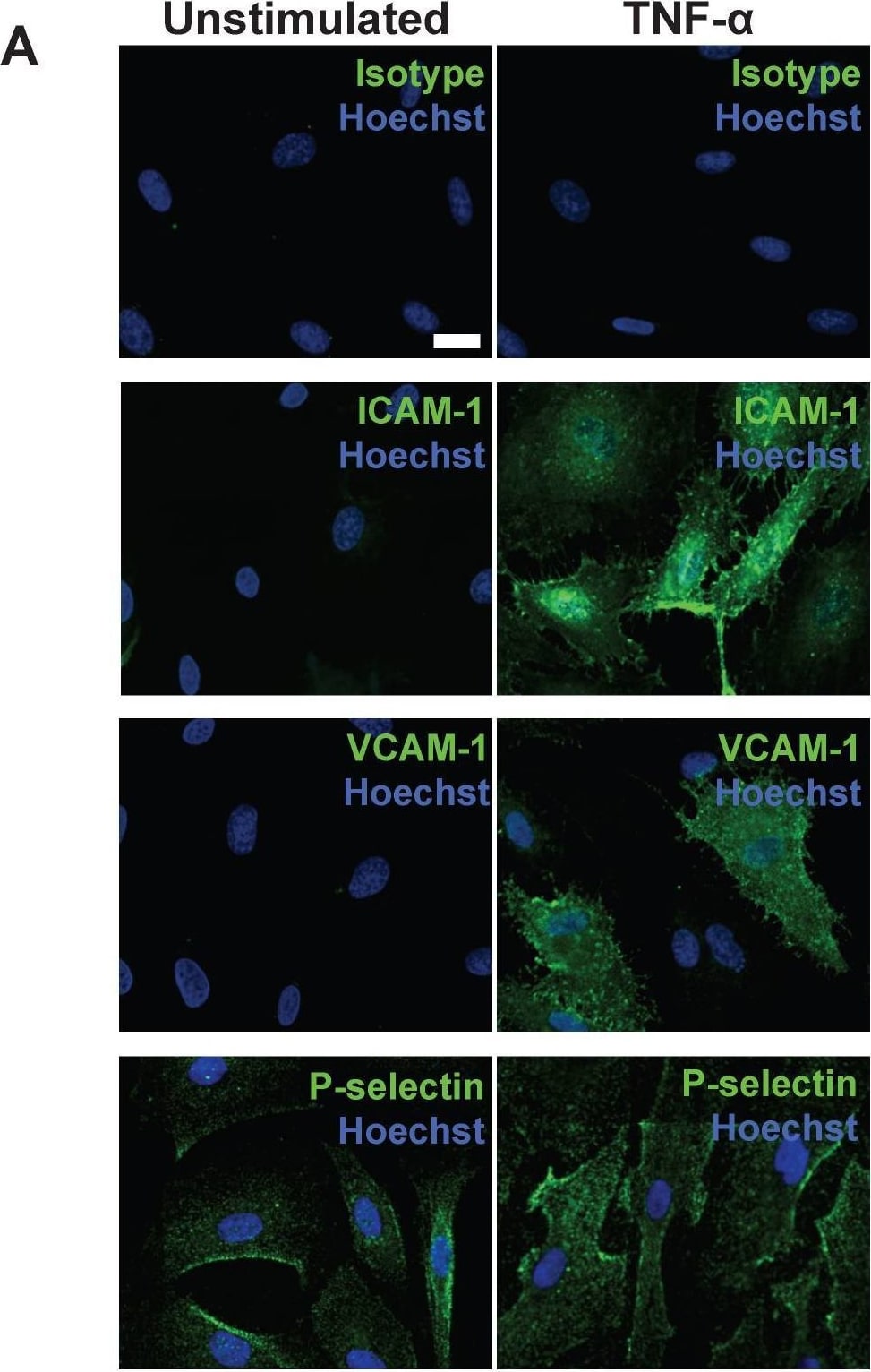
Detection of P-Selectin/CD62P by Immunocytochemistry/ Immunofluorescence
Following stimulation, coronary artery endothelial cells (CAEC) express adhesion molecules detectable via immuno-SERS imaging in single and multiplex formats. (A) Fluorescence images of immunohistochemical staining of ICAM-1, VCAM-1 and P-selectin on CAEC in unstimulated and 10 ng/mL TNF-alpha -stimulated conditions. Isotype control, ICAM-1, VCAM-1 and P-selectin staining shown in green; nuclei were counterstained using Hoechst 33342 (blue). (B) CAEC were stimulated with 10 ng/mL TNF-alpha for 24 h, fixed in acetone, and incubated with isotype control, anti-ICAM-1, anti-VCAM-1 or anti-P-selectin BFNP or (C) with all BFNP simultaneously before being subjected to SERS mapping. (D) Representative spectra from anti-ICAM-1 (purple), anti-VCAM-1 (red) and anti-P-selectin (blue) BFNP acquired from the color-matched circles in (C) are shown above their respective reference spectra. Optical images in (B-C) are darkfield images. Scale bars = 20 μm. Results are representative of 3 independent experiments. Image collected and cropped by CiteAb from the following open publication (https://pubmed.ncbi.nlm.nih.gov/30613292), licensed under a CC-BY license. Not internally tested by R&D Systems.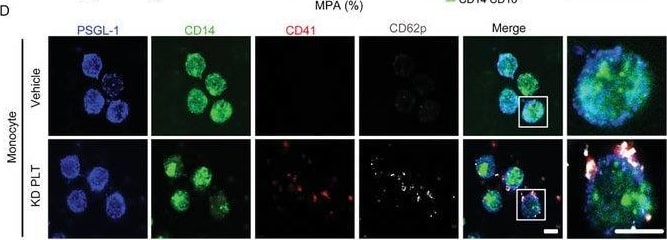
Detection of P-Selectin/CD62P by Immunocytochemistry/ Immunofluorescence
KD platelets crosstalk with monocytes via forming “adhesion junctions”. A) Flow cytometry analysis showing CD62p expression in platelets from HS (n = 24) and KD patients (n = 24). Unpaired t test. B) Correlation between MPA and CD62p positive platelets in patients with acute KD (n = 24). p value was calculated using correlation analysis. C) Heatmap showing selected ligand–receptor interactions between MPA and subtypes of monocytes. D) Immunostaining of PSGL‐1 (blue), CD14 (green), CD41 (red), and CD62p (gray) in monocytes after coculture with KD platelets for 8 h. Activated CD41+ platelets (red) forming CD62p (gray) and PSGL‐1‐mediated junctions (blue) with CD14+ monocytes (green) are shown (n = 6). Scale bar: 5 µm. E) Immunostaining of CD11b (blue), CD14 (green), CD41 (red), GPIb alpha (gray) in monocytes after coculture with KD platelets for 8 h. Activated CD41+ platelets (red) forming GPIb alpha (gray) and CD11b‐mediated junctions (blue) with CD14+ monocytes (green) are shown (n = 6). Scale bar: 5 µm. F,G) Proximity ligation assay (PLA) showing adhesion junctions of CD62p–PSGL‐1 (F), GPIb alpha –CD11b (G) on monocytes. PLA staining: red; nuclei: blue; wheat germ agglutinin (WGA): green (n = 5). Scale bar: 10 µm. PLT, platelet; HS, healthy subject; KD, Kawasaki disease; MPA, platelet–monocyte aggregate; ITGAM, integrin subunit alpha M (CD11b). Image collected and cropped by CiteAb from the following open publication (https://pubmed.ncbi.nlm.nih.gov/39665236), licensed under a CC-BY license. Not internally tested by R&D Systems.Applications for Human P-Selectin/CD62P Antibody (9E1)
Adhesion Blockade
Immunohistochemistry
Sample: Immersion fixed paraffin-embedded sections of human breast cancer tissue
Reviewed Applications
Read 1 review rated 4 using BBA30 in the following applications:
Formulation, Preparation, and Storage
Purification
Reconstitution
Sterile PBS to a final concentration of 0.5 mg/mL.
Formulation
Shipping
Stability & Storage
- 12 months from date of receipt, -20 to -70 °C as supplied.
- 1 month, 2 to 8 °C under sterile conditions after reconstitution.
- 6 months, -20 to -70 °C under sterile conditions after reconstitution.
Calculators
Background: P-Selectin/CD62P
Alternate Names
Gene Symbol
Additional P-Selectin/CD62P Products
Product Documents for Human P-Selectin/CD62P Antibody (9E1)
Certificate of Analysis
To download a Certificate of Analysis, please enter a lot or batch number in the search box below.
Note: Certificate of Analysis not available for kit components.
Product Specific Notices for Human P-Selectin/CD62P Antibody (9E1)
For research use only
Citations for Human P-Selectin/CD62P Antibody (9E1)
 Powered by Bioz
Customer Reviews for Human P-Selectin/CD62P Antibody (9E1) (1)
Have you used Human P-Selectin/CD62P Antibody (9E1)?
Submit a review and receive an Amazon gift card!
$25/€18/£15/$25CAN/¥2500 for a review with an image
$10/€7/£6/$10CAN/¥1110 for a review without an image
Submit a review
-
Application: ELISASample Tested: EDTA Plasma, Citrate Plasma and Heparin PlasmaSpecies: HumanVerified Customer | Posted 12/20/2017
There are no reviews that match your criteria.
Protocols
Find general support by application which include: protocols, troubleshooting, illustrated assays, videos and webinars.
- Antigen Retrieval Protocol (PIER)
- Antigen Retrieval for Frozen Sections Protocol
- Appropriate Fixation of IHC/ICC Samples
- Cellular Response to Hypoxia Protocols
- Chromogenic IHC Staining of Formalin-Fixed Paraffin-Embedded (FFPE) Tissue Protocol
- Chromogenic Immunohistochemistry Staining of Frozen Tissue
- ClariTSA™ Fluorophore Kits
- Detection & Visualization of Antibody Binding
- Fluorescent IHC Staining of Frozen Tissue Protocol
- Graphic Protocol for Heat-induced Epitope Retrieval
- Graphic Protocol for the Preparation and Fluorescent IHC Staining of Frozen Tissue Sections
- Graphic Protocol for the Preparation and Fluorescent IHC Staining of Paraffin-embedded Tissue Sections
- Graphic Protocol for the Preparation of Gelatin-coated Slides for Histological Tissue Sections
- IHC Sample Preparation (Frozen sections vs Paraffin)
- Immunofluorescent IHC Staining of Formalin-Fixed Paraffin-Embedded (FFPE) Tissue Protocol
- Immunohistochemistry (IHC) and Immunocytochemistry (ICC) Protocols
- Immunohistochemistry Frozen Troubleshooting
- Immunohistochemistry Paraffin Troubleshooting
- Preparing Samples for IHC/ICC Experiments
- Preventing Non-Specific Staining (Non-Specific Binding)
- Primary Antibody Selection & Optimization
- Protocol for Heat-Induced Epitope Retrieval (HIER)
- Protocol for Making a 4% Formaldehyde Solution in PBS
- Protocol for VisUCyte™ HRP Polymer Detection Reagent
- Protocol for the Preparation & Fixation of Cells on Coverslips
- Protocol for the Preparation and Chromogenic IHC Staining of Frozen Tissue Sections
- Protocol for the Preparation and Chromogenic IHC Staining of Frozen Tissue Sections - Graphic
- Protocol for the Preparation and Chromogenic IHC Staining of Paraffin-embedded Tissue Sections
- Protocol for the Preparation and Chromogenic IHC Staining of Paraffin-embedded Tissue Sections - Graphic
- Protocol for the Preparation and Fluorescent IHC Staining of Frozen Tissue Sections
- Protocol for the Preparation and Fluorescent IHC Staining of Paraffin-embedded Tissue Sections
- Protocol for the Preparation of Gelatin-coated Slides for Histological Tissue Sections
- TUNEL and Active Caspase-3 Detection by IHC/ICC Protocol
- The Importance of IHC/ICC Controls
- Troubleshooting Guide: Immunohistochemistry
- View all Protocols, Troubleshooting, Illustrated assays and Webinars