
Human phospho-EGFR (Y1173) Antibody
R&D Systems | Catalog # AF1095


Scientific images may be resized, cropped, or adjusted for brightness or contrast for presentation purposes. These updates are limited to presentation and do not affect the underlying scientific interpretation of the data. Where available, additional source data may be provided upon request.
Key Product Details
Validated by
Species Reactivity
Validated:
Cited:
Applications
Validated:
Cited:
Label
Antibody Source
Product Specifications
Immunogen
Specificity
Clonality
Host
Isotype
Scientific Data Images for Human phospho-EGFR (Y1173) Antibody
Detection of Human Phospho-EGFR (Y1173) by Western Blot.
Western blot shows lysates of A431 human epithelial carcinoma cell line untreated (-) or treated (+) with 100 µM pervanadate (PV) for 10 minutes. PVDF membrane was probed with 0.2 µg/mL of Rabbit Anti-Human Phospho-EGFR (Y1173) Antigen Affinity-purified Polyclonal Antibody, followed by HRP-conjugated Anti-Rabbit IgG Secondary Antibody (Catalog # HAF008). A specific band was detected for Phospho-EGFR (Y1173) at approximately 185 kDa (as indicated). This experiment was conducted under reducing conditions and using Immunoblot Buffer Group 1.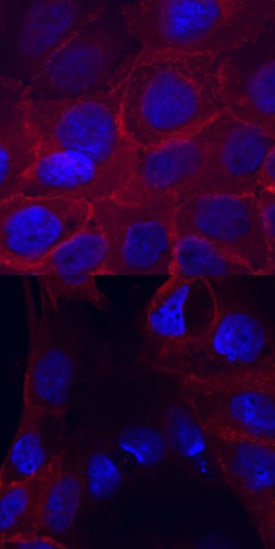
Phospho-EGFR (Y1173) in A431 Human Cell Line.
EGFR phosphorylated at Y1173 was detected in immersion fixed A431 human epithelial carcinoma cell line untreated (lower panel) or treated (upper panel) with pervanadate using Rabbit Anti-Human Phospho-EGFR (Y1173) Antigen Affinity-purified Polyclonal Antibody (Catalog # AF1095) at 10 µg/mL for 3 hours at room temperature. Cells were stained using the NorthernLights™ 557-conjugated Anti-Rabbit IgG Secondary Antibody (red; Catalog # NL004) and counterstained with DAPI (blue). View our protocol for Fluorescent ICC Staining of Cells on Coverslips.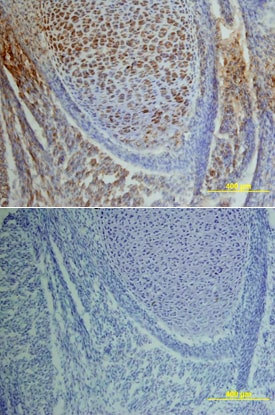
Phospho-EGFR (Y1173) in Mouse Embryo.
EGFR phosphorylated at Y1173 was detected in immersion fixed frozen sections of mouse embryo using Rabbit Anti-Human Phospho-EGFR (Y1173) Antigen Affinity-purified Polyclonal Antibody (Catalog # AF1095) at 15 µg/mL overnight at 4 °C. Tissue was stained using the Anti-Rabbit HRP-DAB Cell & Tissue Staining Kit (brown; Catalog # CTS005) and counterstained with hematoxylin (blue). Lower panel shows a lack of labeling if primary antibodies are omitted and tissue is stained only with secondary antibody followed by incubation with detection reagents. View our protocol for Chromogenic IHC Staining of Frozen Tissue Sections.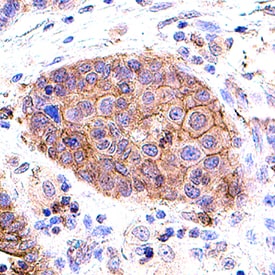
EGFR in Human Lung Cancer.
EGFR was detected in immersion fixed frozen sections of human lung cancer using Rabbit Anti-Human Phospho-EGFR (Y1173) Antigen Affinity-purified Polyclonal Antibody (Catalog # AF1095) at 0.5 µg/mL for 1 hour at room temperature followed by incubation with the Anti-Rabbit IgG VisUCyte™ HRP Polymer Antibody (VC003). Before incubation with the primary antibody, tissue was subjected to heat-induced epitope retrieval using Antigen Retrieval Reagent-Basic (CTS013). Tissue was stained using DAB (brown) and counterstained with hematoxylin (blue). Specific staining was localized to cell membrane in cancer cells. Staining was performed using our protocol for IHC Staining with VisUCyte HRP Polymer Detection Reagents.
Detection of Phospho-EGFR (Y1173) in A431 Human Cell Line by Flow Cytometry.
A431 human epithelial carcinoma cells were untreated (open histogram), or treated for 5 minutes with 100 ng/mL Recombinant Human EGF (Catalog # 236-EG; filled histogram) then stained with Rabbit Anti-Human Phospho-EGFR (Y1173) Antigen Affinity-purified Polyclonal Antibody (Catalog # AF1095), followed by Phycoerythrin-conjugated Anti-Rabbit IgG Secondary Antibody (Catalog # F0110). To facilitate intracellular staining, cells were fixed with para-formaldehyde and permeabilized with saponin.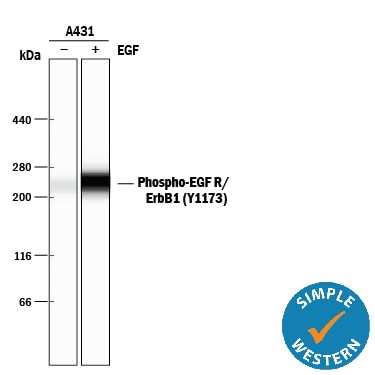
Detection of Human Phospho-EGFR (Y1173) by Simple WesternTM.
Simple Western lane view shows lysates of A431 human epithelial carcinoma cell line untreated (-) or treated (+) with 10 ng/mL Recombinant Human EGF (Catalog # 236-EG) for 5 minutes, loaded at 0.2 mg/mL. A specific band was detected for Phospho-EGFR (Y1173) at approximately 265 kDa (as indicated) using 2 µg/mL of Rabbit Anti-Human Phospho-EGFR (Y1173) Antigen Affinity-purified Polyclonal Antibody (Catalog # AF1095). This experiment was conducted under reducing conditions and using the 66-440 kDa separation system.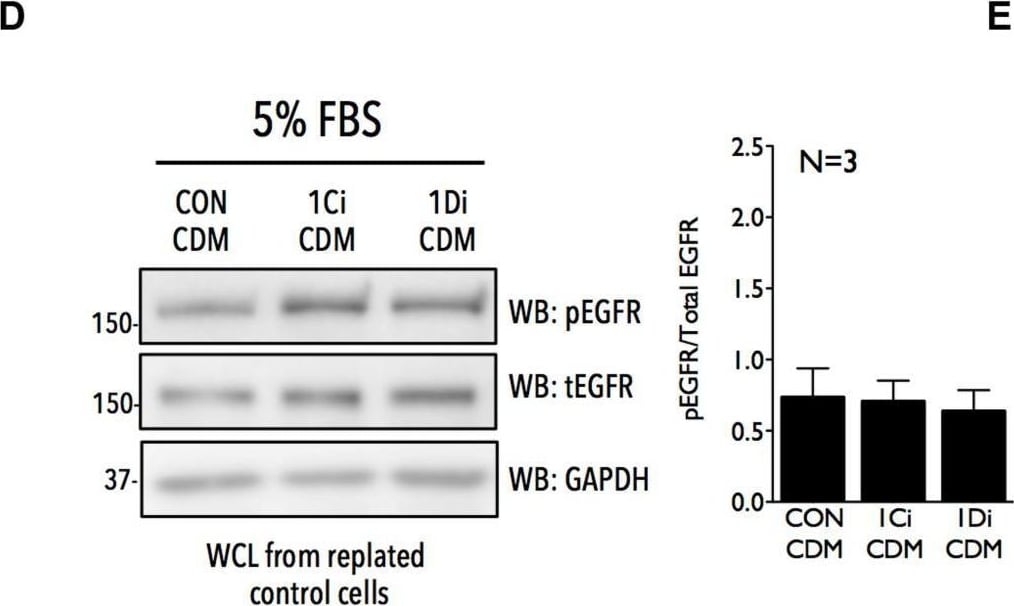
Detection of Phospho-EGFR (Y1173) by Western Blot
Matrix Fibulin-1 regulates EGF dependent EGFR activation in Calu-1. (A) Endogenous Fibulin-1 (WB: FBLN1) & GAPDH (WB: GAPDH) detected by WB in cell derived matrix (CDM before replating) made from control (CON), FBLN1C (1Ci) & FBLN1D (1Di) knockdown Calu-1, grown with serum (5% FBS) for 72 h. Calu-1 replated on this CDM & grown for 18 h with serum [+18 h (5% FBS)] & levels of Fibulin-1 (WB: FBLN1) & GAPDH (WB: GAPDH) detected by WB in cell derived matrix (CDM after replating) & compared to those seen in CDM before replating. FBLN1C & FBLN1D isoforms detected in blots of knockdown lysates are marked by arrows. Blot is best representative of three independent experiments that gave similar results. (B) Representative individual migration tracks of Calu-1 adherent in the presence of serum growth factors (5% FBS) on CDM (made as detailed above) from control (CON-CDM), FBLN1C (1Ci-CDM), & FBLN1D (1Di-CDM) knockdown Calu-1. (C) Accumulated distance, euclidean distance, velocity & directionality of 100 migrating (per experiment) & represented in the bar graphs as mean ± SE from eight independent experiments. p values calculated using one-way ANOVA & Tukey’s post hoc test & represented if found to be significant. (D,E) WB detection of EGFR phosphorylated on tyrosine 1173 (WB: pEGFR), total EGFR (WB: tEGFR) & GAPDH (WB: GAPDH) in Calu-1 plated on CDM (made as detailed above) from control (CON-CDM), FBLN1C (1Ci-CDM) & FBLN1D (1Di-CDM) knockdown (D) in the presence of serum growth factors (5% FBS) (E) on stimulation with EGF (100 ng/ml) for 5 min (+EGF) in serum deprived Calu-1. Bar graphs represents mean ± SE of pEGFR to total EGFR ratio from 3 or 4 independent experiments as indicated. Statistical analysis of the data was done using the students t-test & p values are as shown. Image collected & cropped by CiteAb from the following open publication (https://pubmed.ncbi.nlm.nih.gov/32719793), licensed under a CC-BY license. Not internally tested by R&D Systems.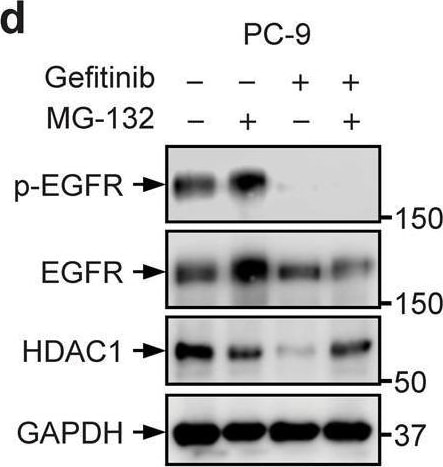
Detection of Human Phospho-EGFR (Y1173) by Western Blot
EGFR inhibition destabilizes HDAC1 protein by promoting its ubiquitination. A PC-9, A549 and H1975 cells were treated with the indicated dose of Gefitinib for 24 h and HDAC1 expression was assessed by Western blot analysis. b Quantification of HDAC1 expression following treatment with the indicated dose of Gefitinib. Graphed values indicate mean ± SEM, n = 4 for PC-9 cells or n = 3 for A549 and H1975 cells. c PC-9, A549 and H1975 cells were treated with 1 µM AG-1478 for 24 h. HDAC1 expression was assessed by Western blot. d PC-9 cells were treated with 1 μM Gefitinib for 24 h and 10 μM MG-132 4 h prior to collection and HDAC1 expression was assessed by Western blot analysis. e HEK293T cells were co-transfected with plasmids expressing HA-tagged ubiquitin and Flag-tagged HDAC1, and were treated with MG-132. Cell lysates were precipitated with an anti-Flag tag antibody and blotted with an anti-HA tag antibody. f HEK293T cells were co-transfected with plasmids expressing His6-tagged ubiquitin and Flag-tagged HDAC1, and were treated with MG-132. Cell lysates were subjected to pulldown with Ni-NTA agarose, and blotted with an antibody to Flag. g Myc-tagged EGFR and either Flag-tagged HDAC1 WT or Y72F mutant were co-expressed in HEK293T cells and were analyzed by Western blot. h HEK293T cells were transfected with plasmids expressing Flag-tagged HDAC1 WT or Y72F mutant. Cells were exposed to 100 µM cycloheximide (CHX) for up to 10 h. At every 2 h, cell lysates were collected and the expression of Flag-tagged HDAC1 was assessed. i Quantification of the expression of Flag-tagged HDAC1. Image collected and cropped by CiteAb from the following open publication (https://pubmed.ncbi.nlm.nih.gov/33976119), licensed under a CC-BY license. Not internally tested by R&D Systems.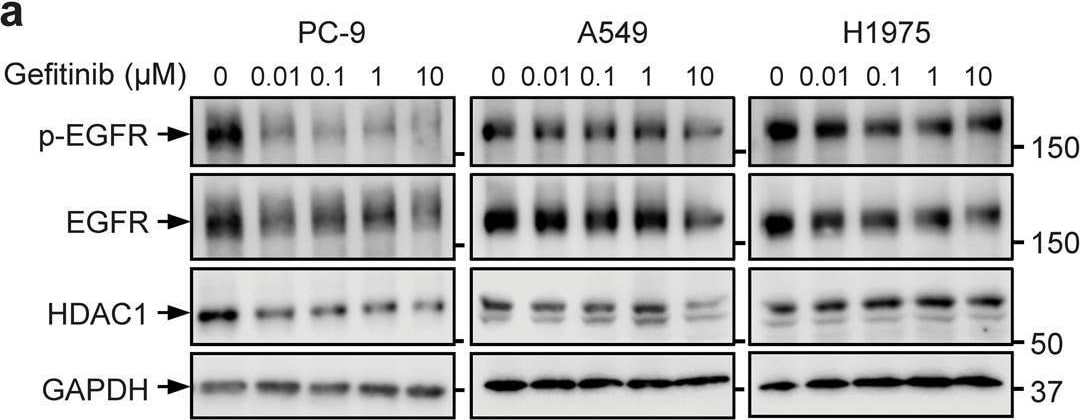
Detection of Human Phospho-EGFR (Y1173) by Western Blot
EGFR inhibition destabilizes HDAC1 protein by promoting its ubiquitination. A PC-9, A549 and H1975 cells were treated with the indicated dose of Gefitinib for 24 h and HDAC1 expression was assessed by Western blot analysis. b Quantification of HDAC1 expression following treatment with the indicated dose of Gefitinib. Graphed values indicate mean ± SEM, n = 4 for PC-9 cells or n = 3 for A549 and H1975 cells. c PC-9, A549 and H1975 cells were treated with 1 µM AG-1478 for 24 h. HDAC1 expression was assessed by Western blot. d PC-9 cells were treated with 1 μM Gefitinib for 24 h and 10 μM MG-132 4 h prior to collection and HDAC1 expression was assessed by Western blot analysis. e HEK293T cells were co-transfected with plasmids expressing HA-tagged ubiquitin and Flag-tagged HDAC1, and were treated with MG-132. Cell lysates were precipitated with an anti-Flag tag antibody and blotted with an anti-HA tag antibody. f HEK293T cells were co-transfected with plasmids expressing His6-tagged ubiquitin and Flag-tagged HDAC1, and were treated with MG-132. Cell lysates were subjected to pulldown with Ni-NTA agarose, and blotted with an antibody to Flag. g Myc-tagged EGFR and either Flag-tagged HDAC1 WT or Y72F mutant were co-expressed in HEK293T cells and were analyzed by Western blot. h HEK293T cells were transfected with plasmids expressing Flag-tagged HDAC1 WT or Y72F mutant. Cells were exposed to 100 µM cycloheximide (CHX) for up to 10 h. At every 2 h, cell lysates were collected and the expression of Flag-tagged HDAC1 was assessed. i Quantification of the expression of Flag-tagged HDAC1. Image collected and cropped by CiteAb from the following open publication (https://pubmed.ncbi.nlm.nih.gov/33976119), licensed under a CC-BY license. Not internally tested by R&D Systems.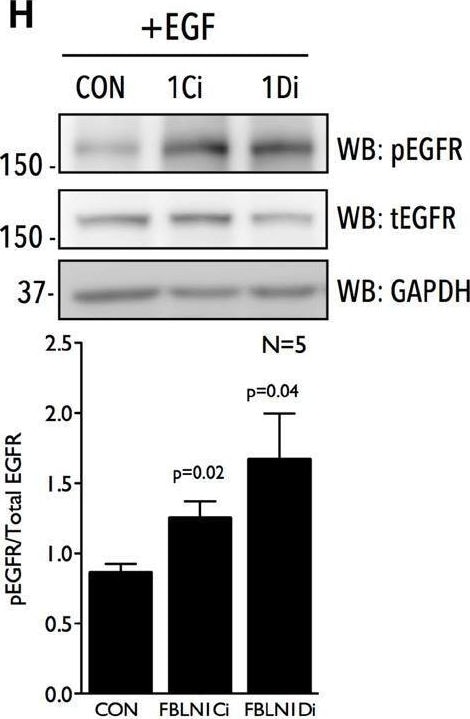
Detection of Phospho-EGFR (Y1173) by Western Blot
Fibulin-1 is a negative regulator of EGFR activation and function in Calu-1 cells. (G–I) Western blot detection of EGFR phosphorylated on tyrosine1173 (WB: pEGFR), total EGFR (WB: tEGFR), and GAPDH (WB: GAPDH) in lysates from Calu-1 cells (G) in the presence of serum growth factors (5% FBS), (H) on stimulation with EGF (100 ng/ml) for 5 min (+EGF) in serum deprived control (CON), FBLN1C (1Ci), FBLN1D (1Di) knockdown cells and (I) in the presence of serum growth factors (5% FBS) in Calu-1 cells overexpressing untagged FBLN1C or FBLN1D. Overexpression of Fibulin-1C (+FBLN1C) and Fibulin-1D (+FBLN1D) was confirmed by western blot (WB: FBLN1). Arrows mark the position of FBLN1C and FBLN1D isoforms in the representative blots. (G–I) Bar graphs represents mean ± SE of pEGFR to total EGFR ratio from 3 to 5 independent experiments as indicated in each graph. Statistical analysis of the data was done using the students t-test and p values are as shown. (J) Representative images of wound healing assay done in the presence of serum growth factor (5% FBS) in Control (CON) vs. FBLN1C (1Ci) vs. FBLN1D (1Di) knockdown Calu-1 cells at 0 h and 36 h in the presence of DMSO or 10 μM Erlotinib. Images were analyzed using T-Scratch software and the percent closed wound area calculated. Graph represents mean ± SE from four independent experiments. Statistical analysis of the data was done using two-way ANOVA and p values are as shown. Image collected and cropped by CiteAb from the following open publication (https://pubmed.ncbi.nlm.nih.gov/32719793), licensed under a CC-BY license. Not internally tested by R&D Systems.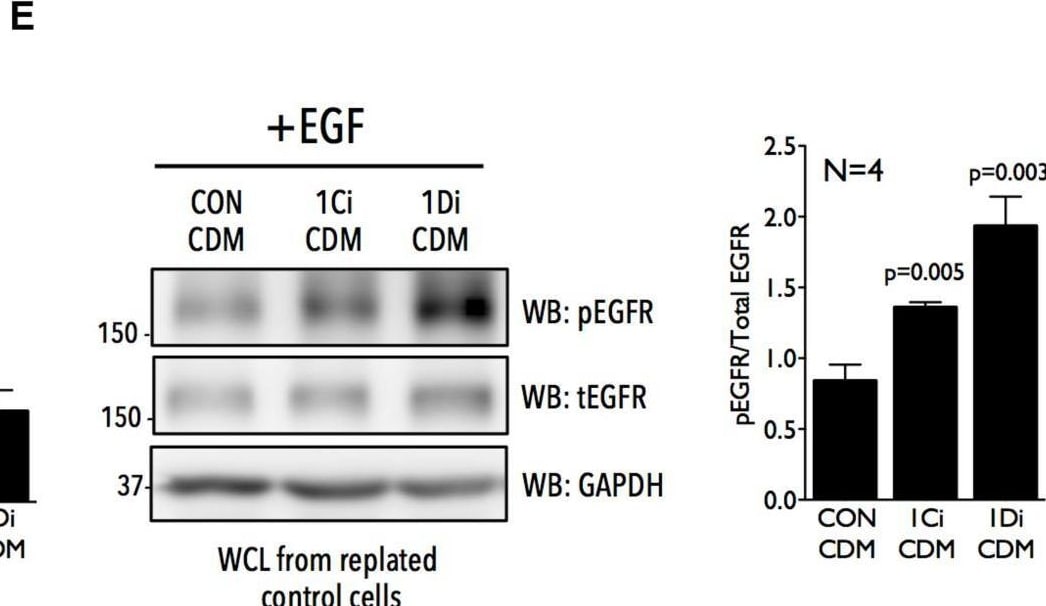
Detection of Phospho-EGFR (Y1173) by Western Blot
Matrix Fibulin-1 regulates EGF dependent EGFR activation in Calu-1. (A) Endogenous Fibulin-1 (WB: FBLN1) & GAPDH (WB: GAPDH) detected by WB in cell derived matrix (CDM before replating) made from control (CON), FBLN1C (1Ci) & FBLN1D (1Di) knockdown Calu-1, grown with serum (5% FBS) for 72 h. Calu-1 replated on this CDM & grown for 18 h with serum [+18 h (5% FBS)] & levels of Fibulin-1 (WB: FBLN1) & GAPDH (WB: GAPDH) detected by WB in cell derived matrix (CDM after replating) & compared to those seen in CDM before replating. FBLN1C & FBLN1D isoforms detected in blots of knockdown lysates are marked by arrows. Blot is best representative of three independent experiments that gave similar results. (B) Representative individual migration tracks of Calu-1 adherent in the presence of serum growth factors (5% FBS) on CDM (made as detailed above) from control (CON-CDM), FBLN1C (1Ci-CDM), & FBLN1D (1Di-CDM) knockdown Calu-1. (C) Accumulated distance, euclidean distance, velocity & directionality of 100 migrating (per experiment) & represented in the bar graphs as mean ± SE from eight independent experiments. p values calculated using one-way ANOVA & Tukey’s post hoc test & represented if found to be significant. (D,E) WB detection of EGFR phosphorylated on tyrosine 1173 (WB: pEGFR), total EGFR (WB: tEGFR) & GAPDH (WB: GAPDH) in Calu-1 plated on CDM (made as detailed above) from control (CON-CDM), FBLN1C (1Ci-CDM) & FBLN1D (1Di-CDM) knockdown (D) in the presence of serum growth factors (5% FBS) (E) on stimulation with EGF (100 ng/ml) for 5 min (+EGF) in serum deprived Calu-1. Bar graphs represents mean ± SE of pEGFR to total EGFR ratio from 3 or 4 independent experiments as indicated. Statistical analysis of the data was done using the students t-test & p values are as shown. Image collected & cropped by CiteAb from the following open publication (https://pubmed.ncbi.nlm.nih.gov/32719793), licensed under a CC-BY license. Not internally tested by R&D Systems.Applications for Human phospho-EGFR (Y1173) Antibody
CyTOF-ready
Immunocytochemistry
Sample: Immersion fixed A431 human epithelial carcinoma cell line treated with pervanadate
Immunohistochemistry
Sample: Immersion fixed frozen sections of mouse embryo (E13.5-15.5) and human lung cancer
Intracellular Staining by Flow Cytometry
Sample: A431 human epithelial carcinoma cell line treated with Recombinant Human EGF (Catalog # 236-EG), fixed with paraformaldehyde, and permeabilized with saponin
Simple Western
Sample: A431 human epithelial carcinoma cell line treated with Recombinant Human EGF (Catalog # 236-EG)
Western Blot
Sample: Pervanadate-treated A431 human epithelial carcinoma cell line
Flow Cytometry Panel Builder
Bio-Techne Knows Flow Cytometry
Save time and reduce costly mistakes by quickly finding compatible reagents using the Panel Builder Tool.
Advanced Features
- Spectra Viewer - Custom analysis of spectra from multiple fluorochromes
- Spillover Popups - Visualize the spectra of individual fluorochromes
- Antigen Density Selector - Match fluorochrome brightness with antigen density

Formulation, Preparation, and Storage
Purification
Reconstitution
Reconstitute at 0.2 mg/mL in sterile PBS. For liquid material, refer to CoA for concentration.
Formulation
Shipping
Stability & Storage
- 12 months from date of receipt, -20 to -70 °C as supplied.
- 1 month, 2 to 8 °C under sterile conditions after reconstitution.
- 6 months, -20 to -70 °C under sterile conditions after reconstitution.
Calculators
Background: EGFR
Long Name
Alternate Names
Gene Symbol
Additional EGFR Products
Product Documents for Human phospho-EGFR (Y1173) Antibody
Certificate of Analysis
To download a Certificate of Analysis, please enter a lot or batch number in the search box below.
Note: Certificate of Analysis not available for kit components.
Product Specific Notices for Human phospho-EGFR (Y1173) Antibody
For research use only
Related Research Areas
Citations for Human phospho-EGFR (Y1173) Antibody
 Powered by Bioz
Customer Reviews for Human phospho-EGFR (Y1173) Antibody
There are currently no reviews for this product. Be the first to review Human phospho-EGFR (Y1173) Antibody and earn rewards!
Have you used Human phospho-EGFR (Y1173) Antibody?
Submit a review and receive an Amazon gift card!
$25/€18/£15/$25CAN/¥2500 for a review with an image
$10/€7/£6/$10CAN/¥1110 for a review without an image
Submit a review
Protocols
Find general support by application which include: protocols, troubleshooting, illustrated assays, videos and webinars.
- 7-Amino Actinomycin D (7-AAD) Cell Viability Flow Cytometry Protocol
- Antigen Retrieval Protocol (PIER)
- Antigen Retrieval for Frozen Sections Protocol
- Appropriate Fixation of IHC/ICC Samples
- Cellular Response to Hypoxia Protocols
- Chromogenic IHC Staining of Formalin-Fixed Paraffin-Embedded (FFPE) Tissue Protocol
- Chromogenic Immunohistochemistry Staining of Frozen Tissue
- ClariTSA™ Fluorophore Kits
- Detection & Visualization of Antibody Binding
- Extracellular Membrane Flow Cytometry Protocol
- Flow Cytometry Protocol for Cell Surface Markers
- Flow Cytometry Protocol for Staining Membrane Associated Proteins
- Flow Cytometry Staining Protocols
- Flow Cytometry Troubleshooting Guide
- Fluorescent IHC Staining of Frozen Tissue Protocol
- Graphic Protocol for Heat-induced Epitope Retrieval
- Graphic Protocol for the Preparation and Fluorescent IHC Staining of Frozen Tissue Sections
- Graphic Protocol for the Preparation and Fluorescent IHC Staining of Paraffin-embedded Tissue Sections
- Graphic Protocol for the Preparation of Gelatin-coated Slides for Histological Tissue Sections
- ICC Cell Smear Protocol for Suspension Cells
- ICC Immunocytochemistry Protocol Videos
- ICC for Adherent Cells
- IHC Sample Preparation (Frozen sections vs Paraffin)
- Immunocytochemistry (ICC) Protocol
- Immunocytochemistry Troubleshooting
- Immunofluorescence of Organoids Embedded in Cultrex Basement Membrane Extract
- Immunofluorescent IHC Staining of Formalin-Fixed Paraffin-Embedded (FFPE) Tissue Protocol
- Immunohistochemistry (IHC) and Immunocytochemistry (ICC) Protocols
- Immunohistochemistry Frozen Troubleshooting
- Immunohistochemistry Paraffin Troubleshooting
- Intracellular Flow Cytometry Protocol Using Alcohol (Methanol)
- Intracellular Flow Cytometry Protocol Using Detergents
- Intracellular Nuclear Staining Flow Cytometry Protocol Using Detergents
- Intracellular Staining Flow Cytometry Protocol Using Alcohol Permeabilization
- Intracellular Staining Flow Cytometry Protocol Using Detergents to Permeabilize Cells
- Preparing Samples for IHC/ICC Experiments
- Preventing Non-Specific Staining (Non-Specific Binding)
- Primary Antibody Selection & Optimization
- Propidium Iodide Cell Viability Flow Cytometry Protocol
- Protocol for Heat-Induced Epitope Retrieval (HIER)
- Protocol for Liperfluo
- Protocol for Making a 4% Formaldehyde Solution in PBS
- Protocol for VisUCyte™ HRP Polymer Detection Reagent
- Protocol for the Characterization of Human Th22 Cells
- Protocol for the Characterization of Human Th9 Cells
- Protocol for the Fluorescent ICC Staining of Cell Smears - Graphic
- Protocol for the Fluorescent ICC Staining of Cultured Cells on Coverslips - Graphic
- Protocol for the Preparation & Fixation of Cells on Coverslips
- Protocol for the Preparation and Chromogenic IHC Staining of Frozen Tissue Sections
- Protocol for the Preparation and Chromogenic IHC Staining of Frozen Tissue Sections - Graphic
- Protocol for the Preparation and Chromogenic IHC Staining of Paraffin-embedded Tissue Sections
- Protocol for the Preparation and Chromogenic IHC Staining of Paraffin-embedded Tissue Sections - Graphic
- Protocol for the Preparation and Fluorescent ICC Staining of Cells on Coverslips
- Protocol for the Preparation and Fluorescent ICC Staining of Non-adherent Cells
- Protocol for the Preparation and Fluorescent ICC Staining of Stem Cells on Coverslips
- Protocol for the Preparation and Fluorescent IHC Staining of Frozen Tissue Sections
- Protocol for the Preparation and Fluorescent IHC Staining of Paraffin-embedded Tissue Sections
- Protocol for the Preparation of Gelatin-coated Slides for Histological Tissue Sections
- Protocol for the Preparation of a Cell Smear for Non-adherent Cell ICC - Graphic
- Protocol: Annexin V and PI Staining by Flow Cytometry
- Protocol: Annexin V and PI Staining for Apoptosis by Flow Cytometry
- R&D Systems Quality Control Western Blot Protocol
- TUNEL and Active Caspase-3 Detection by IHC/ICC Protocol
- The Importance of IHC/ICC Controls
- Troubleshooting Guide: Fluorokine Flow Cytometry Kits
- Troubleshooting Guide: Immunohistochemistry
- Troubleshooting Guide: Western Blot Figures
- Western Blot Conditions
- Western Blot Protocol
- Western Blot Protocol for Cell Lysates
- Western Blot Troubleshooting
- Western Blot Troubleshooting Guide
- View all Protocols, Troubleshooting, Illustrated assays and Webinars
Associated Pathways


