
Protein Tyrosine Phoshatase Receptor-type sigma (PTPR sigma ), also known as PTP sigma, is an integral membrane protein with a non-glycosylated molecular weight of 214 kilodaltons. The extracellular domain, which was used as immunogen, is cleaved near the cell membrane by an endoprotease to generate a glycated 140 kDa protein. Significant levels of this protein are found in the brain and in endocrine tissues such as the pituitary gland and pancreas. Knockout mice deficient in PTPR sigma have severe neurological deficits and most die shortly after birth.
Human PTP sigma/PTPRS Antibody
R&D Systems | Catalog # AF3430


Scientific images may be resized, cropped, or adjusted for brightness or contrast for presentation purposes. These updates are limited to presentation and do not affect the underlying scientific interpretation of the data. Where available, additional source data may be provided upon request.
Key Product Details
Species Reactivity
Validated:
Human
Cited:
Human, Mouse, Rat, Chicken
Applications
Validated:
Western Blot, Immunocytochemistry
Cited:
Immunohistochemistry, Western Blot, Flow Cytometry, Immunocytochemistry, Immunoprecipitation
Label
Unconjugated
Antibody Source
Polyclonal Goat IgG
Loading...
Product Specifications
Immunogen
Mouse myeloma cell line NS0-derived recombinant human PTP sigma /PTPRS
Glu30-Gly1260
Accession # NP_570924
Glu30-Gly1260
Accession # NP_570924
Specificity
Detects the endogenous cleaved extracellular domain of human PTP sigma /PTPRS in Western blots. In Western blots, less than 1% cross-reactivity with recombinant human LAR, PTPR beta, PTPR delta, PTPRµ, or PTPR kappa is observed.
Clonality
Polyclonal
Host
Goat
Isotype
IgG
Scientific Data Images for Human PTP sigma/PTPRS Antibody
Detection of Human PTP sigma /PTPRS by Western Blot.
Western blot shows lysates of SH-SY5Y human neuroblastoma cell line, CHP-100 human neuroblastoma cell line, and A431 human epithelial carcinoma cell line. PVDF membrane was probed with 1 µg/mL Goat Anti-Human PTP sigma/PTPRS Antigen Affinity-purified Polyclonal Antibody (Catalog # AF3430) followed by HRP-conjugated Anti-Goat IgG Secondary Antibody (Catalog # HAF109). For additional reference, recombinant human PTPR mu, PTPR kappa, LAR, PTPR sigma, PTPR delta, and PTPR beta (40 ng/lane) were included. A specific band for PTP sigma/PTPRS was detected at approximately 140 kDa (as indicated). This experiment was conducted under reducing conditions and using Immunoblot Buffer Group 1.
PTP sigma /PTPRS in A431 Cell Line.
PTPs/PTPRS was detected in immersion fixed A431 human epithelial carcinoma cell line using Goat Anti-Human PTPs/PTPRS Antigen Affinity-purified Polyclonal Antibody (Catalog # AF3430) at 10 µg/mL for 3 hours at room temperature. Cells were stained using the NorthernLights™ 557-conjugated Anti-Goat IgG Secondary Antibody (red; Catalog # NL001) and counterstained with DAPI(blue). Specific staining was localized to cytoplasm. View our protocol for Fluorescent ICC Staining of Cells on Coverslips.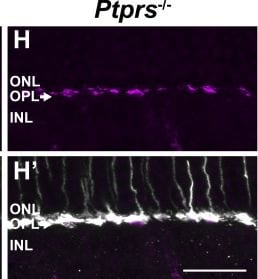
Detection of PTPR sigma by Immunohistochemistry
GRIK1 localization in WT, FAT3, and PTP sigma mutant retinas. (A) Immunostaining for GRIK1 (magenta) in the OPL region of WT retinal sections. (B) Immunostaining for GRIK1 (magenta) in Fat3∆TM/∆TM retinal sections. (A′ and B′) Cone arrestin (ARR3) (white) labels the cone photoreceptor axonal endings in the OPL in A′ and B′. (C) Quantification of GRIK1 integrated intensity in the OPL. WT Controls: 1.00 ± 0.06 (n = 13 animals, 60 retinal regions); Fat3∆TM/∆TM: 0.56 ± 0.04 (n = 12 animals, 54 retinal regions). Each data point corresponds to a retinal region, color-coded by animal, nested two-tailed test. Error bar: SEM. (D) Immunostaining for GRIK1 (magenta) in the OPL region of WT retinal sections. (E) Immunostaining for GRIK1 (magenta) in the OPL region of Fat3∆ICD-GFP/∆ICD-GFP retinal sections. (D′ and E′) Cone arrestin (ARR3) (white) labels the cone photoreceptor endings in the OPL in D′ and E′. (F) Quantification of GRIK1 integrated intensity in the OPL. WT Controls: 1.00 ± 0.04 (n = 8 animals, 32 retinal regions); Fat3∆ICD/∆ICD: 0.75 ± 0.04 (n = 8 animals, 32 retinal regions). Each data point corresponds to a retinal region, color-coded by animal, nested two-tailed test. Error bar: SEM. (G) Immunostaining for GRIK1 (magenta) in the OPL region of WT retinal sections. (H) Immunostaining for GRIK1 (magenta) in Ptprs−/− retinal sections. (G′ and H′) Cone arrestin (ARR3) (white) labels the cone photoreceptor endings in the OPL in G′ and H′. (I) Quantification of GRIK1 integrated intensity in the OPL. WT Controls: 1.00 ± 0.06 (n = 6 animals, 30 retinal regions); Ptprs−/−: 0.66 ± 0.04 (n = 6 animals, 30 retinal regions). Each data point corresponds to a retinal region, color-coded by animal, nested two-tailed test. Error bar: SEM. Scale bars: 20 µm. Image collected and cropped by CiteAb from the following open publication (https://pubmed.ncbi.nlm.nih.gov/39903280), licensed under a CC-BY license. Not internally tested by R&D Systems.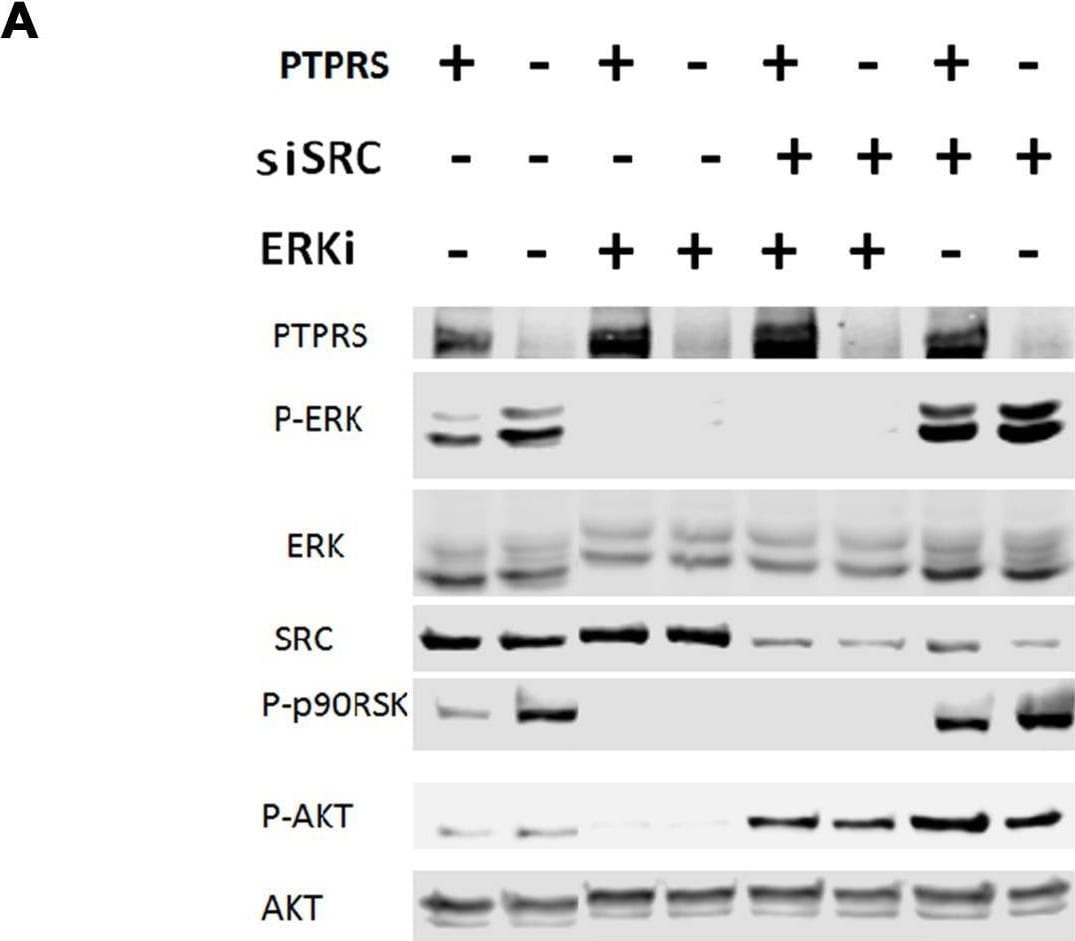
Detection of PTPR sigma by Western Blot
siRNA knockdown of SRC increased apoptotic response to ERK inhibition.HCT116 PTPRS KO and parental cells + PTPRS were treated with siRNA to SRC for 24 hours and then incubated with an ERKi for 48 hours. (A) Western analysis: Parental control cells (+PTPRS) treated with control siRNA (–), ERKi (SCH772984), siRNA to SRC (+), and a combination of SRC siRNA and ERKi; PTPRS KO (-PTPRS) cells were given the same treatments respectively. In the figure the two control lanes on the left were taken from the right end of this original blot and moved to conform to Figure 6 and for ease of understanding. The experiment was performed in triplicate for quantitative densitometry analysis see Supplementary Figure 6. (B) Annexin V apoptosis assays for these treatments revealed that the siRNA knockdown of SRC in combination with ERKi treatment in cells containing PTPRS caused the same amount of apoptosis as the ERKi in PTPRS KO cells. “116Ctl” represent parental cells + PTPRS, 116KO are HCT116 with PTPRS knockout cells, siC is siRNA scrambled control RNA, NT = not treated and ERKi = SCH 772984. The addition of the SRC siRNA 24 hours before a 48-hour ERK inhibition of the PTPRS KO cells did not enhance apoptosis (lane 6 compared to lane 8). The paired, two-tailed t test was performed for comparisons. NS – not significant; **p < 0.01. Image collected and cropped by CiteAb from the following open publication (https://pubmed.ncbi.nlm.nih.gov/31827720), licensed under a CC-BY license. Not internally tested by R&D Systems.Applications for Human PTP sigma/PTPRS Antibody
Application
Recommended Usage
Immunocytochemistry
5-15 µg/mL
Sample: Immersion fixed A431 human epithelial carcinoma cell line
Sample: Immersion fixed A431 human epithelial carcinoma cell line
Western Blot
1 µg/mL
Sample: SH-SY5Y human neuroblastoma cell line, CHP-100 human neuroblastoma cell line, and A431 human epithelial carcinoma cell line
Sample: SH-SY5Y human neuroblastoma cell line, CHP-100 human neuroblastoma cell line, and A431 human epithelial carcinoma cell line
Formulation, Preparation, and Storage
Purification
Antigen Affinity-purified
Reconstitution
Reconstitute at 0.2 mg/mL in sterile PBS. For liquid material, refer to CoA for concentration.
Loading...
Formulation
Lyophilized from a 0.2 μm filtered solution in PBS with Trehalose. *Small pack size (SP) is supplied either lyophilized or as a 0.2 µm filtered solution in PBS.
Shipping
Lyophilized product is shipped at ambient temperature. Liquid small pack size (-SP) is shipped with polar packs. Upon receipt, store immediately at the temperature recommended below.
Stability & Storage
Use a manual defrost freezer and avoid repeated freeze-thaw cycles.
- 12 months from date of receipt, -20 to -70 °C as supplied.
- 1 month, 2 to 8 °C under sterile conditions after reconstitution.
- 6 months, -20 to -70 °C under sterile conditions after reconstitution.
Calculators
Background: PTP sigma/PTPRS
Long Name
Protein Tyrosine Phosphatase Receptor-type Sigma
Alternate Names
PTPR sigma, PTPRS
Gene Symbol
PTPRS
UniProt
Additional PTP sigma/PTPRS Products
Product Documents for Human PTP sigma/PTPRS Antibody
Certificate of Analysis
To download a Certificate of Analysis, please enter a lot or batch number in the search box below.
Note: Certificate of Analysis not available for kit components.
Product Specific Notices for Human PTP sigma/PTPRS Antibody
For research use only
Related Research Areas
Citations for Human PTP sigma/PTPRS Antibody
 Powered by Bioz
Customer Reviews for Human PTP sigma/PTPRS Antibody
There are currently no reviews for this product. Be the first to review Human PTP sigma/PTPRS Antibody and earn rewards!
Have you used Human PTP sigma/PTPRS Antibody?
Submit a review and receive an Amazon gift card!
$25/€18/£15/$25CAN/¥2500 for a review with an image
$10/€7/£6/$10CAN/¥1110 for a review without an image
Submit a review
Protocols
Find general support by application which include: protocols, troubleshooting, illustrated assays, videos and webinars.
- Appropriate Fixation of IHC/ICC Samples
- Cellular Response to Hypoxia Protocols
- ClariTSA™ Fluorophore Kits
- Detection & Visualization of Antibody Binding
- ICC Cell Smear Protocol for Suspension Cells
- ICC Immunocytochemistry Protocol Videos
- ICC for Adherent Cells
- Immunocytochemistry (ICC) Protocol
- Immunocytochemistry Troubleshooting
- Immunofluorescence of Organoids Embedded in Cultrex Basement Membrane Extract
- Immunohistochemistry (IHC) and Immunocytochemistry (ICC) Protocols
- Preparing Samples for IHC/ICC Experiments
- Preventing Non-Specific Staining (Non-Specific Binding)
- Primary Antibody Selection & Optimization
- Protocol for VisUCyte™ HRP Polymer Detection Reagent
- Protocol for the Fluorescent ICC Staining of Cell Smears - Graphic
- Protocol for the Fluorescent ICC Staining of Cultured Cells on Coverslips - Graphic
- Protocol for the Preparation and Fluorescent ICC Staining of Cells on Coverslips
- Protocol for the Preparation and Fluorescent ICC Staining of Non-adherent Cells
- Protocol for the Preparation and Fluorescent ICC Staining of Stem Cells on Coverslips
- Protocol for the Preparation of a Cell Smear for Non-adherent Cell ICC - Graphic
- R&D Systems Quality Control Western Blot Protocol
- TUNEL and Active Caspase-3 Detection by IHC/ICC Protocol
- The Importance of IHC/ICC Controls
- Troubleshooting Guide: Western Blot Figures
- Western Blot Conditions
- Western Blot Protocol
- Western Blot Protocol for Cell Lysates
- Western Blot Troubleshooting
- Western Blot Troubleshooting Guide
- View all Protocols, Troubleshooting, Illustrated assays and Webinars
Loading...