
Siglecs (sialic acid binding Ig-like lectins) are I-type lectins that belong to the immunoglobulin superfamily. They are characterized by an N‑terminal Ig-like V-set domain which mediates sialic acid binding, followed by a varying numbers of Ig-like C2-set domains. Siglecs‑3 and 5‑13 constitute the CD33/Siglec-3 related group, which are defined by their sequence homology and differential expression in the ematopoietic system (1‑3). Mature human Siglec-11 consists of a 534 amino acid (aa) extracellular domain (ECD), a 23 aa transmembrane segment, and a 114 aa cytoplasmic domain. The ECD contains one Ig-like V-set domain, and three Ig-like C2-set domains. The cytoplasmic domain contains two immunoreceptor tyrosine-based inhibitory motifs (ITIMs) (4). A splice variant of Siglec-11 has a deletion of nearly 100 aa in the extracellular juxtamembrane region. Among siglecs, the ECD of Siglec-11 is most closely related to that of Siglec-10 (82% aa sequence identity). The cytoplasmic domains of these proteins are only 20% identical. Siglec-11 is closely related to the pseudogenes Siglec-14 and Siglec-16 (4, 5). Human Siglec-11 shares 90%‑96% aa sequence identity with Siglec-11 from great apes. Rodent orthologs of Siglec-11 have not been identified. In human, Siglec-11 is expressed in tissue macrophages, brain microglia, and inflammatory site monocytes (4). Strong microglial expression is specific to humans, as it is less prominent or absent in chimpanzees and orangutans (5). Siglec-11 forms 180 kDa disulfide-linked dimers. It shows a strong binding preference for sialic acid in alpha 2-8 linkage which is unusual for siglecs (4). A conserved arginine in the Ig-like V-set domain only partially contributes to Siglec-11 ligand recognition, in contrast to its being required in other siglecs (4). Tyrosine phosphorylation of the cytoplasmic region of Siglec-11 promotes association with the phosphatases SHP-1 and SHP-2 (4).

Scientific images may be resized, cropped, or adjusted for brightness or contrast for presentation purposes. These updates are limited to presentation and do not affect the underlying scientific interpretation of the data. Where available, additional source data may be provided upon request.
Key Product Details
Species Reactivity
Applications
Label
Antibody Source
Product Specifications
Immunogen
Asn17-His543 (Glu84Ala, Lys145Gln)
Accession # Q96RL6
Specificity
Clonality
Host
Isotype
Scientific Data Images for Human Siglec-11 Antibody
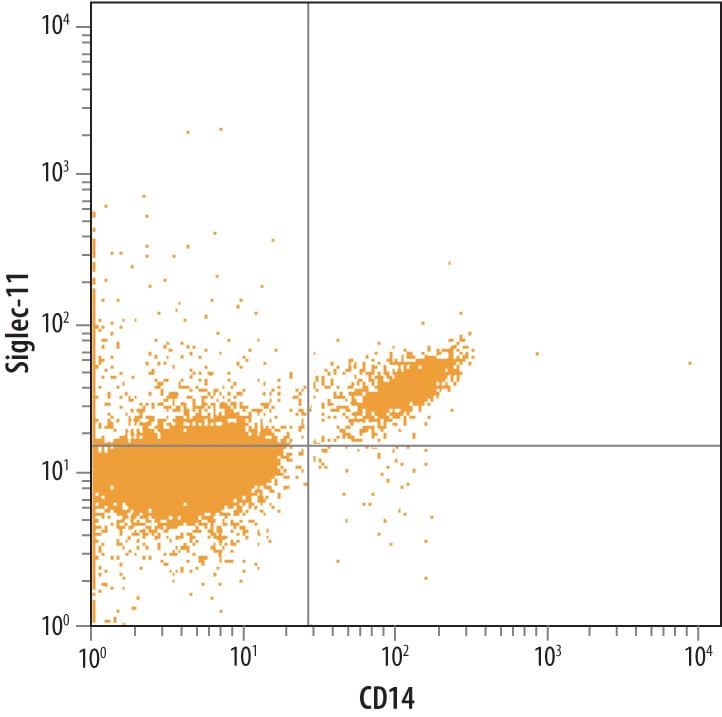
Detection of Siglec‑11 in Human PBMCs by Flow Cytometry.
Human peripheral blood monocytes (PBMC) were labeled with Goat Anti-Human Siglec-11 Antigen Affinity-purified Polyclonal Antibody (Catalog # AF3258) followed by Phycoerythrin-conjugated Anti-Goat IgG Secondary Antibody (Catalog # F0107) and Human CD14 APC-conjugated Monoclonal Antibody (Catalog # FAB3832A). Quadrant markers were set based on control antibody staining (Catalog # AB-108-C).Applications for Human Siglec-11 Antibody
Blockade of Receptor-ligand Interaction
CyTOF-ready
Flow Cytometry
Sample: Human peripheral blood monocytes
Western Blot
Sample: Recombinant Human Siglec‑11 Fc Chimera (Catalog # 3258-SL)
Flow Cytometry Panel Builder
Bio-Techne Knows Flow Cytometry
Save time and reduce costly mistakes by quickly finding compatible reagents using the Panel Builder Tool.
Advanced Features
- Spectra Viewer - Custom analysis of spectra from multiple fluorochromes
- Spillover Popups - Visualize the spectra of individual fluorochromes
- Antigen Density Selector - Match fluorochrome brightness with antigen density

Formulation, Preparation, and Storage
Purification
Reconstitution
Reconstitute at 0.2 mg/mL in sterile PBS. For liquid material, refer to CoA for concentration.
Formulation
Shipping
Stability & Storage
- 12 months from date of receipt, -20 to -70 °C as supplied.
- 1 month, 2 to 8 °C under sterile conditions after reconstitution.
- 6 months, -20 to -70 °C under sterile conditions after reconstitution.
Calculators
Background: Siglec-11
References
- Varki, A. and T. Angata (2006) Glycobiology 16:1R.
- Crocker, P.R. (2005) Curr. Opin. Pharmacol. 5:431.
- Crocker, P.R. (2002) Curr. Opin. Struct. Biol. 12:609.
- Angata, T. et al. (2002) J. Biol. Chem. 277:24466.
- Hayakawa, T. et al. (2005) Science 309:1693.
Long Name
Alternate Names
Entrez Gene IDs
Gene Symbol
UniProt
Additional Siglec-11 Products
Product Documents for Human Siglec-11 Antibody
Certificate of Analysis
To download a Certificate of Analysis, please enter a lot or batch number in the search box below.
Note: Certificate of Analysis not available for kit components.
Product Specific Notices for Human Siglec-11 Antibody
For research use only
Customer Reviews for Human Siglec-11 Antibody
There are currently no reviews for this product. Be the first to review Human Siglec-11 Antibody and earn rewards!
Have you used Human Siglec-11 Antibody?
Submit a review and receive an Amazon gift card!
$25/€18/£15/$25CAN/¥2500 for a review with an image
$10/€7/£6/$10CAN/¥1110 for a review without an image
Submit a review
Protocols
Find general support by application which include: protocols, troubleshooting, illustrated assays, videos and webinars.
- 7-Amino Actinomycin D (7-AAD) Cell Viability Flow Cytometry Protocol
- Cellular Response to Hypoxia Protocols
- Extracellular Membrane Flow Cytometry Protocol
- Flow Cytometry Protocol for Cell Surface Markers
- Flow Cytometry Protocol for Staining Membrane Associated Proteins
- Flow Cytometry Staining Protocols
- Flow Cytometry Troubleshooting Guide
- Intracellular Flow Cytometry Protocol Using Alcohol (Methanol)
- Intracellular Flow Cytometry Protocol Using Detergents
- Intracellular Nuclear Staining Flow Cytometry Protocol Using Detergents
- Intracellular Staining Flow Cytometry Protocol Using Alcohol Permeabilization
- Intracellular Staining Flow Cytometry Protocol Using Detergents to Permeabilize Cells
- Propidium Iodide Cell Viability Flow Cytometry Protocol
- Protocol for Liperfluo
- Protocol for the Characterization of Human Th22 Cells
- Protocol for the Characterization of Human Th9 Cells
- Protocol: Annexin V and PI Staining by Flow Cytometry
- Protocol: Annexin V and PI Staining for Apoptosis by Flow Cytometry
- R&D Systems Quality Control Western Blot Protocol
- Troubleshooting Guide: Fluorokine Flow Cytometry Kits
- Troubleshooting Guide: Western Blot Figures
- Western Blot Conditions
- Western Blot Protocol
- Western Blot Protocol for Cell Lysates
- Western Blot Troubleshooting
- Western Blot Troubleshooting Guide
- View all Protocols, Troubleshooting, Illustrated assays and Webinars