
Human STAT2 Antibody
R&D Systems | Catalog # PAF-ST2

Scientific images may be resized, cropped, or adjusted for brightness or contrast for presentation purposes. These updates are limited to presentation and do not affect the underlying scientific interpretation of the data. Where available, additional source data may be provided upon request.
Key Product Details
Validated by
Species Reactivity
Validated:
Cited:
Applications
Validated:
Cited:
Label
Antibody Source
Product Specifications
Immunogen
Gln679-Phe851
Accession # P52630
Specificity
Clonality
Host
Isotype
Scientific Data Images for Human STAT2 Antibody
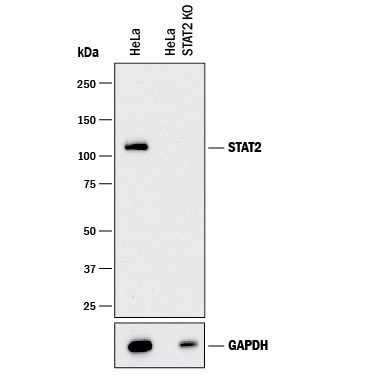
Western Blot Shows Human STAT2 Specificity by Using Knockout Cell Line.
Western blot shows lysates of HeLa human cervical epithelial carcinoma parental cell line and STAT2 knockout HeLa cell line (KO). PVDF membrane was probed with 0.5 µg/mL of Goat Anti-Human STAT2 Antigen Affinity-purified Polyclonal Antibody (Catalog # PAF-ST2) followed by HRP-conjugated Anti-Goat IgG Secondary Antibody (Catalog # HAF017). A specific band was detected for STAT2 at approximately 110 kDa (as indicated) in the parental HeLa cell line, but is not detectable in knockout HeLa cell line. GAPDH (Catalog # AF5718) is shown as a loading control. This experiment was conducted under reducing conditions and using Immunoblot Buffer Group 1.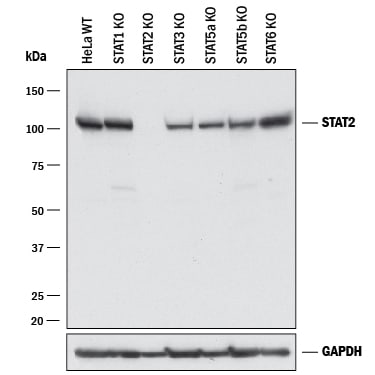
Western Blot Shows Human STAT2 Specificity by Using Knockout Cell Line.
Western blot shows lysates of HeLa human cervical epithelial carcinoma parental cell line, STAT1 knockout (KO) HeLa cell line, STAT2 KO HeLa cell line, STAT3 KO HeLa cell line, STAT5a KO HeLa cell line, STAT5b KO HeLa cell line, and STAT6 KO HeLa cell line. PVDF membrane was probed with 0.5 µg/mL of Goat Anti-Human STAT2 Antigen Affinity-purified Polyclonal Antibody (Catalog # PAF-ST2) followed by HRP-conjugated Anti-Goat IgG Secondary Antibody (Catalog # HAF017). A specific band was detected for STAT2 at approximately 110 kDa (as indicated) in the parental HeLa cell line, but is not detectable in knockout HeLa cell line. GAPDH (Catalog # AF5718) is shown as a loading control. This experiment was conducted under reducing conditions and using Immunoblot Buffer Group 1.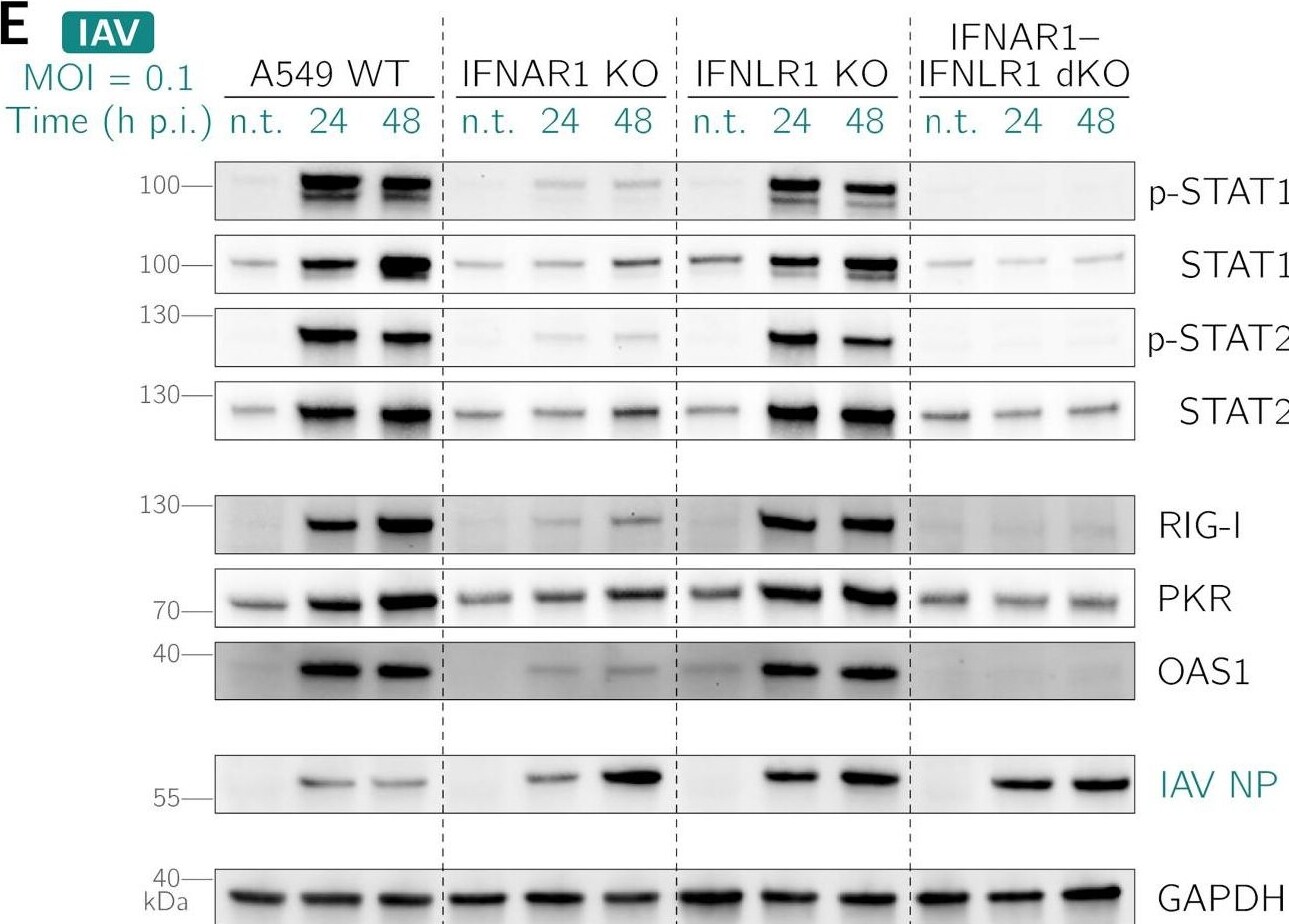
Detection of STAT2 by Western Blot
IFN-beta and IFN-lambda mediate STAT1 and STAT2 activation upon RSV and IAV infection in A549 cells. (A and B) ELISA for IFN-beta following RSV (A) and IAV (B) infection at MOIs of 0.1 and 1. Open circles mark data points with cytokine concentrations below the detection range. Error bars are standard deviations (SD) from technical replicates. (C) IFN-beta (green) (left) and activation of STAT1 (yellow) (right) and IRF3 (red) 24 h after infection of A549 WT cells with RSV (magenta, polyclonal anti-RSV antibody) at an MOI of 0.01. White dotted lines are nuclear outlines determined based on DAPI counterstaining (channel not shown). Bars, 50 μm. (D and E) Activation of STAT1, STAT2, and interferon-stimulated genes (RIG-I, PKR, and OAS1) upon RSV (D) and IAV infection (E) at an MOI of 0.1 at 24 and 48 h postinfection (p.i.) in A549 WT, IFNAR1 KO, IFNLR1 KO, and IFNAR1-IFNLR1 dKO cells. n.t. indicates nontreated cells. Activated STATs p-STAT1 and p-STAT2 are STAT1 and STAT2 phosphorylated at Tyr701 and Tyr690, respectively. RSV F, RSV fusion glycoprotein; IAV NP, IAV nucleoprotein. Image collected and cropped by CiteAb from the following open publication (https://pubmed.ncbi.nlm.nih.gov/36326278), licensed under a CC-BY license. Not internally tested by R&D Systems.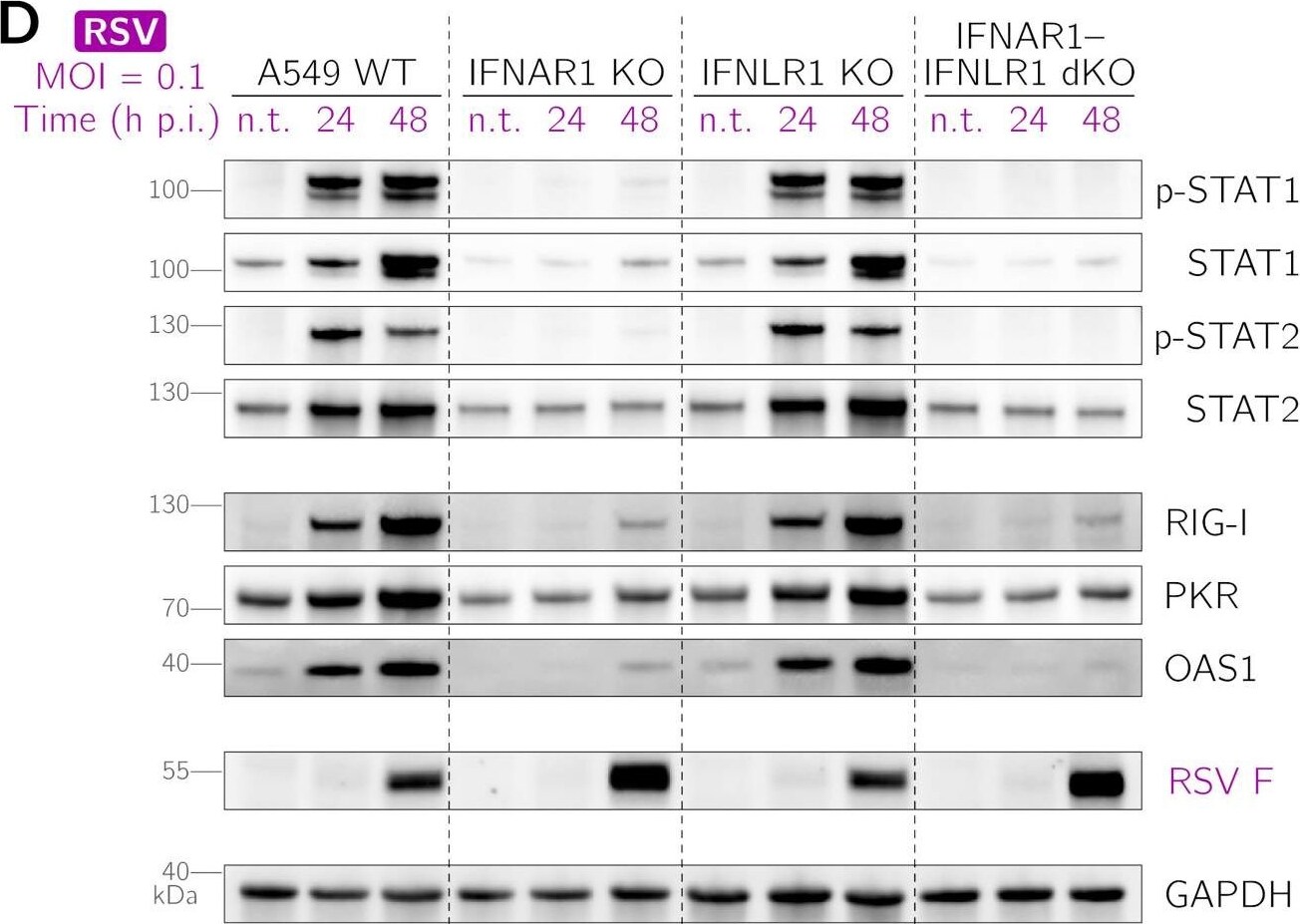
Detection of STAT2 by Western Blot
IFN-beta and IFN-lambda mediate STAT1 and STAT2 activation upon RSV and IAV infection in A549 cells. (A and B) ELISA for IFN-beta following RSV (A) and IAV (B) infection at MOIs of 0.1 and 1. Open circles mark data points with cytokine concentrations below the detection range. Error bars are standard deviations (SD) from technical replicates. (C) IFN-beta (green) (left) and activation of STAT1 (yellow) (right) and IRF3 (red) 24 h after infection of A549 WT cells with RSV (magenta, polyclonal anti-RSV antibody) at an MOI of 0.01. White dotted lines are nuclear outlines determined based on DAPI counterstaining (channel not shown). Bars, 50 μm. (D and E) Activation of STAT1, STAT2, and interferon-stimulated genes (RIG-I, PKR, and OAS1) upon RSV (D) and IAV infection (E) at an MOI of 0.1 at 24 and 48 h postinfection (p.i.) in A549 WT, IFNAR1 KO, IFNLR1 KO, and IFNAR1-IFNLR1 dKO cells. n.t. indicates nontreated cells. Activated STATs p-STAT1 and p-STAT2 are STAT1 and STAT2 phosphorylated at Tyr701 and Tyr690, respectively. RSV F, RSV fusion glycoprotein; IAV NP, IAV nucleoprotein. Image collected and cropped by CiteAb from the following open publication (https://pubmed.ncbi.nlm.nih.gov/36326278), licensed under a CC-BY license. Not internally tested by R&D Systems.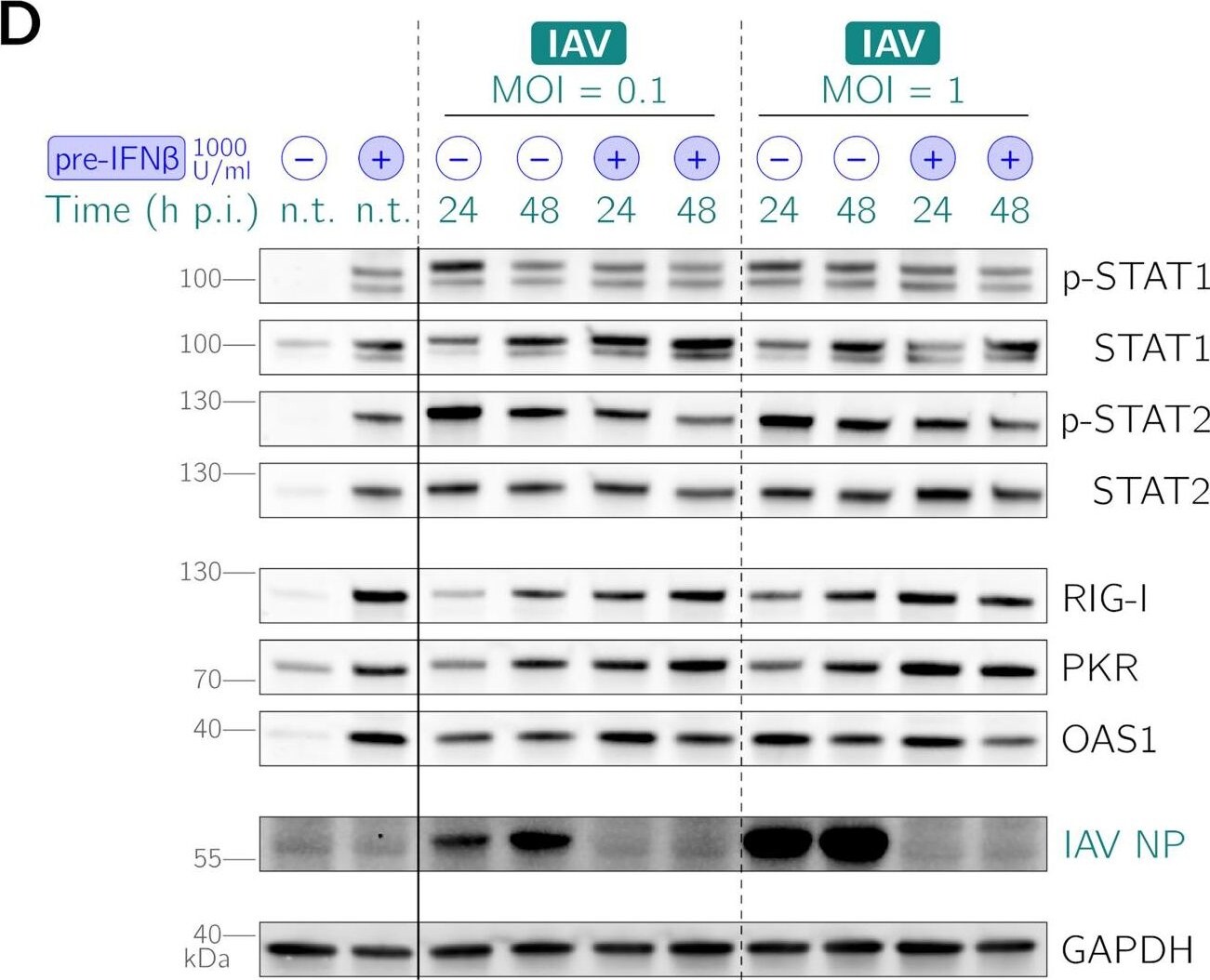
Detection of STAT2 by Western Blot
Prestimulation with IFN-beta or IFN-lambda 1 inhibits the propagation of RSV and IAV in A549 WT cells. (A and B) Effect of prestimulation with IFN-beta (1,000 U/mL) or IFN-lambda 1 (50 ng/mL) 24 h prior to infection on the relative abundance of viral RNA 24 h after RSV (A) and IAV (B) infection at MOIs of 0.1 and 1. Each filled circle corresponds to fold changes compared to nonprestimulated cells in a single experimental replicate (note the logarithmic scale). Error bars show the smallest and the largest ratios of nonprestimulated to IFN-prestimulated cells for all pairs of the respective technical replicates. (C and D) Effect of prestimulation with IFN-beta (1,000 U/mL) 24 h prior to infection on the abundance and activation of STAT1 and STAT2 and the abundance of interferon-stimulated genes (RIG-I, PKR, and OAS1) and the RSV fusion glycoprotein (RSV F) (C) and IAV nucleoprotein (IAV NP) (D) at 24 and 48 h postinfection (p.i.) at MOIs of 0.1 and 1. n.t. indicates nontreated cells. Activated STATs p-STAT1 and p-STAT2 are STAT1 and STAT2 phosphorylated at Tyr701 and Tyr690, respectively. Image collected and cropped by CiteAb from the following open publication (https://pubmed.ncbi.nlm.nih.gov/36326278), licensed under a CC-BY license. Not internally tested by R&D Systems.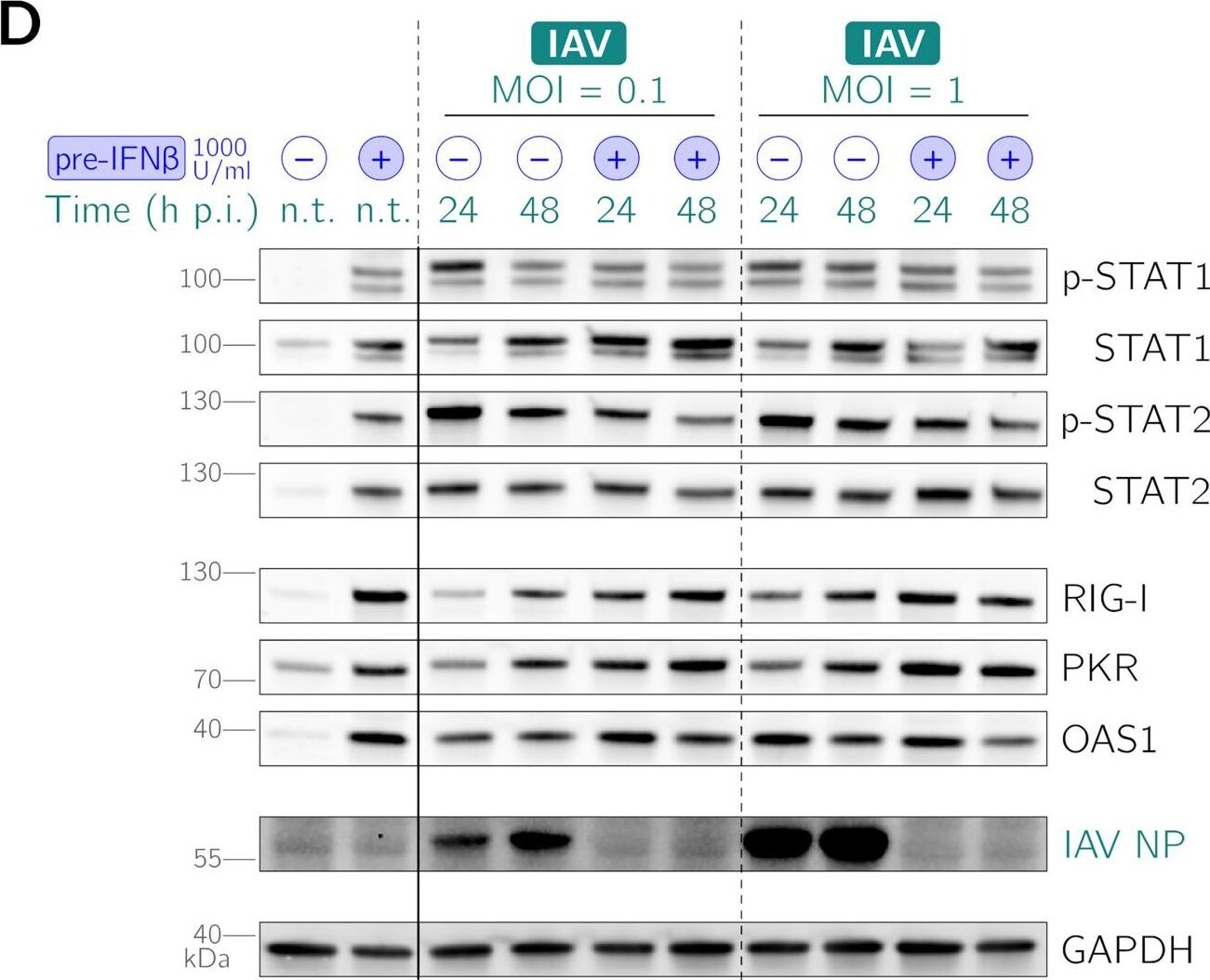
Detection of STAT2 by Western Blot
Prestimulation with IFN-beta or IFN-lambda 1 inhibits the propagation of RSV and IAV in A549 WT cells. (A and B) Effect of prestimulation with IFN-beta (1,000 U/mL) or IFN-lambda 1 (50 ng/mL) 24 h prior to infection on the relative abundance of viral RNA 24 h after RSV (A) and IAV (B) infection at MOIs of 0.1 and 1. Each filled circle corresponds to fold changes compared to nonprestimulated cells in a single experimental replicate (note the logarithmic scale). Error bars show the smallest and the largest ratios of nonprestimulated to IFN-prestimulated cells for all pairs of the respective technical replicates. (C and D) Effect of prestimulation with IFN-beta (1,000 U/mL) 24 h prior to infection on the abundance and activation of STAT1 and STAT2 and the abundance of interferon-stimulated genes (RIG-I, PKR, and OAS1) and the RSV fusion glycoprotein (RSV F) (C) and IAV nucleoprotein (IAV NP) (D) at 24 and 48 h postinfection (p.i.) at MOIs of 0.1 and 1. n.t. indicates nontreated cells. Activated STATs p-STAT1 and p-STAT2 are STAT1 and STAT2 phosphorylated at Tyr701 and Tyr690, respectively. Image collected and cropped by CiteAb from the following open publication (https://pubmed.ncbi.nlm.nih.gov/36326278), licensed under a CC-BY license. Not internally tested by R&D Systems.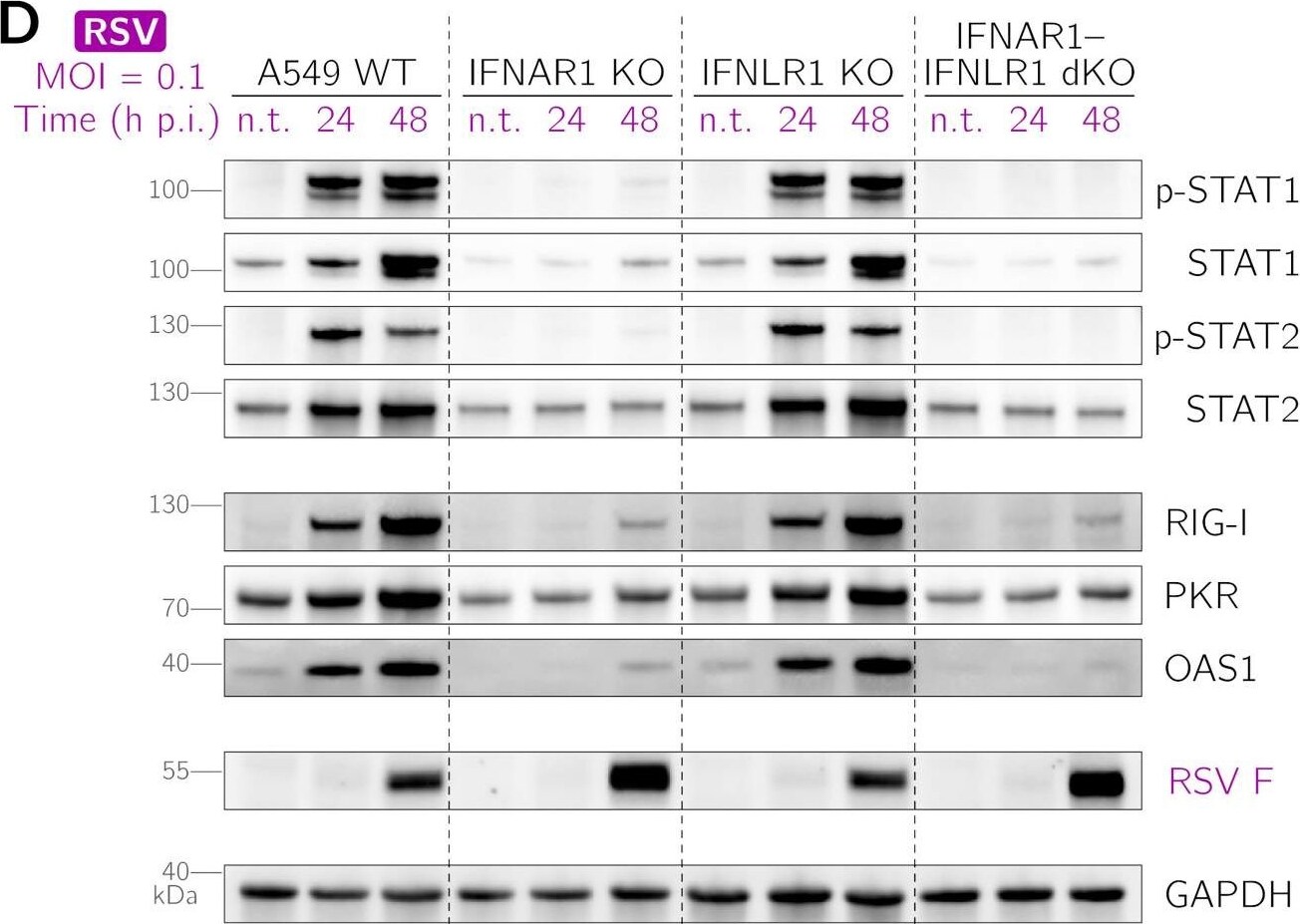
Detection of STAT2 by Western Blot
IFN-beta and IFN-lambda mediate STAT1 and STAT2 activation upon RSV and IAV infection in A549 cells. (A and B) ELISA for IFN-beta following RSV (A) and IAV (B) infection at MOIs of 0.1 and 1. Open circles mark data points with cytokine concentrations below the detection range. Error bars are standard deviations (SD) from technical replicates. (C) IFN-beta (green) (left) and activation of STAT1 (yellow) (right) and IRF3 (red) 24 h after infection of A549 WT cells with RSV (magenta, polyclonal anti-RSV antibody) at an MOI of 0.01. White dotted lines are nuclear outlines determined based on DAPI counterstaining (channel not shown). Bars, 50 μm. (D and E) Activation of STAT1, STAT2, and interferon-stimulated genes (RIG-I, PKR, and OAS1) upon RSV (D) and IAV infection (E) at an MOI of 0.1 at 24 and 48 h postinfection (p.i.) in A549 WT, IFNAR1 KO, IFNLR1 KO, and IFNAR1-IFNLR1 dKO cells. n.t. indicates nontreated cells. Activated STATs p-STAT1 and p-STAT2 are STAT1 and STAT2 phosphorylated at Tyr701 and Tyr690, respectively. RSV F, RSV fusion glycoprotein; IAV NP, IAV nucleoprotein. Image collected and cropped by CiteAb from the following open publication (https://pubmed.ncbi.nlm.nih.gov/36326278), licensed under a CC-BY license. Not internally tested by R&D Systems.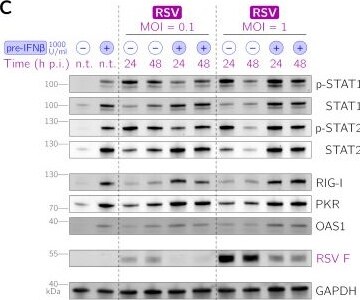
Detection of STAT2 by Western Blot
Prestimulation with IFN-beta or IFN-lambda 1 inhibits the propagation of RSV and IAV in A549 WT cells. (A and B) Effect of prestimulation with IFN-beta (1,000 U/mL) or IFN-lambda 1 (50 ng/mL) 24 h prior to infection on the relative abundance of viral RNA 24 h after RSV (A) and IAV (B) infection at MOIs of 0.1 and 1. Each filled circle corresponds to fold changes compared to nonprestimulated cells in a single experimental replicate (note the logarithmic scale). Error bars show the smallest and the largest ratios of nonprestimulated to IFN-prestimulated cells for all pairs of the respective technical replicates. (C and D) Effect of prestimulation with IFN-beta (1,000 U/mL) 24 h prior to infection on the abundance and activation of STAT1 and STAT2 and the abundance of interferon-stimulated genes (RIG-I, PKR, and OAS1) and the RSV fusion glycoprotein (RSV F) (C) and IAV nucleoprotein (IAV NP) (D) at 24 and 48 h postinfection (p.i.) at MOIs of 0.1 and 1. n.t. indicates nontreated cells. Activated STATs p-STAT1 and p-STAT2 are STAT1 and STAT2 phosphorylated at Tyr701 and Tyr690, respectively. Image collected and cropped by CiteAb from the following open publication (https://pubmed.ncbi.nlm.nih.gov/36326278), licensed under a CC-BY license. Not internally tested by R&D Systems.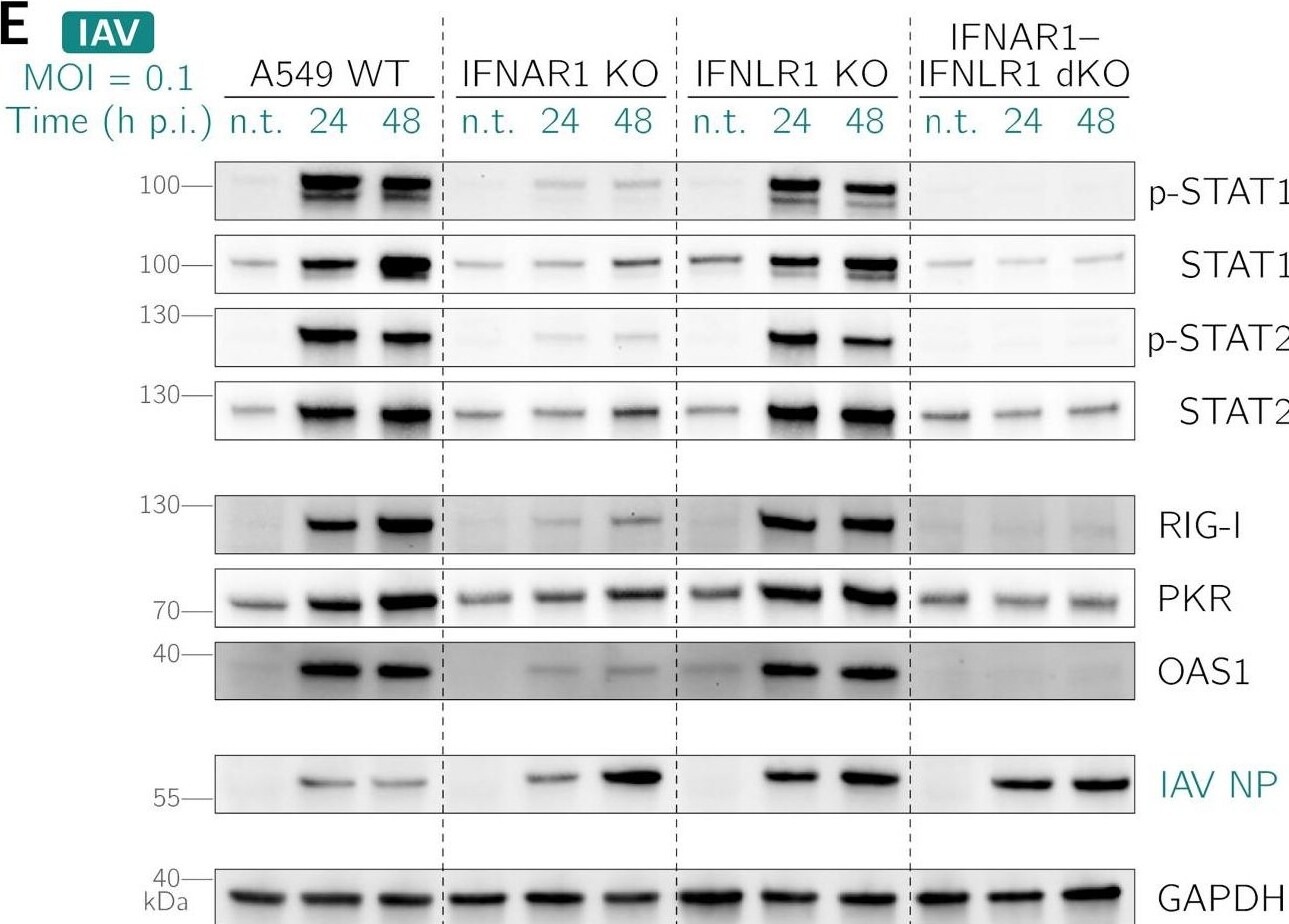
Detection of STAT2 by Western Blot
IFN-beta and IFN-lambda mediate STAT1 and STAT2 activation upon RSV and IAV infection in A549 cells. (A and B) ELISA for IFN-beta following RSV (A) and IAV (B) infection at MOIs of 0.1 and 1. Open circles mark data points with cytokine concentrations below the detection range. Error bars are standard deviations (SD) from technical replicates. (C) IFN-beta (green) (left) and activation of STAT1 (yellow) (right) and IRF3 (red) 24 h after infection of A549 WT cells with RSV (magenta, polyclonal anti-RSV antibody) at an MOI of 0.01. White dotted lines are nuclear outlines determined based on DAPI counterstaining (channel not shown). Bars, 50 μm. (D and E) Activation of STAT1, STAT2, and interferon-stimulated genes (RIG-I, PKR, and OAS1) upon RSV (D) and IAV infection (E) at an MOI of 0.1 at 24 and 48 h postinfection (p.i.) in A549 WT, IFNAR1 KO, IFNLR1 KO, and IFNAR1-IFNLR1 dKO cells. n.t. indicates nontreated cells. Activated STATs p-STAT1 and p-STAT2 are STAT1 and STAT2 phosphorylated at Tyr701 and Tyr690, respectively. RSV F, RSV fusion glycoprotein; IAV NP, IAV nucleoprotein. Image collected and cropped by CiteAb from the following open publication (https://pubmed.ncbi.nlm.nih.gov/36326278), licensed under a CC-BY license. Not internally tested by R&D Systems.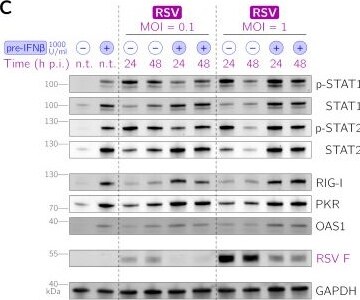
Detection of STAT2 by Western Blot
Prestimulation with IFN-beta or IFN-lambda 1 inhibits the propagation of RSV and IAV in A549 WT cells. (A and B) Effect of prestimulation with IFN-beta (1,000 U/mL) or IFN-lambda 1 (50 ng/mL) 24 h prior to infection on the relative abundance of viral RNA 24 h after RSV (A) and IAV (B) infection at MOIs of 0.1 and 1. Each filled circle corresponds to fold changes compared to nonprestimulated cells in a single experimental replicate (note the logarithmic scale). Error bars show the smallest and the largest ratios of nonprestimulated to IFN-prestimulated cells for all pairs of the respective technical replicates. (C and D) Effect of prestimulation with IFN-beta (1,000 U/mL) 24 h prior to infection on the abundance and activation of STAT1 and STAT2 and the abundance of interferon-stimulated genes (RIG-I, PKR, and OAS1) and the RSV fusion glycoprotein (RSV F) (C) and IAV nucleoprotein (IAV NP) (D) at 24 and 48 h postinfection (p.i.) at MOIs of 0.1 and 1. n.t. indicates nontreated cells. Activated STATs p-STAT1 and p-STAT2 are STAT1 and STAT2 phosphorylated at Tyr701 and Tyr690, respectively. Image collected and cropped by CiteAb from the following open publication (https://pubmed.ncbi.nlm.nih.gov/36326278), licensed under a CC-BY license. Not internally tested by R&D Systems.Applications for Human STAT2 Antibody
Immunoprecipitation
Sample: WS‑1 human fetal skin fibroblast cell line, see our available Western blot detection antibodies
Knockout Validated
Western Blot
Sample: HeLa human cervical epithelial carcinoma cell line
Formulation, Preparation, and Storage
Purification
Reconstitution
Formulation
Shipping
Stability & Storage
- 12 months from date of receipt, -20 to -70 °C as supplied.
- 1 month, 2 to 8 °C under sterile conditions after reconstitution.
- 6 months, -20 to -70 °C under sterile conditions after reconstitution.
Calculators
Background: STAT2
Long Name
Alternate Names
Gene Symbol
UniProt
Additional STAT2 Products
Product Documents for Human STAT2 Antibody
Certificate of Analysis
To download a Certificate of Analysis, please enter a lot or batch number in the search box below.
Note: Certificate of Analysis not available for kit components.
Product Specific Notices for Human STAT2 Antibody
For research use only
Related Research Areas
Citations for Human STAT2 Antibody
 Powered by Bioz
Customer Reviews for Human STAT2 Antibody
There are currently no reviews for this product. Be the first to review Human STAT2 Antibody and earn rewards!
Have you used Human STAT2 Antibody?
Submit a review and receive an Amazon gift card!
$25/€18/£15/$25CAN/¥2500 for a review with an image
$10/€7/£6/$10CAN/¥1110 for a review without an image
Submit a review
Protocols
Find general support by application which include: protocols, troubleshooting, illustrated assays, videos and webinars.
- Cellular Response to Hypoxia Protocols
- Immunoprecipitation Protocol
- R&D Systems Quality Control Western Blot Protocol
- Troubleshooting Guide: Western Blot Figures
- Western Blot Conditions
- Western Blot Protocol
- Western Blot Protocol for Cell Lysates
- Western Blot Troubleshooting
- Western Blot Troubleshooting Guide
- View all Protocols, Troubleshooting, Illustrated assays and Webinars
Associated Pathways
