
Thrombospondin-4 (THSP4) is a 140 kDa calcium-binding protein that interacts with other extracellular matrix molecules and modulates the activity of various cell types. THSP1 and THSP2 constitute subgroup A and form disulfide-linked homotrimers, whereas THSP3, THSP4, and THSP5/COMP constitute subgroup B and form pentamers (1, 2). The human THSP4 cDNA encodes a 961 amino acid (aa) precursor that includes a 26 aa signal sequence followed by an N-terminal heparin-binding domain, a coiled-coil motif, four EGF-like repeats, seven THSP type-3 repeats (one with an RGD motif), and a THSP C‑terminal domain (3). Human THSP4 shares 93% aa sequence identity with mouse and rat THSP4. Within the THSP type-3 repeats and the THSP C‑terminal domain, human THSP4 shares 79% aa sequence identity with THSP3 and COMP, and 58% aa sequence identity with THSP1 and THSP2. The coiled-coil motif mediates pentamer formation with COMP, either homotypically or heterotypically (3-6). THSP4 binds a variety of matrix proteins including collagens I, II, III, V, laminin-1, fibronectin, and matrilin-2 (4). Interactions of THSP4 with non-collagenous proteins are independent of divalent cations, while interactions with collagenous proteins are enhanced in the presence of zinc (4). THSP4 is expressed in heart, skeletal muscle, vascular smooth muscle, and vascular endothelial cells (7-9). It accumulates at neuromuscular junctions and synapse-rich regions and is upregulated in muscle by experimental denervation (8). THSP4 mediates the adhesion of motor and sensory neurons and promotes neurite outgrowth (8). A polymorphism of THSP4 (A387P) is associated with early coronary artery disease (10-12). Unlike wild type THSP4, the A387P variant does not support HUVEC attachment and spreading (9). Integrin alpha M/ beta 2 enables activated neutrophil adhesion to both the variant A387P and wild type THSP4, although the A387P variant induces a greater release of pro-inflammatory molecules (13).

Scientific images may be resized, cropped, or adjusted for brightness or contrast for presentation purposes. These updates are limited to presentation and do not affect the underlying scientific interpretation of the data. Where available, additional source data may be provided upon request.
Key Product Details
Validated by
Species Reactivity
Validated:
Cited:
Applications
Validated:
Cited:
Label
Antibody Source
Product Specifications
Immunogen
Ala22-Asn961 (Pro276Ala, Ala420Val)
Accession # P35443
Specificity
Clonality
Host
Isotype
Scientific Data Images for Human Thrombospondin-4 Antibody
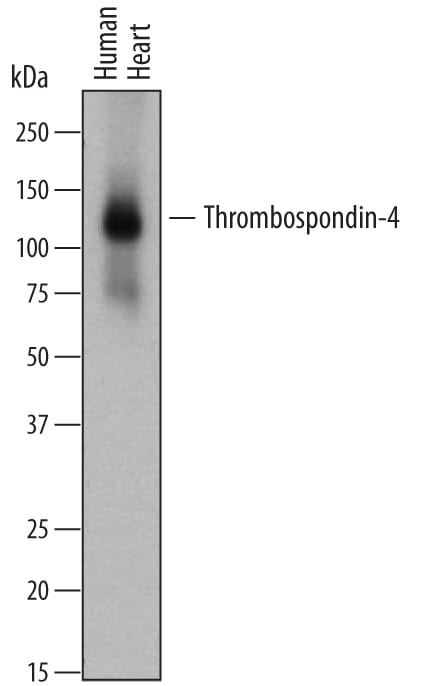
Detection of Human Thrombospondin‑4 by Western Blot.
Western blot shows lysates of human heart tissue. PVDF membrane was probed with 0.2 µg/mL of Goat Anti-Human Thrombospondin-4 Antigen Affinity-purified Polyclonal Antibody (Catalog # AF2390) followed by HRP-conjugated Anti-Goat IgG Secondary Antibody (Catalog # HAF109). A specific band was detected for Thrombospondin-4 at approximately 130kDa (as indicated). This experiment was conducted under reducing conditions and using Immunoblot Buffer Group 1.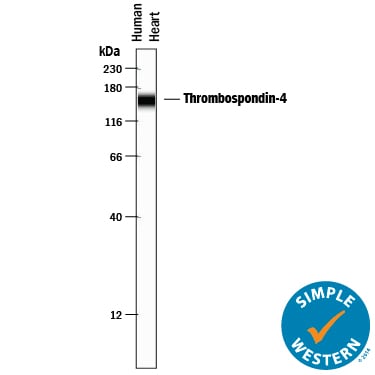
Detection of Human Thrombospondin‑4 by Simple WesternTM.
Simple Western lane view shows lysates of human heart tissue, loaded at 0.2 mg/mL. A specific band was detected for Thrombospondin-4 at approximately 158 kDa (as indicated) using 2 µg/mL of Goat Anti-Human Thrombospondin-4 Antigen Affinity-purified Polyclonal Antibody (Catalog # AF2390) followed by 1:50 dilution of HRP-conjugated Anti-Goat IgG Secondary Antibody (Catalog # HAF109). This experiment was conducted under reducing conditions and using the 12-230 kDa separation system.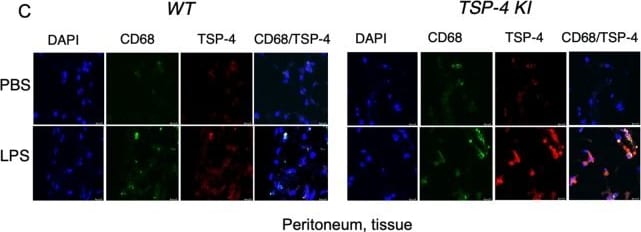
Detection of Mouse Thrombospondin-4 by Immunocytochemistry/Immunofluorescence
TSP-4 promotes accumulation of macrophages in peritoneal tissue of mice with LPS-induced peritonitis.a The number of macrophages in peritoneal cavity in mice with LPS-induced peritonitis. *p < 0.05, n = 5. b TSP-4 expression in macrophages from the peritoneal cavity lavage (left panel) and in the peritoneal tissue. QRT-PCR, fold increase (RQ) over the values in control mice injected with PBS; n = 3; *p < 0.05. c Macrophages and TSP-4 in peritoneal tissue of WT and P387-TSP-4-KI mice with LPS-induced peritonitis. Immunofluorescence; blue = nuclei (DAPI), green = macrophages (anti-CD68), red = TSP-4 (anti-TSP-4). Scale bar is 20 µm. Image collected and cropped by CiteAb from the following publication (https://pubmed.ncbi.nlm.nih.gov/31974349), licensed under a CC-BY license. Not internally tested by R&D Systems.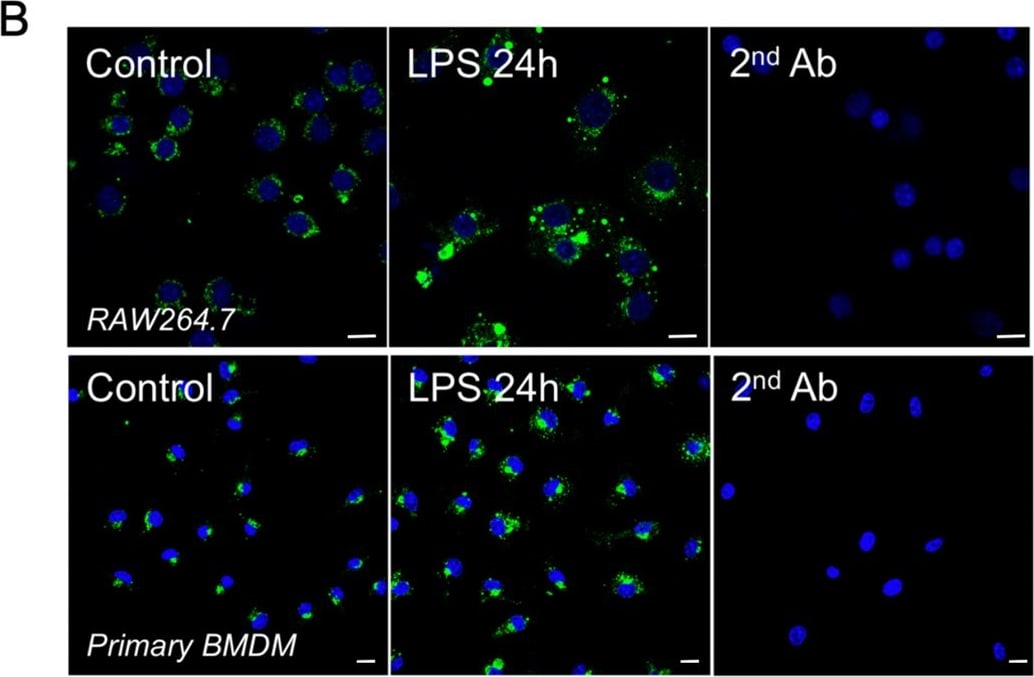
Detection of Mouse Thrombospondin-4 by Immunocytochemistry/Immunofluorescence
LPS induces TSP-4 in cultured macrophages.a Cultured macrophage-like RAW264.7 and cells and mouse bone-marrow-derived macrophages (BMDM) were treated with LPS (0.5 μg/ml for 1–24 h); western blotting with anti-TSP-4 Ab. b Cultured RAW264.7 (upper panels) and BMDM (lower panels) treated with LPS for 24 h were stained with anti-TSP-4 Ab; green = TSP-4, blue = nuclei, DAPI. Scale bar is 10 µm. c RAW 264.7 and BMDM cells were treated with LPS (0.5 μg/mL) for 24 h, and qRT-PCR was done (control = PBS treated); d RAW 264.7 cells were treated with CHX (25 μM) for 1–5 h and CHX (25 μM) + LPS (0.5 μg/mL) for 1–3 h followed by western blot detection of TSP-4 ( beta -actin as loading controls). CHX was added at time 0, followed by addition of LPS. Image collected and cropped by CiteAb from the following publication (https://pubmed.ncbi.nlm.nih.gov/31974349), licensed under a CC-BY license. Not internally tested by R&D Systems.Applications for Human Thrombospondin-4 Antibody
Simple Western
Sample: Human heart tissue
Western Blot
Sample: Human heart tissue
Reviewed Applications
Read 6 reviews rated 4.3 using AF2390 in the following applications:
Formulation, Preparation, and Storage
Purification
Reconstitution
Reconstitute at 0.2 mg/mL in sterile PBS. For liquid material, refer to CoA for concentration.
Formulation
Shipping
Stability & Storage
- 12 months from date of receipt, -20 to -70 °C as supplied.
- 1 month, 2 to 8 °C under sterile conditions after reconstitution.
- 6 months, -20 to -70 °C under sterile conditions after reconstitution.
Calculators
Background: Thrombospondin-4
References
- Adams, J.C. and J. Lawler (2004) Int. J. Biochem. Cell Biol. 36:961.
- Stenina, O.I. et al. (2004) Int. J. Biochem. Cell Biol. 36:1013.
- Lawler, J. et al. (1995) J. Biol. Chem. 270:2809.
- Narouz-Ott, L. et al. (2000) J. Biol. Chem. 275:37110.
- Hauser, N. et al. (1995) FEBS Lett. 368:307.
- Sodersten, F. et al. (2006) Connect. Tissue Res. 47:85.
- Lawler, J. et al. (1993) J. Cell Biochem. 120:1059.
- Arber, S. and P. Caroni (1995) J. Cell Biol. 131:1083.
- Stenina, O.I. et al. (2003) Circulation 108:1514.
- Topol, E.J. et al. (2001) Circulation 104:2641.
- Wessel, J. et al. (2004) Am. Heart J. 147:905.
- Stenina, O.I. et al. (2005) FASEB J. 19:1893.
- Pluskota, E. et al. (2005) Blood 106:3970.
Alternate Names
Gene Symbol
UniProt
Additional Thrombospondin-4 Products
Product Documents for Human Thrombospondin-4 Antibody
Certificate of Analysis
To download a Certificate of Analysis, please enter a lot or batch number in the search box below.
Note: Certificate of Analysis not available for kit components.
Product Specific Notices for Human Thrombospondin-4 Antibody
For research use only
Related Research Areas
Citations for Human Thrombospondin-4 Antibody
 Powered by Bioz
Customer Reviews for Human Thrombospondin-4 Antibody (6)
Have you used Human Thrombospondin-4 Antibody?
Submit a review and receive an Amazon gift card!
$25/€18/£15/$25CAN/¥2500 for a review with an image
$10/€7/£6/$10CAN/¥1110 for a review without an image
Submit a review
Customer Images
-
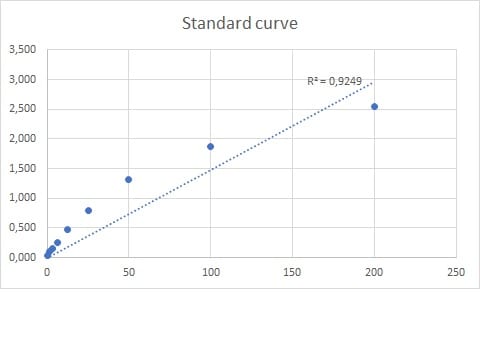
Application: ELISASample Tested: Serum and PlasmaSpecies: HumanVerified Customer | Posted 07/01/2024

-
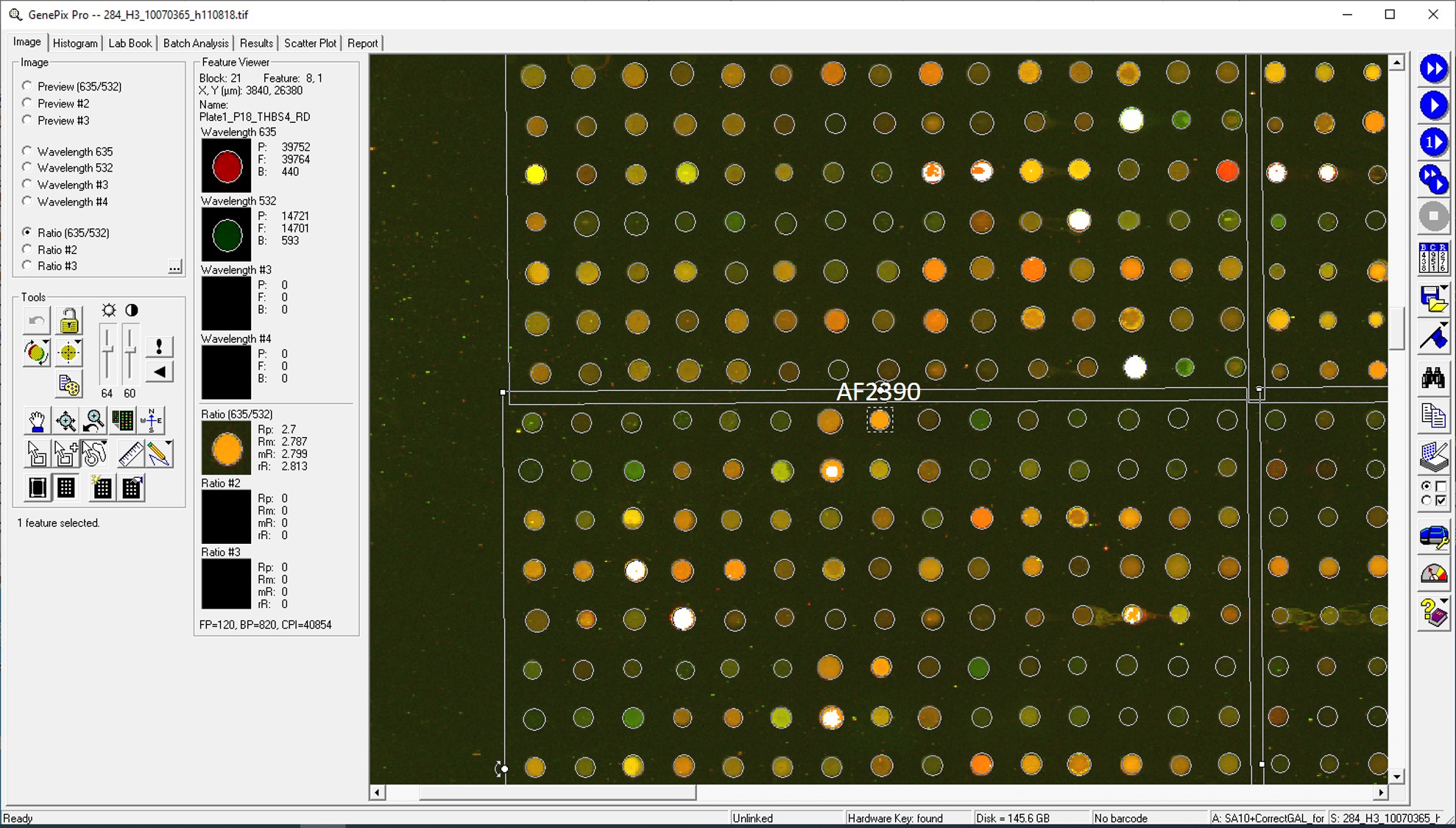
Application: MicroarraysSample Tested: EDTA PlasmaSpecies: HumanVerified Customer | Posted 01/14/2021
-
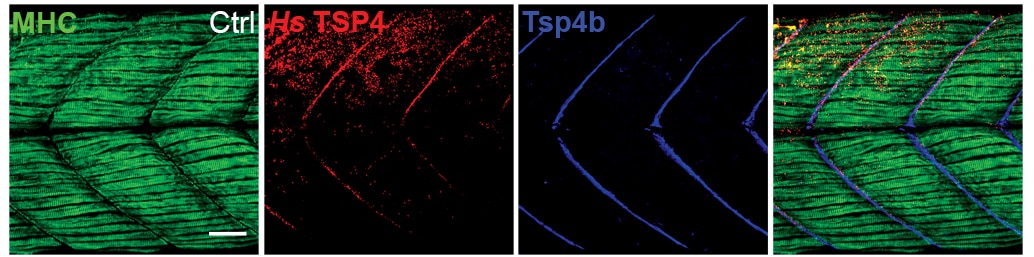
Application: ImmunohistochemistrySample Tested: EmbryoSpecies: ZebrafishVerified Customer | Posted 03/14/2020The antibody was used to detect human TSP4 protein (Red channel in the figure) that was injected into a zebrafish embryo. The antibody did not cross-react with zebrafish Tsp4 protein. The data has been published (eLife 2014;3:e02372).
-
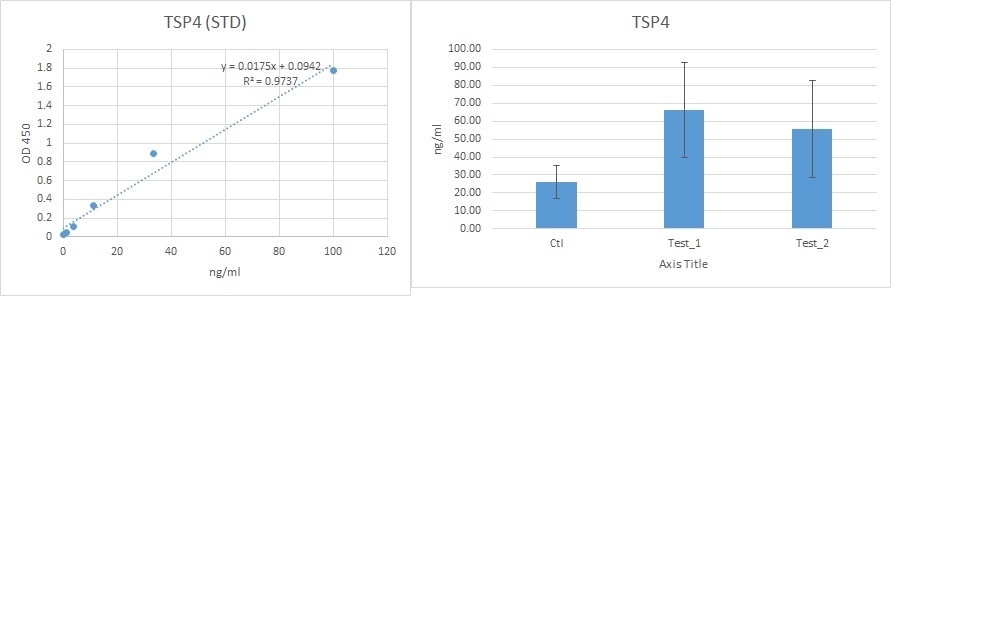
Application: ELISASample Tested: Serum and PlasmaSpecies: HumanVerified Customer | Posted 10/04/2019We used this antibody for a sandwich ELISA in combination with mAb (MAB2390)) and protein (2390-TH). This combination works very well for detecting the TSP4 in human serum and plasma
-
Application: LuminexSample Tested: SerumSpecies: HumanVerified Customer | Posted 11/08/2018
-
Application: MicroarraySample Tested: EDTA PlasmaSpecies: HumanVerified Customer | Posted 10/31/2018
There are no reviews that match your criteria.
Protocols
Find general support by application which include: protocols, troubleshooting, illustrated assays, videos and webinars.
- Cellular Response to Hypoxia Protocols
- R&D Systems Quality Control Western Blot Protocol
- Troubleshooting Guide: Western Blot Figures
- Western Blot Conditions
- Western Blot Protocol
- Western Blot Protocol for Cell Lysates
- Western Blot Troubleshooting
- Western Blot Troubleshooting Guide
- View all Protocols, Troubleshooting, Illustrated assays and Webinars
Associated Pathways
