


Scientific images may be resized, cropped, or adjusted for brightness or contrast for presentation purposes. These updates are limited to presentation and do not affect the underlying scientific interpretation of the data. Where available, additional source data may be provided upon request.
Key Product Details
Species Reactivity
Validated:
Human
Cited:
Human, Mouse, Transgenic Mouse
Applications
Validated:
Western Blot, Intracellular Staining by Flow Cytometry, CyTOF-ready
Cited:
Immunohistochemistry, Western Blot, Flow Cytometry
Label
Unconjugated
Antibody Source
Polyclonal Goat IgG
Loading...
Product Specifications
Immunogen
E. coli-derived recombinant human WT1
Met127-Gly249
Accession # P19544
Met127-Gly249
Accession # P19544
Specificity
Detects human WT1 in direct ELISAs and Western blots.
Clonality
Polyclonal
Host
Goat
Isotype
IgG
Scientific Data Images for Human WT1 Antibody
Detection of Human WT1 by Western Blot.
Western blot shows lysates of K562 human chronic myelogenous leukemia cell line. PVDF membrane was probed with 1 µg/mL of Goat Anti-Human WT1 Antigen Affinity-purified Polyclonal Antibody (Catalog # AF5729) followed by HRP-conjugated Anti-Goat IgG Secondary Antibody (Catalog # HAF019). A specific band was detected for WT1 at approximately 54 kDa (as indicated). This experiment was conducted under reducing conditions and using Immunoblot Buffer Group 8.
Detection of WT1 in HL‑60 Human Cell Line by Flow Cytometry.
HL-60 human acute promyelocytic leukemia cell line was stained with Goat Anti-Human WT1 Antigen Affinity-purified Polyclonal Antibody (Catalog # AF5729, filled histogram) or control antibody (Catalog # AB-108-C, open histogram), followed by Allophycocyanin-conjugated Anti-Goat IgG Secondary Antibody (Catalog # F0108). To facilitate intracellular staining, cells were fixed with paraformaldehyde and permeabilized with saponin.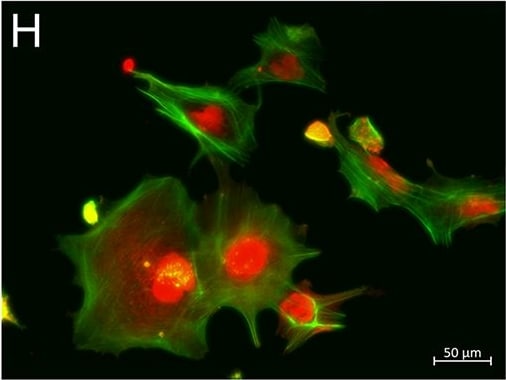
Detection of Human WT1 by Immunocytochemistry/Immunofluorescence
Immunostaining of podocyte-like cells derived from the iPSC line SBAD3 with podocyte markers and F-actin staining.iPSC were differentiated on glass cover slips fixed and stained for synaptopodin, WT-1, podocin, and F-actin as described in methods. Red and green colours were applied post capture. Staining in two other iPSC lines are provided in S1 and S2 Figs. Image collected and cropped by CiteAb from the following publication (https://pubmed.ncbi.nlm.nih.gov/30222766), licensed under a CC-BY license. Not internally tested by R&D Systems.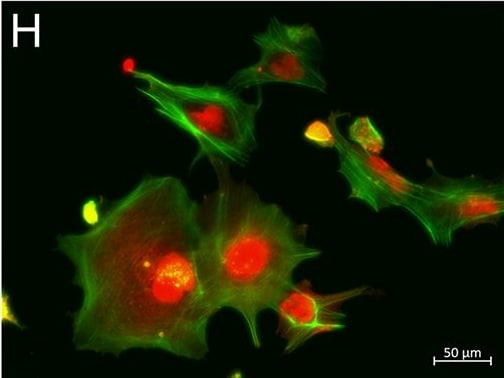
Detection of Human WT1 by Immunocytochemistry/Immunofluorescence
Immunostaining of podocyte-like cells derived from the iPSC line SBAD3 with podocyte markers and F-actin staining.iPSC were differentiated on glass cover slips fixed and stained for synaptopodin, WT-1, podocin, and F-actin as described in methods. Red and green colours were applied post capture. Staining in two other iPSC lines are provided in S1 and S2 Figs. Image collected and cropped by CiteAb from the following publication (https://pubmed.ncbi.nlm.nih.gov/30222766), licensed under a CC-BY license. Not internally tested by R&D Systems.
Detection of Human WT1 by Western Blot
Immunostaining of podocyte-like cells derived from the iPSC line SBAD3 with podocyte markers and F-actin staining.iPSC were differentiated on glass cover slips fixed and stained for synaptopodin, WT-1, podocin, and F-actin as described in methods. Red and green colours were applied post capture. Staining in two other iPSC lines are provided in S1 and S2 Figs. Image collected and cropped by CiteAb from the following publication (https://pubmed.ncbi.nlm.nih.gov/30222766), licensed under a CC-BY license. Not internally tested by R&D Systems.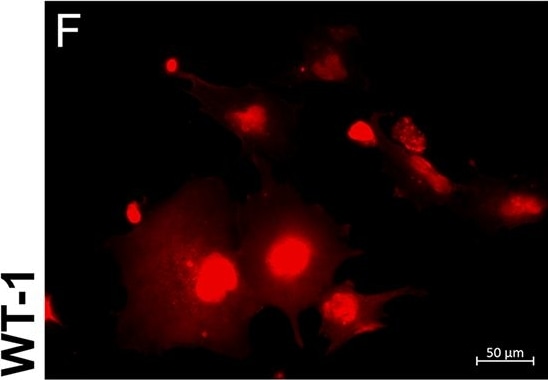
Detection of Human WT1 by Immunocytochemistry/Immunofluorescence
Immunostaining of podocyte-like cells derived from the iPSC line SBAD3 with podocyte markers and F-actin staining.iPSC were differentiated on glass cover slips fixed and stained for synaptopodin, WT-1, podocin, and F-actin as described in methods. Red and green colours were applied post capture. Staining in two other iPSC lines are provided in S1 and S2 Figs. Image collected and cropped by CiteAb from the following publication (https://pubmed.ncbi.nlm.nih.gov/30222766), licensed under a CC-BY license. Not internally tested by R&D Systems.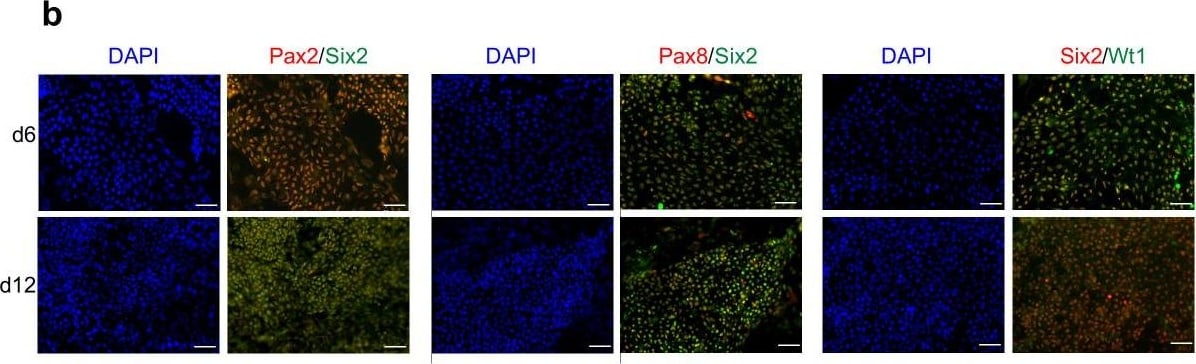
Detection of Human WT1 by Immunocytochemistry/Immunofluorescence
Differentiation of human iPSC clone IV towards renal commitment.(a) Representative immunofluorescence images of co-staining for Lhx1/Osr1 up to day 6. (b) Images of co-staining of Pax2/Six2, Pax8/Six2 and Six2/Wt1 from day 6 to 12. (c) Expression of renal progenitor markers such as CD24, Claudin1 and GGT1 from day 0 to 19. Nuclei are stained with DAPI (blue). Scale bars: 50 μm (a, b), 20 μm (c). (d) Gene expression analysis for renal progenitor markers at different points in time. Image collected and cropped by CiteAb from the following publication (https://www.nature.com/articles/srep08826), licensed under a CC-BY license. Not internally tested by R&D Systems.
Detection of Human WT1 by Immunocytochemistry/Immunofluorescence
Immunostaining of podocyte-like cells derived from the iPSC line SBAD3 with podocyte markers and F-actin staining.iPSC were differentiated on glass cover slips fixed and stained for synaptopodin, WT-1, podocin, and F-actin as described in methods. Red and green colours were applied post capture. Staining in two other iPSC lines are provided in S1 and S2 Figs. Image collected and cropped by CiteAb from the following publication (https://pubmed.ncbi.nlm.nih.gov/30222766), licensed under a CC-BY license. Not internally tested by R&D Systems.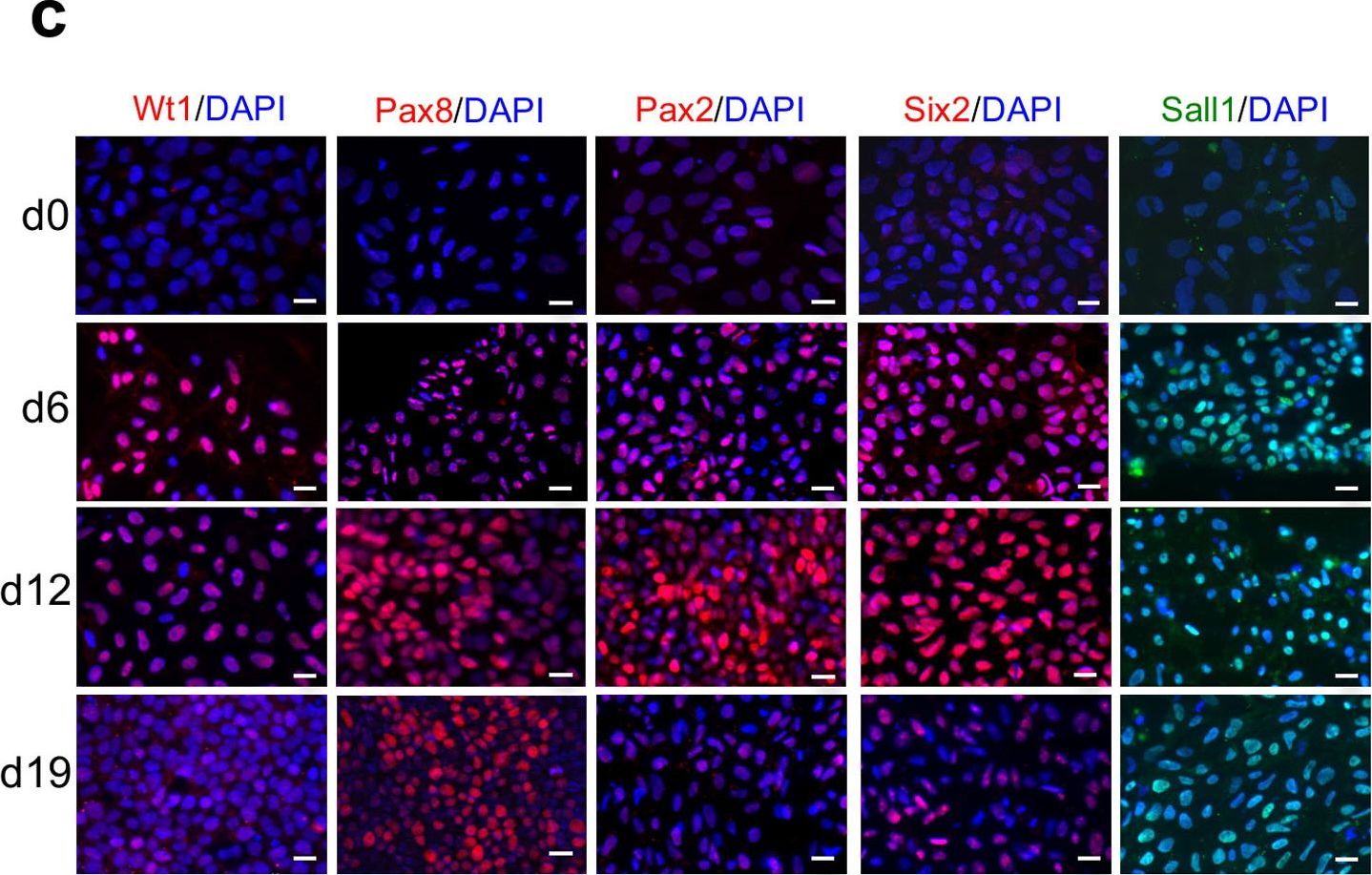
Detection of Human WT1 by Immunocytochemistry/Immunofluorescence
Stepwise differentiation of human iPSCs towards renal progenitor cells (RPCs).(a) Schematic description of the two-stage protocol applied to iPSC-renal commitment. (b, c, d, e) Immunofluorescence of iPSCs (derived from retroviral transfected dermal fibroblasts) exposed to differentiating media. (b) The pluripotency markers SSEA4, TRA-1-81, Nanog, ME marker T(Bry) and IM marker Osr1. (c) IM and MM marker expression as Wt1, Pax8, Pax2, Six2 and Sall1. (d) Renal progenitor markers CD133, CD24, NCAM, glomerular epithelial marker Claudin1 and proximal tubular epithelial markers AQP1, GGT1. (e) Markers identifying endodermal AFP, ectodermal Pax6, and cardiac mesodermal Nkx2.5 derivation. Nuclei are stained with DAPI (blue). Scale bars: 20 μm (b, c, d, e). Image collected and cropped by CiteAb from the following publication (https://www.nature.com/articles/srep08826), licensed under a CC-BY license. Not internally tested by R&D Systems.Applications for Human WT1 Antibody
Application
Recommended Usage
CyTOF-ready
Ready to be labeled using established conjugation methods. No BSA or other carrier proteins that could interfere with conjugation.
Intracellular Staining by Flow Cytometry
2.5 µg/106 cells
Sample: HL‑60 human acute promyelocytic leukemia cell line fixed with paraformaldehyde and permeabilized with saponin
Sample: HL‑60 human acute promyelocytic leukemia cell line fixed with paraformaldehyde and permeabilized with saponin
Western Blot
1 µg/mL
Sample: K562 human chronic myelogenous leukemia cell line
Sample: K562 human chronic myelogenous leukemia cell line
Flow Cytometry Panel Builder
Bio-Techne Knows Flow Cytometry
Save time and reduce costly mistakes by quickly finding compatible reagents using the Panel Builder Tool.
Advanced Features
- Spectra Viewer - Custom analysis of spectra from multiple fluorochromes
- Spillover Popups - Visualize the spectra of individual fluorochromes
- Antigen Density Selector - Match fluorochrome brightness with antigen density

Formulation, Preparation, and Storage
Purification
Antigen Affinity-purified
Reconstitution
Reconstitute at 0.2 mg/mL in sterile PBS. For liquid material, refer to CoA for concentration.
Loading...
Formulation
Lyophilized from a 0.2 μm filtered solution in PBS with Trehalose. *Small pack size (SP) is supplied either lyophilized or as a 0.2 µm filtered solution in PBS.
Shipping
Lyophilized product is shipped at ambient temperature. Liquid small pack size (-SP) is shipped with polar packs. Upon receipt, store immediately at the temperature recommended below.
Stability & Storage
Use a manual defrost freezer and avoid repeated freeze-thaw cycles.
- 12 months from date of receipt, -20 to -70 °C as supplied.
- 1 month, 2 to 8 °C under sterile conditions after reconstitution.
- 6 months, -20 to -70 °C under sterile conditions after reconstitution.
Calculators
Background: WT1
(aa 323‑347; 353‑377; 383‑405; 414‑438). WT1 forms homodimers, and interacts with multiple molecules. Interaction with the zinc fingers generally promotes gene transcription, while N‑terminal interactions block gene transcription. There are at least two dozen splice variants. Some are combinations of deletions of aa 250‑266 and 408‑410, plus an alternate start site 68 aa upstream of the standard site, and a three aa substitution for aa 1‑147. Over aa 127‑249, human WT1 shares 98% aa identity with mouse WT1.
Long Name
Wilms Tumor 1
Alternate Names
GUD, WAGR, WIT-2, WT33
Gene Symbol
WT1
UniProt
Additional WT1 Products
Product Documents for Human WT1 Antibody
Certificate of Analysis
To download a Certificate of Analysis, please enter a lot or batch number in the search box below.
Note: Certificate of Analysis not available for kit components.
Product Specific Notices for Human WT1 Antibody
For research use only
Related Research Areas
Citations for Human WT1 Antibody
 Powered by Bioz
Customer Reviews for Human WT1 Antibody
There are currently no reviews for this product. Be the first to review Human WT1 Antibody and earn rewards!
Have you used Human WT1 Antibody?
Submit a review and receive an Amazon gift card!
$25/€18/£15/$25CAN/¥2500 for a review with an image
$10/€7/£6/$10CAN/¥1110 for a review without an image
Submit a review
Protocols
Find general support by application which include: protocols, troubleshooting, illustrated assays, videos and webinars.
- 7-Amino Actinomycin D (7-AAD) Cell Viability Flow Cytometry Protocol
- Cellular Response to Hypoxia Protocols
- Extracellular Membrane Flow Cytometry Protocol
- Flow Cytometry Protocol for Cell Surface Markers
- Flow Cytometry Protocol for Staining Membrane Associated Proteins
- Flow Cytometry Staining Protocols
- Flow Cytometry Troubleshooting Guide
- Intracellular Flow Cytometry Protocol Using Alcohol (Methanol)
- Intracellular Flow Cytometry Protocol Using Detergents
- Intracellular Nuclear Staining Flow Cytometry Protocol Using Detergents
- Intracellular Staining Flow Cytometry Protocol Using Alcohol Permeabilization
- Intracellular Staining Flow Cytometry Protocol Using Detergents to Permeabilize Cells
- Propidium Iodide Cell Viability Flow Cytometry Protocol
- Protocol for Liperfluo
- Protocol for the Characterization of Human Th22 Cells
- Protocol for the Characterization of Human Th9 Cells
- Protocol: Annexin V and PI Staining by Flow Cytometry
- Protocol: Annexin V and PI Staining for Apoptosis by Flow Cytometry
- R&D Systems Quality Control Western Blot Protocol
- Troubleshooting Guide: Fluorokine Flow Cytometry Kits
- Troubleshooting Guide: Western Blot Figures
- Western Blot Conditions
- Western Blot Protocol
- Western Blot Protocol for Cell Lysates
- Western Blot Troubleshooting
- Western Blot Troubleshooting Guide
- View all Protocols, Troubleshooting, Illustrated assays and Webinars
Loading...
Associated Pathways
