

Detection of Porcine IL-10R alpha by Immunocytochemistry/ Immunofluorescence
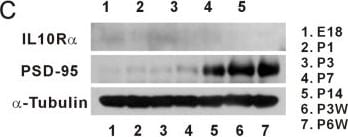
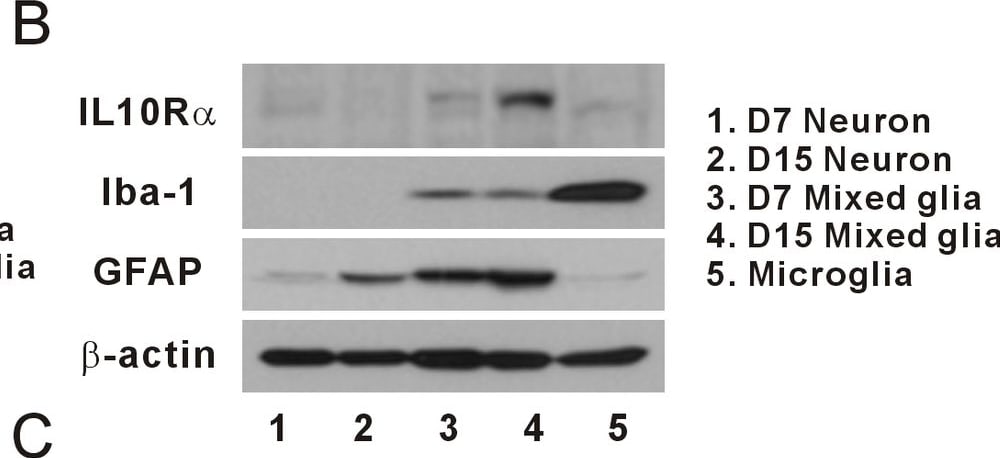
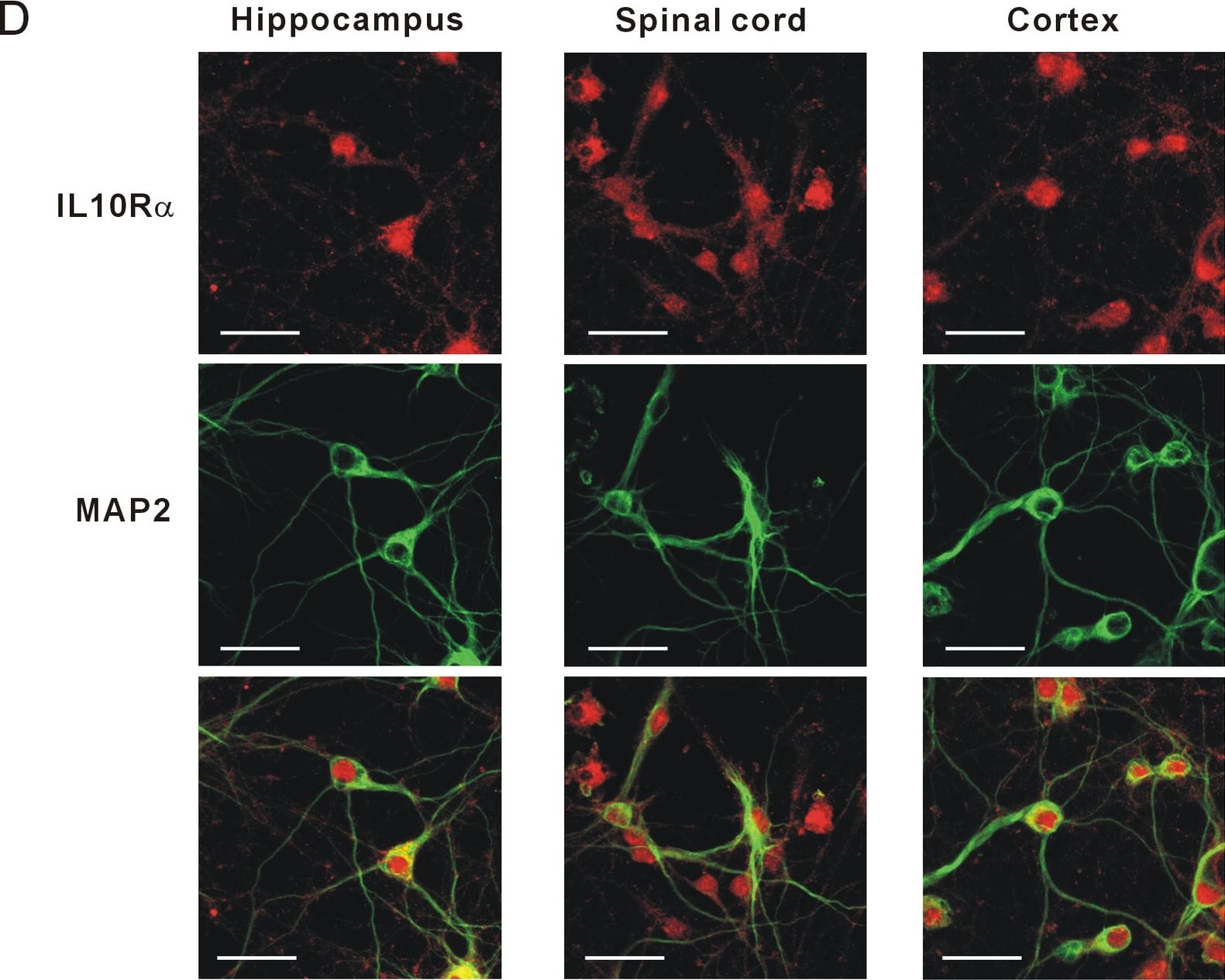
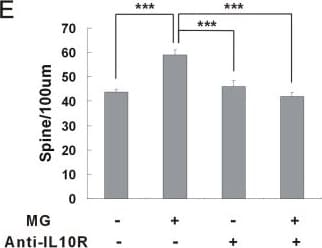
IL-10 receptors expressed on hippocampal neurons.(A) Expression of IL-10 receptor mRNAs in hippocampal neurons. The expression of the IL-10 receptor was identified using RT-PCR. The mRNAs of IL-10 receptor alpha and beta were expressed in the hippocampal neurons. IL-10 receptor alpha was expressed mainly in hippocampal neurons of DIV 7. (1, cultured hippocampal neurons at DIV 7; 2, cultured hippocampal neurons at DIV 15; 3, mixed glial culture at DIV 7; 4, mixed glial culture at DIV 15; 5, microglia) Quantification (DIV 15 neuron/ DIV 7 neuron): IL-10 receptor alpha, 0.61; IL-10 receptor beta, 1.06. (B) Expression of IL-10 receptor proteins in cultured hippocampal neurons. Similar to the expression of mRNA, the IL-10 receptor alpha protein was expressed mainly in neurons of DIV 7. Anti-IL-10 receptor alpha antibodies (0.5 μg/ml, Santa Cruz, sc-985) were used for western blotting [27]. Quantification (DIV 15 neuron/ DIV 7 neurons): IL-10 receptor alpha, 0.73.(C) Expression of IL-10 receptor proteins in the developing rat brains. The IL-10 receptor alpha proteins were expressed mainly in the developing brains of embryonic and early postnatal days (E18~P3). Quantification of IL-10 receptor alpha : E18, 0.30; P1, 0.27; P3, 1.0; P7, 0.22; P14, 0.20; P3W, 0.17; P6W, 0.15 (E, embryonic days; P, postnatal days).(D) Images of IL-10 receptor expressions in cultured hippocampal neurons. Hippocampal neurons of DIV 6 were stained with antibodies of IL-10 receptor alpha (5 μg/ml, Santa Cruz, sc-985) (red) and MAP2 (the neuronal marker, green) after treatment with 4% formaldehyde and then -20 °C methanol. Hippocampal neurons expressed IL-10 receptor proteins comparable to spinal neurons or cortical neurons.(E) The induction of synaptic formation by microglia was antagonized by the neutralizing antibody of IL-10 receptor alpha. When anti-mouse IL-10 receptor alpha antibody was applied to the co-culture of mouse microglia and mouse hippocampal neurons, the density of dendritic spines was significantly decreased compared with the control (without anti-IL-10 receptor antibody). Means±SEM. n=30 dendrites for no microglia without anti-IL-10 receptor antibody, 29 for the application of microglia only, 29 for no microglia with anti-IL-10 receptor antibody only, 29 for microglia with anti-IL-10 receptor antibody. ***p<0.001 by the Newman-Keuls multiple comparison test after application of one-way ANOVA, F=17.35, p<0.0001.(F) The induction of synaptic formation via microglia was not antagonized by the blocking antibody of TNF alpha. When anti-rat TNF alpha antibody was applied to the co-culture of rat microglia and rat hippocampal neurons, the density of dendritic spine was not decreased compared with control (without anti-TNF alpha antibody). Means±SEM. n=27 dendrites for no microglia without anti-TNF alpha antibody, 28 for the application of microglia only, 29 for no microglia with anti-TNF alpha receptor antibody only, 27 for microglia with anti-TNF alpha antibody. **p<0.01 and ***p<0.001 by the Newman-Keuls multiple comparison test after application of one-way ANOVA, F=9.104, p<0.0001. Image collected and cropped by CiteAb from the following open publication (
https://pubmed.ncbi.nlm.nih.gov/24278397), licensed under a CC-BY license. Not internally tested by R&D Systems.
