

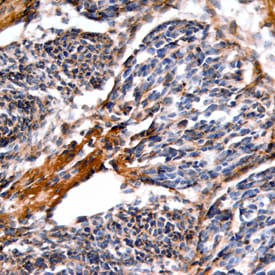
Secreted Frizzled Related Protein 3 (sFRP-3) was originally identified in bovine cartilage for its chondrogenic ability. Human, mouse, chick and Xenopus clones have also been isolated. sFRP-3 is often referred to as FRZB, other names also include Fritz, Frzb1, and FRP-3. At the amino acid sequence level, sFRP-3 is highly conserved. The mouse protein shares 76% identity with Xenopus and 92% with human proteins. The gene for mouse sFRP-3 has been localized to the central region of chromosome 2. Murine sFRP-3 is expressed in the primitive streak during gastrulation, as well as in the retina, foregut diverticulum, nervous system, and posterior mesoderm during development. In adult tissues, sFRP-3 expression, as determined by Northern blot, is detected in the heart, brain, spleen, skeletal muscle, kidney, and testis.
The N-terminal portion of sFRP-3 protein shows 50% amino acid identity to the corresponding region of the Drosophila frizzled gene product, a receptor for Wg/Wnt signals. The similarity of sFRP-3 with frizzled proteins is restricted to the N-terminal cysteine-rich domain (CRD) that contains at least ten cysteine residues with highly conserved spacing between them. sFRP-3 was subsequently shown to be a soluble antagonist of Wnt signals. It lacks all transmembrane domains of frizzled proteins but retains the ability to bind Wnts. Ectopic expression of sFRP-3 mRNA has been shown to interfere with the induction of secondary axes in Xenopus embryos injected with Xwnt-8 mRNA.
 Powered by Bioz
