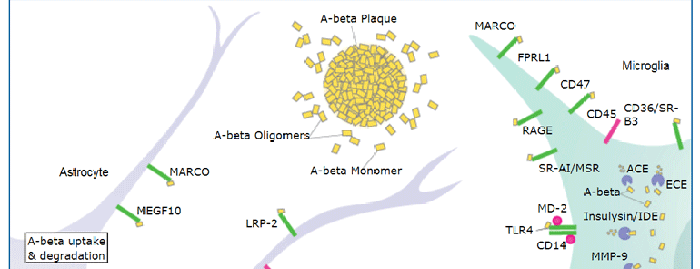
The scavenger receptor (SR) family comprises a group of functionally defined membrane receptors that share the common ability to bind and internalize modified forms of Low Density Lipoproteins (mLDL) (1 - 3). Family members are classified alphabetically. The A class include four proteins: the three subtypes of SR-A (AI, AII, and AIII) that are generated by alternative splicing of the same gene, and a structurally similar protein named MARCO (4). All A class SRs are multidomain trimeric type II membrane proteins. SR-AI has an N-terminal cytoplasmic domain, a transmembrane domain, a spacer domain, an alpha -helical coiled coil, a collagen-like domain and a C-terminal cysteine-rich domain. SR-A is expressed by most tissue macrophages, dendritic cells and Kupffer cells. It is also highly expressed by microglia in neonatal as well as Alzheimer’ Disease brains. SR-AI binds a broad range of polyanionic ligands including modified proteins (e.g. Oxidized, acetylated or maleylated LDL, Advanced glycation end-product proteins), polyribonucleotides (polyguanosine and polyinosine), polysaccharides (dextran sulfate, fucoidan), phospholipids (phosphatidylserine), bacterial products (lipopolysaccharide and lipoteichoic acid) and selected chemical compounds (silica, crocidolite asbestos). The ligand-binding region has been localized to a positively charged region in the carboxyl end of the collagen-like domain. Based on its ligand binding characteristics, SR-AI is implicated in many physiological and pathophysiological functions. Studies using SR-A knockout mouse have also suggested roles of SR-A in atherogenesis, host defense and innate immunity, acquired immune responses, macrophage adhesion, and phagocytosis of apoptotic cells (1 - 3).
Mouse SR-AI/MSR Antibody
R&D Systems | Catalog # AF1797

Key Product Details
Species Reactivity
Validated:
Mouse
Cited:
Human, Mouse
Applications
Validated:
Western Blot, Blockade of Receptor-ligand Interaction
Cited:
Immunohistochemistry, Western Blot, Neutralization, Flow Cytometry, Immunocytochemistry, In vivo assay
Label
Unconjugated
Antibody Source
Polyclonal Goat IgG
Loading...
Product Specifications
Immunogen
Mouse myeloma cell line NS0-derived recombinant mouse SR-AI/MSR
Trp79-Ser454
Accession # AAA39747
Trp79-Ser454
Accession # AAA39747
Specificity
Detects mouse SR-A1/MSR in direct ELISAs and Western blots.
Clonality
Polyclonal
Host
Goat
Isotype
IgG
Endotoxin Level
<0.10 EU per 1 μg of the antibody by the LAL method.
Scientific Data Images for Mouse SR-AI/MSR Antibody
Detection of Mouse SR-AI/MSR by Western Blot
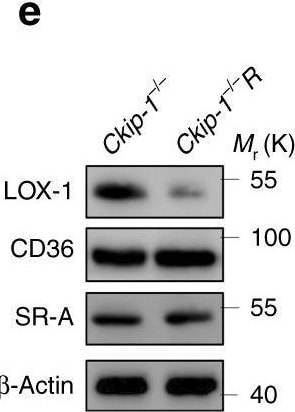
CKIP-1 diminishes Oct-1-mediated LOX-1 expression. e Expression of LOX-1, CD36, and SR-A in Ckip-1−/− and Ckip-1−/−R BMDMs. Image collected and cropped by CiteAb from the following open publication (https://pubmed.ncbi.nlm.nih.gov/30683852), licensed under a CC-BY license. Not internally tested by R&D Systems.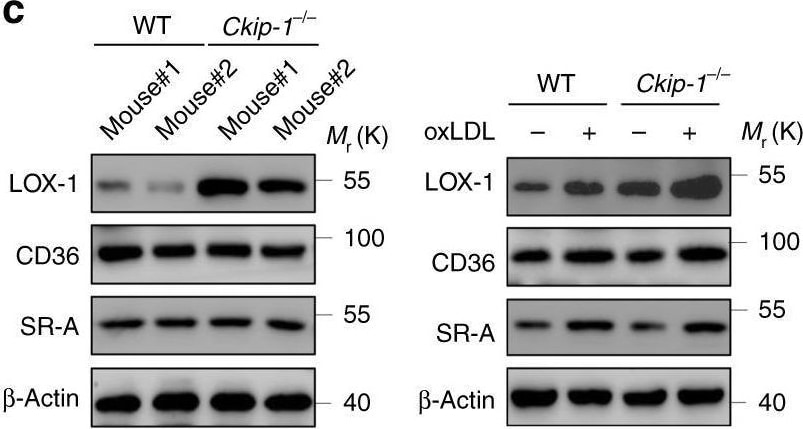
Detection of Mouse SR-AI/MSR by Western Blot
CKIP-1 diminishes Oct-1-mediated LOX-1 expression. c Expression of LOX-1, CD36, and SR-A in WT and Ckip-1−/− BMDMs after 24 h incubation with or without 20 μg per ml oxLDL. Image collected and cropped by CiteAb from the following open publication (https://pubmed.ncbi.nlm.nih.gov/30683852), licensed under a CC-BY license. Not internally tested by R&D Systems.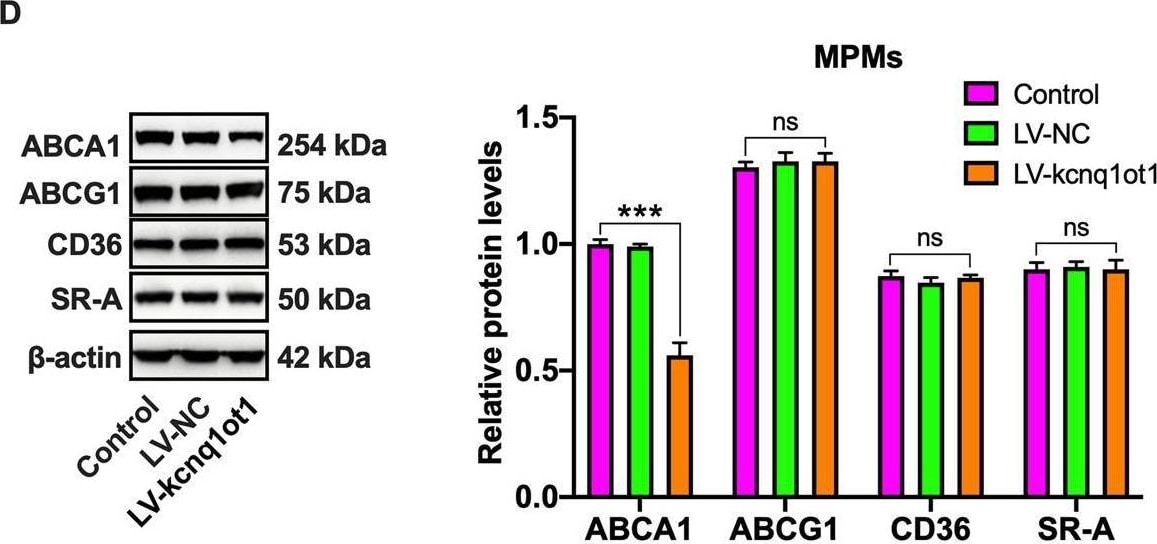
Detection of SR-AI/MSR by Western Blot
Effects of kcnq1ot1 on cholesterol transporter and receptor expression. A, B The mRNA and protein levels of ABCA1, ABCG1, CD36, and SR-A in the aorta from apoE−/− mice were assayed by qRT-PCR and western blot, respectively (n = 10). C, D qRT-PCR and western blot analyses of ABCA1, ABCG1, CD36 and SR-A expression in MPMs from apoE−/− mice (n = 5). E, F After treatment of THP-1 macrophages with PBS, LV-NC or LV-kcnq1ot1 for 72 h, both qRT-PCR and western blot were employed for detection of ABCA1, ABCG1, CD36, and SR-A expressions. Data are represented as mean ± SD. ***P < 0.001; ns not significant. Image collected and cropped by CiteAb from the following open publication (https://pubmed.ncbi.nlm.nih.gov/33293505), licensed under a CC-BY license. Not internally tested by R&D Systems.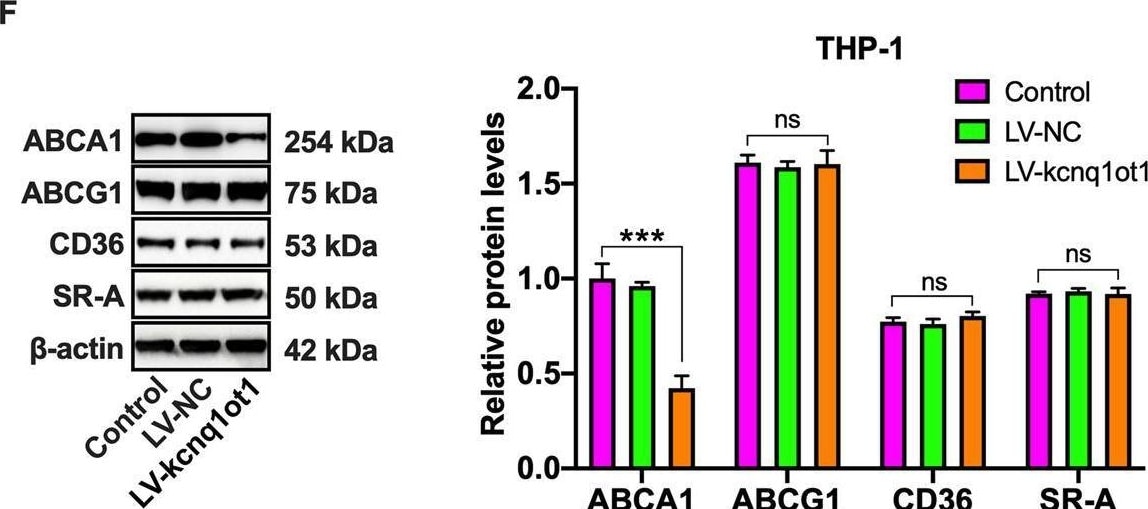
Detection of SR-AI/MSR by Western Blot
Effects of kcnq1ot1 on cholesterol transporter and receptor expression. A, B The mRNA and protein levels of ABCA1, ABCG1, CD36, and SR-A in the aorta from apoE−/− mice were assayed by qRT-PCR and western blot, respectively (n = 10). C, D qRT-PCR and western blot analyses of ABCA1, ABCG1, CD36 and SR-A expression in MPMs from apoE−/− mice (n = 5). E, F After treatment of THP-1 macrophages with PBS, LV-NC or LV-kcnq1ot1 for 72 h, both qRT-PCR and western blot were employed for detection of ABCA1, ABCG1, CD36, and SR-A expressions. Data are represented as mean ± SD. ***P < 0.001; ns not significant. Image collected and cropped by CiteAb from the following open publication (https://pubmed.ncbi.nlm.nih.gov/33293505), licensed under a CC-BY license. Not internally tested by R&D Systems.Applications for Mouse SR-AI/MSR Antibody
Application
Recommended Usage
Blockade of Receptor-ligand Interaction
In a functional ELISA, 0.5-2 µg/mL of this antibody will block 50% of the binding of 100 ng/mL of biotinylated AGE‑BSA to immobilized Recombinant Mouse SR-AI/MSR1 (Catalog # 1797-MS) coated at 5 µg/mL (100 µL/well). At 20 µg/mL, this antibody will block >90% of the binding.
Western Blot
0.1 µg/mL
Sample: Recombinant Mouse SR-AI/MSR (Catalog # 1797-MS)
Sample: Recombinant Mouse SR-AI/MSR (Catalog # 1797-MS)
Formulation, Preparation, and Storage
Purification
Antigen Affinity-purified
Reconstitution
Reconstitute at 0.2 mg/mL in sterile PBS. For liquid material, refer to CoA for concentration.
Loading...
Formulation
Lyophilized from a 0.2 μm filtered solution in PBS with Trehalose. *Small pack size (SP) is supplied either lyophilized or as a 0.2 µm filtered solution in PBS.
Shipping
Lyophilized product is shipped at ambient temperature. Liquid small pack size (-SP) is shipped with polar packs. Upon receipt, store immediately at the temperature recommended below.
Stability & Storage
Use a manual defrost freezer and avoid repeated freeze-thaw cycles.
- 12 months from date of receipt, -20 to -70 °C as supplied.
- 1 month, 2 to 8 °C under sterile conditions after reconstitution.
- 6 months, -20 to -70 °C under sterile conditions after reconstitution.
Calculators
Background: SR-AI/MSR
References
- Daugherty, A. et al. (2000) Curr. Opin. Cardiovasc. Pulm. Ren. Invest. Drugs 2:223.
- Platt, N. and S. Gordon (2001) J. Clin. Invest. 108:649.
- Platt, N. and S. Gordon (1998) Chem. Biol. 5:R193.
- Elomaa, O. et al. (1995) Cell 80:603.
Long Name
Macrophage Scavenger Receptor Types I and II
Alternate Names
CD204, MSR1, SCARA1, SRAI
Gene Symbol
MSR1
UniProt
Additional SR-AI/MSR Products
Product Documents for Mouse SR-AI/MSR Antibody
Certificate of Analysis
To download a Certificate of Analysis, please enter a lot or batch number in the search box below.
Note: Certificate of Analysis not available for kit components.
Product Specific Notices for Mouse SR-AI/MSR Antibody
For research use only
Related Research Areas
Citations for Mouse SR-AI/MSR Antibody
 Powered by Bioz
Customer Reviews for Mouse SR-AI/MSR Antibody
There are currently no reviews for this product. Be the first to review Mouse SR-AI/MSR Antibody and earn rewards!
Have you used Mouse SR-AI/MSR Antibody?
Submit a review and receive an Amazon gift card!
$25/€18/£15/$25CAN/¥2500 for a review with an image
$10/€7/£6/$10CAN/¥1110 for a review without an image
Submit a review
Protocols
Find general support by application which include: protocols, troubleshooting, illustrated assays, videos and webinars.
- Cellular Response to Hypoxia Protocols
- R&D Systems Quality Control Western Blot Protocol
- Troubleshooting Guide: Western Blot Figures
- Western Blot Conditions
- Western Blot Protocol
- Western Blot Protocol for Cell Lysates
- Western Blot Troubleshooting
- Western Blot Troubleshooting Guide
- View all Protocols, Troubleshooting, Illustrated assays and Webinars
Loading...
Associated Pathways