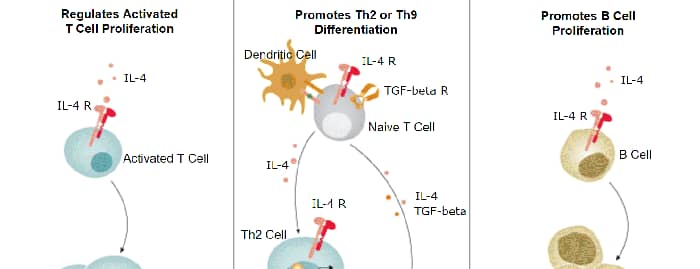
VCAM-1 (CD106), a member of the immunoglobulin superfamily, is a cell surface protein expressed by activated endothelial cells and certain leukocytes (such as macrophages). VCAM-1 expression is induced by IL-1 beta, IL-4, TNF-alpha and IFN-gamma. VCAM-1 binds to leukocyte integrins VLA-4 and alpha 4 beta 7. The human and mouse VCAM-1 proteins share approximately 76% amino acid similarity. During the inflammatory adhesion mechanism, activated integrins halt rolling leukocytes and attach them firmly to the vascular endothelium. They do this by binding to their ligands, for example VCAM-1, on endothelium. The VCAM-1: VLA-4/ alpha 4 beta 7 interaction is also thought to be involved in the extravasation of white blood cells through the blood vessel wall to sites of inflammation. ELISA techniques have shown that detectable levels of soluble VCAM-1 are present in the biological fluids of apparently normal individuals. Furthermore, a number of studies have reported that levels of VCAM-1 may be elevated or lowered in subjects with a variety of pathological conditions.
Mouse VCAM-1/CD106 Antibody (112734)
R&D Systems | Catalog # MAB6432

Scientific images may be resized, cropped, or adjusted for brightness or contrast for presentation purposes. These updates are limited to presentation and do not affect the underlying scientific interpretation of the data. Where available, additional source data may be provided upon request.
Key Product Details
Validated by
Species Reactivity
Validated:
Cited:
Applications
Validated:
Cited:
Label
Antibody Source
Product Specifications
Immunogen
Phe25-Glu698 (predicted)
Accession # P29533
Specificity
Clonality
Host
Isotype
Scientific Data Images for Mouse VCAM-1/CD106 Antibody (112734)
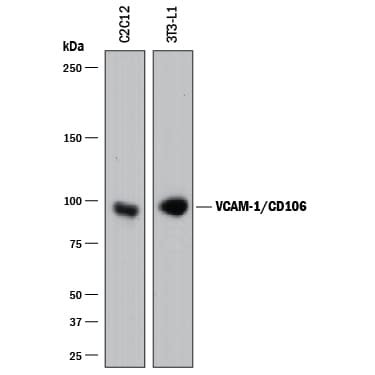
Detection of Mouse VCAM‑1/CD106 by Western Blot.
Western blot shows lysates of 3T3-L1 mouse embryonic fibroblast adipose-like cell line and C2C12 mouse myoblast cell line. PVDF membrane was probed with 2 µg/mL of Rat Anti-Mouse VCAM-1/CD106 Monoclonal Antibody (Catalog # MAB6432) followed by HRP-conjugated Anti-Rat IgG Secondary Antibody (Catalog # HAF005). A specific band was detected for VCAM-1/ CD106 at approximately 95 kDa (as indicated). This experiment was conducted under reducing conditions and using Immunoblot Buffer Group 1.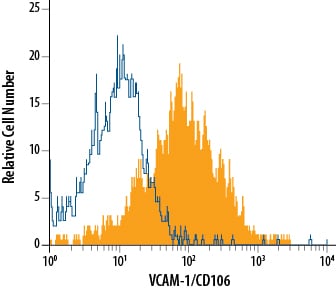
Detection of VCAM‑1/CD106 in bEnd.3 Mouse Cell Line by Flow Cytometry.
bEnd.3 mouse endothelioma cell line was stained with Rat Anti-Mouse VCAM-1/CD106 Monoclonal Antibody (Catalog # MAB6432, filled histogram) or isotype control antibody (Catalog # MAB006, open histogram), followed by Allophycocyanin-conjugated Anti-Rat IgG Secondary Antibody (Catalog # F0113).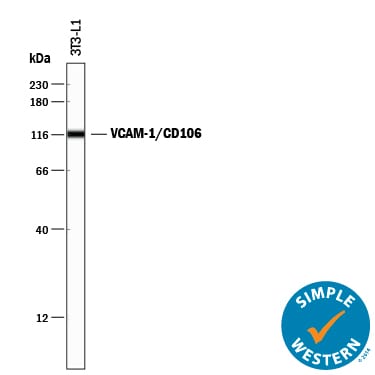
Detection of Mouse VCAM‑1/CD106 by Simple WesternTM.
Simple Western lane view shows lysates of 3T3-L1 mouse embryonic fibroblast adipose-like cell line, loaded at 0.2 mg/mL. A specific band was detected for VCAM-1/CD106 at approximately 118 kDa (as indicated) using 100 µg/mL of Rat Anti-Mouse VCAM-1/CD106 Monoclonal Antibody (Catalog # MAB6432) followed by 1:50 dilution of HRP-conjugated Anti-Rat IgG Secondary Antibody (Catalog # HAF005). This experiment was conducted under reducing conditions and using the 12-230 kDa separation system.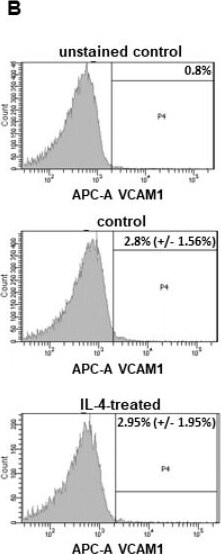
Detection of Mouse VCAM-1/CD106 by Flow Cytometry
Analysis of IL-4 influence on expression of selected cell membrane proteins in ESCs. (A) Expression of Cdh15, Vcam1, Itga4, and Itgb1 in undifferentiated and differentiating ESCs cultured with or without exogenous IL-4. beta -actin was used as a reference gene. RQ = 1 for the expression level detected in 13.5-day-old mouse embryo. Data are presented as means of three independent experiments with standard deviations; * p < 0.05; ** p < 0.01. (B) Representative histograms presenting percentage of cells synthesizing VCAM1 in unstained control (upper), control (middle), or IL-4-treated (bottom) ESCs after 2 days of treatment, analyzed with flow cytometry. Image collected and cropped by CiteAb from the following publication (https://pubmed.ncbi.nlm.nih.gov/31412558), licensed under a CC-BY license. Not internally tested by R&D Systems.
Mouse VCAM-1 / CD106 ELISA Standard Curve
Recombinant Mouse VCAM‑1/CD106 Fc Chimera (Catalog # 643-VM) was serially diluted and captured by Rat Anti-Mouse VCAM‑1/CD106 Monoclonal Antibody (Catalog # MAB6432) coated on a Clear Polystyrene Microplate (Catalog # DY990). Rat Anti-Mouse VCAM‑1/CD106 Biotinylated Monoclonal Antibody (Catalog # ) was incubated with the protein captured on the plate. Detection of the standard curve was achieved by incubating Streptavidin-HRP (Catalog # DY998)Applications for Mouse VCAM-1/CD106 Antibody (112734)
CyTOF-ready
Flow Cytometry
Sample: bEnd.3 mouse endothelioma cell line
Simple Western
Sample: 3T3‑L1 mouse embryonic fibroblast adipose-like cell line
Western Blot
Sample: 3T3‑L1 mouse embryonic fibroblast adipose-like cell line and C2C12 mouse myoblast cell line
Mouse VCAM-1/CD106 Sandwich Immunoassay
Reviewed Applications
Read 2 reviews rated 5 using MAB6432 in the following applications:
Flow Cytometry Panel Builder
Bio-Techne Knows Flow Cytometry
Save time and reduce costly mistakes by quickly finding compatible reagents using the Panel Builder Tool.
Advanced Features
- Spectra Viewer - Custom analysis of spectra from multiple fluorochromes
- Spillover Popups - Visualize the spectra of individual fluorochromes
- Antigen Density Selector - Match fluorochrome brightness with antigen density

Formulation, Preparation, and Storage
Purification
Reconstitution
Reconstitute at 0.5 mg/mL in sterile PBS. For liquid material, refer to CoA for concentration.
Formulation
Shipping
Stability & Storage
- 12 months from date of receipt, -20 to -70 °C as supplied.
- 1 month, 2 to 8 °C under sterile conditions after reconstitution.
- 6 months, -20 to -70 °C under sterile conditions after reconstitution.
Calculators
Background: VCAM-1/CD106
Long Name
Alternate Names
Gene Symbol
UniProt
Additional VCAM-1/CD106 Products
Product Documents for Mouse VCAM-1/CD106 Antibody (112734)
Certificate of Analysis
To download a Certificate of Analysis, please enter a lot or batch number in the search box below.
Note: Certificate of Analysis not available for kit components.
Product Specific Notices for Mouse VCAM-1/CD106 Antibody (112734)
For research use only
Related Research Areas
Citations for Mouse VCAM-1/CD106 Antibody (112734)
 Powered by Bioz
Customer Reviews for Mouse VCAM-1/CD106 Antibody (112734) (2)
Have you used Mouse VCAM-1/CD106 Antibody (112734)?
Submit a review and receive an Amazon gift card!
$25/€18/£15/$25CAN/¥2500 for a review with an image
$10/€7/£6/$10CAN/¥1110 for a review without an image
Submit a review
-
Application: Western BlotSample Tested: SVEC4-10 mouse vascular endothelial cell lineSpecies: MouseVerified Customer | Posted 05/27/2019
-
Application: Western BlotSample Tested: Cell LysatesSpecies: MouseVerified Customer | Posted 03/13/2019
There are no reviews that match your criteria.
Protocols
Find general support by application which include: protocols, troubleshooting, illustrated assays, videos and webinars.
- 7-Amino Actinomycin D (7-AAD) Cell Viability Flow Cytometry Protocol
- Cellular Response to Hypoxia Protocols
- Extracellular Membrane Flow Cytometry Protocol
- Flow Cytometry Protocol for Cell Surface Markers
- Flow Cytometry Protocol for Staining Membrane Associated Proteins
- Flow Cytometry Staining Protocols
- Flow Cytometry Troubleshooting Guide
- Intracellular Flow Cytometry Protocol Using Alcohol (Methanol)
- Intracellular Flow Cytometry Protocol Using Detergents
- Intracellular Nuclear Staining Flow Cytometry Protocol Using Detergents
- Intracellular Staining Flow Cytometry Protocol Using Alcohol Permeabilization
- Intracellular Staining Flow Cytometry Protocol Using Detergents to Permeabilize Cells
- Propidium Iodide Cell Viability Flow Cytometry Protocol
- Protocol for Liperfluo
- Protocol for the Characterization of Human Th22 Cells
- Protocol for the Characterization of Human Th9 Cells
- Protocol: Annexin V and PI Staining by Flow Cytometry
- Protocol: Annexin V and PI Staining for Apoptosis by Flow Cytometry
- R&D Systems Quality Control Western Blot Protocol
- Troubleshooting Guide: Fluorokine Flow Cytometry Kits
- Troubleshooting Guide: Western Blot Figures
- Western Blot Conditions
- Western Blot Protocol
- Western Blot Protocol for Cell Lysates
- Western Blot Troubleshooting
- Western Blot Troubleshooting Guide
- View all Protocols, Troubleshooting, Illustrated assays and Webinars
Associated Pathways