

Human Amphiregulin Antibody

R&D Systems | Catalog # AB-262-NA

R&D Systems
Loading...

Key Product Details

Species Reactivity

Validated:

Human

Cited:

Human

Applications

Validated:

Immunohistochemistry, Western Blot, Neutralization

Cited:

Neutralization

Label

Unconjugated

Antibody Source

Polyclonal Goat IgG
Loading...

Product Specifications

Immunogen

E. coli-derived recombinant human Amphiregulin
Val107-Lys184
Accession # P15514

Specificity

Detects human Amphiregulin in direct ELISAs and Western blots. In direct ELISAs, less than 1% cross-reactivity with recombinant human (rh) EGF, rhTGF-alpha, and rhHB-EGF is observed.

Clonality

Polyclonal

Host

Goat

Isotype

IgG

Endotoxin Level

<0.10 EU per 1 μg of the antibody by the LAL method.

Scientific Data Images for Human Amphiregulin Antibody

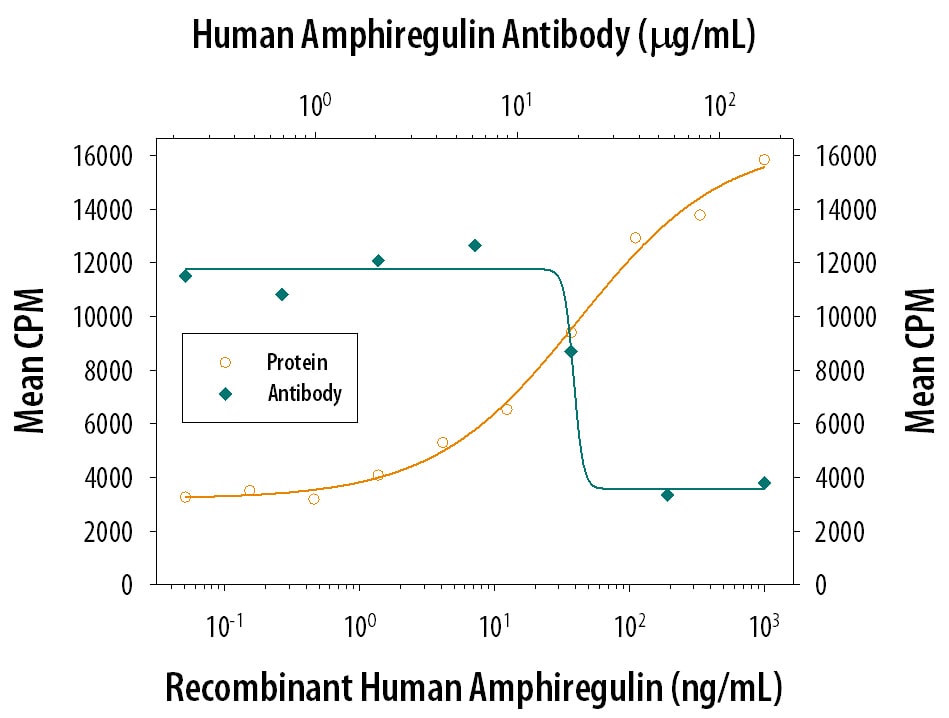
Cell Proliferation Induced by Amphiregulin and Neutralization by Human Amphiregulin Antibody.

Cell Proliferation Induced by Amphiregulin and Neutralization by Human Amphiregulin Antibody.

Recombinant Human Amphiregulin (Catalog # 262-AR) stimulates proliferation in the Balb/3T3 mouse embryonic fibroblast cell line in a dose-dependent manner (orange line). Proliferation elicited by Recombinant Human Amphiregulin (50 ng/mL) is neutralized (green line) by increasing concentrations of Goat Anti-Human Amphiregulin Polyclonal Antibody (Catalog # AB-262-NA). The ND50 is typically 5-20 µg/mL.

Applications for Human Amphiregulin Antibody

Application
Recommended Usage

Immunohistochemistry

5-15 µg/mL
Sample: Immersion fixed paraffin-embedded sections of human breast cancer tissue

Western Blot

1 µg/mL
Sample: Recombinant Human Amphiregulin (Catalog # 262-AR)

Neutralization

Measured by its ability to neutralize Amphiregulin-induced proliferation in the Balb/3T3 mouse embryonic fibroblast cell line. The Neutralization Dose (ND50) is typically 5-20 µg/mL in the presence of 50 ng/mL Recombinant Human Amphiregulin.

Formulation, Preparation, and Storage

Purification

Protein A or G purified

Reconstitution

Reconstitute at 1 mg/mL in sterile PBS.


Loading...

Formulation

Lyophilized from a 0.2 μm filtered solution in PBS with Trehalose.

Shipping

The product is shipped at ambient temperature. Upon receipt, store it immediately at the temperature recommended below.

Stability & Storage

Use a manual defrost freezer and avoid repeated freeze-thaw cycles.
  • 12 months from date of receipt, -20 to -70 °C as supplied.
  • 1 month, 2 to 8 °C under sterile conditions after reconstitution.
  • 6 months, -20 to -70 °C under sterile conditions after reconstitution.

Calculators

The reconstitution calculator allows you to quickly calculate the volume of a reagent to reconstitute your vial. Simply enter the mass of reagent and the target concentration and the calculator will determine the rest.

=
÷

Background: Amphiregulin

Amphiregulin (AR) is a member of the EGF family of cytokines which is comprised of at least ten proteins including EGF, TGF-alpha, HB-EGF, and the various heregulins. All of these cytokines are synthesized as transmembrane precursors and are characterized by the presence of one or several EGF structural units in their extracellular domain. The soluble forms of these cytokines are released by proteolytic cleavage. Amphiregulin was originally isolated from the conditioned media of a PMA-treated MCF-7 human breast carcinoma cell line. The AR cDNA encodes a 252 amino acid (aa) residue transmembrane precursor. Multiple forms of native AR containing either 78 or 84 aa residues and both N- and O-linked oligosaccharides have been found. Amphiregulin mRNA expression can be detected in numerous carcinoma cell lines and the epithelial cells of various human tissues including colon, stomach, breast, ovary, kidney, etc.

Human AR stimulates the proliferation of various human and mouse keratinocytes, mammary epithelial cells and some fibroblasts. AR is also a growth inhibitor for various tumor cell lines. In certain colon carcinoma cell lines, AR has been shown to be an autocrine growth factor. Amphiregulin can bind to the EGF receptor. It has been suggested that in certain cell types, AR bioactivity may be mediated through the EGF receptor. The 98 aa residue long form of recombinant amphiregulin has shown to be approximately 5‑10 fold more active than the 78 aa residue form of recombinant AR in an in vitro proliferation assay using Balb/3T3 fibroblasts.

Alternate Names

AREG

Entrez Gene IDs

374 (Human); 11839 (Mouse)

Gene Symbol

AREG

UniProt

Additional Amphiregulin Products

Product Documents for Human Amphiregulin Antibody

Certificate of Analysis

To download a Certificate of Analysis, please enter a lot or batch number in the search box below.

Note: Certificate of Analysis not available for kit components.

Product Specific Notices for Human Amphiregulin Antibody

For research use only

Related Research Areas

Citations for Human Amphiregulin Antibody

Customer Reviews for Human Amphiregulin Antibody

There are currently no reviews for this product. Be the first to review Human Amphiregulin Antibody and earn rewards!

Have you used Human Amphiregulin Antibody?

Submit a review and receive an Amazon gift card!

$25/€18/£15/$25CAN/¥2500 Yen for a review with an image

$10/€7/£6/$10CAN/¥1110 Yen for a review without an image

Submit a review
Amazon Gift Card

Protocols

Find general support by application which include: protocols, troubleshooting, illustrated assays, videos and webinars.

FAQs

No product specific FAQs exist for this product.

View all FAQs for Antibodies
Loading...

Associated Pathways

Th2 Differentiation Pathway Th2 Differentiation Pathway Thumbnail
