
Biglycan is a small secreted proteoglycan belonging to the leucine-rich repeat (LRR) protein family. It contains a central 12 LRR repeat domain flanked by small cysteine clusters at either side. Two glycosaminoglycans (GAG) chains are attached near the amino terminus. Biglycan binds BMP-4 and Chordin to regulate BMP-4 signaling. It may also be involved in collagen fiber assembly. Human Biglycan shares 98% amino acid sequence homology with mouse Biglycan, 97% sequence homology with rat and bovine Biglycan and 96% sequence homology with canine and equine Biglycan.
Human Biglycan Antibody
R&D Systems | Catalog # AF2667

Scientific images may be resized, cropped, or adjusted for brightness or contrast for presentation purposes. These updates are limited to presentation and do not affect the underlying scientific interpretation of the data. Where available, additional source data may be provided upon request.
Key Product Details
Validated by
Biological Validation
Species Reactivity
Validated:
Human
Cited:
Human, Mouse
Applications
Validated:
Immunohistochemistry, Western Blot
Cited:
Immunohistochemistry, Immunohistochemistry-Paraffin, Immunohistochemistry-Frozen, Western Blot, Flow Cytometry, Immunocytochemistry/ Immunofluorescence, Chromatin Immunoprecipitation (ChIP)
Label
Unconjugated
Antibody Source
Polyclonal Goat IgG
Loading...
Product Specifications
Immunogen
Mouse myeloma cell line NS0-derived recombinant human Biglycan
Asp38-Lys368
Accession # P21810
Asp38-Lys368
Accession # P21810
Specificity
Detects human Biglycan in direct ELISAs and Western blots.
Clonality
Polyclonal
Host
Goat
Isotype
IgG
Scientific Data Images for Human Biglycan Antibody
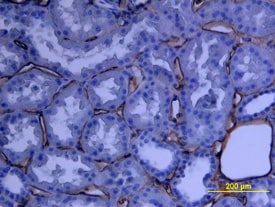
Biglycan in Human Kidney Array.
Biglycan was detected in immersion fixed paraffin-embedded sections of human kidney array using Human Biglycan Antigen Affinity-purified Polyclonal Antibody (Catalog # AF2667) at 15 µg/mL overnight at 4 °C. Tissue was stained using the Anti-Goat HRP-DAB Cell & Tissue Staining Kit (brown; Catalog # CTS008) and counterstained with hematoxylin (blue). View our protocol for Chromogenic IHC Staining of Paraffin-embedded Tissue Sections.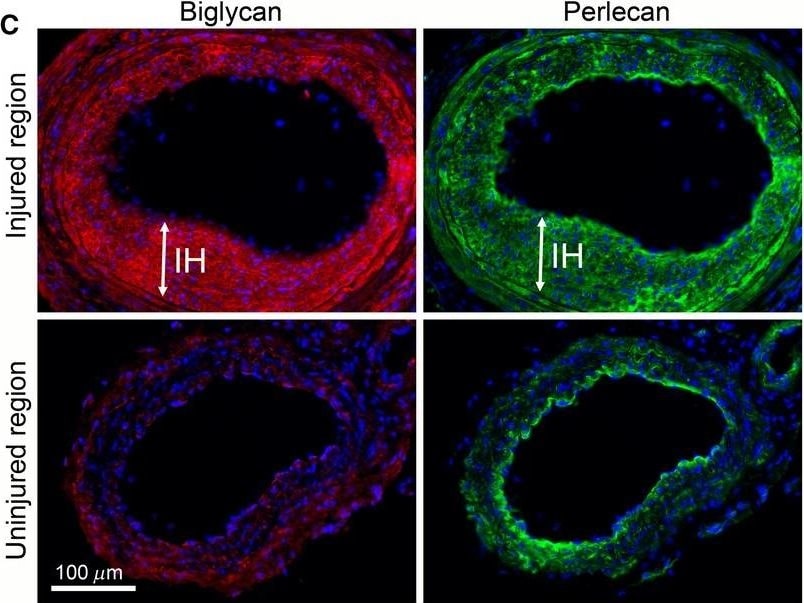
Detection of Mouse Biglycan by Immunocytochemistry/Immunofluorescence
LDL binding to the vessel wall in vitro following treatment with Site B peptide or enzymatic digestion of proteoglycan GAG chains. Tissue sections of carotid arteries from wild‐type mice with intimal hyperplasia were incubated with human LDL. Bound LDL was detected using anti‐apoB antibody. (A) LDL binding to tissue sections pre‐incubated with positively charged SiteB peptide (white circles) or neutrally charged SiteB KE peptide (gray circles). Black circles=no pre‐treatment. White triangles=no LDL incubation (buffer only). (B) LDL binding to tissue sections pre‐treated with the GAG‐degrading enzymes chondroitinase (white circles) or heparinase (white dot circles). Black circles=no pre‐treatment. White triangles=no LDL incubation (buffer only). Data was analyzed using Mann–Whitney rank sum test. Graph bars show median values. P < 0.05 is regarded significant, n = 5–8 in each group. (C) Multi‐immunostaining for biglycan (red, left panels) and perlecan (green, right panels) of tissue sections from the injured region (upper panels) and the uninjured region (lower panels) 3 weeks after carotid injury in a wild‐type mouse. Nuclei are stained with DAPI (blue). Image collected and cropped by CiteAb from the following publication (https://pubmed.ncbi.nlm.nih.gov/28716818), licensed under a CC-BY license. Not internally tested by R&D Systems.Applications for Human Biglycan Antibody
Application
Recommended Usage
Immunohistochemistry
5-15 µg/mL
Sample: Immersion fixed paraffin-embedded sections of human kidney and skin
Sample: Immersion fixed paraffin-embedded sections of human kidney and skin
Western Blot
0.1 µg/mL
Sample: Recombinant Human Biglycan (Catalog # 2667-CM)
Sample: Recombinant Human Biglycan (Catalog # 2667-CM)
Formulation, Preparation, and Storage
Purification
Antigen Affinity-purified
Reconstitution
Reconstitute at 0.2 mg/mL in sterile PBS. For liquid material, refer to CoA for concentration.
Loading...
Formulation
Lyophilized from a 0.2 μm filtered solution in PBS with Trehalose. *Small pack size (SP) is supplied either lyophilized or as a 0.2 µm filtered solution in PBS.
Shipping
Lyophilized product is shipped at ambient temperature. Liquid small pack size (-SP) is shipped with polar packs. Upon receipt, store immediately at the temperature recommended below.
Stability & Storage
Use a manual defrost freezer and avoid repeated freeze-thaw cycles.
- 12 months from date of receipt, -20 to -70 °C as supplied.
- 1 month, 2 to 8 °C under sterile conditions after reconstitution.
- 6 months, -20 to -70 °C under sterile conditions after reconstitution.
Calculators
Background: Biglycan
Alternate Names
BGN, DSPG1, PG-S1, SLRR1A
Gene Symbol
BGN
UniProt
Additional Biglycan Products
Product Documents for Human Biglycan Antibody
Certificate of Analysis
To download a Certificate of Analysis, please enter a lot or batch number in the search box below.
Note: Certificate of Analysis not available for kit components.
Product Specific Notices for Human Biglycan Antibody
For research use only
Related Research Areas
Citations for Human Biglycan Antibody
 Powered by Bioz
Customer Reviews for Human Biglycan Antibody
There are currently no reviews for this product. Be the first to review Human Biglycan Antibody and earn rewards!
Have you used Human Biglycan Antibody?
Submit a review and receive an Amazon gift card!
$25/€18/£15/$25CAN/¥2500 for a review with an image
$10/€7/£6/$10CAN/¥1110 for a review without an image
Submit a review
Protocols
Find general support by application which include: protocols, troubleshooting, illustrated assays, videos and webinars.
- Antigen Retrieval Protocol (PIER)
- Antigen Retrieval for Frozen Sections Protocol
- Appropriate Fixation of IHC/ICC Samples
- Cellular Response to Hypoxia Protocols
- Chromogenic IHC Staining of Formalin-Fixed Paraffin-Embedded (FFPE) Tissue Protocol
- Chromogenic Immunohistochemistry Staining of Frozen Tissue
- ClariTSA™ Fluorophore Kits
- Detection & Visualization of Antibody Binding
- Fluorescent IHC Staining of Frozen Tissue Protocol
- Graphic Protocol for Heat-induced Epitope Retrieval
- Graphic Protocol for the Preparation and Fluorescent IHC Staining of Frozen Tissue Sections
- Graphic Protocol for the Preparation and Fluorescent IHC Staining of Paraffin-embedded Tissue Sections
- Graphic Protocol for the Preparation of Gelatin-coated Slides for Histological Tissue Sections
- IHC Sample Preparation (Frozen sections vs Paraffin)
- Immunofluorescent IHC Staining of Formalin-Fixed Paraffin-Embedded (FFPE) Tissue Protocol
- Immunohistochemistry (IHC) and Immunocytochemistry (ICC) Protocols
- Immunohistochemistry Frozen Troubleshooting
- Immunohistochemistry Paraffin Troubleshooting
- Preparing Samples for IHC/ICC Experiments
- Preventing Non-Specific Staining (Non-Specific Binding)
- Primary Antibody Selection & Optimization
- Protocol for Heat-Induced Epitope Retrieval (HIER)
- Protocol for Making a 4% Formaldehyde Solution in PBS
- Protocol for VisUCyte™ HRP Polymer Detection Reagent
- Protocol for the Preparation & Fixation of Cells on Coverslips
- Protocol for the Preparation and Chromogenic IHC Staining of Frozen Tissue Sections
- Protocol for the Preparation and Chromogenic IHC Staining of Frozen Tissue Sections - Graphic
- Protocol for the Preparation and Chromogenic IHC Staining of Paraffin-embedded Tissue Sections
- Protocol for the Preparation and Chromogenic IHC Staining of Paraffin-embedded Tissue Sections - Graphic
- Protocol for the Preparation and Fluorescent IHC Staining of Frozen Tissue Sections
- Protocol for the Preparation and Fluorescent IHC Staining of Paraffin-embedded Tissue Sections
- Protocol for the Preparation of Gelatin-coated Slides for Histological Tissue Sections
- R&D Systems Quality Control Western Blot Protocol
- TUNEL and Active Caspase-3 Detection by IHC/ICC Protocol
- The Importance of IHC/ICC Controls
- Troubleshooting Guide: Immunohistochemistry
- Troubleshooting Guide: Western Blot Figures
- Western Blot Conditions
- Western Blot Protocol
- Western Blot Protocol for Cell Lysates
- Western Blot Troubleshooting
- Western Blot Troubleshooting Guide
- View all Protocols, Troubleshooting, Illustrated assays and Webinars
Loading...
Associated Pathways

