
Cathepsin V, also known as cathepsin L2 and cathepsin U, is a lysosomal cysteine protease expressed in the thymus, testis, and corneal epithelium. It may play a role in tumor progression since it is expressed in colorectal and breast carcinomas but not in normal colon, mammary gland, or peritumoral tissues. Additionally, it may be involved in corneal physiology. The amino acid sequence of human Cathepsin V shares 99%, 83% and 76% identical with that of chimpanzee, dog and mouse/rat, respectively.
Human Cathepsin V Antibody (182021)
R&D Systems | Catalog # MAB10801

Scientific images may be resized, cropped, or adjusted for brightness or contrast for presentation purposes. These updates are limited to presentation and do not affect the underlying scientific interpretation of the data. Where available, additional source data may be provided upon request.
Key Product Details
Species Reactivity
Validated:
Human
Cited:
Human
Applications
Validated:
Western Blot, Immunoprecipitation
Cited:
Western Blot
Label
Unconjugated
Antibody Source
Monoclonal Mouse IgG2B Clone # 182021
Loading...
Product Specifications
Immunogen
Mouse myeloma cell line NS0-derived recombinant human Cathepsin V
Val18-Val334
Accession # O60911
Val18-Val334
Accession # O60911
Specificity
Detects human Cathepsin V in direct ELISAs and Western blots. In direct ELISAs, no cross‑reactivity with recombinant human (rh) Cathepsin B, C, F, K, L, O, S, or Z is observed. In Western blots, less than 5% cross‑reactivity with rhCathepsin K and no corss-reactivity with rhCathepsin B, C, F, L, O, S, or Z is observed. This antibody specifically identifies the pro form but not the active form of Cathepsin V in Western blots.
Clonality
Monoclonal
Host
Mouse
Isotype
IgG2B
Scientific Data Images for Human Cathepsin V Antibody (182021)
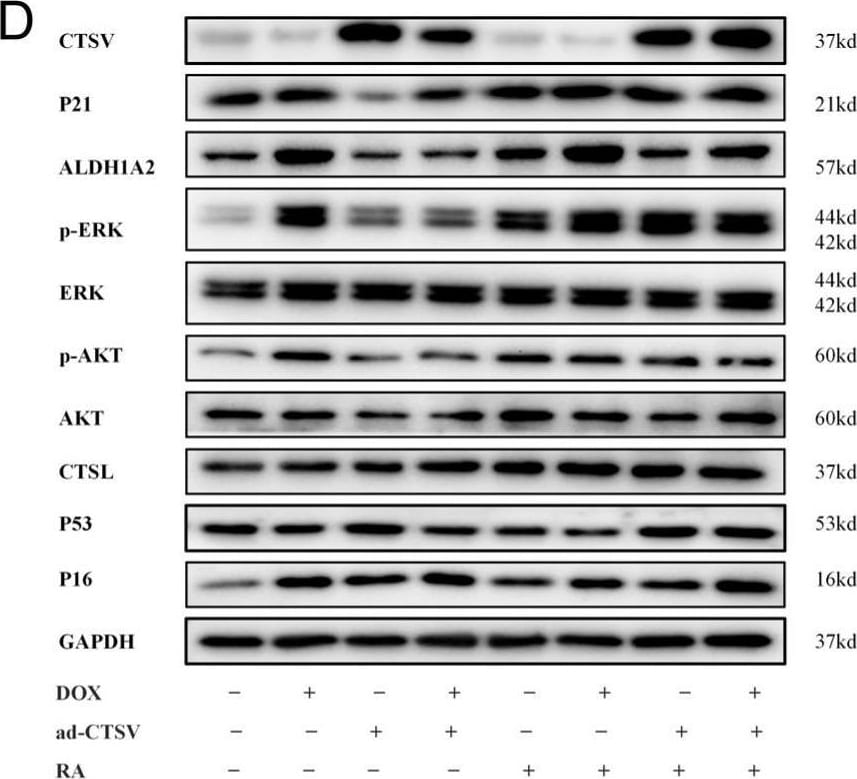
Detection of Cathepsin V by Western Blot
CTSV attenuates DOX-induced cellular senescence. (A). HUVECs were treated with ad-negative control (NC) or ad-CTSV (MOI = 10) for 8 h and simulated with 100 nM doxorubicin (DOX) and 1 μM RA for 24 h after incubated in complete growth medium for 40 h. SA-beta -gal activity was analyzed (blue staining for the senescent cells, scale bar = 50 μm, n = 4). (B) EdU assay of the cell proliferation ability in HUVECs treated with DOX, RA and ad-CTSV (red staining for the EdU, blue staining for Hoechst, scale bar = 25 μm, n = 4). (C) Representative image of the wound healing assay and the quantification of wound area in HUVECs (scale bar = 100 μm, n = 4). (D) Western blot of CTSV, ALDH1A2, P21, p-ERK1/2, ERK1/2, p-AKT, AKT, CTSL, P53, and P16 in HUVECs treated with DOX, RA and ad-CTSV (n = 4). (E) Relative mRNA level of CTSV, ALDH1A2, P21, IL-1 beta, IL-6, and ICAM-1 (n = 4). (F) RA concentration in HUVECs treated with DOX, RA, and ad-CTSV (n = 4). Data are presented as mean ± SEM. One-way ANOVA test was used. * p < 0.05, ** p < 0.01, *** p < 0.001. Image collected and cropped by CiteAb from the following open publication (https://pubmed.ncbi.nlm.nih.gov/36671735), licensed under a CC-BY license. Not internally tested by R&D Systems.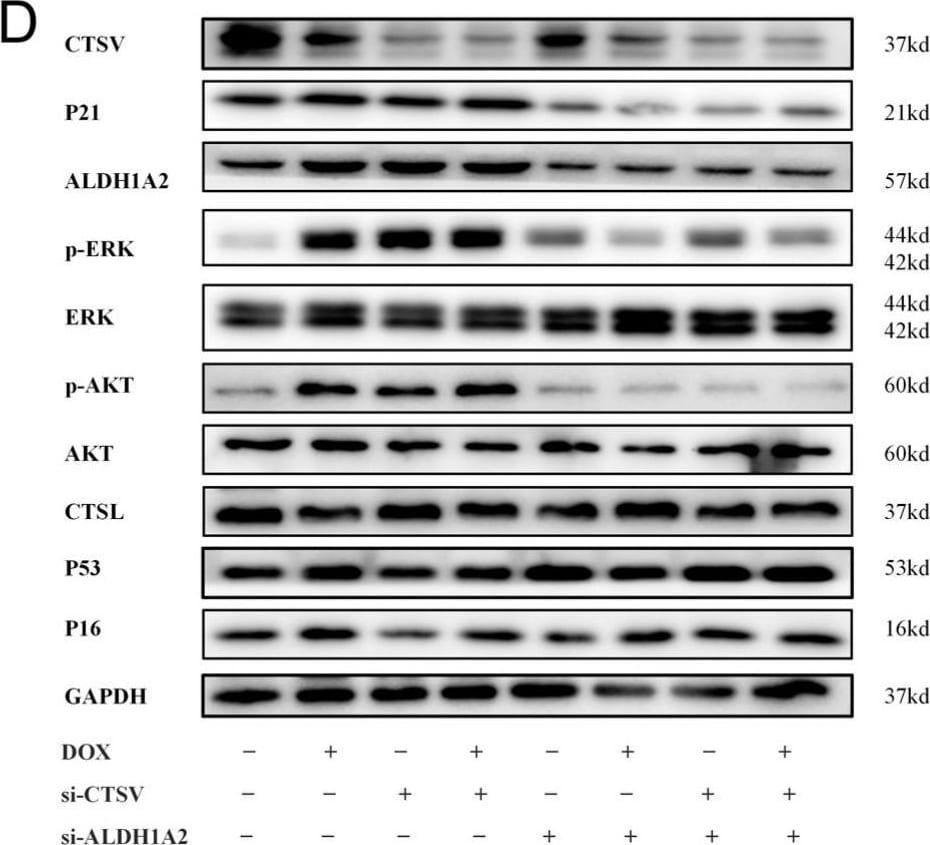
Detection of Cathepsin V by Western Blot
Inhibition of CTSV induces cellular senescence. (A) HUVECs were treated with si-negative control (NC), si-CTSV, si-ALDH1A2 or si-CTSV + si-ALDH1A2 for 24 h and simulated with 100 nM doxorubicin (DOX) for 24 h after incubated in complete growth medium for 24 h. SA-beta -gal activity was analyzed (blue staining for the senescent cells, scale bar = 50 μm, n = 4). (B) EdU assay of the cell proliferation ability in HUVECs treated with DOX, si-CTSV and si-ALDH1A2 (red staining for the EdU, blue staining for Hoechst, scale bar = 25 μm, n = 4). (C) Representative image of the wound healing assay and the quantification of wound area in HUVECs (scale bar = 100 μm, n = 4). (D) Western blot of CTSV, ALDH1A2, P21, p-ERK1/2, ERK1/2, p-AKT, AKT, CTSL, P53 and P16 in HUVECs treated with DOX and siRNAs (n = 4). (E) Relative mRNA level of CTSV, ALDH1A2, P21, IL-1 beta, IL-6 and ICAM-1 (n = 4). (F) RA concentration in HUVECs treated with DOX and siRNAs (n = 4). Data are presented as mean ± SEM. One-way ANOVA test was used. * p < 0.05, ** p < 0.01, *** p < 0.001. Image collected and cropped by CiteAb from the following open publication (https://pubmed.ncbi.nlm.nih.gov/36671735), licensed under a CC-BY license. Not internally tested by R&D Systems.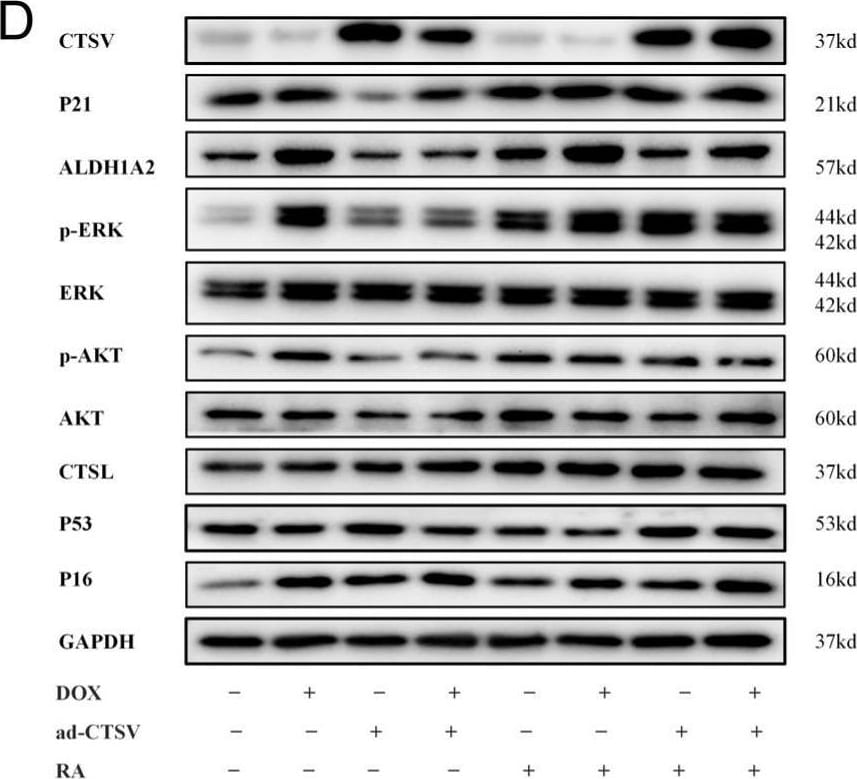
Detection of Cathepsin V by Western Blot
CTSV attenuates DOX-induced cellular senescence. (A). HUVECs were treated with ad-negative control (NC) or ad-CTSV (MOI = 10) for 8 h and simulated with 100 nM doxorubicin (DOX) and 1 μM RA for 24 h after incubated in complete growth medium for 40 h. SA-beta -gal activity was analyzed (blue staining for the senescent cells, scale bar = 50 μm, n = 4). (B) EdU assay of the cell proliferation ability in HUVECs treated with DOX, RA and ad-CTSV (red staining for the EdU, blue staining for Hoechst, scale bar = 25 μm, n = 4). (C) Representative image of the wound healing assay and the quantification of wound area in HUVECs (scale bar = 100 μm, n = 4). (D) Western blot of CTSV, ALDH1A2, P21, p-ERK1/2, ERK1/2, p-AKT, AKT, CTSL, P53, and P16 in HUVECs treated with DOX, RA and ad-CTSV (n = 4). (E) Relative mRNA level of CTSV, ALDH1A2, P21, IL-1 beta, IL-6, and ICAM-1 (n = 4). (F) RA concentration in HUVECs treated with DOX, RA, and ad-CTSV (n = 4). Data are presented as mean ± SEM. One-way ANOVA test was used. * p < 0.05, ** p < 0.01, *** p < 0.001. Image collected and cropped by CiteAb from the following open publication (https://pubmed.ncbi.nlm.nih.gov/36671735), licensed under a CC-BY license. Not internally tested by R&D Systems.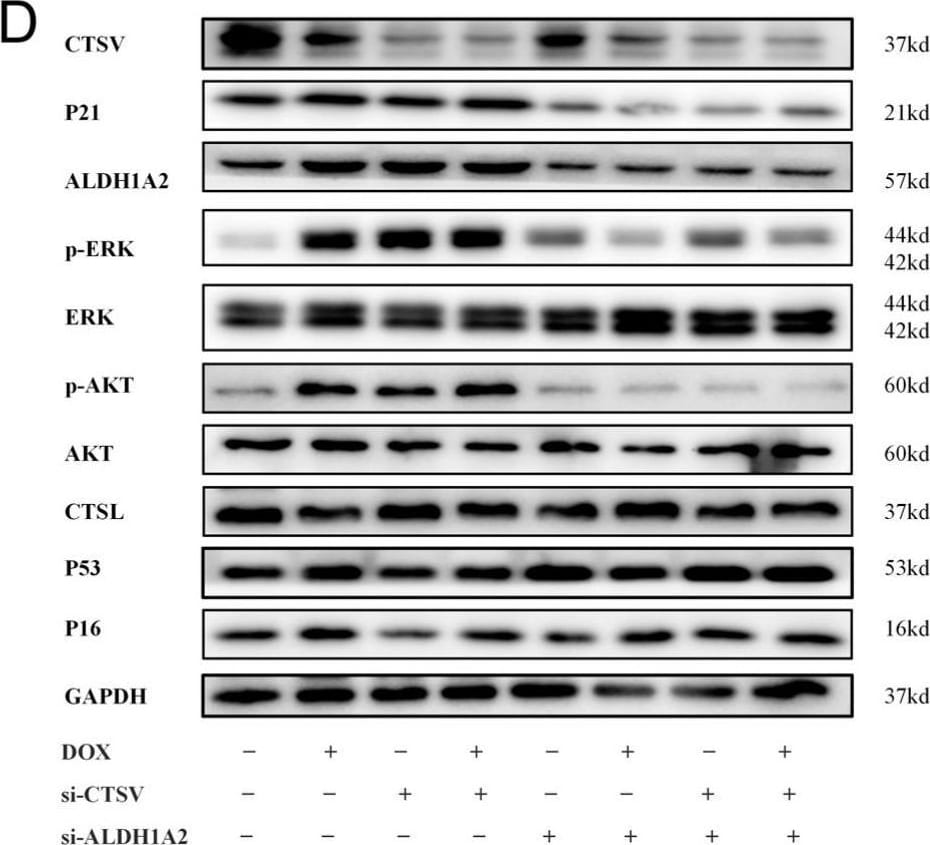
Detection of Cathepsin V by Western Blot
Inhibition of CTSV induces cellular senescence. (A) HUVECs were treated with si-negative control (NC), si-CTSV, si-ALDH1A2 or si-CTSV + si-ALDH1A2 for 24 h and simulated with 100 nM doxorubicin (DOX) for 24 h after incubated in complete growth medium for 24 h. SA-beta -gal activity was analyzed (blue staining for the senescent cells, scale bar = 50 μm, n = 4). (B) EdU assay of the cell proliferation ability in HUVECs treated with DOX, si-CTSV and si-ALDH1A2 (red staining for the EdU, blue staining for Hoechst, scale bar = 25 μm, n = 4). (C) Representative image of the wound healing assay and the quantification of wound area in HUVECs (scale bar = 100 μm, n = 4). (D) Western blot of CTSV, ALDH1A2, P21, p-ERK1/2, ERK1/2, p-AKT, AKT, CTSL, P53 and P16 in HUVECs treated with DOX and siRNAs (n = 4). (E) Relative mRNA level of CTSV, ALDH1A2, P21, IL-1 beta, IL-6 and ICAM-1 (n = 4). (F) RA concentration in HUVECs treated with DOX and siRNAs (n = 4). Data are presented as mean ± SEM. One-way ANOVA test was used. * p < 0.05, ** p < 0.01, *** p < 0.001. Image collected and cropped by CiteAb from the following open publication (https://pubmed.ncbi.nlm.nih.gov/36671735), licensed under a CC-BY license. Not internally tested by R&D Systems.Applications for Human Cathepsin V Antibody (182021)
Application
Recommended Usage
Immunoprecipitation
25 µg/mL
Sample: Conditioned cell culture medium spiked with Recombinant Human Cathepsin V (Catalog # 1080-CY), see our available Western blot detection antibodies
Sample: Conditioned cell culture medium spiked with Recombinant Human Cathepsin V (Catalog # 1080-CY), see our available Western blot detection antibodies
Western Blot
1 µg/mL
Sample: Recombinant Human Cathepsin V (Catalog # 1080-CY)
Sample: Recombinant Human Cathepsin V (Catalog # 1080-CY)
Formulation, Preparation, and Storage
Purification
Protein A or G purified from hybridoma culture supernatant
Reconstitution
Reconstitute at 0.5 mg/mL in sterile PBS. For liquid material, refer to CoA for concentration.
Loading...
Formulation
Lyophilized from a 0.2 μm filtered solution in PBS with Trehalose. *Small pack size (SP) is supplied either lyophilized or as a 0.2 µm filtered solution in PBS.
Shipping
Lyophilized product is shipped at ambient temperature. Liquid small pack size (-SP) is shipped with polar packs. Upon receipt, store immediately at the temperature recommended below.
Stability & Storage
Use a manual defrost freezer and avoid repeated freeze-thaw cycles.
- 12 months from date of receipt, -20 to -70 °C as supplied.
- 1 month, 2 to 8 °C under sterile conditions after reconstitution.
- 6 months, -20 to -70 °C under sterile conditions after reconstitution.
Calculators
Background: Cathepsin V
Alternate Names
Cathepsin L2, Cathepsin U, CTSL2
Entrez Gene IDs
1515 (Human)
Gene Symbol
CTSV
UniProt
Additional Cathepsin V Products
Product Documents for Human Cathepsin V Antibody (182021)
Certificate of Analysis
To download a Certificate of Analysis, please enter a lot or batch number in the search box below.
Note: Certificate of Analysis not available for kit components.
Product Specific Notices for Human Cathepsin V Antibody (182021)
For research use only
Related Research Areas
Citations for Human Cathepsin V Antibody (182021)
 Powered by Bioz
Customer Reviews for Human Cathepsin V Antibody (182021)
There are currently no reviews for this product. Be the first to review Human Cathepsin V Antibody (182021) and earn rewards!
Have you used Human Cathepsin V Antibody (182021)?
Submit a review and receive an Amazon gift card!
$25/€18/£15/$25CAN/¥2500 for a review with an image
$10/€7/£6/$10CAN/¥1110 for a review without an image
Submit a review
Protocols
Find general support by application which include: protocols, troubleshooting, illustrated assays, videos and webinars.
- Cellular Response to Hypoxia Protocols
- Immunoprecipitation Protocol
- R&D Systems Quality Control Western Blot Protocol
- Troubleshooting Guide: Western Blot Figures
- Western Blot Conditions
- Western Blot Protocol
- Western Blot Protocol for Cell Lysates
- Western Blot Troubleshooting
- Western Blot Troubleshooting Guide
- View all Protocols, Troubleshooting, Illustrated assays and Webinars
Loading...