
CCL5, also known as RANTES (Regulated upon Activation, Normal T cell Expressed and presumably Secreted) is a member of the beta (C-C) chemokine subfamily. It binds and activates the chemokine receptors CCR1, 3 and 5.

Scientific images may be resized, cropped, or adjusted for brightness or contrast for presentation purposes. These updates are limited to presentation and do not affect the underlying scientific interpretation of the data. Where available, additional source data may be provided upon request.
Key Product Details
Validated by
Biological Validation
Species Reactivity
Validated:
Human, Primate
Cited:
Human, Primate - Macaca fascicularis (Crab-eating Monkey or Cynomolgus Macaque), Transgenic Mouse
Applications
Validated:
Western Blot, ELISA Capture (Matched Antibody Pair), Neutralization
Cited:
Immunohistochemistry, Neutralization, Immunocytochemistry, Bioassay, ELISA Capture, ELISA Development, ELISA Microarray Development, In vivo assay, Functional Assay, Luminex Development, Mass Spectrometry
Label
Unconjugated
Antibody Source
Monoclonal Mouse IgG1 Clone # 21418
Loading...
Product Specifications
Immunogen
E. coli-derived recombinant human CCL5/RANTES
Specificity
Detects human and primate CCL5/RANTES in direct ELISAs and Western blots. When used in combination with the biotinylated anti-human/primate CCL5/RANTES detection antibody (Catalog # BAF278) in sandwich ELISAs, no significant cross-reactivity or interference is observed with recombinant human (rh) ANG, rhCNTF, rh beta -ECGF, rhEGF, mouse (m) EGF, rhEpo, bovine (b) FGF acidic, rhFGF acidic, bFGF basic, rhFGF basic, rhFGF-4, rhG-CSF, rhGM-CSF, recombinant mouse (rm) GM-CSF, rhGRO alpha, rhIFN-gamma, rhIGF-I, rhIGF-II, rhIL-1 alpha, rmIL-1 alpha, rhIL-1 beta, rmIL‑1 beta, rhIL-1ra, recombinant rat (rr) IL-1ra, rhIL-2, rhIL-3, rmIL-3, rmIL-4, rhIL-5, rmIL-5, rhIL-6, rmIL-6, rhIL-7, rmIL-7, rhIL-8, rhIL-9, rmIL-9, rhIL‑10, rhIL-11, rhLIF, rhMCP‑1, rhM-CSF, rhMIP-1 alpha, rmMIP-1 alpha, rhMIP-1 beta, rmMIP-1 beta, rhOSM, human (h) PDGF, pPDGF, rhPDGF-AA, rhPDGF‑AB, rhPDGF-BB, rhSCF, rmSCF, rhSLPI, rhTGF-alpha, pTGF-beta 1, hTGF-beta 1, rhTGF-beta 1, pTGF-beta 2, rhTGF-beta 2, recombinant canine TGF-beta 3, rhTGF-beta 3, recombinant amphibian TGF-beta 5, rhTNF-alpha, rmTNF-alpha, or rmTNF-beta.
Clonality
Monoclonal
Host
Mouse
Isotype
IgG1
Endotoxin Level
<0.10 EU per 1 μg of the antibody by the LAL method.
Scientific Data Images for CCL5/RANTES Antibody (21418)
Detection of Human CCL5/RANTES by Functional
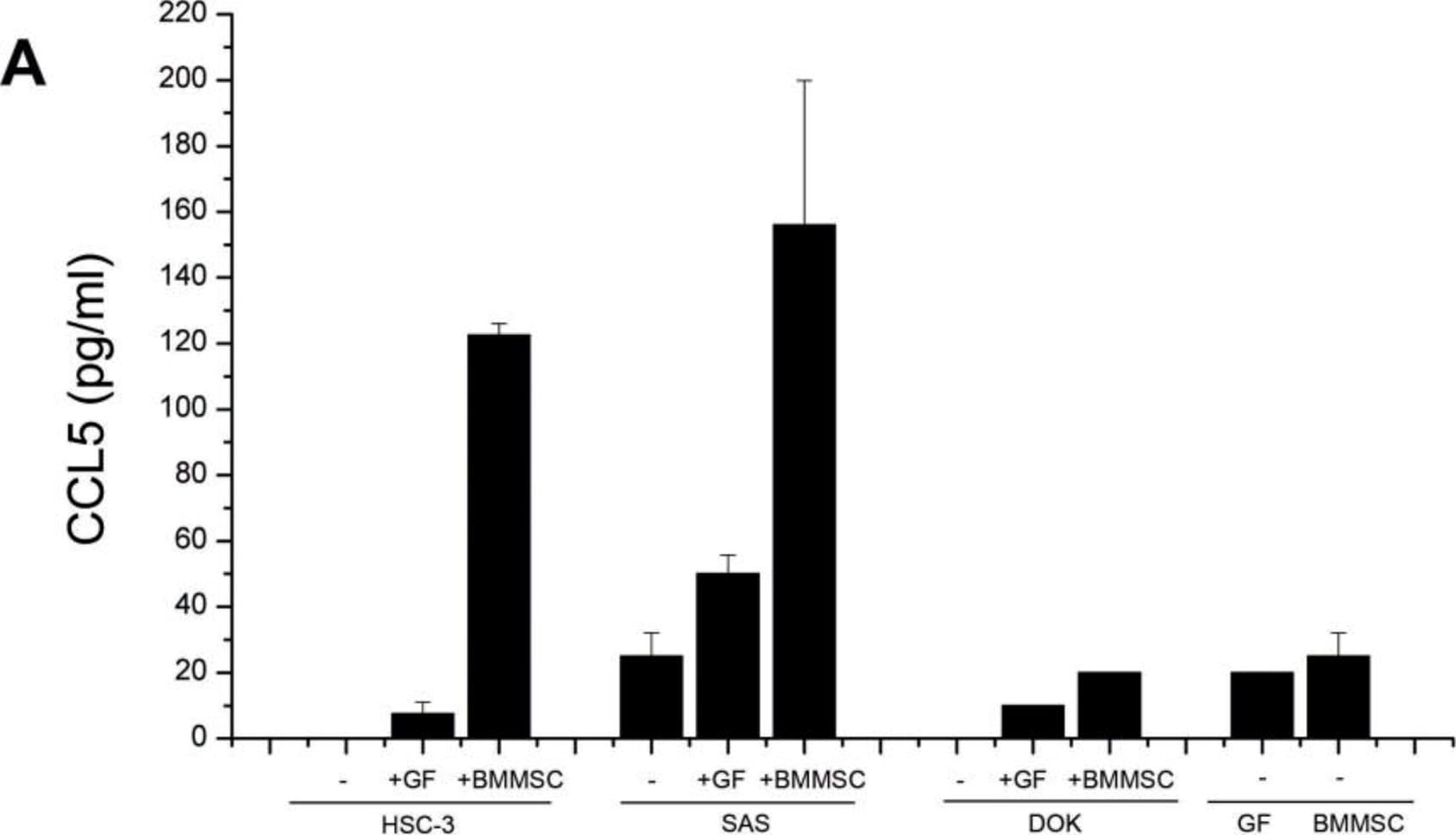
The expression of chemokine CCL5 is up-regulated in co-cultures of BMMSCs cells and OTSCC.Co-culture of OTSCC cells with BMMSCs results in the high expression of chemokine CCL5 in HSC-3 and SAS cells, but not in dysplastic DOK cells (A). Function-blocking monoclonal antibody against CCL5 (Mab CCL5) slightly inhibits BMMSC enhanced invasion area, but has no effect on the invasion depth, whereas the antibody against CXCL1 does not increase the inhibitory effect in OTSCC invasion (B, C). Image collected and cropped by CiteAb from the following publication (https://pubmed.ncbi.nlm.nih.gov/24204919), licensed under a CC-BY license. Not internally tested by R&D Systems.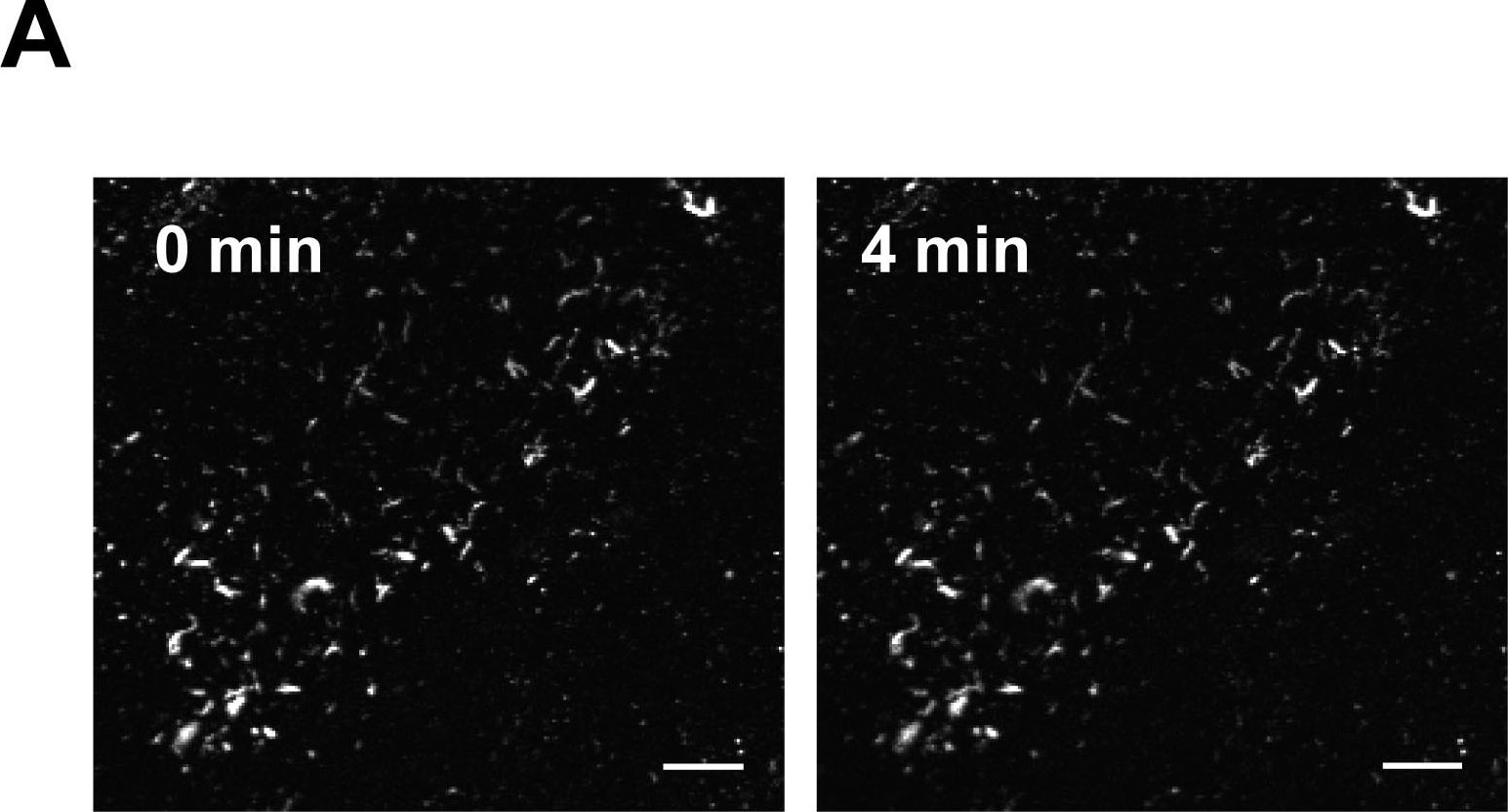
Detection of Human CCL5/RANTES by Immunocytochemistry/Immunofluorescence
RANTES filaments are present after exposure to shear stress.(A) HUVECs were electroporated with DNA encoding RANTES, cultivated on coverslips before stimulation with TNF alpha + IFN gamma for 30 h. RANTESwas labeled with an anti-RANTES antibody (clone 21418), and the cover slipswere mounted in a laminar flow chamber. The flow rate was adjusted to mimicvessel wall shear stress of 1 dyne/cm2. The imageswere acquired by confocal microscopy before (left image, 0 min) andafter 4 min with exposure to flow forces (right image, 4 min).(B) HUVECs were treated as described in (A) except that they were notlabeled with anti-RANTES antibody before exposure to flow. Human peripheralblood mononuclear cells were labeled with an anti-CD45 antibody, resuspendedin medium and applied by a pump to the flow chamber(1 dyne/cm2). After 10 min, the cells werelabeled with a rabbit anti-RANTES antibody. Images were acquired bysequential scanning confocal microscopy. Arrows and arrow heads indicateRANTES filaments and RANTES positive platelets, respectively. Originalmagnification in all panels, × 100. Scale bars, 10 μm. Image collected and cropped by CiteAb from the following publication (https://pubmed.ncbi.nlm.nih.gov/25791723), licensed under a CC-BY license. Not internally tested by R&D Systems.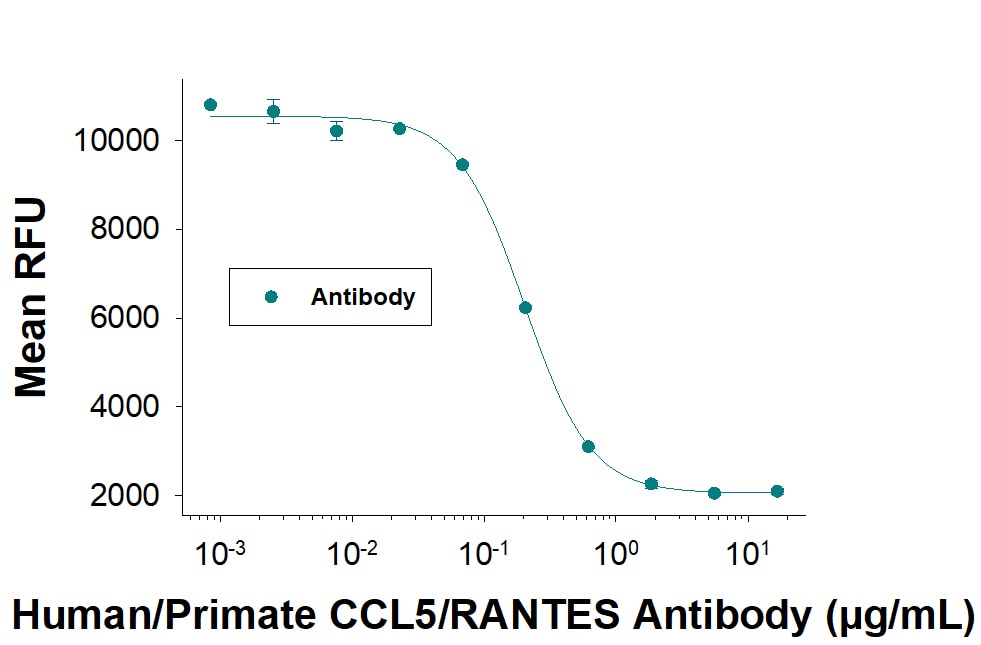
Neutralization by Human/Primate CCL5/RANTES Antibody.
Human/Primate CCL5/RANTES Antibody (Catalog # MAB678) neutralizes Recombinant Human CCL5/RANTES (278-RN) induced chemotaxis in the BaF3 mouse pro-B cell line transfected with human CCR5. The Neutralization Dose (ND50) for this effect is typically 80.0-800 ng/mL in the presence of 10 ng/mL Recombinant Human CCL5/RANTES.
Human CCL5 / RANTES ELISA Standard Curve
Recombinant Human CCL5/RANTES (Catalog # 278-RN) was serially diluted and captured by Mouse Anti-Human/Primate CCL5/RANTES Monoclonal Antibody (Catalog # MAB678) coated on a Clear Polystyrene Microplate (Catalog # DY990). Goat Anti-Human CCL5/RANTES Antigen Affinity-purified Polyclonal Antibody (Catalog # AF-278-NA) was biotinylated and incubated with the protein captured on the plate. Detection of the standard curve was achieved by incubating Streptavidin-HRP (Catalog # DY998)Applications for CCL5/RANTES Antibody (21418)
Application
Recommended Usage
Western Blot
1 µg/mL
Sample: Recombinant Human CCL5/RANTES (Catalog # 278-RN)
Sample: Recombinant Human CCL5/RANTES (Catalog # 278-RN)
Neutralization
Human/Primate CCL5/RANTES Antibody (Catalog # MAB678) neutralizes Recombinant Human CCL5/RANTES (Catalog # 278-RN) induced chemotaxis in the BaF3 mouse pro-B cell line transfected with human CCR5. The Neutralization Dose (ND50) for this effect is typically 80.0-800 ng/mL in the presence of 10 ng/mL Recombinant Human CCL5/RANTES.
Human/Primate CCL5/RANTES Sandwich Immunoassay
Please Note: Optimal dilutions of this antibody should be experimentally determined.
Reviewed Applications
Read 4 reviews rated 4.5 using MAB678 in the following applications:
Formulation, Preparation, and Storage
Purification
Protein A or G purified from hybridoma culture supernatant
Reconstitution
Reconstitute at 0.5 mg/mL in sterile PBS. For liquid material, refer to CoA for concentration.
Loading...
Formulation
Lyophilized from a 0.2 μm filtered solution in PBS with Trehalose. See Certificate of Analysis for details.<br/>*Small pack size (-SP) is supplied either lyophilized or as a 0.2 µm filtered solution in PBS.
Shipping
Lyophilized product is shipped at ambient temperature. Liquid small pack size (-SP) is shipped with polar packs. Upon receipt, store immediately at the temperature recommended below.
Stability & Storage
Use a manual defrost freezer and avoid repeated freeze-thaw cycles.
- 12 months from date of receipt, -20 to -70 °C as supplied.
- 1 month, 2 to 8 °C under sterile conditions after reconstitution.
- 6 months, -20 to -70 °C under sterile conditions after reconstitution.
Calculators
Background: CCL5/RANTES
Alternate Names
RANTES, SISd
Gene Symbol
CCL5
Additional CCL5/RANTES Products
Product Documents for CCL5/RANTES Antibody (21418)
Certificate of Analysis
To download a Certificate of Analysis, please enter a lot or batch number in the search box below.
Note: Certificate of Analysis not available for kit components.
Product Specific Notices for CCL5/RANTES Antibody (21418)
For research use only
Citations for CCL5/RANTES Antibody (21418)
 Powered by Bioz
Customer Reviews for CCL5/RANTES Antibody (21418) (4)
4.5 out of 5
4 Customer Ratings
Have you used CCL5/RANTES Antibody (21418)?
Submit a review and receive an Amazon gift card!
$25/€18/£15/$25CAN/¥2500 for a review with an image
$10/€7/£6/$10CAN/¥1110 for a review without an image
Submit a review
Customer Images
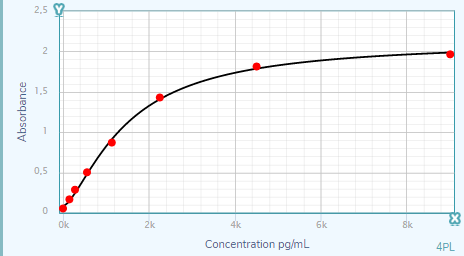
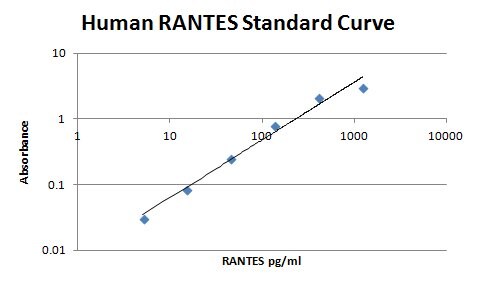
Showing
1
-
4 of
4 reviews
Showing All
Filter By:
-
Application: ELISASample Tested: SerumSpecies: PrimateVerified Customer | Posted 11/28/2022Used as a capture in our NHP ELISA

-
Application: ELISASample Tested: EDTA PlasmaSpecies: HumanVerified Customer | Posted 07/24/2018
-
Application: ELISASample Tested: EDTA PlasmaSpecies: HumanVerified Customer | Posted 12/06/2017
-
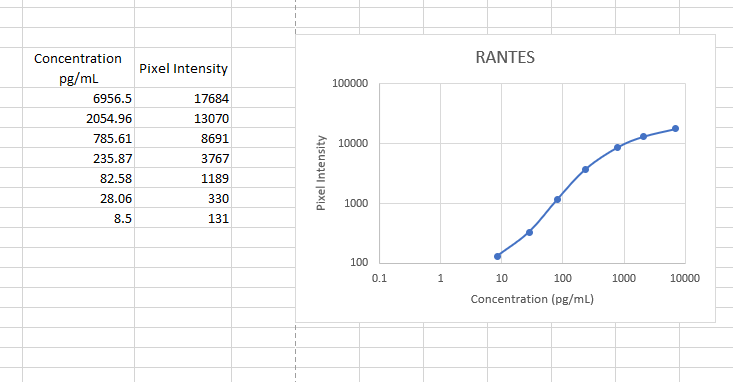
Application: ELISASample Tested: Serum and PlasmaSpecies: HumanVerified Customer | Posted 11/22/2017The RANTES ELISA we made used MAG678 as the capture and BAF278 as the detection. Dilutional linearity of samples wasn't great but otherwise the assay worked very well.
There are no reviews that match your criteria.
Protocols
Find general support by application which include: protocols, troubleshooting, illustrated assays, videos and webinars.
- Cellular Response to Hypoxia Protocols
- R&D Systems Quality Control Western Blot Protocol
- Troubleshooting Guide: Western Blot Figures
- Western Blot Conditions
- Western Blot Protocol
- Western Blot Protocol for Cell Lysates
- Western Blot Troubleshooting
- Western Blot Troubleshooting Guide
- View all Protocols, Troubleshooting, Illustrated assays and Webinars
Loading...
Associated Pathways
