
Clusterin, also known as Apolipoprotein J, Sulfated Glycoprotein 2 (SGP-2), TRPM-2, and SP-40,40, is a secreted multi-functional protein that was named for its ability to induce cellular clustering. It binds a wide range of molecules and may function as a chaperone of misfolded extracellular proteins. It also participates in the control of cell proliferation, apoptosis, and carcinogenesis (1, 2). Clusterin is predominantly expressed in adult testis, ovary, adrenal gland, liver, heart, and brain and in many epithelial tissues during embryonic development (3). Human Clusterin is synthesized as a precursor that contains two coiled coil domains, three nuclear localization signals (NLS), and one heparin binding domain (4-6). Intracellular cleavages of the precursor remove the signal peptide and generate comparably sized alpha and beta chains which are secreted as an 80 kDa N-glycosylated disulfide-linked heterodimer (7, 8). Mature human Clusterin shares 77% amino acid sequence identity with mouse and rat Clusterin. High μg/mL concentrations of Clusterin circulate predominantly as a component of high density lipoprotein particles, and these are internalized and degraded through interactions with LRP-2/Megalin (9, 10). In human, an alternately spliced 50 kDa isoform of Clusterin (nCLU) lacks the signal peptide and remains intracellular (5, 11). This molecule is neither glycosylated nor cleaved into alpha and beta chains (11). In the cytoplasm, nCLU destabilizes the actin cytoskeleton and inhibits NF kappa B activation (12, 13). Cellular exposure to ionizing radiation promotes the translocation of nCLU to the nucleus where it interacts with Ku70 and promotes apoptosis (5, 11). This function contrasts with the cytoprotective effect of secreted Clusterin (14). During colon cancer tumor progression there is a downregulation of the intracellular form and an upregulation of the glycosylated secreted form (11).
Human Clusterin Isoform 1 Antibody
R&D Systems | Catalog # AF2937

Scientific images may be resized, cropped, or adjusted for brightness or contrast for presentation purposes. These updates are limited to presentation and do not affect the underlying scientific interpretation of the data. Where available, additional source data may be provided upon request.
Key Product Details
Validated by
Species Reactivity
Validated:
Cited:
Applications
Validated:
Cited:
Label
Antibody Source
Product Specifications
Immunogen
Asp75-Glu501
Accession # NP_001822
Specificity
Clonality
Host
Isotype
Scientific Data Images for Human Clusterin Isoform 1 Antibody
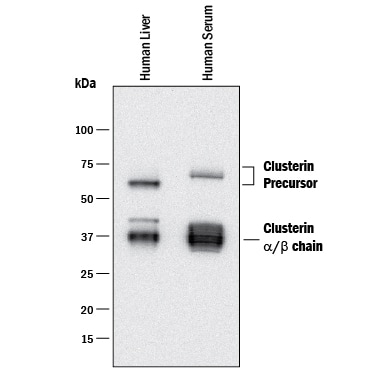
Detection of Human Clusterin by Western Blot.
Western blot shows lysates of human liver tissue and human serum. PVDF membrane was probed with 1 µg/mL of Goat Anti-Human Clusterin Isoform 1 Antigen Affinity-purified Polyclonal Antibody (Catalog # AF2937) followed by HRP-conjugated Anti-Goat IgG Secondary Antibody (Catalog # HAF017). Specific bands were detected for Clusterin Precusor at approximately 60-65 kDa and Clusterin a and beta chains at approximately 36 kDa (as indicated). This experiment was conducted under reducing conditions and using Immunoblot Buffer Group 1.
Clusterin in Human Alzheimer's Disease Brain.
Clusterin was detected in immersion fixed paraffin-embedded of human Alzheimer's disease brain using Human Clusterin Isoform 1 Antigen Affinity-purified Polyclonal Antibody (Catalog # AF2937) at 5 µg/mL overnight at 4 °C. Tissue was stained using the Anti-Goat HRP-DAB Cell & Tissue Staining Kit (brown; Catalog # CTS008) and counterstained with hematoxylin (blue). View our protocol for Chromogenic IHC Staining of Paraffin-embedded Tissue Sections.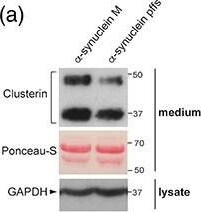
Detection of Human Clusterin/APOJ by Western Blot
Extracellular clusterin interacts with alpha ‐synuclein preformed fibrils (pffs). (a) Medium from primary astrocytes treated with alpha ‐synuclein pffs for 16 hr, or with monomeric alpha ‐synuclein (m), were subjected to immunoblotting using clusterin antibody. Ponceau‐S staining was used as a loading control. (b) Quantification of clusterin is normalized to GAPDH protein of cell lysates. Data are from eight independent experiments and are expressed as the mean ± SD. Data were analyzed using unpaired t test; **p =.0028. (c) alpha ‐Synuclein pffs isolated by centrifugation from total medium of primary astrocytes treated with alpha ‐synuclein pffs, or monomeric alpha ‐synuclein (M), for 16 hr were subjected to immunoblotting using clusterin and alpha ‐synuclein antibodies. Asterisk in the alpha ‐synuclein immunoblot indicates clusterin bands still present after Clusterin antibody stripping. (d) Clusterin immunoprecipitated from the medium of primary astrocytes treated with alpha ‐synuclein pffs for 16 hr was subjected to immunoblotting using an alpha ‐synuclein antibody. (e) Quantification of clusterin— alpha ‐synuclein pffs interaction has been obtained by normalization of alpha ‐synuclein pffs bound to clusterin for alpha ‐synuclein pffs bound to protein‐G beads. Data are representative of three independent experiments and are expressed as the mean ± SD. Data were analyzed using one‐sample t test; *p = .0493. (f) Z‐stack frames of primary astrocytes treated with alpha ‐synuclein pffs for 16 hr and stained for alpha ‐synuclein (purple), clusterin (green), cadherin (red), and nuclei with DAPI (blue). Scale bar 10 μm. (g) Maximum intensity Z‐projection confocal images of primary astrocytes treated with alpha ‐synuclein pffs for 16 hr and stained for alpha ‐synuclein (purple), clusterin (red), Early Endosome Antigen 1 (EEA1) (green) and nuclei with DAPI (blue). Scale bar 10 μm. Individual points of the graphs represent each single experiment [Color figure can be viewed at wileyonlinelibrary.com] Image collected and cropped by CiteAb from the following p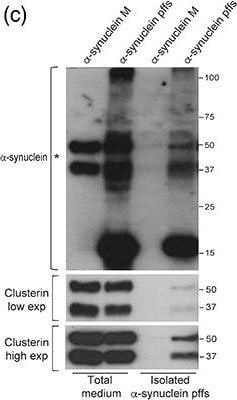
Detection of Human Clusterin/APOJ by Western Blot
Extracellular clusterin interacts with alpha ‐synuclein preformed fibrils (pffs). (a) Medium from primary astrocytes treated with alpha ‐synuclein pffs for 16 hr, or with monomeric alpha ‐synuclein (m), were subjected to immunoblotting using clusterin antibody. Ponceau‐S staining was used as a loading control. (b) Quantification of clusterin is normalized to GAPDH protein of cell lysates. Data are from eight independent experiments and are expressed as the mean ± SD. Data were analyzed using unpaired t test; **p =.0028. (c) alpha ‐Synuclein pffs isolated by centrifugation from total medium of primary astrocytes treated with alpha ‐synuclein pffs, or monomeric alpha ‐synuclein (M), for 16 hr were subjected to immunoblotting using clusterin and alpha ‐synuclein antibodies. Asterisk in the alpha ‐synuclein immunoblot indicates clusterin bands still present after Clusterin antibody stripping. (d) Clusterin immunoprecipitated from the medium of primary astrocytes treated with alpha ‐synuclein pffs for 16 hr was subjected to immunoblotting using an alpha ‐synuclein antibody. (e) Quantification of clusterin— alpha ‐synuclein pffs interaction has been obtained by normalization of alpha ‐synuclein pffs bound to clusterin for alpha ‐synuclein pffs bound to protein‐G beads. Data are representative of three independent experiments and are expressed as the mean ± SD. Data were analyzed using one‐sample t test; *p = .0493. (f) Z‐stack frames of primary astrocytes treated with alpha ‐synuclein pffs for 16 hr and stained for alpha ‐synuclein (purple), clusterin (green), cadherin (red), and nuclei with DAPI (blue). Scale bar 10 μm. (g) Maximum intensity Z‐projection confocal images of primary astrocytes treated with alpha ‐synuclein pffs for 16 hr and stained for alpha ‐synuclein (purple), clusterin (red), Early Endosome Antigen 1 (EEA1) (green) and nuclei with DAPI (blue). Scale bar 10 μm. Individual points of the graphs represent each single experiment [Color figure can be viewed at wileyonlinelibrary.com] Image collected and cropped by CiteAb from the following p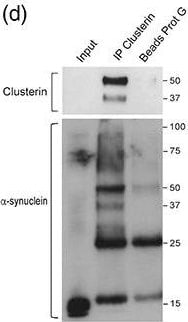
Detection of Human Clusterin/APOJ by Western Blot
Extracellular clusterin interacts with alpha ‐synuclein preformed fibrils (pffs). (a) Medium from primary astrocytes treated with alpha ‐synuclein pffs for 16 hr, or with monomeric alpha ‐synuclein (m), were subjected to immunoblotting using clusterin antibody. Ponceau‐S staining was used as a loading control. (b) Quantification of clusterin is normalized to GAPDH protein of cell lysates. Data are from eight independent experiments and are expressed as the mean ± SD. Data were analyzed using unpaired t test; **p =.0028. (c) alpha ‐Synuclein pffs isolated by centrifugation from total medium of primary astrocytes treated with alpha ‐synuclein pffs, or monomeric alpha ‐synuclein (M), for 16 hr were subjected to immunoblotting using clusterin and alpha ‐synuclein antibodies. Asterisk in the alpha ‐synuclein immunoblot indicates clusterin bands still present after Clusterin antibody stripping. (d) Clusterin immunoprecipitated from the medium of primary astrocytes treated with alpha ‐synuclein pffs for 16 hr was subjected to immunoblotting using an alpha ‐synuclein antibody. (e) Quantification of clusterin— alpha ‐synuclein pffs interaction has been obtained by normalization of alpha ‐synuclein pffs bound to clusterin for alpha ‐synuclein pffs bound to protein‐G beads. Data are representative of three independent experiments and are expressed as the mean ± SD. Data were analyzed using one‐sample t test; *p = .0493. (f) Z‐stack frames of primary astrocytes treated with alpha ‐synuclein pffs for 16 hr and stained for alpha ‐synuclein (purple), clusterin (green), cadherin (red), and nuclei with DAPI (blue). Scale bar 10 μm. (g) Maximum intensity Z‐projection confocal images of primary astrocytes treated with alpha ‐synuclein pffs for 16 hr and stained for alpha ‐synuclein (purple), clusterin (red), Early Endosome Antigen 1 (EEA1) (green) and nuclei with DAPI (blue). Scale bar 10 μm. Individual points of the graphs represent each single experiment [Color figure can be viewed at wileyonlinelibrary.com] Image collected and cropped by CiteAb from the following p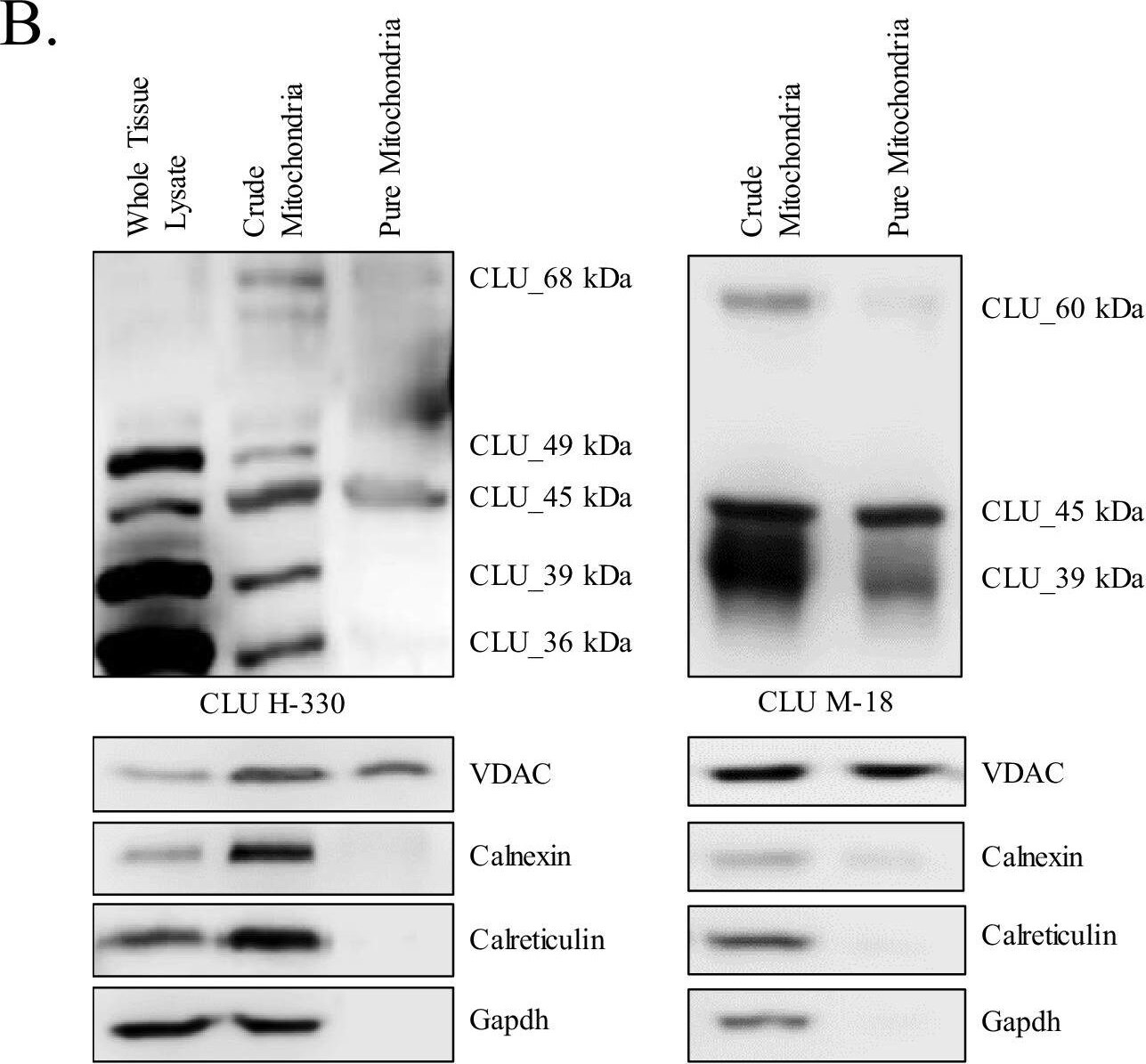
Detection of Rat Clusterin/APOJ by Western Blot
Identification of a mitochondrial CLU protein isoform.(A) DIV 9 Mitotracker-stained (green) primary neurons were probed for CLU immunoreactivity using anti-CLU H-330 (red) and visualized using 40X confocal microscopy. (B) Pure cortical mitochondria were isolated as indicated. Equal concentrations of whole tissue lysate, crude mitochondria, and pure mitochondria were analyzed via SDS-PAGE and probed for CLU immunoreactivity using anti-CLU H-330 (left panel) and anti-CLU M-18 (right panel) (n = 3 independent isolations). Biochemical characterization of isolated fractions was performed using a panel of organelle-specific antibodies: voltage-dependent anion channels (VDAC) (mitochondria), calnexin and calreticulin (ER), and Gapdh (cytosol). (C) Crude and pure mitochondria were isolated and subjected to endoglycosidase treatment using PNGase F and Endo H. Deglycosylated mitochondrial lysates were then analyzed for CLU immunoreactivity using anti-CLU M-18. Red font: deglycosylated protein isoforms; blue font: isoforms that were unaffected by glycosidase treatment; green asterisk: excess Endo H enzyme.Positive controls for deglycosylation studies.RNase B, a high mannose glycoprotein, has a single N-linked glycosylation site and was used as a positive control for endoglycosidases that cleave N-linked carbohydrates. Fetuin, a glycoprotein containing sialylated N-linked and O-linked glycans, was used as a positive control for endoglycosidases that cleave both N-linked and O-linked carbohydrates. Image collected and cropped by CiteAb from the following open publication (https://pubmed.ncbi.nlm.nih.gov/31738162), licensed under a CC-BY license. Not internally tested by R&D Systems.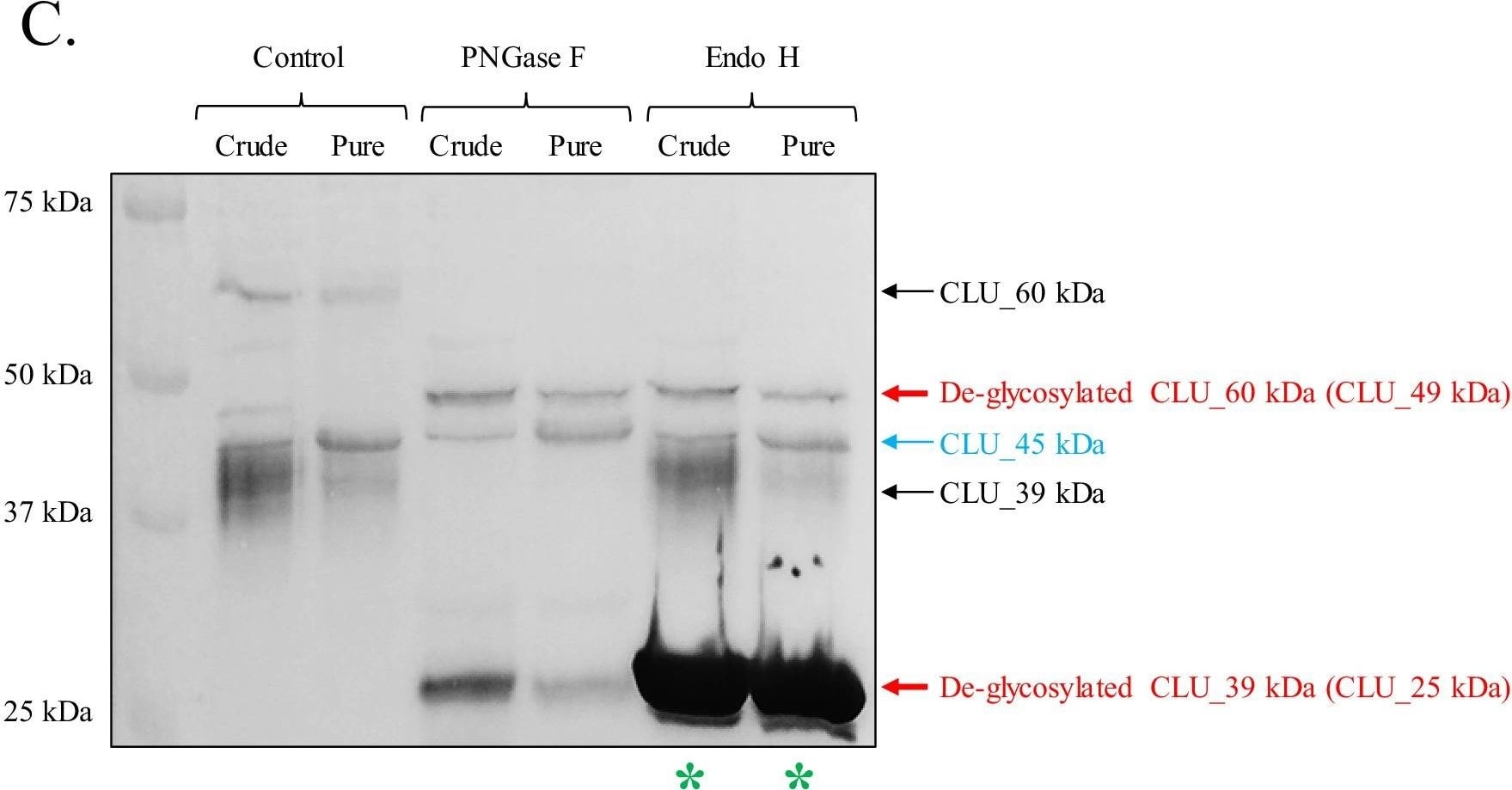
Detection of Rat Clusterin/APOJ by Western Blot
Identification of a mitochondrial CLU protein isoform.(A) DIV 9 Mitotracker-stained (green) primary neurons were probed for CLU immunoreactivity using anti-CLU H-330 (red) and visualized using 40X confocal microscopy. (B) Pure cortical mitochondria were isolated as indicated. Equal concentrations of whole tissue lysate, crude mitochondria, and pure mitochondria were analyzed via SDS-PAGE and probed for CLU immunoreactivity using anti-CLU H-330 (left panel) and anti-CLU M-18 (right panel) (n = 3 independent isolations). Biochemical characterization of isolated fractions was performed using a panel of organelle-specific antibodies: voltage-dependent anion channels (VDAC) (mitochondria), calnexin and calreticulin (ER), and Gapdh (cytosol). (C) Crude and pure mitochondria were isolated and subjected to endoglycosidase treatment using PNGase F and Endo H. Deglycosylated mitochondrial lysates were then analyzed for CLU immunoreactivity using anti-CLU M-18. Red font: deglycosylated protein isoforms; blue font: isoforms that were unaffected by glycosidase treatment; green asterisk: excess Endo H enzyme.Positive controls for deglycosylation studies.RNase B, a high mannose glycoprotein, has a single N-linked glycosylation site and was used as a positive control for endoglycosidases that cleave N-linked carbohydrates. Fetuin, a glycoprotein containing sialylated N-linked and O-linked glycans, was used as a positive control for endoglycosidases that cleave both N-linked and O-linked carbohydrates. Image collected and cropped by CiteAb from the following open publication (https://pubmed.ncbi.nlm.nih.gov/31738162), licensed under a CC-BY license. Not internally tested by R&D Systems.Applications for Human Clusterin Isoform 1 Antibody
Immunohistochemistry
Sample: Immersion fixed paraffin-embedded sections of human Alzheimer's disease brain
Immunoprecipitation
Sample: Conditioned cell culture medium spiked with Recombinant Human Clusterin (Catalog # 2937‑HS), see our available Western blot detection antibodies
Western Blot
Sample: Human liver tissue and human serum
Formulation, Preparation, and Storage
Purification
Reconstitution
Reconstitute at 0.2 mg/mL in sterile PBS. For liquid material, refer to CoA for concentration.
Formulation
Shipping
Stability & Storage
- 12 months from date of receipt, -20 to -70 °C as supplied.
- 1 month, 2 to 8 °C under sterile conditions after reconstitution.
- 6 months, -20 to -70 °C under sterile conditions after reconstitution.
Calculators
Background: Clusterin
References
- Carver, J.A. et al. (2003) IUBMB Life 55:661.
- Shannan, B. et al. (2006) Cell Death Differ. 13:12.
- French, L.E. et al. (1993) J. Cell Biol. 122:1119.
- Kirszbaum, L. et al. (1989) EMBO J. 8:711.
- Leskov, K.S. et al. (2003) J. Biol. Chem. 278:11590.
- Pankhurst, G.J. et al. (1998) Biochemistry 37:4823.
- Burkey, B.F. et al. (1991) J. Lipid. Res. 32:1039.
- de Silva, H.V. et al. (1990) J. Biol. Chem. 265:14292.
-
Jenne, D.E. et al. (1991) J. Biol. Chem. 266:11030.
-
Kounnas, M.Z. et al. (1995) J. Biol. Chem. 270:13070.
-
Pucci, S. et al. (2004) Oncogene 23:2298.
-
Moretti, R.M. et al. (2007) Cancer Res. 67:10325.
-
Santilli, G. et al. (2003) J. Biol. Chem. 278:38214.
-
Trougakos, I.P. et al. (2004) Cancer Res. 64:1834.
Alternate Names
Gene Symbol
UniProt
Additional Clusterin Products
Product Documents for Human Clusterin Isoform 1 Antibody
Certificate of Analysis
To download a Certificate of Analysis, please enter a lot or batch number in the search box below.
Note: Certificate of Analysis not available for kit components.
Product Specific Notices for Human Clusterin Isoform 1 Antibody
For research use only
Related Research Areas
Citations for Human Clusterin Isoform 1 Antibody
 Powered by Bioz
Customer Reviews for Human Clusterin Isoform 1 Antibody
There are currently no reviews for this product. Be the first to review Human Clusterin Isoform 1 Antibody and earn rewards!
Have you used Human Clusterin Isoform 1 Antibody?
Submit a review and receive an Amazon gift card!
$25/€18/£15/$25CAN/¥2500 for a review with an image
$10/€7/£6/$10CAN/¥1110 for a review without an image
Submit a review
Protocols
Find general support by application which include: protocols, troubleshooting, illustrated assays, videos and webinars.
- Antigen Retrieval Protocol (PIER)
- Antigen Retrieval for Frozen Sections Protocol
- Appropriate Fixation of IHC/ICC Samples
- Cellular Response to Hypoxia Protocols
- Chromogenic IHC Staining of Formalin-Fixed Paraffin-Embedded (FFPE) Tissue Protocol
- Chromogenic Immunohistochemistry Staining of Frozen Tissue
- ClariTSA™ Fluorophore Kits
- Detection & Visualization of Antibody Binding
- Fluorescent IHC Staining of Frozen Tissue Protocol
- Graphic Protocol for Heat-induced Epitope Retrieval
- Graphic Protocol for the Preparation and Fluorescent IHC Staining of Frozen Tissue Sections
- Graphic Protocol for the Preparation and Fluorescent IHC Staining of Paraffin-embedded Tissue Sections
- Graphic Protocol for the Preparation of Gelatin-coated Slides for Histological Tissue Sections
- IHC Sample Preparation (Frozen sections vs Paraffin)
- Immunofluorescent IHC Staining of Formalin-Fixed Paraffin-Embedded (FFPE) Tissue Protocol
- Immunohistochemistry (IHC) and Immunocytochemistry (ICC) Protocols
- Immunohistochemistry Frozen Troubleshooting
- Immunohistochemistry Paraffin Troubleshooting
- Immunoprecipitation Protocol
- Preparing Samples for IHC/ICC Experiments
- Preventing Non-Specific Staining (Non-Specific Binding)
- Primary Antibody Selection & Optimization
- Protocol for Heat-Induced Epitope Retrieval (HIER)
- Protocol for Making a 4% Formaldehyde Solution in PBS
- Protocol for VisUCyte™ HRP Polymer Detection Reagent
- Protocol for the Preparation & Fixation of Cells on Coverslips
- Protocol for the Preparation and Chromogenic IHC Staining of Frozen Tissue Sections
- Protocol for the Preparation and Chromogenic IHC Staining of Frozen Tissue Sections - Graphic
- Protocol for the Preparation and Chromogenic IHC Staining of Paraffin-embedded Tissue Sections
- Protocol for the Preparation and Chromogenic IHC Staining of Paraffin-embedded Tissue Sections - Graphic
- Protocol for the Preparation and Fluorescent IHC Staining of Frozen Tissue Sections
- Protocol for the Preparation and Fluorescent IHC Staining of Paraffin-embedded Tissue Sections
- Protocol for the Preparation of Gelatin-coated Slides for Histological Tissue Sections
- R&D Systems Quality Control Western Blot Protocol
- TUNEL and Active Caspase-3 Detection by IHC/ICC Protocol
- The Importance of IHC/ICC Controls
- Troubleshooting Guide: Immunohistochemistry
- Troubleshooting Guide: Western Blot Figures
- Western Blot Conditions
- Western Blot Protocol
- Western Blot Protocol for Cell Lysates
- Western Blot Troubleshooting
- Western Blot Troubleshooting Guide
- View all Protocols, Troubleshooting, Illustrated assays and Webinars