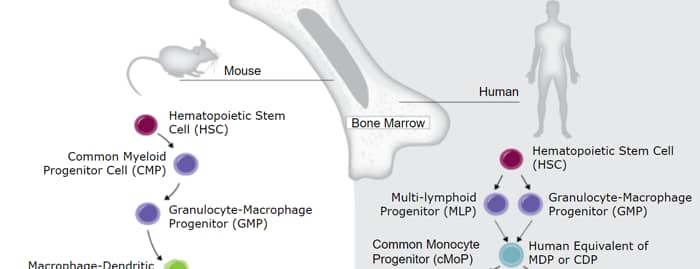
IFN-beta (interferon beta; also fibroblast IFN) is a secreted, monomeric 23-24 kDa member of the alpha/beta interferon family of molecules. It can be produced by almost all cell types in response to bacterial DNA or viral double-stranded RNA and is abundantly secreted by circulating plasmacytoid DCs. IFN-beta drives monocytic transformation into DCs, and it appears to stimulate a B cell switch from from IgM to IgG secretion. Mature human IFN-beta is 166 amino acids (aa) in length (aa 22-187) and contains one phosphorylation site at Ser140. There is one potential alternative start site at Met22. Full-length human IFN-beta (aa 22-187) shares 47% aa identity with mouse IFN-beta.
Human IFN-beta Antibody
R&D Systems | Catalog # AF814

Scientific images may be resized, cropped, or adjusted for brightness or contrast for presentation purposes. These updates are limited to presentation and do not affect the underlying scientific interpretation of the data. Where available, additional source data may be provided upon request.
Key Product Details
Species Reactivity
Validated:
Human
Cited:
Human
Applications
Validated:
Western Blot, Neutralization
Cited:
Neutralization
Label
Unconjugated
Antibody Source
Polyclonal Goat IgG
Loading...
Product Specifications
Immunogen
E. coli-derived recombinant human IFN-beta
Specificity
Detects human IFN-beta in direct ELISAs and Western blots. In direct ELISAs, less than 5% cross‑reactivity with recombinant mouse IFN‑ beta 1, recombinant human IFN‑ gamma, recombinant cotton ra (rcr) IFN-alpha and rcrIFN‑ gamma is observed.
Clonality
Polyclonal
Host
Goat
Isotype
IgG
Endotoxin Level
<0.10 EU per 1 μg of the antibody by the LAL method.
Scientific Data Images for Human IFN-beta Antibody
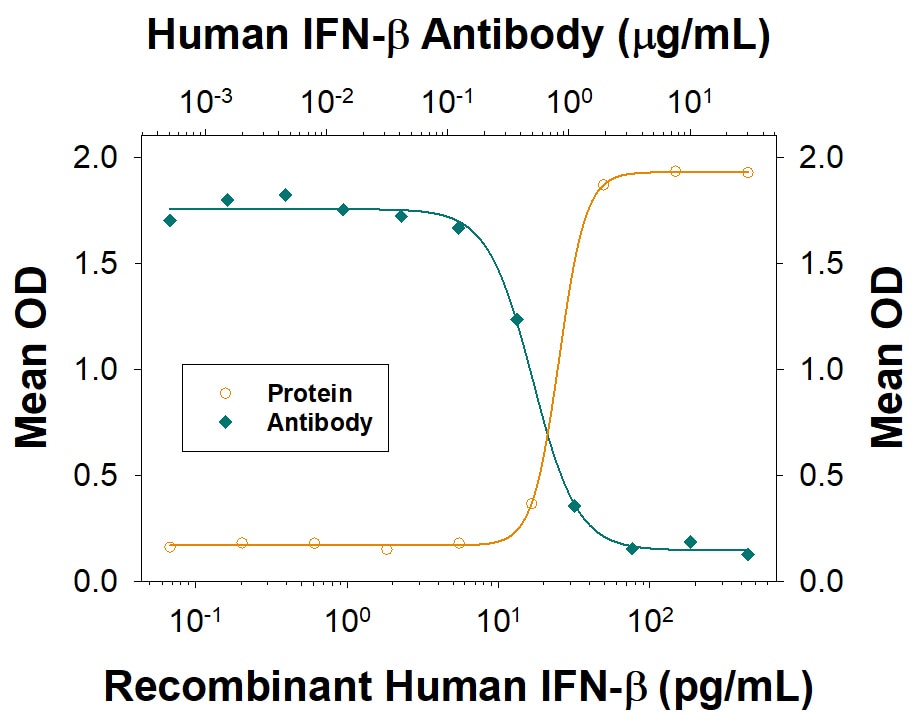
IFN‑ beta Inhibition of EMCV-induced Cytopathy and Neutralization by Human IFN-beta Antibody.
Recombinant Human IFN-beta (8499-IF) reduces the Encephalomyocarditis Virus (EMCV)-induced cytopathy in the HeLa human cervical epithelial carcinoma cell line in a dose-dependent manner (orange line), as measured by crystal violet staining. Inhibition of EMCV activity elicited by Recombinant Human IFN-beta (50 pg/mL) is neutralized (green line) by increasing concentrations of Goat Anti-Human IFN-beta Antigen Affinity-purified Polyclonal Antibody (Catalog # AF814). The ND50 is typically 0.100 - 1.00 µg/mL.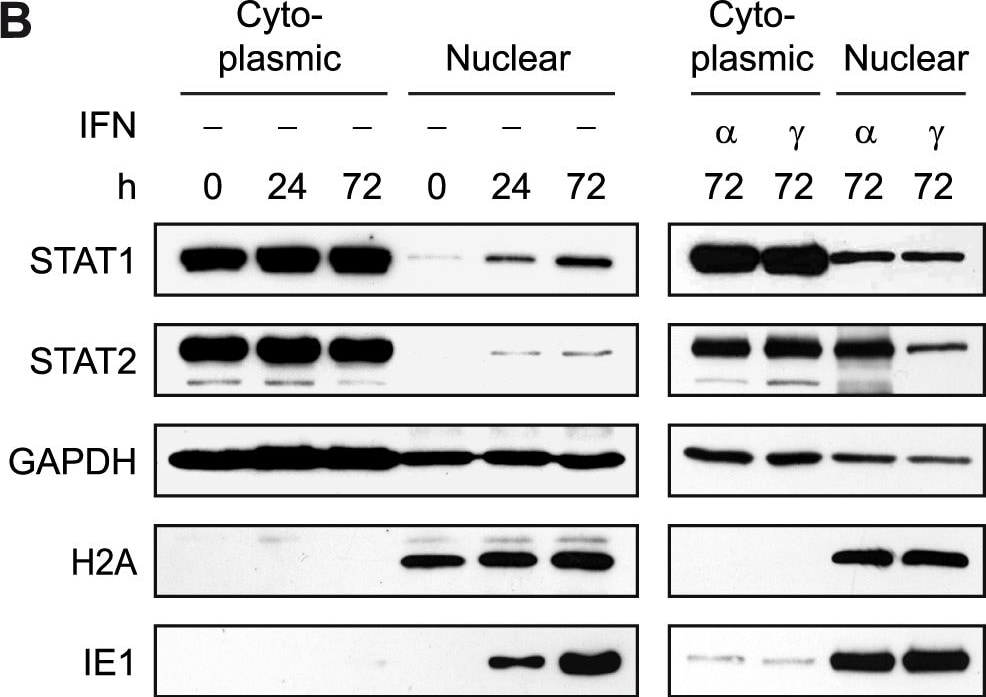
Detection of IFN-beta by Western Blot
IE1 expression leads to nuclear accumulation of STAT1.A) TetR and TetR-IE1 cells were treated with doxycycline for 72 h. Where indicated, TetR cells were incubated in the presence of IFN-gamma or IFN-alpha for 1 h before samples were fixed with paraformaldehyde and examined by indirect immunofluorescence coupled to confocal microscopy. Samples were simultaneously reacted with rabbit polyclonal antibodies against STAT1 (left) or STAT2 (right) and a mouse monoclonal antibody against IE1, followed by incubation with a rabbit-specific Alexa Fluor 546 conjugate and a mouse-specific Alexa Fluor 633 conjugate. TetRnlsEGFP (TetR) fluorescence is shown to visualize nuclei. Additionally, merge images of STAT, IE1, and TetR signals are presented. Scale bar, 10 µm. B) TetR-IE1 cells were treated with doxycycline for 0 h, 24 h, or 72 h. Cytoplasmic and nuclear extracts were prepared and subjected to immunoblotting with anti-STAT1, anti-STAT2, anti-GAPDH, anti-H2A, and anti-IE1 antibodies. For the right panel, TetR-IE1 cells were treated with IFN-alpha or IFN-gamma for 1 h before fractionation. Image collected and cropped by CiteAb from the following open publication (https://pubmed.ncbi.nlm.nih.gov/21533215), licensed under a CC-BY license. Not internally tested by R&D Systems.Applications for Human IFN-beta Antibody
Application
Recommended Usage
Western Blot
0.1 µg/mL
Sample: Recombinant Human IFN-beta
Sample: Recombinant Human IFN-beta
Neutralization
Measured by its ability to neutralize IFN‑ beta inhibition of EMCV-induced cytopathy in the HeLa human cervical epithelial carcinoma cell line. Meager, A. (1987) in Lymphokines and Interferons, a Practical Approach. Clemens, M.J. et al. (eds): IRL Press. 129. The Neutralization Dose (ND50) is typically 0.100 - 1.00 µg/mL in the presence of 50 pg/mL Recombinant Human IFN‑ beta.
Formulation, Preparation, and Storage
Purification
Antigen Affinity-purified
Reconstitution
Reconstitute at 0.2 mg/mL in sterile PBS. For liquid material, refer to CoA for concentration.
Loading...
Formulation
Lyophilized from a 0.2 μm filtered solution in PBS with Trehalose. See Certificate of Analysis for details.<br/>*Small pack size (-SP) is supplied either lyophilized or as a 0.2 µm filtered solution in PBS.
Shipping
Lyophilized product is shipped at ambient temperature. Liquid small pack size (-SP) is shipped with polar packs. Upon receipt, store immediately at the temperature recommended below.
Stability & Storage
Use a manual defrost freezer and avoid repeated freeze-thaw cycles.
- 12 months from date of receipt, -20 to -70 °C as supplied.
- 1 month, 2 to 8 °C under sterile conditions after reconstitution.
- 6 months, -20 to -70 °C under sterile conditions after reconstitution.
Calculators
Background: IFN-beta
Long Name
Interferon beta
Alternate Names
IFB, IFF, IFNB, IFNB1, IFNbeta
Gene Symbol
IFNB1
Additional IFN-beta Products
Product Documents for Human IFN-beta Antibody
Certificate of Analysis
To download a Certificate of Analysis, please enter a lot or batch number in the search box below.
Note: Certificate of Analysis not available for kit components.
Product Specific Notices for Human IFN-beta Antibody
Sold under license from Pestka Biomedical Laboratories, Inc. d/b/a PBL Interferon Source. For research use only. Not for resale. Not for diagnostic, therapeutic or clinical purposes.
For research use only
Citations for Human IFN-beta Antibody
 Powered by Bioz
Customer Reviews for Human IFN-beta Antibody
There are currently no reviews for this product. Be the first to review Human IFN-beta Antibody and earn rewards!
Have you used Human IFN-beta Antibody?
Submit a review and receive an Amazon gift card!
$25/€18/£15/$25CAN/¥2500 for a review with an image
$10/€7/£6/$10CAN/¥1110 for a review without an image
Submit a review
Protocols
Find general support by application which include: protocols, troubleshooting, illustrated assays, videos and webinars.
- Cellular Response to Hypoxia Protocols
- R&D Systems Quality Control Western Blot Protocol
- Troubleshooting Guide: Western Blot Figures
- Western Blot Conditions
- Western Blot Protocol
- Western Blot Protocol for Cell Lysates
- Western Blot Troubleshooting
- Western Blot Troubleshooting Guide
- View all Protocols, Troubleshooting, Illustrated assays and Webinars