
Matrilin-2 is an extracellular matrix protein that belongs to the superfamily of von Willebrand factor A (VWA) containing proteins. It is expressed in many tissues and functions as a bridging component between other matrix proteins (1‑4). The human Matrilin-2 cDNA encodes a 956 amino acid (aa) precursor with a 23 aa signal sequence, two VWA domains separated by ten tandem EGF-like repeats, and a C-terminal coiled-coil domain (5, 6). Alternate splicing generates Isoform 2 (with an 18 aa deletion near the C-terminus), Isoform 3 (with a deletion of the fourth EGF-like repeat), and Isoform 4 (with a deletion of the first VWA and first EGF-like repeat). Human Matrilin-2 shares 87% and 84% aa sequence identity with mouse and canine Matrilin-2, respectively, and 27%, 22%, and 33% aa sequence identity with human Matrilin-1, -3, and -4, respectively. Matrilin-2 forms a variety of disulfide-linked oligomers via its coiled-coil domain (4, 7, 8, 9). It can assemble into homotrimers or heterotrimers with Matrilin-1 and/or Matrilin-4 (4, 7, 8) but has not been detected in heterotrimers containing Matrilin-3 (8). The VWA domains are thought to mediate Matrilin-Matrilin interactions as well as interactions with other matrix proteins such as Fibronectin, Collagen I, Fibrillin-2, and Laminin-1/Nidogen-1 complexes (7). Matrilin-2 knockout mice do not display any obvious abnormalities, suggesting that the expression of other molecules can compensate for the lack of Matrilin-2 (10).
Human Matrilin-2 Antibody
R&D Systems | Catalog # AF3044

Key Product Details
Validated by
Biological Validation
Species Reactivity
Human
Applications
Western Blot, Immunocytochemistry
Label
Unconjugated
Antibody Source
Polyclonal Goat IgG
Loading...
Product Specifications
Immunogen
Mouse myeloma cell line NS0-derived recombinant human Matrilin-2 short isoform
Arg24-Arg937
Accession # AAH10444
Arg24-Arg937
Accession # AAH10444
Specificity
Detects human Matrilin-2 in direct ELISAs and Western blots.
Clonality
Polyclonal
Host
Goat
Isotype
IgG
Scientific Data Images for Human Matrilin-2 Antibody
Matrilin‑2 in U2OS Human Cell Line.
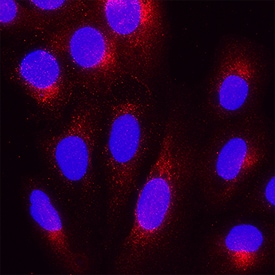
Matrilin‑2 was detected in immersion fixed U2OS human osteosarcoma cell line using Goat Anti-Human Matrilin‑2 Antigen Affinity-purified Polyclonal Antibody (Catalog # AF3044) at 5 µg/mL for 3 hours at room temperature. Cells were stained using the NorthernLights™ 557-conjugated Anti-Goat IgG Secondary Antibody (red; NL001) and counterstained with DAPI (blue). Specific staining was localized to cytoplasm. Staining was performed using our protocol for Fluorescent ICC Staining of Non-adherent Cells.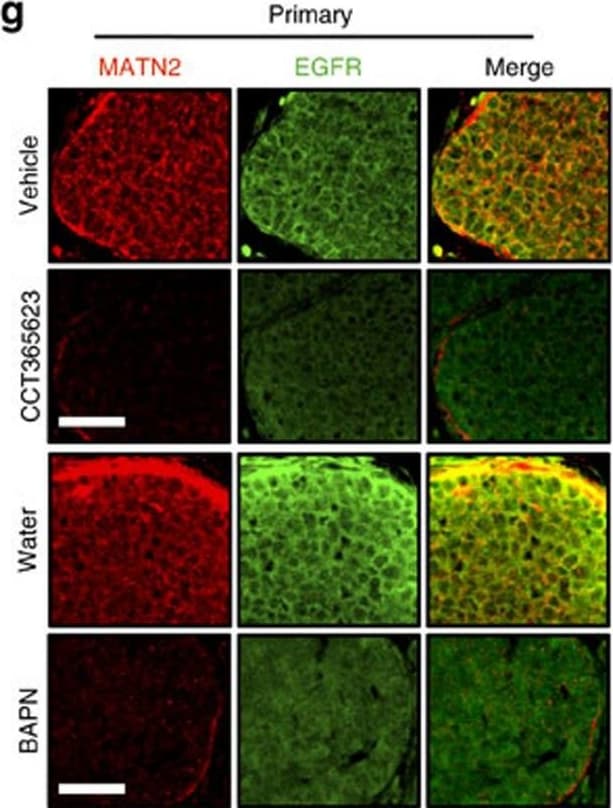
Detection of Mouse Matrilin-2 by Immunohistochemistry
Chemical inhibition of LOX blocks tumour growth and metastasis.(a) Tumour growth in vehicle or CCT365623-treated MMTV-PyMT mice. Data are represented as mean±s.d. from six mice per group. **P<0.01, Student's t-test. (b) H&E stained lungs from vehicle or CCT365623 treated MMTV-PyMT mice. Scale bar, 100 μm. (c) Quantification of lung metastasis in mice from a. All data are presented as mean±range, n=6 animals. **P<0.05, Mann–Whitney analysis. (d) Tumour growth in water or BAPN-treated MMTV-PyMT mice. Data are represented as mean±s.d. from seven mice per group. **P<0.01, Student's t-test. (e) H&E stained lungs from water or BAPN-treated MMTV-PyMT mice. Scale bar, 100 μm. (f) Quantification of lung metastasis in mice from d. All data are presented as mean±range, n=7 animals. **P<0.05, Mann–Whitney analysis. (g,h) Confocal photomicrographs of MATN2 (red) and EGFR (green) staining in primary and metastatic tumours from vehicle, CCT365623, water or BAPN-treated MMTV-PyMT mice. Scale bars, 20 μm. (i–l) Quantification of MATN2 and EGFR staining in primary or metastatic tumours from g and h. All data are represented as mean±s.e.m. Samples from six vehicle or CCT365623 and seven water or BAPN-treated mice were analysed. **P<0.01, Student's t-test. Image collected and cropped by CiteAb from the following publication (https://www.nature.com/articles/ncomms14909), licensed under a CC-BY license. Not internally tested by R&D Systems.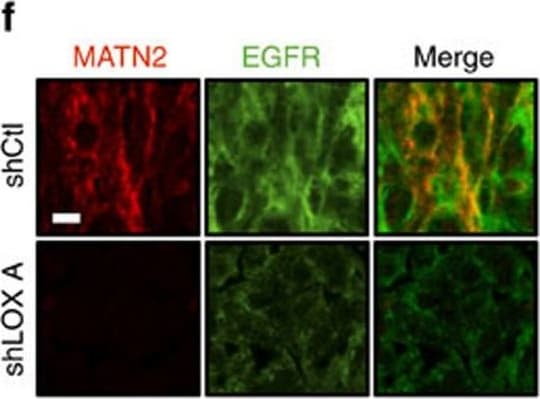
Detection of Mouse Matrilin-2 by Immunohistochemistry
LOX controls EGF-dependent cell proliferation in vitro and tumour growth in vivo.(a,b) Graphs showing cell proliferation in control (shCtl) and LOX-depleted (shLOX A,B) MDA-MB-231 (a) and U87 (b) cells grown in 10% FBS (serum) or serum-free medium (serum free) and treated with PBS, rhMATN2 (500 ng ml−1) and EGF (50 ng ml−1) as indicated. All data are represented as mean±s.d. from four independent experiments. **P<0.01, Student's t-test. (c) Kaplan–Meier survival plot for mice following tail vein injection of control (shCtl) or LOX-depleted (shLOX A) MDA-MB-231 cells. Seven mice were used in each group. (d) H&E staining of lungs from mice in c. Scale bar, 500 μm. (e) Quantification of lung deposits in mice. Data is represented as mean±s.d. from seven samples. **P<0.05, Mann–Whitney analysis. (f) Photomicrographs for MATN2 (red) and EGFR (green) in lung deposits. Scale bar, 10 μm. (g) Quantification of samples in f. Data is represented as mean±s.e.m. from six samples. **P<0.01, Student's t-test. Image collected and cropped by CiteAb from the following publication (https://www.nature.com/articles/ncomms14909), licensed under a CC-BY license. Not internally tested by R&D Systems.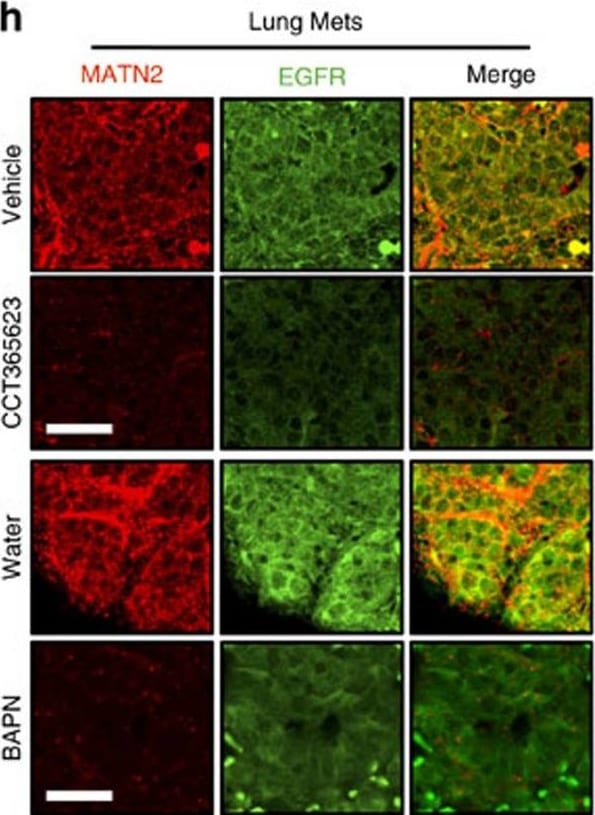
Detection of Mouse Matrilin-2 by Immunohistochemistry
Chemical inhibition of LOX blocks tumour growth and metastasis.(a) Tumour growth in vehicle or CCT365623-treated MMTV-PyMT mice. Data are represented as mean±s.d. from six mice per group. **P<0.01, Student's t-test. (b) H&E stained lungs from vehicle or CCT365623 treated MMTV-PyMT mice. Scale bar, 100 μm. (c) Quantification of lung metastasis in mice from a. All data are presented as mean±range, n=6 animals. **P<0.05, Mann–Whitney analysis. (d) Tumour growth in water or BAPN-treated MMTV-PyMT mice. Data are represented as mean±s.d. from seven mice per group. **P<0.01, Student's t-test. (e) H&E stained lungs from water or BAPN-treated MMTV-PyMT mice. Scale bar, 100 μm. (f) Quantification of lung metastasis in mice from d. All data are presented as mean±range, n=7 animals. **P<0.05, Mann–Whitney analysis. (g,h) Confocal photomicrographs of MATN2 (red) and EGFR (green) staining in primary and metastatic tumours from vehicle, CCT365623, water or BAPN-treated MMTV-PyMT mice. Scale bars, 20 μm. (i–l) Quantification of MATN2 and EGFR staining in primary or metastatic tumours from g and h. All data are represented as mean±s.e.m. Samples from six vehicle or CCT365623 and seven water or BAPN-treated mice were analysed. **P<0.01, Student's t-test. Image collected and cropped by CiteAb from the following publication (https://www.nature.com/articles/ncomms14909), licensed under a CC-BY license. Not internally tested by R&D Systems.Applications for Human Matrilin-2 Antibody
Application
Recommended Usage
Immunocytochemistry
5-15 µg/mL
Sample: Immersion fixed U2OS human osteosarcoma cell line
Sample: Immersion fixed U2OS human osteosarcoma cell line
Western Blot
0.1 µg/mL
Sample: Recombinant Human Matrilin‑2 (Catalog # 3044-MN)
Sample: Recombinant Human Matrilin‑2 (Catalog # 3044-MN)
Formulation, Preparation, and Storage
Purification
Antigen Affinity-purified
Reconstitution
Reconstitute at 0.2 mg/mL in sterile PBS. For liquid material, refer to CoA for concentration.
Loading...
Formulation
Lyophilized from a 0.2 μm filtered solution in PBS with Trehalose. *Small pack size (SP) is supplied either lyophilized or as a 0.2 µm filtered solution in PBS.
Shipping
Lyophilized product is shipped at ambient temperature. Liquid small pack size (-SP) is shipped with polar packs. Upon receipt, store immediately at the temperature recommended below.
Stability & Storage
Use a manual defrost freezer and avoid repeated freeze-thaw cycles.
- 12 months from date of receipt, -20 to -70 °C as supplied.
- 1 month, 2 to 8 °C under sterile conditions after reconstitution.
- 6 months, -20 to -70 °C under sterile conditions after reconstitution.
Calculators
Background: Matrilin-2
References
- Wagener, R. et al. (2005) FEBS Lett. 579:3323.
- Deak, F. et al. (1999) Matrix Biol. 18:55.
- Whittaker, C.A. and R.O. Hynes (2002) Mol. Biol. Cell 13:3369.
- Piecha, D. et al. (1999) J. Biol. Chem. 274:13353.
- Muratoglu, S. et al. (2000) Cytogenet. Cell Genet. 90:323.
- Deak, F. et al. (1997) J. Biol. Chem. 272:9268.
- Piecha, D. et al. (2002) Biochem. J. 367:715.
- Frank, S. et al. (2002) J. Biol. Chem. 277:19071.
- Pan, O.H. and K. Beck (1998) J. Biol. Chem. 273:14205.
- Mates, L. et al. (2004) Matrix Biol. 23:195.
Alternate Names
MATN2, Matrilin2
Entrez Gene IDs
4147 (Human)
Gene Symbol
MATN2
UniProt
Additional Matrilin-2 Products
Product Documents for Human Matrilin-2 Antibody
Certificate of Analysis
To download a Certificate of Analysis, please enter a lot or batch number in the search box below.
Note: Certificate of Analysis not available for kit components.
Product Specific Notices for Human Matrilin-2 Antibody
For research use only
Related Research Areas
Citations for Human Matrilin-2 Antibody
 Powered by Bioz
Customer Reviews for Human Matrilin-2 Antibody
There are currently no reviews for this product. Be the first to review Human Matrilin-2 Antibody and earn rewards!
Have you used Human Matrilin-2 Antibody?
Submit a review and receive an Amazon gift card!
$25/€18/£15/$25CAN/¥2500 for a review with an image
$10/€7/£6/$10CAN/¥1110 for a review without an image
Submit a review
Protocols
Find general support by application which include: protocols, troubleshooting, illustrated assays, videos and webinars.
- Appropriate Fixation of IHC/ICC Samples
- Cellular Response to Hypoxia Protocols
- ClariTSA™ Fluorophore Kits
- Detection & Visualization of Antibody Binding
- ICC Cell Smear Protocol for Suspension Cells
- ICC Immunocytochemistry Protocol Videos
- ICC for Adherent Cells
- Immunocytochemistry (ICC) Protocol
- Immunocytochemistry Troubleshooting
- Immunofluorescence of Organoids Embedded in Cultrex Basement Membrane Extract
- Immunohistochemistry (IHC) and Immunocytochemistry (ICC) Protocols
- Preparing Samples for IHC/ICC Experiments
- Preventing Non-Specific Staining (Non-Specific Binding)
- Primary Antibody Selection & Optimization
- Protocol for VisUCyte™ HRP Polymer Detection Reagent
- Protocol for the Fluorescent ICC Staining of Cell Smears - Graphic
- Protocol for the Fluorescent ICC Staining of Cultured Cells on Coverslips - Graphic
- Protocol for the Preparation and Fluorescent ICC Staining of Cells on Coverslips
- Protocol for the Preparation and Fluorescent ICC Staining of Non-adherent Cells
- Protocol for the Preparation and Fluorescent ICC Staining of Stem Cells on Coverslips
- Protocol for the Preparation of a Cell Smear for Non-adherent Cell ICC - Graphic
- R&D Systems Quality Control Western Blot Protocol
- TUNEL and Active Caspase-3 Detection by IHC/ICC Protocol
- The Importance of IHC/ICC Controls
- Troubleshooting Guide: Western Blot Figures
- Western Blot Conditions
- Western Blot Protocol
- Western Blot Protocol for Cell Lysates
- Western Blot Troubleshooting
- Western Blot Troubleshooting Guide
- View all Protocols, Troubleshooting, Illustrated assays and Webinars
Loading...