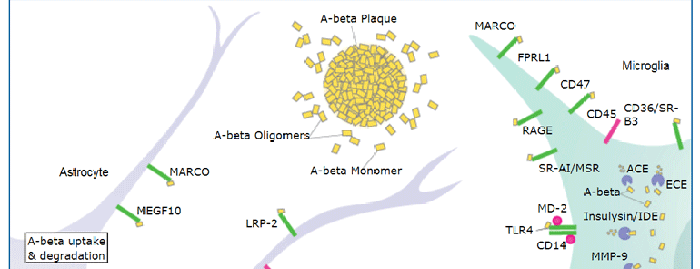
MMP-9 (Gelatinase B) is a metalloproteinase that degrades multiple extracellular matrix components including Gelatin, Collagens III, IV, V, and XI, Elastin, Nidogen-1, and Vitronectin. It also cleaves a variety of chemokines and growth factors (e.g. IL-1 beta, CXCL8/IL-8, CXCL7, CXCL4, CXCL1, Latent TGF-beta, membrane bound TNF-alpha, VEGF, and FGF basic), Amyloid beta peptide, Substance P, and Myelin Basic Protein. MMP-9 can trigger signaling through various transmembrane proteins or inhibit signaling by inducing their shedding from the cell surface (e.g. CD44, E-Cadherin, Integrins, ICAM-1, and CD25/IL-2 R alpha). The activity of MMP-9 is regulated by its association with the TIMP-1 protease inhibitor. Circulating levels of MMP-9 are elevated in many inflammatory disorders including intraluminal thrombus formation, atherosclerosis, Crohn’s disease, hepatitis C virus infection, colorectal cancer, and Duchenne muscular dystrophy.


Scientific images may be resized, cropped, or adjusted for brightness or contrast for presentation purposes. These updates are limited to presentation and do not affect the underlying scientific interpretation of the data. Where available, additional source data may be provided upon request.
Key Product Details
Species Reactivity
Validated:
Cited:
Applications
Validated:
Cited:
Label
Antibody Source
Product Specifications
Immunogen
Specificity
Clonality
Host
Isotype
Scientific Data Images for Human MMP-9 Antibody
MMP‑9 in MMP‑9 transfected NS0 Mouse Cell Line.
MMP‑9 was detected in immersion fixed MMP-9 transfected NS0 mouse myeloma cell line using Goat Anti-Human MMP‑9 Polyclonal Antibody (Catalog # AB911) at 5 µg/mL for 3 hours at room temperature. Cells were stained (red) and counterstained (green). Specific labeling was localized to the cytoplasm. View our protocol for Fluorescent ICC Staining of Cells on Coverslips.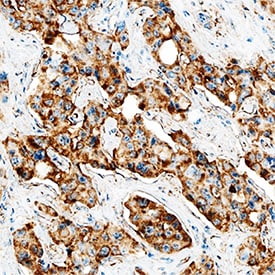
MMP‑9 in Human Liver Cancer Tissue.
MMP-9 was detected in immersion fixed paraffin-embedded sections of human liver cancer tissue using Goat Anti-Human MMP-9 Polyclonal Antibody (Catalog # AB911) at 10 µg/mL overnight at 4 °C. Tissue was stained using the Anti-Goat HRP-DAB Cell & Tissue Staining Kit (brown; Catalog # CTS008) and counterstained with hematoxylin (blue). Specific staining was localized to cytoplasm in cancer cells. View our protocol for Chromogenic IHC Staining of Paraffin-embedded Tissue Sections.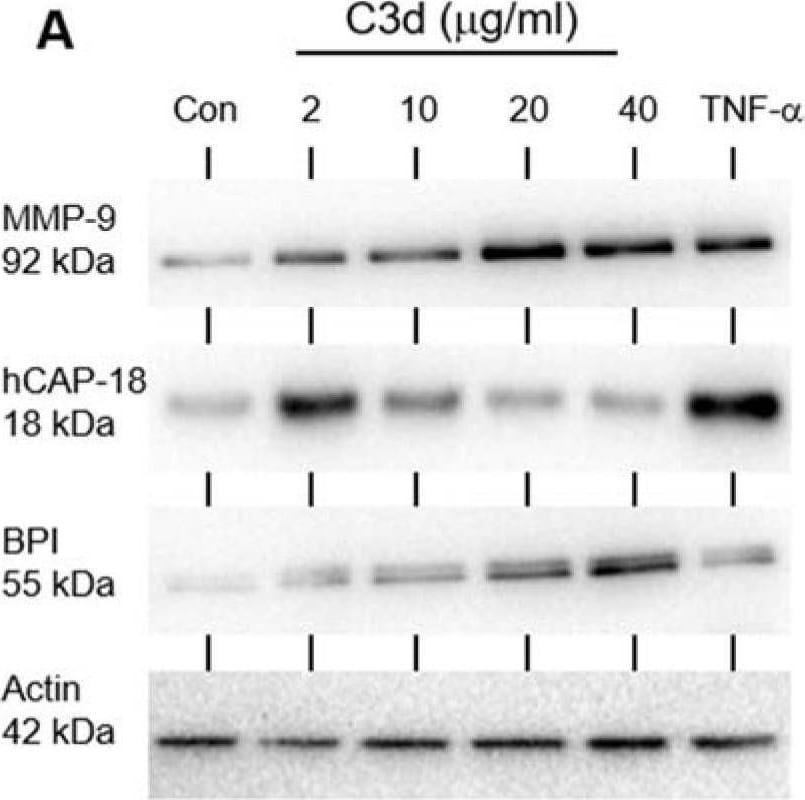
Detection of MMP-9 by Western Blot
Neutrophil degranulation is increased in response to C3d treatment. Neutrophils isolated from HC individuals were incubated at 37 °C and remained unstimulated (Con) or were stimulated with C3d (2–40 µg/mL) or TNF-alpha (10 ng / 2 × 10⁷ cells) (A–C). (A) Cell-free supernatants were collected at 10 min and immunoblotted for markers of tertiary granule (MMP-9), secondary granule (hCAP-18), or primary granule (BPI) release. Densitometry of MMP-9 (B), hCAP-18 (C), and BLPI (D) immunobands was performed. Western blot analyses of whole cell lysates demonstrated equal expression levels of beta -actin, confirming the use of equal cell numbers per reaction. C3d-challenged neutrophils released significantly greater levels of all three granule types when compared to untreated controls (Con) (n = 5 biological repeats, ANOVA followed by Bonferroni post-hoc test for selected groups). All results are expressed as relative densitometry units (DU), with representative Western blots presented. Image collected and cropped by CiteAb from the following open publication (https://pubmed.ncbi.nlm.nih.gov/34944741), licensed under a CC-BY license. Not internally tested by R&D Systems.Applications for Human MMP-9 Antibody
Immunocytochemistry
Sample: Immersion fixed MMP‑9 transfected NS0 mouse myeloma cell line
Immunohistochemistry
Sample: Immersion fixed paraffin-embedded sections of human liver cancer tissue
Immunoprecipitation
Sample: Conditioned cell culture medium spiked with Recombinant Human MMP‑9 (Catalog # 911-MP), see our available Western blot detection antibodies
Western Blot
Sample: Recombinant Human MMP‑9 Western Blot Standard (Catalog # WBC018)
Formulation, Preparation, and Storage
Purification
Reconstitution
Reconstitute at 1 mg/mL in sterile PBS.
Formulation
Shipping
Stability & Storage
- 12 months from date of receipt, -20 to -70 °C as supplied.
- 1 month, 2 to 8 °C under sterile conditions after reconstitution.
- 6 months, -20 to -70 °C under sterile conditions after reconstitution.
Calculators
Background: MMP-9
Long Name
Alternate Names
Gene Symbol
Additional MMP-9 Products
Product Documents for Human MMP-9 Antibody
Certificate of Analysis
To download a Certificate of Analysis, please enter a lot or batch number in the search box below.
Note: Certificate of Analysis not available for kit components.
Product Specific Notices for Human MMP-9 Antibody
For research use only
Citations for Human MMP-9 Antibody
 Powered by Bioz
Customer Reviews for Human MMP-9 Antibody
There are currently no reviews for this product. Be the first to review Human MMP-9 Antibody and earn rewards!
Have you used Human MMP-9 Antibody?
Submit a review and receive an Amazon gift card!
$25/€18/£15/$25CAN/¥2500 for a review with an image
$10/€7/£6/$10CAN/¥1110 for a review without an image
Submit a review
Protocols
Find general support by application which include: protocols, troubleshooting, illustrated assays, videos and webinars.
- Antigen Retrieval Protocol (PIER)
- Antigen Retrieval for Frozen Sections Protocol
- Appropriate Fixation of IHC/ICC Samples
- Cellular Response to Hypoxia Protocols
- Chromogenic IHC Staining of Formalin-Fixed Paraffin-Embedded (FFPE) Tissue Protocol
- Chromogenic Immunohistochemistry Staining of Frozen Tissue
- ClariTSA™ Fluorophore Kits
- Detection & Visualization of Antibody Binding
- Fluorescent IHC Staining of Frozen Tissue Protocol
- Graphic Protocol for Heat-induced Epitope Retrieval
- Graphic Protocol for the Preparation and Fluorescent IHC Staining of Frozen Tissue Sections
- Graphic Protocol for the Preparation and Fluorescent IHC Staining of Paraffin-embedded Tissue Sections
- Graphic Protocol for the Preparation of Gelatin-coated Slides for Histological Tissue Sections
- ICC Cell Smear Protocol for Suspension Cells
- ICC Immunocytochemistry Protocol Videos
- ICC for Adherent Cells
- IHC Sample Preparation (Frozen sections vs Paraffin)
- Immunocytochemistry (ICC) Protocol
- Immunocytochemistry Troubleshooting
- Immunofluorescence of Organoids Embedded in Cultrex Basement Membrane Extract
- Immunofluorescent IHC Staining of Formalin-Fixed Paraffin-Embedded (FFPE) Tissue Protocol
- Immunohistochemistry (IHC) and Immunocytochemistry (ICC) Protocols
- Immunohistochemistry Frozen Troubleshooting
- Immunohistochemistry Paraffin Troubleshooting
- Immunoprecipitation Protocol
- Preparing Samples for IHC/ICC Experiments
- Preventing Non-Specific Staining (Non-Specific Binding)
- Primary Antibody Selection & Optimization
- Protocol for Heat-Induced Epitope Retrieval (HIER)
- Protocol for Making a 4% Formaldehyde Solution in PBS
- Protocol for VisUCyte™ HRP Polymer Detection Reagent
- Protocol for the Fluorescent ICC Staining of Cell Smears - Graphic
- Protocol for the Fluorescent ICC Staining of Cultured Cells on Coverslips - Graphic
- Protocol for the Preparation & Fixation of Cells on Coverslips
- Protocol for the Preparation and Chromogenic IHC Staining of Frozen Tissue Sections
- Protocol for the Preparation and Chromogenic IHC Staining of Frozen Tissue Sections - Graphic
- Protocol for the Preparation and Chromogenic IHC Staining of Paraffin-embedded Tissue Sections
- Protocol for the Preparation and Chromogenic IHC Staining of Paraffin-embedded Tissue Sections - Graphic
- Protocol for the Preparation and Fluorescent ICC Staining of Cells on Coverslips
- Protocol for the Preparation and Fluorescent ICC Staining of Non-adherent Cells
- Protocol for the Preparation and Fluorescent ICC Staining of Stem Cells on Coverslips
- Protocol for the Preparation and Fluorescent IHC Staining of Frozen Tissue Sections
- Protocol for the Preparation and Fluorescent IHC Staining of Paraffin-embedded Tissue Sections
- Protocol for the Preparation of Gelatin-coated Slides for Histological Tissue Sections
- Protocol for the Preparation of a Cell Smear for Non-adherent Cell ICC - Graphic
- R&D Systems Quality Control Western Blot Protocol
- TUNEL and Active Caspase-3 Detection by IHC/ICC Protocol
- The Importance of IHC/ICC Controls
- Troubleshooting Guide: Immunohistochemistry
- Troubleshooting Guide: Western Blot Figures
- Western Blot Conditions
- Western Blot Protocol
- Western Blot Protocol for Cell Lysates
- Western Blot Troubleshooting
- Western Blot Troubleshooting Guide
- View all Protocols, Troubleshooting, Illustrated assays and Webinars