Key Product Details

Species Reactivity

Validated:

Human, Mouse

Cited:

Human, Mouse, Primate - Papio anubis (Olive Baboon)

Applications

Validated:

Immunohistochemistry, Western Blot

Cited:

Immunohistochemistry, Immunohistochemistry-Paraffin, Western Blot, ELISA Development

Label

Unconjugated

Antibody Source

Polyclonal Goat IgG
Loading...

Product Specifications

Immunogen

Mouse myeloma cell line NS0-derived recombinant human Angiopoietin-1
Ser20-Phe498
Accession # Q5HYA0

Specificity

Detects human and mouse Angiopoietin-1 in direct ELISAs and Western blots.

Clonality

Polyclonal

Host

Goat

Isotype

IgG

Scientific Data Images for Human/Mouse Angiopoietin‑1 Antibody

Angiopoietin-1 antibody in Human Prostate Cancer Tissue by Immunohistochemistry (IHC-P).

Angiopoietin‑1 in Human Prostate Cancer Tissue.

Angiopoietin-1 was detected in immersion fixed paraffin-embedded sections of human prostate cancer tissue using 15 µg/mL Goat Anti-Human/Mouse Angiopoietin-1 Antigen Affinity-purified Polyclonal Antibody (Catalog # AF923) overnight at 4 °C. Tissue was stained with the Anti-Goat HRP-DAB Cell & Tissue Staining Kit (brown; CTS008) and counterstained with hematoxylin (blue). View our protocol for Chromogenic IHC Staining of Paraffin-embedded Tissue Sections.
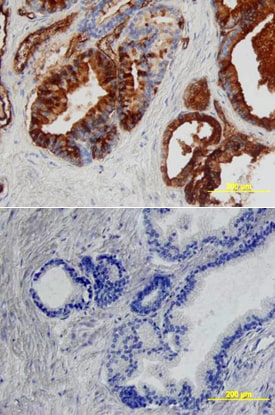
Angiopoietin-1 antibody in Human Prostate by Immunohistochemistry (IHC-P).

Angiopoietin‑1 in Human Prostate.

Angiopoietin-1 was detected in immersion fixed paraffin-embedded sections of human prostate array using Goat Anti-Human/Mouse Angiopoietin-1 Antigen Affinity-purified Polyclonal Antibody (Catalog # AF923) at 5 µg/mL overnight at 4 °C. Tissue was stained using the Anti-Goat HRP-DAB Cell & Tissue Staining Kit (brown; CTS008) and counterstained with hematoxylin (blue). Lower panel shows a lack of labeling if primary antibodies are omitted and tissue is stained only with secondary antibody followed by incubation with detection reagents. View our protocol for Chromogenic IHC Staining of Paraffin-embedded Tissue Sections.
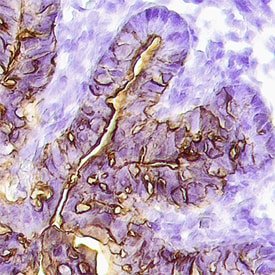
Angiopoietin-1 antibody in Mouse Embryo by Immunohistochemistry (IHC-Fr).

Angiopoietin‑1 in Mouse Embryo.

Angiopoietin-1 was detected in perfusion fixed frozen sections of mouse embryo (15 d.p.c.) using Goat Anti-Human/Mouse Angiopoietin-1 Antigen Affinity-purified Polyclonal Antibody (Catalog # AF923) at 15 µg/mL overnight at 4 °C. Tissue was stained using the Anti-Goat HRP-DAB Cell & Tissue Staining Kit (brown; CTS008) and counterstained with hematoxylin (blue). Specific staining was localized to endothelium in the loop of the midgut. View our protocol for Chromogenic IHC Staining of Frozen Tissue Sections.
Detection of Human Angiopoietin-1 by Immunohistochemistry

Detection of Human Angiopoietin-1 by Immunohistochemistry

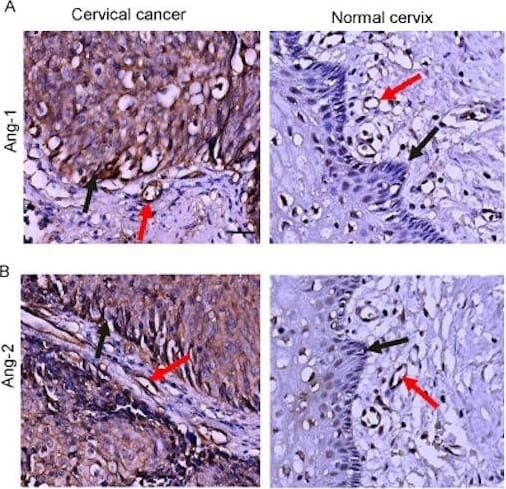
sAng-2 concentration positively relates with Ang-2 expression on the epithelia and MVD in cervical tissues.Representative immunohistochemical staining of Ang-1 (A), Ang-2 (B) and CD34 (C) in 25 cervical cancer tissue specimens and 10 normal controls. Black arrows denote positively stained epithelial cells, whereas red arrows denote positively staining endothelial cells, all appearing brown. Scale bar, 20 µm. (D) sAng-2 is significantly higher in the patients with positive Ang-2 expression on cervix epithelia than those with negative Ang-2 expression. The scatter diagrams show the correlations of sAng-1 (E), sAng-2 (F) and sAng-1/ sAng-2 ratio (G) to MVD in the 35 cervical tissue specimens. Image collected and cropped by CiteAb from the following open publication (https://pubmed.ncbi.nlm.nih.gov/28584715), licensed under a CC-BY license. Not internally tested by R&D Systems.
Detection of Human Angiopoietin-1 by Immunohistochemistry

Detection of Human Angiopoietin-1 by Immunohistochemistry

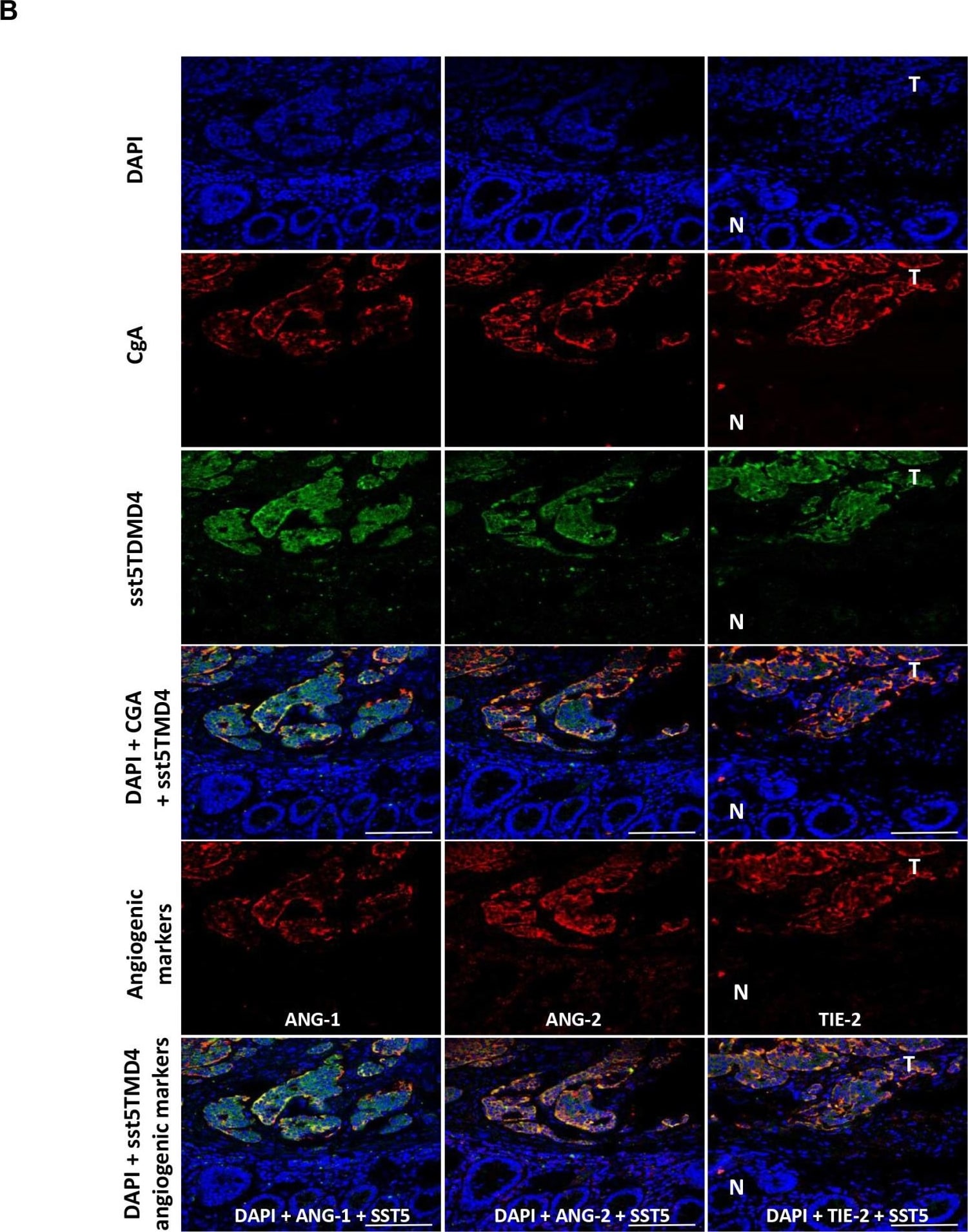
Expression of sst5TMD4 and co-localization with angiogenic marker in GEP-NET(A) Analysis of expression of angiogenic molecules and sst5TMD4 by specific serial immunohistochemistry in a pancreatic NET. Original magnification ×100 and ×400 (insets). N: normal tissue; T: tumor tissue. For specific immunostaining techniques see the “Materials and methods” section. (B) Expression of sst5TMD4 and angiogenic molecules by triple immunofluorescence in a gastrointestinal NET sample. Original magnification ×400. N: normal tissue; T: tumor tissue. For specific immunofluorescence techniques see the “Materials and methods” section. Scale bar for 100 μm is represented with a line for each Figure. Image collected and cropped by CiteAb from the following open publication (https://pubmed.ncbi.nlm.nih.gov/26673010), licensed under a CC-BY license. Not internally tested by R&D Systems.

Applications for Human/Mouse Angiopoietin‑1 Antibody

Application
Recommended Usage

Immunohistochemistry

5-15 µg/mL
Sample: Immersion fixed paraffin-embedded sections of human prostate cancer tissue and normal human prostate tissue, and perfusion fixed frozen sections of mouse embryo (15 d.p.c.)

Western Blot

0.1 µg/mL
Sample: Recombinant Human Angiopoietin‑1 (Catalog # 923-AN)

Reviewed Applications

Read 2 reviews rated 2.5 using AF923 in the following applications:

Formulation, Preparation, and Storage

Purification

Antigen Affinity-purified

Reconstitution

Reconstitute at 0.2 mg/mL in sterile PBS. For liquid material, refer to CoA for concentration.


Loading...

Formulation

Lyophilized from a 0.2 μm filtered solution in PBS with Trehalose. *Small pack size (SP) is supplied either lyophilized or as a 0.2 µm filtered solution in PBS.

Shipping

Lyophilized product is shipped at ambient temperature. Liquid small pack size (-SP) is shipped with polar packs. Upon receipt, store immediately at the temperature recommended below.

Stability & Storage

Use a manual defrost freezer and avoid repeated freeze-thaw cycles.
  • 12 months from date of receipt, -20 to -70 °C as supplied.
  • 1 month, 2 to 8 °C under sterile conditions after reconstitution.
  • 6 months, -20 to -70 °C under sterile conditions after reconstitution.

Calculators

The reconstitution calculator allows you to quickly calculate the volume of a reagent to reconstitute your vial. Simply enter the mass of reagent and the target concentration and the calculator will determine the rest.

=
÷

Background: Angiopoietin-1

Angiopoietin-1 (Ang-1) and Angiopoietin-2 (Ang-2) are two closely related secreted ligands which bind with similar affinity to Tie-2, a receptor tyrosine kinase with immunoglobulin and epidermal growth factor homology domains expressed primarily on endothelial cells and early hematopoietic cells. Tie-2 and angiopoietins have been shown to play critical roles in embryogenic angiogenesis and in maintaining the integrity of the adult vasculature (1).

Ang-1 cDNA encodes a 498 amino acid (aa) residue precursor protein that contains a coiled-coiled domain near the amino-terminus and a fibrinogen-like domain at the C-terminus. Human Ang-1 shares approximately 97% and 60% amino acid sequence identity with mouse Ang-1 and human Ang-2, respectively (1, 2). Ang-1 activates Tie-2 signaling on endothelial cells to promote chemotaxis, cell survival, cell sprouting, vessel growth and stabilization (1, 3, 4). Ang-2 has alternatively been reported to be an antagonist for Ang-1 induced Tie-2 signaling as well as an agonist for Tie-2 signaling, depending on the cell context (5).

References

  1. Jones, N. et al. (2001) Nat. Rev. Mol. Cell Biol. 2:257.
  2. Davis, S. et al. (1996) Cell 87:1161.
  3. Witzenbichler, B. et al. (1998) J. Biol. Chem. 273:18514.
  4. Papapetropoulos, A. et al. (1999) Lab. Inest. 79:213.
  5. Teichert-Kuliszewska, K. et al. (2001) Cardiovasc. Res. 49:659.

Alternate Names

ANGPT1

Entrez Gene IDs

284 (Human); 11600 (Mouse)

Gene Symbol

ANGPT1

UniProt

Additional Angiopoietin-1 Products

Product Documents for Human/Mouse Angiopoietin‑1 Antibody

Certificate of Analysis

To download a Certificate of Analysis, please enter a lot or batch number in the search box below.

Note: Certificate of Analysis not available for kit components.

Product Specific Notices for Human/Mouse Angiopoietin‑1 Antibody

For research use only

Citations for Human/Mouse Angiopoietin‑1 Antibody

Customer Reviews for Human/Mouse Angiopoietin‑1 Antibody (2)

2.5 out of 5
2 Customer Ratings
5 Stars
0%
4 Stars
0%
3 Stars
50%
2 Stars
50%
1 Stars
0%

Have you used Human/Mouse Angiopoietin‑1 Antibody?

Submit a review and receive an Amazon gift card!

$25/€18/£15/$25CAN/¥2500 Yen for a review with an image

$10/€7/£6/$10CAN/¥1110 Yen for a review without an image

Submit a review
Amazon Gift Card

Customer Images


Showing  1 - 2 of 2 reviews Showing All
Filter By:
  • Human/Mouse Angiopoietin-1 Antibody
    Name: Anonymous
    Application: Western Blot
    Sample Tested: HUVEC human umbilical vein endothelial cells
    Species: Human
    Verified Customer | Posted 04/10/2024
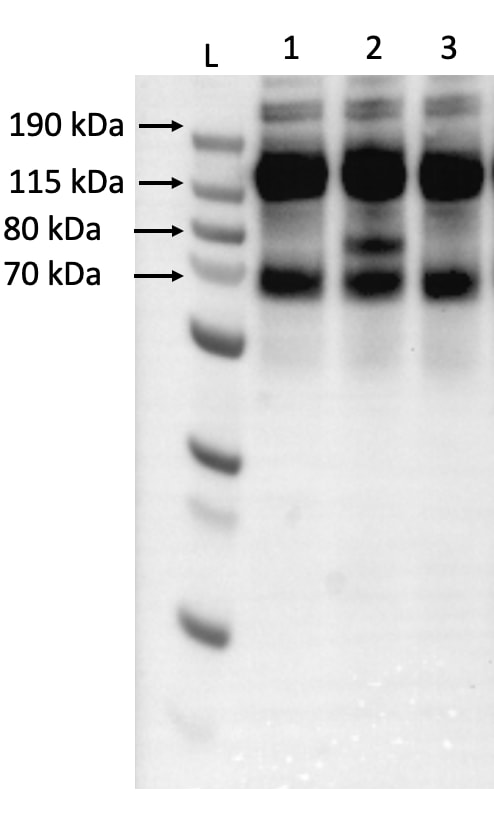
    Lane 1 is control treated cells (water). Here, no 923-AN was added. Lane 2 is rh ANGPT1 (923-AN) treated cells. Lane 3 is cells treated with ANGPT1 (923-AN) + ANGPT1 competitor. It didn't seem to work for my experiment. I prefer MAB923 based on my expected result.
    Human/Mouse Angiopoietin‑1 Antibody AF923
    Bio-Techne Response
    Thank you for reviewing our product. We are sorry to hear that this product did not perform as expected. We have been in touch with the customer to resolve this issue according to our Product Guarantee and to the customer’s satisfaction.
  • Human/Mouse Angiopoietin‑1 Antibody
    Name: Anonymous
    Application: Immunohistochemistry
    Sample Tested: Adult lung
    Species: Mouse
    Verified Customer | Posted 11/23/2015

There are no reviews that match your criteria.

Showing  1 - 2 of 2 reviews Showing All

Protocols

Find general support by application which include: protocols, troubleshooting, illustrated assays, videos and webinars.

FAQs

No product specific FAQs exist for this product.

View all FAQs for Antibodies
Loading...