
Contactin-1 (CNTN1) is a member of the contactin subgroup within the immunoglobulin superfamily. It was originally designated contactin in human, F3 in rodents, and F11 in chicken. Other members of this family in human include Contactin-2 (TAG-1), Contactin-5 (NB-2), and Contactin-6 (NB-3). Additional family members have been described in other species. CNTN1 shares less than 50% amino acid sequence identity with the other contactins. The human and rodent CNTN1 proteins share 96% sequence identity. The 998 amino acid mature protein contains 6 Ig-like domains and 4 fibronectin type III-like domains, and is attached to the membrane by a GPI anchor. CNTN1 is differentially expressed in numerous neuronal tissues and functions in nervous system development. It associates with two other cell-surface proteins believed to participate in signal transduction, receptor protein tyrosine phosphatase beta (RPTP beta ) and Contactin-associated protein (Caspr). Reported ligands include Nr-CAM and the extracellular matrix glycoprotein, tenascin.


Key Product Details
Species Reactivity
Validated:
Human, Mouse, Rat
Cited:
Human, Mouse, Rat, Porcine, Transgenic Mouse
Applications
Validated:
Immunohistochemistry, Western Blot, Neutralization, Simple Western
Cited:
Immunohistochemistry, Western Blot, Neutralization, Immunocytochemistry, Immunoprecipitation
Label
Unconjugated
Antibody Source
Polyclonal Goat IgG
Loading...
Product Specifications
Immunogen
S. frugiperda insect ovarian cell line Sf 21-derived recombinant human Contactin-1
Glu21-Ser993
Accession # CAA79696
Glu21-Ser993
Accession # CAA79696
Specificity
Detects human Contactin-1 in direct ELISAs. Detects human, mouse, and rat Contactin-1 in Western blots.
Clonality
Polyclonal
Host
Goat
Isotype
IgG
Endotoxin Level
<0.10 EU per 1 μg of the antibody by the LAL method.
Scientific Data Images for Contactin-1 Antibody
Contactin‑1 in Human Dorsal Root Ganglia.
Contactin-1 was detected in immersion fixed paraffin-embedded sections of human dorsal root ganglia using 15 µg/mL Goat Anti-Human/ Mouse/Rat Contactin-1 Antigen Affinity-purified Polyclonal Antibody (Catalog # AF904) overnight at 4 °C. Tissue was stained with the Anti-Goat HRP-DAB Cell & Tissue Staining Kit (brown; Catalog # CTS008) and counterstained with hematoxylin (blue). View our protocol for Chromogenic IHC Staining of Paraffin-embedded Tissue Sections.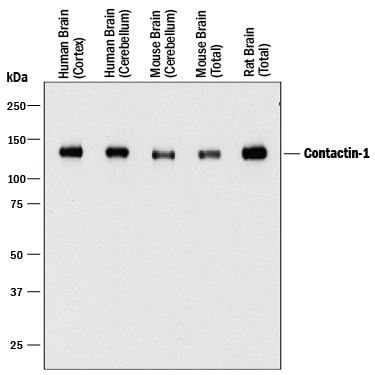
Detection of Human, Mouse, and Rat Contactin‑1 by Western Blot.
Western blot shows lysates of human brain (cortex) tissue, human brain (cerebellum) tissue, mouse brain (cerebellum) tissue, mouse brain (total) tissue, and rat brain (total) tissue. PVDF membrane was probed with 0.5 µg/mL of Goat Anti-Human/Mouse/ Rat Contactin-1 Antigen Affinity-purified Polyclonal Antibody (Catalog # AF904) followed by HRP-conjugated Anti-Goat IgG Secondary Antibody (Catalog # HAF017). A specific band was detected for Contactin-1 at approximately 135 kDa (as indicated). This experiment was conducted under reducing conditions and using Immunoblot Buffer Group 1.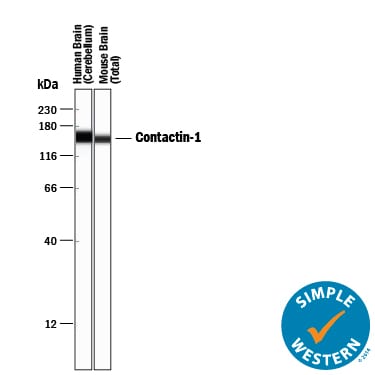
Detection of Human and Mouse Contactin‑1 by Simple WesternTM.
Simple Western lane view shows lysates of human brain tissue and mouse brain tissue, loaded at 0.2 mg/mL. A specific band was detected for Contactin-1 at approximately 158 kDa (as indicated) using 5 µg/mL of Goat Anti-Human/Mouse/Rat Contactin-1 Antigen Affinity-purified Polyclonal Antibody (Catalog # AF904) followed by 1:50 dilution of HRP-conjugated Anti-Goat IgG Secondary Antibody (Catalog # HAF109). This experiment was conducted under reducing conditions and using the 12-230 kDa separation system.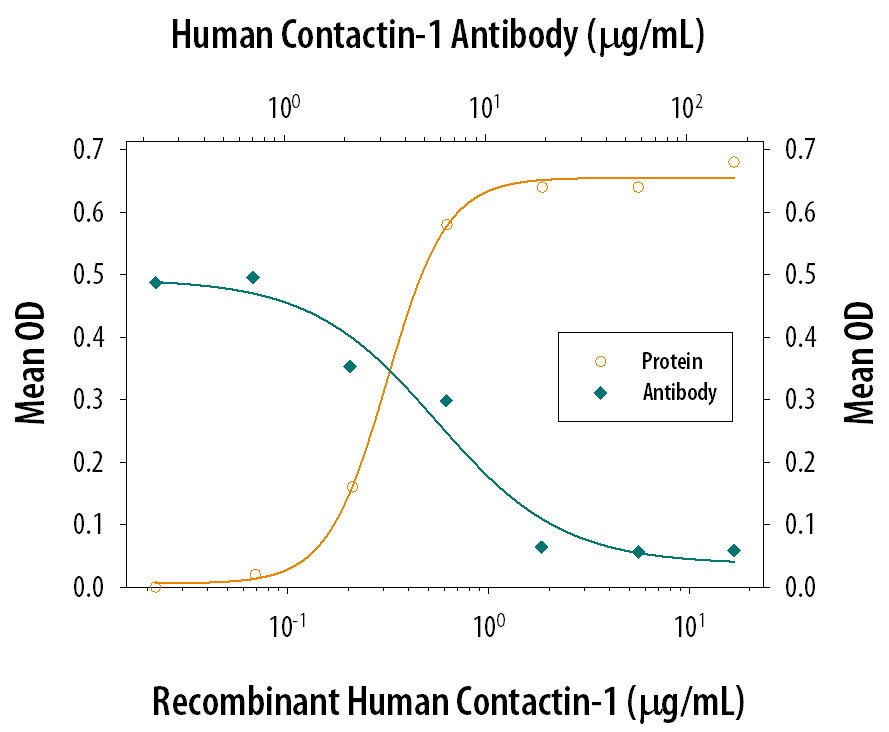
Cell Adhesion Mediated by Contactin‑1 and Neutralization by Human Contactin‑1 Antibody.
Recombinant Human Contactin-1 Fc Chimera (Catalog # 904-CN), immobilized onto a microplate, supports the adhesion of the C6 rat glioma cell line in a dose-dependent manner (orange line). Adhesion elicited by Recombinant Human Contactin-1 Fc Chimera (2 µg/mL) is neutralized (green line) by increasing concentrations of Goat Anti-Human/Mouse/Rat Contactin-1 Antigen Affinity-purified Polyclonal Antibody (Catalog # AF904). The ND50 is typically 1-5 µg/mL.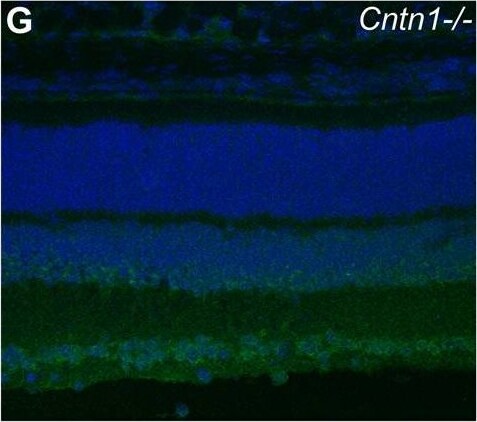
Detection of Contactin-1 by Immunohistochemistry
Expression and localization of Cntn1 in the retina.A–C In situ hybridization for Cntn1 expression in the wild type mouse retina at P5 (A), P10 (B), and P21 (C). A subset of cells in the retinal ganglion cell layer (bottom) and inner nuclear layer are positive for Cntn1 expression. Photoreceptors in the outer nuclear layer (top) do not have signals above background. D) Double label in situ hybridization with Cntn1 and syntaxin1a at P21 demonstrates that some amacrine cells in the inner nuclear layer are positive for Cntn1 expression (arrowheads). Other Cntn1-positive cells are likely to be bipolar cells based on their position (arrows). E) In the retinal ganglion cell layer, a majority of cells expressing Cntn1 at P21 also express Thy1, a marker of ganglion cells. F) Immunolabeling of retinas with anti-CNTN1 antibodies at P14 revealed strong labeling of the synaptic plexiform layers, as well as immunoreactivity in the cellular layers, particularly the inner nuclear layer. G) Immunolabeling retinas from Cntn1 mutant mice revealed a marked reduction, but not an elimination of signal intensity in images collected with equivalent parameters. Image collected and cropped by CiteAb from the following open publication (https://pubmed.ncbi.nlm.nih.gov/22242131), licensed under a CC-BY license. Not internally tested by R&D Systems.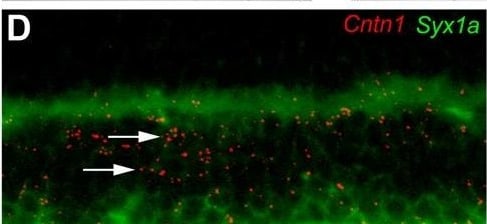
Detection of Contactin-1 by Immunohistochemistry
Expression and localization of Cntn1 in the retina.A–C In situ hybridization for Cntn1 expression in the wild type mouse retina at P5 (A), P10 (B), and P21 (C). A subset of cells in the retinal ganglion cell layer (bottom) and inner nuclear layer are positive for Cntn1 expression. Photoreceptors in the outer nuclear layer (top) do not have signals above background. D) Double label in situ hybridization with Cntn1 and syntaxin1a at P21 demonstrates that some amacrine cells in the inner nuclear layer are positive for Cntn1 expression (arrowheads). Other Cntn1-positive cells are likely to be bipolar cells based on their position (arrows). E) In the retinal ganglion cell layer, a majority of cells expressing Cntn1 at P21 also express Thy1, a marker of ganglion cells. F) Immunolabeling of retinas with anti-CNTN1 antibodies at P14 revealed strong labeling of the synaptic plexiform layers, as well as immunoreactivity in the cellular layers, particularly the inner nuclear layer. G) Immunolabeling retinas from Cntn1 mutant mice revealed a marked reduction, but not an elimination of signal intensity in images collected with equivalent parameters. Image collected and cropped by CiteAb from the following open publication (https://pubmed.ncbi.nlm.nih.gov/22242131), licensed under a CC-BY license. Not internally tested by R&D Systems.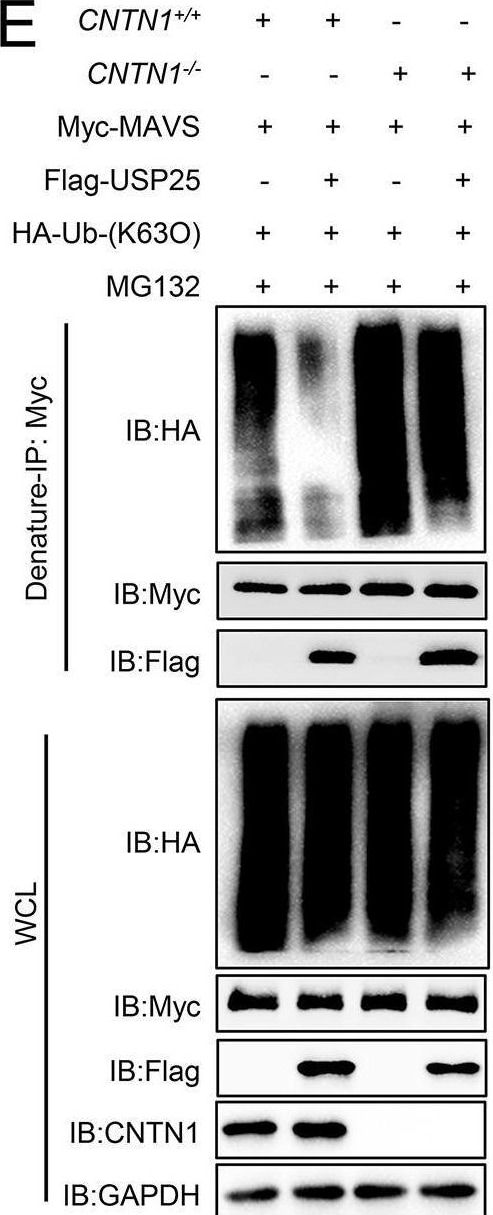
Detection of Contactin-1 by Western Blot
CNTN1 facilitates USP25 to degrade MAVS through the proteasomal pathway.(A) USP25 inhibits K63-linked ubiquitination of MAVS. HEK293 cells transfected with Myc-MAVS, HA-ubiquitin, or its mutants (K48O, K63O), together with a control or USP25 plasmids, were pre-treated with MG132 (10 μM) for 6 h, and the cells were then subjected to denature-IP and immunoblotting analysis with the indicated antibodies. (B) USP25+/+ and USP25-/- cells transfected with Myc-MAVS, HA-ubiquitin (K63O), were left uninfected or infected with SeV for 12 h. The cells were then subjected to denature-IP and immunoblotting analysis with the indicated antibodies. (C) USP25+/+ and USP25-/- cells were left uninfected or infected with SeV for 12 h. Twenty-four hours later, cells were harvested for SDD-AGE or SDS-PAGE followed by immunoblotting analysis with the indicated antibodies. (D) USP25-knockdown inhibits CNTN1-triggered K63-linked ubiquitination of MAVS. HEK293 cells were transfected with the indicated plasmids and USP25 siRNA or NC for 24 h. The cells were then treated with MG132 for 6 h before being used in ubiquitination assays with the indicated antibodies. (E) CNTN1+/+ or CNTN1-/- HEK293 cells were transfected with Myc-MAVS and HA-ubiquitin (K63O), together with a control or USP25 plasmids. The cells were then subjected to denature-IP and immunoblotting analysis with the indicated antibodies. (F) USP25-knockdown inhibits CNTN1-mediated degradation of MAVS. HEK293 cells were transfected with the indicated plasmids and USP25 siRNA or NC for 24 h before immunoblotting analysis. Image collected and cropped by CiteAb from the following open publication (https://pubmed.ncbi.nlm.nih.gov/35171955), licensed under a CC-BY license. Not internally tested by R&D Systems.Applications for Contactin-1 Antibody
Application
Recommended Usage
Immunohistochemistry
5-15 µg/mL
Sample: Immersion fixed paraffin-embedded sections of human dorsal root ganglia
Sample: Immersion fixed paraffin-embedded sections of human dorsal root ganglia
Simple Western
5 µg/mL
Sample: Human brain tissue and mouse brain tissue
Sample: Human brain tissue and mouse brain tissue
Western Blot
0.5 µg/mL
Sample: Human brain (cortex) tissue, human brain (cerebellum) tissue, mouse brain (cerebellum) tissue, mouse brain (total) tissue, and rat brain (total) tissue
Sample: Human brain (cortex) tissue, human brain (cerebellum) tissue, mouse brain (cerebellum) tissue, mouse brain (total) tissue, and rat brain (total) tissue
Neutralization
Measured by its ability to neutralize Contactin‑1-mediated adhesion of the C6 rat glioma cell line [Revest, J.M. et al. (1999) Adv. Exp. Med. Biol. 468:309]. The Neutralization Dose (ND50) is typically 1-5 µg/mL in the presence of 2 µg/mL Recombinant Human Contactin‑1 Fc Chimera.
Formulation, Preparation, and Storage
Purification
Antigen Affinity-purified
Reconstitution
Reconstitute at 0.2 mg/mL in sterile PBS. For liquid material, refer to CoA for concentration.
Loading...
Formulation
Lyophilized from a 0.2 μm filtered solution in PBS with Trehalose. *Small pack size (SP) is supplied either lyophilized or as a 0.2 µm filtered solution in PBS.
Shipping
Lyophilized product is shipped at ambient temperature. Liquid small pack size (-SP) is shipped with polar packs. Upon receipt, store immediately at the temperature recommended below.
Stability & Storage
Use a manual defrost freezer and avoid repeated freeze-thaw cycles.
- 12 months from date of receipt, -20 to -70 °C as supplied.
- 1 month, 2 to 8 °C under sterile conditions after reconstitution.
- 6 months, -20 to -70 °C under sterile conditions after reconstitution.
Calculators
Background: Contactin-1
References
- Reid, R.A. et al. (1994) Brain Res. Mol. Brain Res. 21:1.
- Walsh, F.S. and P. Doherty (1991) Cell Biol. Int. Rep. 15:1151.
Alternate Names
CNTN1, Contactin1, F11, F3cam
Gene Symbol
CNTN1
UniProt
Additional Contactin-1 Products
Product Documents for Contactin-1 Antibody
Certificate of Analysis
To download a Certificate of Analysis, please enter a lot or batch number in the search box below.
Note: Certificate of Analysis not available for kit components.
Product Specific Notices for Contactin-1 Antibody
For research use only
Related Research Areas
Citations for Contactin-1 Antibody
 Powered by Bioz
Customer Reviews for Contactin-1 Antibody
There are currently no reviews for this product. Be the first to review Contactin-1 Antibody and earn rewards!
Have you used Contactin-1 Antibody?
Submit a review and receive an Amazon gift card!
$25/€18/£15/$25CAN/¥2500 for a review with an image
$10/€7/£6/$10CAN/¥1110 for a review without an image
Submit a review
Protocols
Find general support by application which include: protocols, troubleshooting, illustrated assays, videos and webinars.
- Antigen Retrieval Protocol (PIER)
- Antigen Retrieval for Frozen Sections Protocol
- Appropriate Fixation of IHC/ICC Samples
- Cellular Response to Hypoxia Protocols
- Chromogenic IHC Staining of Formalin-Fixed Paraffin-Embedded (FFPE) Tissue Protocol
- Chromogenic Immunohistochemistry Staining of Frozen Tissue
- ClariTSA™ Fluorophore Kits
- Detection & Visualization of Antibody Binding
- Fluorescent IHC Staining of Frozen Tissue Protocol
- Graphic Protocol for Heat-induced Epitope Retrieval
- Graphic Protocol for the Preparation and Fluorescent IHC Staining of Frozen Tissue Sections
- Graphic Protocol for the Preparation and Fluorescent IHC Staining of Paraffin-embedded Tissue Sections
- Graphic Protocol for the Preparation of Gelatin-coated Slides for Histological Tissue Sections
- IHC Sample Preparation (Frozen sections vs Paraffin)
- Immunofluorescent IHC Staining of Formalin-Fixed Paraffin-Embedded (FFPE) Tissue Protocol
- Immunohistochemistry (IHC) and Immunocytochemistry (ICC) Protocols
- Immunohistochemistry Frozen Troubleshooting
- Immunohistochemistry Paraffin Troubleshooting
- Preparing Samples for IHC/ICC Experiments
- Preventing Non-Specific Staining (Non-Specific Binding)
- Primary Antibody Selection & Optimization
- Protocol for Heat-Induced Epitope Retrieval (HIER)
- Protocol for Making a 4% Formaldehyde Solution in PBS
- Protocol for VisUCyte™ HRP Polymer Detection Reagent
- Protocol for the Preparation & Fixation of Cells on Coverslips
- Protocol for the Preparation and Chromogenic IHC Staining of Frozen Tissue Sections
- Protocol for the Preparation and Chromogenic IHC Staining of Frozen Tissue Sections - Graphic
- Protocol for the Preparation and Chromogenic IHC Staining of Paraffin-embedded Tissue Sections
- Protocol for the Preparation and Chromogenic IHC Staining of Paraffin-embedded Tissue Sections - Graphic
- Protocol for the Preparation and Fluorescent IHC Staining of Frozen Tissue Sections
- Protocol for the Preparation and Fluorescent IHC Staining of Paraffin-embedded Tissue Sections
- Protocol for the Preparation of Gelatin-coated Slides for Histological Tissue Sections
- R&D Systems Quality Control Western Blot Protocol
- TUNEL and Active Caspase-3 Detection by IHC/ICC Protocol
- The Importance of IHC/ICC Controls
- Troubleshooting Guide: Immunohistochemistry
- Troubleshooting Guide: Western Blot Figures
- Western Blot Conditions
- Western Blot Protocol
- Western Blot Protocol for Cell Lysates
- Western Blot Troubleshooting
- Western Blot Troubleshooting Guide
- View all Protocols, Troubleshooting, Illustrated assays and Webinars
Loading...
Associated Pathways
