
Glutathione Peroxidase 4/GPX4 Antibody (565320)
R&D Systems | Catalog # MAB5457


Scientific images may be resized, cropped, or adjusted for brightness or contrast for presentation purposes. These updates are limited to presentation and do not affect the underlying scientific interpretation of the data. Where available, additional source data may be provided upon request.
Key Product Details
Species Reactivity
Validated:
Cited:
Applications
Validated:
Cited:
Label
Antibody Source
Product Specifications
Immunogen
Gly74-Phe168
Accession # P36969
Specificity
Clonality
Host
Isotype
Scientific Data Images for Glutathione Peroxidase 4/GPX4 Antibody (565320)
Detection of Human/Mouse/Rat Glutathione Peroxidase 4 by Western Blot.
Western blot shows lysates of mouse, human, and rat liver tissue. PVDF membrane was probed with 0.5 µg/mL of Human/Mouse/Rat Glutathione Peroxidase 4 Monoclonal Antibody (Catalog # MAB5457) followed by HRP-conjugated Anti-Mouse IgG Secondary Antibody (Catalog # HAF007). A specific band was detected for Glutathione Peroxidase 4 at approximately 21 kDa (as indicated). This experiment was conducted under reducing conditions and using Immunoblot Buffer Group 2.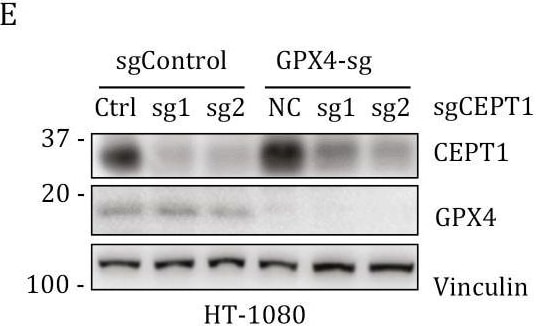
Detection of Glutathione Peroxidase 4/GPX4 by Western Blot
CEPT1 inhibits ferroptosis. (E) Western blot analysis of indicated protein levels in control (sgCtrl) and CEPT1-GPX4 single and double knockout HT-1080 cells. (F and G) Relative lipid peroxidation and cell death by PI staining in the control (sgCtrl) and CEPT1-GPX4 single or double knockout HT-1080 cells with or without 5 µmol/L ferrostatin-1 (Fer-1) for 48 (F) or 72 (G) h. (H) Cell death was measured by PI staining in 786-O cells overexpressing CEPT1 or transfected with empty vector (EV) treated with DMSO or 50 nmol/L RSL3 for 24 h. (I) Cell death was measured by PI staining in 786-O cells overexpressing CEPT1 or transfected with empty vector (EV) cultured in cystine-containing (+Cystine) or cystine-free (−Cystine) medium for 24 h. (J) Cell death was measured by PI staining in 786-O cells overexpressing CEPT1 or transfected with empty vector (EV) with treatment of DMSO or 10 µmol/L erastin for 24 h. (K) Tumor volumes over time in control (sgControl) and CEPT1-knockout (sgCEPT1) HT-1080 cells-derived xenografts under the indicated treatments. (L) End-point weights of HT-1080 xenograft tumors with indicated genotypes treated with IKE or vehicle. (M–O) Representative immunochemical images (M) from HT-1080 xenograft tumors with indicated genotypes treated with IKE or vehicle and corresponding immunoreactive scores of cleaved caspase-3 (N) or 4-HNE (O). Image collected and cropped by CiteAb from the following open publication (https://academic.oup.com/proteincell/article/15/9/686/7618045), licensed under a CC-BY license. Not internally tested by R&D Systems.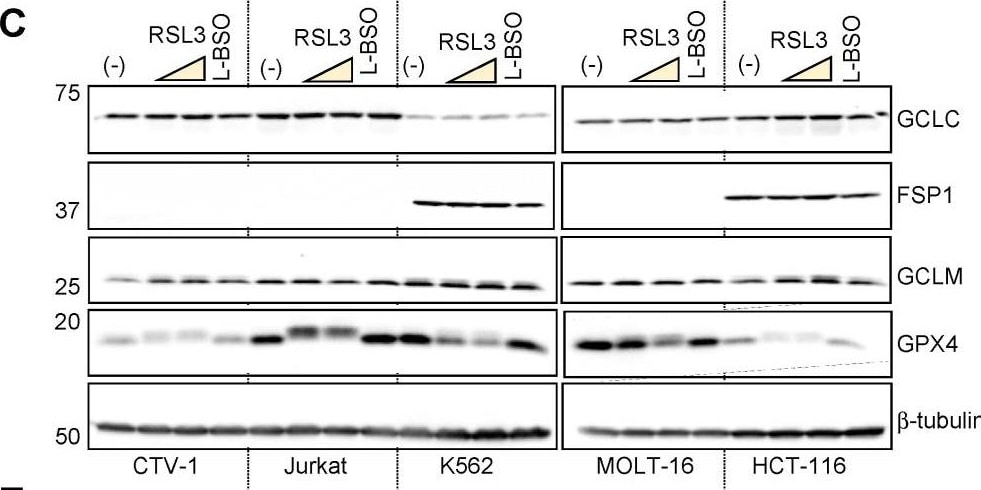
Detection of Glutathione Peroxidase 4/GPX4 by Western Blot
FSP1 is silenced in acute lymphoblastic leukemia (ALL) cell lines. A. Immune blot detection of FSP1, GCLC, GCLM, and GPX4 in total protein extracts from the cell lines depicted in the figure. LaminB1 was used as loading control. B. RT-qPCR analysis of the expression of FSP1 in MOLT-16, CTV-1, Jurkat and HCT-116. Data are plotted as expression relative to the level of RNA detected in MOLT-16 (mean ± SD, one-way ANOVA corrected for multiple comparison using a Tukey test, ****P < 0.0001, ***P = 0.0004). C. Immune blot detection of FSP1, GCLC, GCLM, and GPX4 in total protein extracts from the cell lines exposed to 1S,3S-RSL3 (RSL3) or l-buthionine sulfoximine (L-BSO) for 24 h. The concentrations used were 0.25 and 1 μmol L−1 RSL3 for CTV-1, Jurkat, K562 and HCT-116. For MOLT-16 RSL3 was used at 0.05 and 0.25 μmol L−1. L-BSO was used at 100 μmol L−1 in all the cell lines. D. Quantification of FSP1 immuneblot shown in C. The data plotted correspond to 3 independent biological replicates. b-tubulin was used as loading control. E. Quantification of GCLC, GCLM and GPX4 immuneblots shown in Fig. 3C. The data plotted correspond to 3 independent biological replicates. b-tubulin was used as loading control (mean ± SD; n = 3). Image collected and cropped by CiteAb from the following open publication (https://pubmed.ncbi.nlm.nih.gov/35944469), licensed under a CC-BY license. Not internally tested by R&D Systems.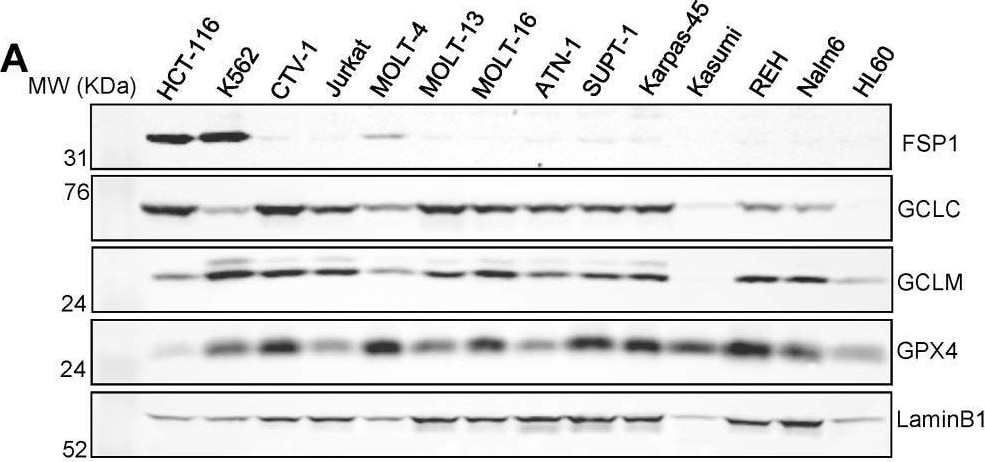
Detection of Glutathione Peroxidase 4/GPX4 by Western Blot
FSP1 is silenced in acute lymphoblastic leukemia (ALL) cell lines. A. Immune blot detection of FSP1, GCLC, GCLM, and GPX4 in total protein extracts from the cell lines depicted in the figure. LaminB1 was used as loading control. B. RT-qPCR analysis of the expression of FSP1 in MOLT-16, CTV-1, Jurkat and HCT-116. Data are plotted as expression relative to the level of RNA detected in MOLT-16 (mean ± SD, one-way ANOVA corrected for multiple comparison using a Tukey test, ****P < 0.0001, ***P = 0.0004). C. Immune blot detection of FSP1, GCLC, GCLM, and GPX4 in total protein extracts from the cell lines exposed to 1S,3S-RSL3 (RSL3) or l-buthionine sulfoximine (L-BSO) for 24 h. The concentrations used were 0.25 and 1 μmol L−1 RSL3 for CTV-1, Jurkat, K562 and HCT-116. For MOLT-16 RSL3 was used at 0.05 and 0.25 μmol L−1. L-BSO was used at 100 μmol L−1 in all the cell lines. D. Quantification of FSP1 immuneblot shown in C. The data plotted correspond to 3 independent biological replicates. b-tubulin was used as loading control. E. Quantification of GCLC, GCLM and GPX4 immuneblots shown in Fig. 3C. The data plotted correspond to 3 independent biological replicates. b-tubulin was used as loading control (mean ± SD; n = 3). Image collected and cropped by CiteAb from the following open publication (https://pubmed.ncbi.nlm.nih.gov/35944469), licensed under a CC-BY license. Not internally tested by R&D Systems.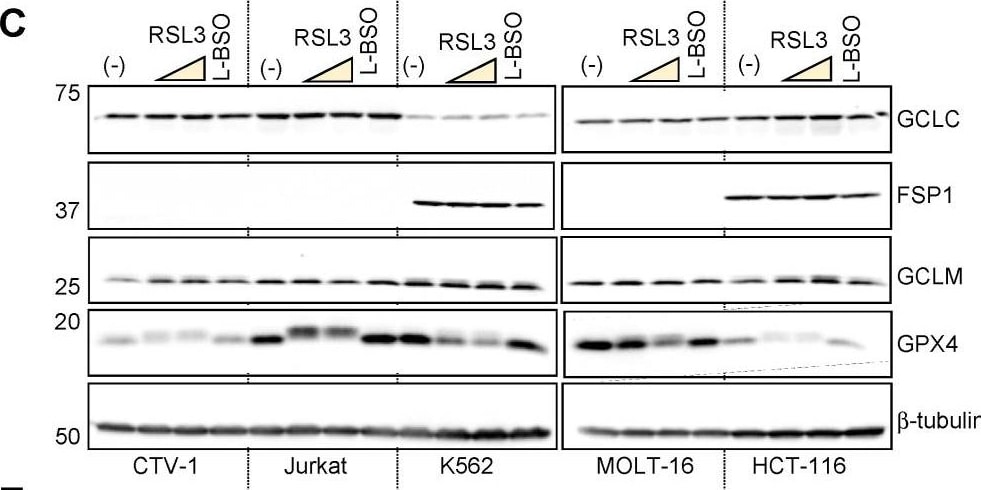
Detection of Glutathione Peroxidase 4/GPX4 by Western Blot
FSP1 is silenced in acute lymphoblastic leukemia (ALL) cell lines. A. Immune blot detection of FSP1, GCLC, GCLM, and GPX4 in total protein extracts from the cell lines depicted in the figure. LaminB1 was used as loading control. B. RT-qPCR analysis of the expression of FSP1 in MOLT-16, CTV-1, Jurkat and HCT-116. Data are plotted as expression relative to the level of RNA detected in MOLT-16 (mean ± SD, one-way ANOVA corrected for multiple comparison using a Tukey test, ****P < 0.0001, ***P = 0.0004). C. Immune blot detection of FSP1, GCLC, GCLM, and GPX4 in total protein extracts from the cell lines exposed to 1S,3S-RSL3 (RSL3) or l-buthionine sulfoximine (L-BSO) for 24 h. The concentrations used were 0.25 and 1 μmol L−1 RSL3 for CTV-1, Jurkat, K562 and HCT-116. For MOLT-16 RSL3 was used at 0.05 and 0.25 μmol L−1. L-BSO was used at 100 μmol L−1 in all the cell lines. D. Quantification of FSP1 immuneblot shown in C. The data plotted correspond to 3 independent biological replicates. b-tubulin was used as loading control. E. Quantification of GCLC, GCLM and GPX4 immuneblots shown in Fig. 3C. The data plotted correspond to 3 independent biological replicates. b-tubulin was used as loading control (mean ± SD; n = 3). Image collected and cropped by CiteAb from the following open publication (https://pubmed.ncbi.nlm.nih.gov/35944469), licensed under a CC-BY license. Not internally tested by R&D Systems.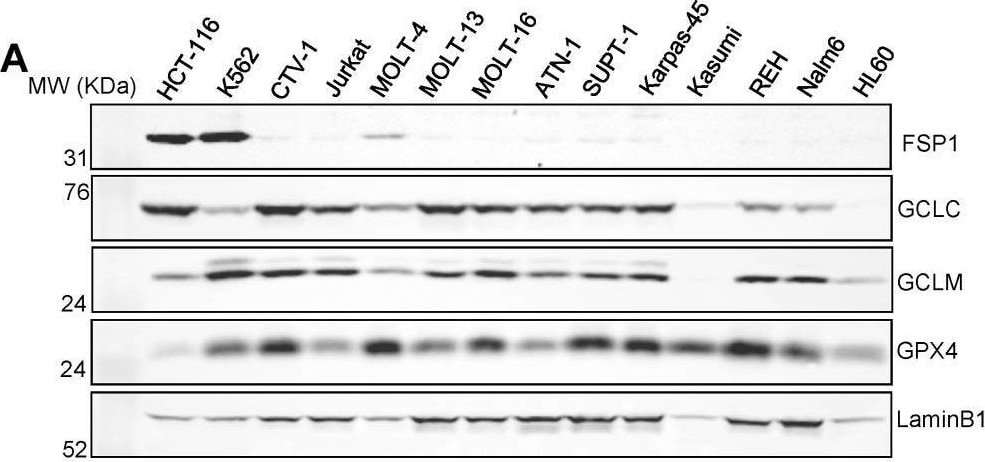
Detection of Glutathione Peroxidase 4/GPX4 by Western Blot
FSP1 is silenced in acute lymphoblastic leukemia (ALL) cell lines. A. Immune blot detection of FSP1, GCLC, GCLM, and GPX4 in total protein extracts from the cell lines depicted in the figure. LaminB1 was used as loading control. B. RT-qPCR analysis of the expression of FSP1 in MOLT-16, CTV-1, Jurkat and HCT-116. Data are plotted as expression relative to the level of RNA detected in MOLT-16 (mean ± SD, one-way ANOVA corrected for multiple comparison using a Tukey test, ****P < 0.0001, ***P = 0.0004). C. Immune blot detection of FSP1, GCLC, GCLM, and GPX4 in total protein extracts from the cell lines exposed to 1S,3S-RSL3 (RSL3) or l-buthionine sulfoximine (L-BSO) for 24 h. The concentrations used were 0.25 and 1 μmol L−1 RSL3 for CTV-1, Jurkat, K562 and HCT-116. For MOLT-16 RSL3 was used at 0.05 and 0.25 μmol L−1. L-BSO was used at 100 μmol L−1 in all the cell lines. D. Quantification of FSP1 immuneblot shown in C. The data plotted correspond to 3 independent biological replicates. b-tubulin was used as loading control. E. Quantification of GCLC, GCLM and GPX4 immuneblots shown in Fig. 3C. The data plotted correspond to 3 independent biological replicates. b-tubulin was used as loading control (mean ± SD; n = 3). Image collected and cropped by CiteAb from the following open publication (https://pubmed.ncbi.nlm.nih.gov/35944469), licensed under a CC-BY license. Not internally tested by R&D Systems.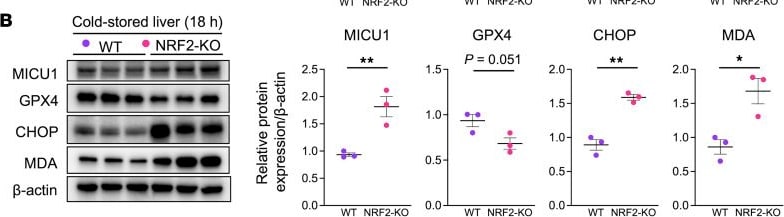
Detection of Glutathione Peroxidase 4/GPX4 by Western Blot
GPX4 pathway is dispensable in cold stress–induced liver injury. Western blot–assisted detection and relative intensity ratio of MICU1, GPX4, CHOP, and MDA in WT and NRF2-deficient (NRF2-KO) (A) naive livers and (B) 18-hour cold-stored livers. Expression of beta -actin served as the internal control and was used for normalization (n = 3/group). (C) WT livers stored in UW solution (4°C/18 h) with/without RSL3 (GPX4 inhibitor) were perfused with PBS (2 mL) through a cuff placed at the portal vein to collect liver flush from inferior vena cava. (D) Western blot–assisted detection of MDA and HMGB1 in the liver flush (5 μL) from cold-stored livers (n = 4/group). (E) LDH and (F) AST/ALT levels (U/L) in the liver flush (n = 4/group). Purple circle: WT livers; pink circle: NRF2-KO livers. Data are shown as mean ± SEM. *P < 0.05, **P < 0.01, Student’s t test (A and B), 1-way ANOVA followed by Tukey’s HSD test (D−F). Image collected and cropped by CiteAb from the following open publication (https://pubmed.ncbi.nlm.nih.gov/38329125), licensed under a CC-BY license. Not internally tested by R&D Systems.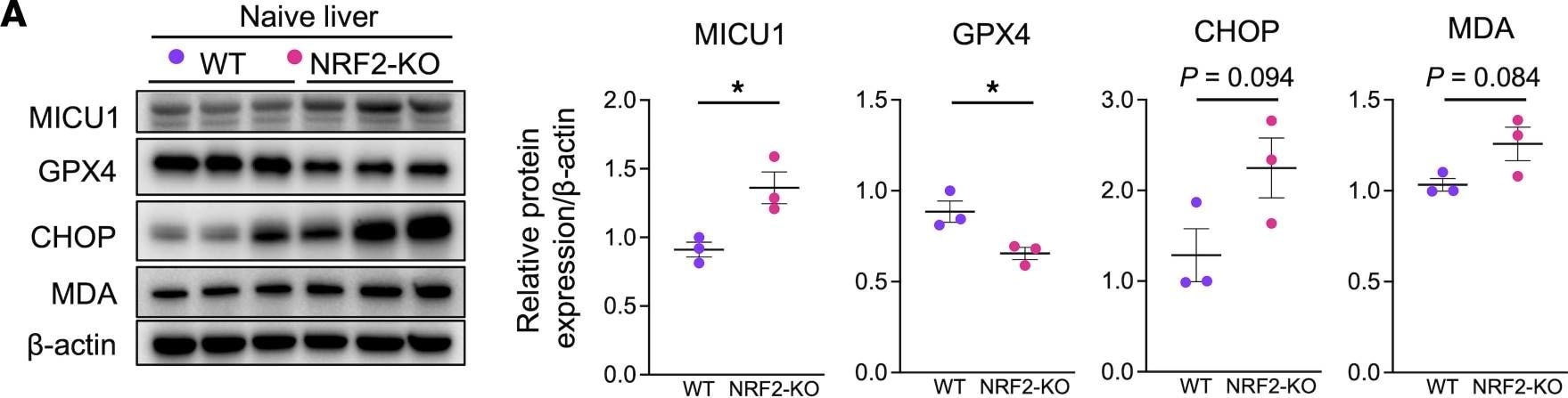
Detection of Glutathione Peroxidase 4/GPX4 by Western Blot
GPX4 pathway is dispensable in cold stress–induced liver injury. Western blot–assisted detection and relative intensity ratio of MICU1, GPX4, CHOP, and MDA in WT and NRF2-deficient (NRF2-KO) (A) naive livers and (B) 18-hour cold-stored livers. Expression of beta -actin served as the internal control and was used for normalization (n = 3/group). (C) WT livers stored in UW solution (4°C/18 h) with/without RSL3 (GPX4 inhibitor) were perfused with PBS (2 mL) through a cuff placed at the portal vein to collect liver flush from inferior vena cava. (D) Western blot–assisted detection of MDA and HMGB1 in the liver flush (5 μL) from cold-stored livers (n = 4/group). (E) LDH and (F) AST/ALT levels (U/L) in the liver flush (n = 4/group). Purple circle: WT livers; pink circle: NRF2-KO livers. Data are shown as mean ± SEM. *P < 0.05, **P < 0.01, Student’s t test (A and B), 1-way ANOVA followed by Tukey’s HSD test (D−F). Image collected and cropped by CiteAb from the following open publication (https://pubmed.ncbi.nlm.nih.gov/38329125), licensed under a CC-BY license. Not internally tested by R&D Systems.Applications for Glutathione Peroxidase 4/GPX4 Antibody (565320)
Western Blot
Sample: Mouse, human, and rat liver tissue
Formulation, Preparation, and Storage
Purification
Reconstitution
Reconstitute at 0.5 mg/mL in sterile PBS. For liquid material, refer to CoA for concentration.
Formulation
Shipping
Stability & Storage
- 12 months from date of receipt, -20 to -70 °C as supplied.
- 1 month, 2 to 8 °C under sterile conditions after reconstitution.
- 6 months, -20 to -70 °C under sterile conditions after reconstitution.
Calculators
Background: Glutathione Peroxidase 4/GPX4
Alternate Names
Gene Symbol
UniProt
Additional Glutathione Peroxidase 4/GPX4 Products
Product Documents for Glutathione Peroxidase 4/GPX4 Antibody (565320)
Certificate of Analysis
To download a Certificate of Analysis, please enter a lot or batch number in the search box below.
Note: Certificate of Analysis not available for kit components.
Product Specific Notices for Glutathione Peroxidase 4/GPX4 Antibody (565320)
For research use only
Related Research Areas
Citations for Glutathione Peroxidase 4/GPX4 Antibody (565320)
 Powered by Bioz
Customer Reviews for Glutathione Peroxidase 4/GPX4 Antibody (565320)
There are currently no reviews for this product. Be the first to review Glutathione Peroxidase 4/GPX4 Antibody (565320) and earn rewards!
Have you used Glutathione Peroxidase 4/GPX4 Antibody (565320)?
Submit a review and receive an Amazon gift card!
$25/€18/£15/$25CAN/¥2500 for a review with an image
$10/€7/£6/$10CAN/¥1110 for a review without an image
Submit a review
Protocols
Find general support by application which include: protocols, troubleshooting, illustrated assays, videos and webinars.
- Cellular Response to Hypoxia Protocols
- R&D Systems Quality Control Western Blot Protocol
- Troubleshooting Guide: Western Blot Figures
- Western Blot Conditions
- Western Blot Protocol
- Western Blot Protocol for Cell Lysates
- Western Blot Troubleshooting
- Western Blot Troubleshooting Guide
- View all Protocols, Troubleshooting, Illustrated assays and Webinars