
NM23-H1 (Non-metastatic protein 23 homolog 1; also NDKA and NME1) is a 19‑20 kDa member of the NDK family of enzymes. NM23-H1 is ubiquitous in expression, and performs multiple functions. It forms disulfide-linked homohexamers, and heterohexamers with NM23-H2, generating a nucleoside diphosphate kinase that catalyzes a phosphoryl transfer from ATP to a nucleoside diphosphate. It also shows His and Ser/Thr protein kinase activity, and forms covalent linkages with molecules diverse as p53 and STRAP. It is found both intracellularly, and in blood at ng/mL concentrations. Human NM23-H1 is 152 amino acids (aa) in length, contains one NDP kinase domain (aa 5‑134) and shows acetylation at Ala2 and Lys56, plus phosphorylation at Tyr52, Thr94, Ser122 and Ser125. Human NM23-H1 shares 89% aa identity with human 17‑18 kDa NM23-H2, and 94% aa identity with mouse NM23-H1. A second H1 isoform named NM23-H1B with 25 additional aa at the N‑terminus has also been described.

Scientific images may be resized, cropped, or adjusted for brightness or contrast for presentation purposes. These updates are limited to presentation and do not affect the underlying scientific interpretation of the data. Where available, additional source data may be provided upon request.
Key Product Details
Species Reactivity
Applications
Label
Antibody Source
Product Specifications
Immunogen
Ala2-Glu152
Accession # P15531
Specificity
Clonality
Host
Isotype
Scientific Data Images for NM23-H1/H2 Antibody (642825)
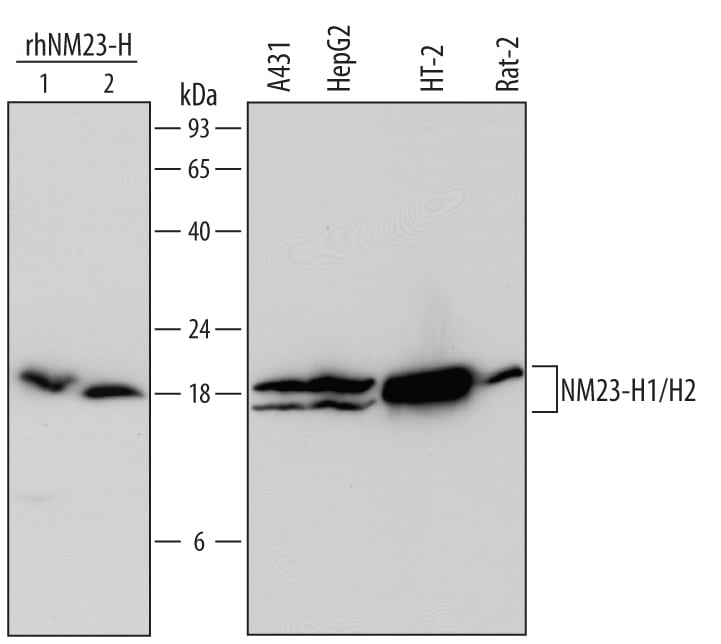
Detection of Human, Mouse, and Rat NM23‑H1/H2 by Western Blot.
Western blot shows lysates of A431 human epithelial carcinoma cell line, HepG2 human hepatocellular carcinoma cell line, HT-2 mouse T cell line, and Rat-2 rat embryonic fibroblast cell line. PVDF Membrane was probed with 0.5 µg/mL of Mouse Anti-Human/Mouse/Rat NM23-H1/H2 Monoclonal Antibody (Catalog # MAB6019) followed by HRP-conjugated Anti-Mouse IgG Secondary Antibody (Catalog # HAF007). For additional reference, recombinant human NM23-H1 and recombinant human NM23-H2 (10 ng/lane) were included. Specific bands were detected for NM23-H1/H2 at approximately 17-20 kDa (as indicated). This experiment was conducted under reducing conditions and using Immunoblot Buffer Group 2.Applications for NM23-H1/H2 Antibody (642825)
Western Blot
Sample: A431 human epithelial carcinoma cell line, HepG2 human hepatocellular carcinoma cell line, HT‑2 mouse T cell line, and Rat‑2 rat embryonic fibroblast cell line
Formulation, Preparation, and Storage
Purification
Reconstitution
Reconstitute at 0.5 mg/mL in sterile PBS. For liquid material, refer to CoA for concentration.
Formulation
Shipping
Stability & Storage
- 12 months from date of receipt, -20 to -70 °C as supplied.
- 1 month, 2 to 8 °C under sterile conditions after reconstitution.
- 6 months, -20 to -70 °C under sterile conditions after reconstitution.
Calculators
Background: NM23-H1/H2
Long Name
Alternate Names
Entrez Gene IDs
Gene Symbol
UniProt
Additional NM23-H1/H2 Products
Product Documents for NM23-H1/H2 Antibody (642825)
Certificate of Analysis
To download a Certificate of Analysis, please enter a lot or batch number in the search box below.
Note: Certificate of Analysis not available for kit components.
Product Specific Notices for NM23-H1/H2 Antibody (642825)
For research use only
Related Research Areas
Customer Reviews for NM23-H1/H2 Antibody (642825)
There are currently no reviews for this product. Be the first to review NM23-H1/H2 Antibody (642825) and earn rewards!
Have you used NM23-H1/H2 Antibody (642825)?
Submit a review and receive an Amazon gift card!
$25/€18/£15/$25CAN/¥2500 for a review with an image
$10/€7/£6/$10CAN/¥1110 for a review without an image
Submit a review
Protocols
Find general support by application which include: protocols, troubleshooting, illustrated assays, videos and webinars.
- Cellular Response to Hypoxia Protocols
- R&D Systems Quality Control Western Blot Protocol
- Troubleshooting Guide: Western Blot Figures
- Western Blot Conditions
- Western Blot Protocol
- Western Blot Protocol for Cell Lysates
- Western Blot Troubleshooting
- Western Blot Troubleshooting Guide
- View all Protocols, Troubleshooting, Illustrated assays and Webinars