
The alpha and beta forms of Neurexins 1-3 are transmembrane neuronal glycoproteins which are transcribed from each of three NRXN genes that utilize alternate promoters. Like other Neurexins, the extracellular domain (ECD) of Neurexin 3 alpha contains six LNS domains interspersed with three EGF-like domains, while that of Neurexin 3 beta contains only the sixth LNS domain and no EGF-like domains (1-3). Mature human Neurexin 3 beta is a 70 kDa glycosylated protein with a 528 amino acid (aa) ECD and a 56 aa cytoplasmic domain that contains a motif for binding PDZ scaffolding proteins (3-5). Within comparable regions of the ECD, human Neurexin 3 beta shares 99% aa sequence identity with mouse and rat Neurexin 3 beta. It shares 65% aa sequence identity with comparable regions of the ECD of human Neurexin 1 beta and 2 beta. Alternative splicing of human Neurexin 3 beta generates multiple isoforms. There are potentially soluble and secreted variants and some which contain a fibronectin type III-like domain (4, 6). Neurexin 3 beta is widely expressed in the brain where it binds the postsynaptic Neuroligins 1, 2, and 3 (6-9). Neurexin 3 beta may also be expressed in non-nervous tissues with a potentially cardiac-specific isoform (10). Human Neurexin 3 beta polymorphisms which affect the splicing pattern are associated with susceptibility to alcohol dependence (6). The Neurexin 3 beta genetic locus has been linked to opioid and nicotine addiction, and Neurexin 3 beta gene expression is upregulated after short term exposure of mice to cocaine (11-13).
Human Neurexin 3 beta/NRXN3b Antibody (1125224)
R&D Systems | Catalog # MAB11829

Scientific images may be resized, cropped, or adjusted for brightness or contrast for presentation purposes. These updates are limited to presentation and do not affect the underlying scientific interpretation of the data. Where available, additional source data may be provided upon request.
Key Product Details
Species Reactivity
Applications
Label
Antibody Source
Product Specifications
Immunogen
Ser35-Thr357
Accession # Q9HDB5
Specificity
Clonality
Host
Isotype
Scientific Data Images for Human Neurexin 3 beta/NRXN3b Antibody (1125224)
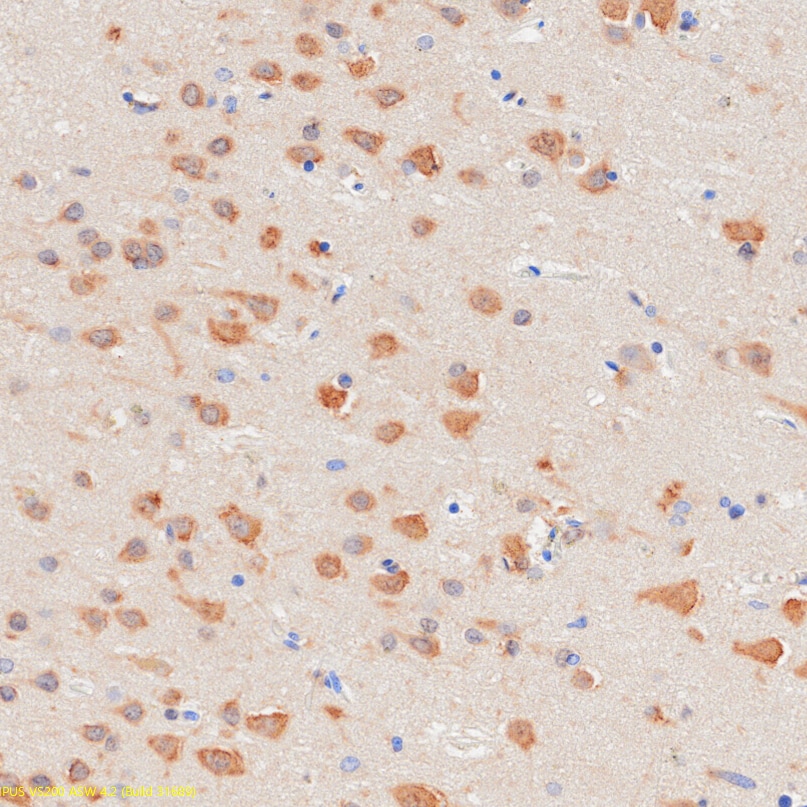
Immersion fixed paraffin-embedded sections of cortex
Neurexin 3 beta /NRXN3b was detected in immersion fixed paraffin-embedded sections of cortex using Mouse Anti-Human Neurexin 3 beta /NRXN3b Monoclonal Antibody (Catalog # MAB11829) at 5 µg/ml overnight at 4 °C. Before incubation with the primary antibody, tissue was subjected to heat-induced epitope retrieval using VisUCyte Antigen Retrieval Reagent-Basic (VCTS021). Tissue was stained using the HRP-conjugated Anti-Mouse IgG Secondary Antibody (HAF007) and counterstained with hematoxylin (blue). Specific staining was localized to the membrane. View our protocol for Chromogenic IHC Staining of Paraffin-embedded Tissue Sections.Applications for Human Neurexin 3 beta/NRXN3b Antibody (1125224)
Immunohistochemistry
Sample: Immersion fixed paraffin-embedded sections of cortex
Formulation, Preparation, and Storage
Purification
Reconstitution
Reconstitute lyophilized material at 0.2 mg/ml in sterile PBS. For liquid material, refer to CoA for concentration.
Formulation
Shipping
Stability & Storage
- 12 months from date of receipt, -20 to -70 °C as supplied.
- 1 month, 2 to 8 °C under sterile conditions after reconstitution.
- 6 months, -20 to -70 °C under sterile conditions after reconstitution.
Calculators
Background: Neurexin 3 beta/NRXN3b
References
- Craig, A.M. and Y. Kang (2007) Curr. Opin. Neurobiol. 17:43.
- Dean, C. and T. Dresbach (2006) Trends Neurosci. 29:21.
- Lise, M.-F. and A. El-Husseini (2006) Cell. Mol. Life Sci. 63:1833.
- Rowen, L. et al. (2002) Genomics 79:587.
- Ushkaryov, Y. A. et al. (1994) J. Biol. Chem. 269:11987.
- Hishimoto, A. et al. (2007) Hum. Mol. Genet. 16:2880.
- Ullrich, B. et al. (1995) Neuron 14:497.
- Ichtchenko, K. et al. (1996) J. Biol. Chem. 271:2676.
- Ichtchenko, K. et al. (1995) Cell 81:435.
- Occhi, G. et al. (2002) Biochem. Biophys. Res. Commun. 298:151.
- Lachman, H.M. et al. (2007) Hum. Mol. Genet. 16:1327.
- Bierut, L.J. et al. (2007) Hum. Mol. Genet. 16:24.
- Kelai, S. et al. (2008) Neuroreport 19:751.
Gene Symbol
UniProt
Additional Neurexin 3 beta/NRXN3b Products
Product Documents for Human Neurexin 3 beta/NRXN3b Antibody (1125224)
Certificate of Analysis
To download a Certificate of Analysis, please enter a lot or batch number in the search box below.
Note: Certificate of Analysis not available for kit components.
Product Specific Notices for Human Neurexin 3 beta/NRXN3b Antibody (1125224)
For research use only
Customer Reviews for Human Neurexin 3 beta/NRXN3b Antibody (1125224)
There are currently no reviews for this product. Be the first to review Human Neurexin 3 beta/NRXN3b Antibody (1125224) and earn rewards!
Have you used Human Neurexin 3 beta/NRXN3b Antibody (1125224)?
Submit a review and receive an Amazon gift card!
$25/€18/£15/$25CAN/¥2500 for a review with an image
$10/€7/£6/$10CAN/¥1110 for a review without an image
Submit a review
Protocols
Find general support by application which include: protocols, troubleshooting, illustrated assays, videos and webinars.
- Antigen Retrieval Protocol (PIER)
- Antigen Retrieval for Frozen Sections Protocol
- Appropriate Fixation of IHC/ICC Samples
- Cellular Response to Hypoxia Protocols
- Chromogenic IHC Staining of Formalin-Fixed Paraffin-Embedded (FFPE) Tissue Protocol
- Chromogenic Immunohistochemistry Staining of Frozen Tissue
- ClariTSA™ Fluorophore Kits
- Detection & Visualization of Antibody Binding
- Fluorescent IHC Staining of Frozen Tissue Protocol
- Graphic Protocol for Heat-induced Epitope Retrieval
- Graphic Protocol for the Preparation and Fluorescent IHC Staining of Frozen Tissue Sections
- Graphic Protocol for the Preparation and Fluorescent IHC Staining of Paraffin-embedded Tissue Sections
- Graphic Protocol for the Preparation of Gelatin-coated Slides for Histological Tissue Sections
- IHC Sample Preparation (Frozen sections vs Paraffin)
- Immunofluorescent IHC Staining of Formalin-Fixed Paraffin-Embedded (FFPE) Tissue Protocol
- Immunohistochemistry (IHC) and Immunocytochemistry (ICC) Protocols
- Immunohistochemistry Frozen Troubleshooting
- Immunohistochemistry Paraffin Troubleshooting
- Preparing Samples for IHC/ICC Experiments
- Preventing Non-Specific Staining (Non-Specific Binding)
- Primary Antibody Selection & Optimization
- Protocol for Heat-Induced Epitope Retrieval (HIER)
- Protocol for Making a 4% Formaldehyde Solution in PBS
- Protocol for VisUCyte™ HRP Polymer Detection Reagent
- Protocol for the Preparation & Fixation of Cells on Coverslips
- Protocol for the Preparation and Chromogenic IHC Staining of Frozen Tissue Sections
- Protocol for the Preparation and Chromogenic IHC Staining of Frozen Tissue Sections - Graphic
- Protocol for the Preparation and Chromogenic IHC Staining of Paraffin-embedded Tissue Sections
- Protocol for the Preparation and Chromogenic IHC Staining of Paraffin-embedded Tissue Sections - Graphic
- Protocol for the Preparation and Fluorescent IHC Staining of Frozen Tissue Sections
- Protocol for the Preparation and Fluorescent IHC Staining of Paraffin-embedded Tissue Sections
- Protocol for the Preparation of Gelatin-coated Slides for Histological Tissue Sections
- TUNEL and Active Caspase-3 Detection by IHC/ICC Protocol
- The Importance of IHC/ICC Controls
- Troubleshooting Guide: Immunohistochemistry
- View all Protocols, Troubleshooting, Illustrated assays and Webinars