


Key Product Details

Species Reactivity

Human

Applications

Neutralization, Intracellular Staining by Flow Cytometry, CyTOF-ready

Label

Unconjugated

Antibody Source

Monoclonal Mouse IgG2A Clone # 17022
Loading...

Product Specifications

Immunogen

E. coli-derived recombinant human Oncostatin M/OSM
Ala26-Arg221
Accession # P13725

Specificity

Detects human Oncostatin M/OSM in direct ELISAs. In direct ELISAs, no cross-reactivity with recombinant mouse Oncostatin M, recombinant human (rh) CLC, rhCNTF, rhCardiotrophin-1, rhIL-6, rhIL-11, or rhLIF is observed.

Clonality

Monoclonal

Host

Mouse

Isotype

IgG2A

Endotoxin Level

<0.10 EU per 1 μg of the antibody by the LAL method.

Scientific Data Images for Human Oncostatin M/OSM Antibody

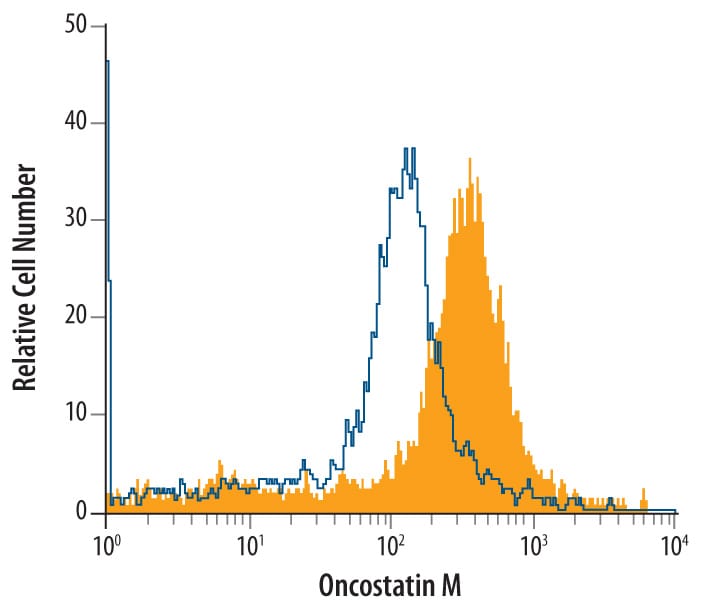
Detection of Oncostatin M/OSM antibody in Human Dendritic Cells antibody by Flow Cytometry.

Detection of Oncostatin M/OSM in Human Dendritic Cells by Flow Cytometry.

Human monocyte-derived dendritic cells were stained with Mouse Anti-Human Oncostatin M Monoclonal Antibody (Catalog # MAB2951, filled histogram) or isotype control antibody (Catalog # MAB003, open histogram), followed by Phycoerythrin-conjugated Anti-Mouse IgG Secondary Antibody (Catalog # F0102B). To facilitate intracellular staining, cells were fixed with paraformaldehyde and permeabilized with saponin.
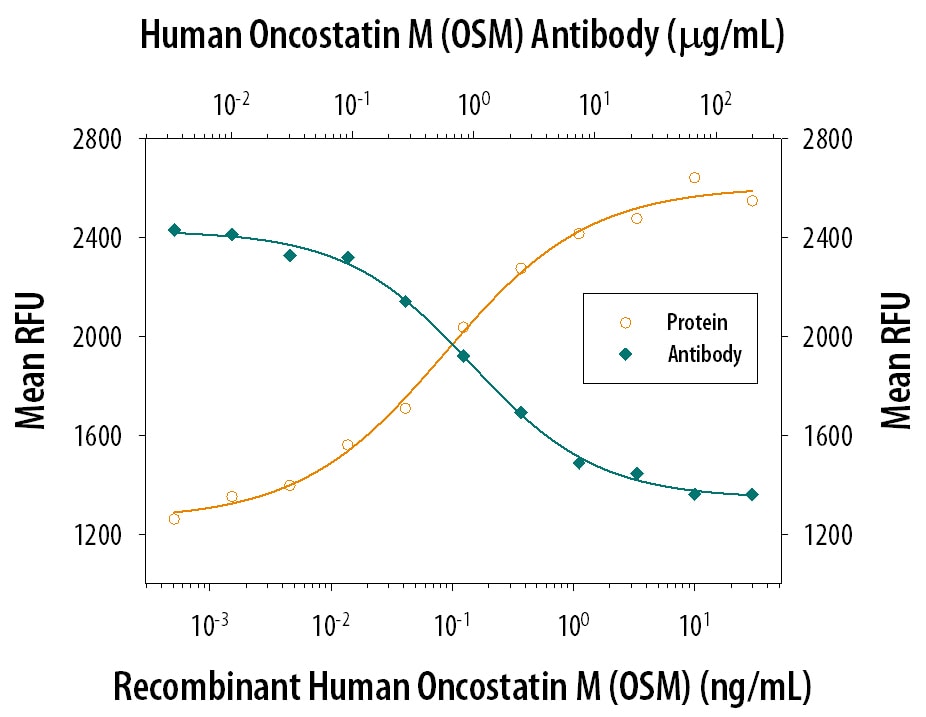
Cell Proliferation Induced by Oncostatin M/OSM and Neutralization by Human Oncostatin M/OSM Antibody.

Cell Proliferation Induced by Oncostatin M/OSM and Neutralization by Human Oncostatin M/OSM Antibody.

Recombinant Human Oncostatin M (Catalog # 295-OM) stimulates proliferation in the TF-1 human erythro-leukemic cell line in a dose-dependent manner (orange line). Prolif-eration elicited by Recom-binant Human Oncostatin M (2 ng/mL) is neutralized (green line) by increasing concentrations of Mouse Anti-Human Oncostatin M Monoclonal Antibody (Catalog # MAB2951). The ND50 is typically 0.3-1.5 µg/mL.

Applications for Human Oncostatin M/OSM Antibody

Application
Recommended Usage

CyTOF-ready

Ready to be labeled using established conjugation methods. No BSA or other carrier proteins that could interfere with conjugation.

Intracellular Staining by Flow Cytometry

2.5 µg/106 cells
Sample: Human monocyte-derived dendritic cells, fixed with paraformaldehyde and permeabilized with saponin

Neutralization

Measured by its ability to neutralize Oncostatin M/OSM-induced proliferation in the TF‑1 human erythroleukemic cell line. Kitamura, T. et al. (1989) J. Cell Physiol. 140:323. The Neutralization Dose (ND50) is typically 0.3‑1.5 µg/mL in the presence of 2 ng/mL Recombinant Human Oncostatin M/OSM.

Flow Cytometry Panel Builder

Bio-Techne Knows Flow Cytometry

Save time and reduce costly mistakes by quickly finding compatible reagents using the Panel Builder Tool.

Advanced Features

  • Spectra Viewer - Custom analysis of spectra from multiple fluorochromes
  • Spillover Popups - Visualize the spectra of individual fluorochromes
  • Antigen Density Selector - Match fluorochrome brightness with antigen density
Build Your Panel Now

Formulation, Preparation, and Storage

Purification

Protein A or G purified from ascites

Reconstitution

Sterile PBS to a final concentration of 0.5 mg/mL. For liquid material, refer to CoA for concentration.


Loading...

Formulation

Lyophilized from a 0.2 μm filtered solution in PBS with Trehalose. *Small pack size (SP) is supplied either lyophilized or as a 0.2 µm filtered solution in PBS.

Shipping

Lyophilized product is shipped at ambient temperature. Liquid small pack size (-SP) is shipped with polar packs. Upon receipt, store immediately at the temperature recommended below.

Stability & Storage

Use a manual defrost freezer and avoid repeated freeze-thaw cycles.
  • 12 months from date of receipt, -20 to -70 °C as supplied.
  • 1 month, 2 to 8 °C under sterile conditions after reconstitution.
  • 6 months, -20 to -70 °C under sterile conditions after reconstitution.

Calculators

The reconstitution calculator allows you to quickly calculate the volume of a reagent to reconstitute your vial. Simply enter the mass of reagent and the target concentration and the calculator will determine the rest.

=
÷

Background: Oncostatin M/OSM

Oncostatin M (OSM) is a cytokine originally isolated from medium conditioned by PMA-treated U-937 human histiocytic leukemia cells based on its ability to inhibit growth of A375 melanoma cells. The human OSM cDNA encodes a 252 amino acid pre-pro-OSM polypeptide with a 25 residue hydrophobic signal peptide and a hydrophilic C-terminal domain that are proteolytically processed to generate the 196 residue mature form of OSM. Although both mature and pro-OSM are equally active in radio-receptor assays, the mature OSM is 5- to 60-fold more active in growth inhibition assays. Thus, proteolytic processing of the pro-OSM peptide may be important in regulating the in vivo activities of OSM.


OSM is a pleiotropic cytokine that initiates its biological activities by binding to specific cell surface receptors. The biological activity of human OSM is mediated either by the LIF/OSM receptor complex composed of gp130 and LIF R alpha or by a human OSM specific receptor composed of gp130 and OSM R alpha. The gp130, a signal transducing component ( beta  subunit) of the IL-6, LIF and CNTF receptor complexes, was identified as a low-affinity OSM receptor that does not transduce OSM signals. The low affinity LIF receptor (LIF R, a gp130-related protein) has been identified to be a component of a high-affinity OSM receptor that will transduce OSM signals. Besides its growth inhibitory activities on human A375 melanoma and mouse M1 myeloid leukemic cells, as well as on other solid tumor cells, OSM also has growth stimulatory activities on normal fibroblasts, AIDS-Kaposi’s sarcoma cells, and a human erythroleukemia cell line, TF-1. Other OSM-mediated activities reported to date include: stimulation of plasminogen activator activity in cultured bovine aortic endothelial cells; regulation of IL-6 expression in human endothelial cells; and stimulation of LDL uptake and up-regulation of cell surface LDL receptors in HepG2 cells.

Alternate Names

MGC20461, oncostatin M, oncostatin-M

Entrez Gene IDs

5008 (Human); 18413 (Mouse)

Gene Symbol

OSM

UniProt

Additional Oncostatin M/OSM Products

Product Documents for Human Oncostatin M/OSM Antibody

Certificate of Analysis

To download a Certificate of Analysis, please enter a lot or batch number in the search box below.

Note: Certificate of Analysis not available for kit components.

Product Specific Notices for Human Oncostatin M/OSM Antibody

For research use only

Customer Reviews for Human Oncostatin M/OSM Antibody

There are currently no reviews for this product. Be the first to review Human Oncostatin M/OSM Antibody and earn rewards!

Have you used Human Oncostatin M/OSM Antibody?

Submit a review and receive an Amazon gift card!

$25/€18/£15/$25CAN/¥2500 Yen for a review with an image

$10/€7/£6/$10CAN/¥1110 Yen for a review without an image

Submit a review
Amazon Gift Card

FAQs

No product specific FAQs exist for this product.

View all FAQs for Antibodies
Loading...