
LDHA (lactate dehydrogenase A chain; also LDH-M and PIG-19) is a 34-36 kDa member of the LDH family of enzymes. It is a part of a cytoplasmic complex that is found principally in hepatocytes and skeletal muscle. The LDHA complex catalyzes the conversion of pyruvate to lactate, thereby generating NAD, the final step in anerobic glycolysis. This NAD is essential for the subsequent generation of ATP. Human LDHA is 332 amino acids (aa) in length. It contains an N-terminal coenzyme binding region, a central catalytic site, and at least nine utilized Lys acetylation and two Tyr phosphorylation sites. It also undergoes ISGylation where a 17 kDa product of the ISG15 gene is covalently attached to LDHA in a ubiquitin-like manner. LDHA forms tetramers composed of two dimers of varying composition. The tetramer may be homotetrameric (four monomers), or contain from one to three substitute LDHB monomers typically found in heart muscle. There are multiple splice variants. One possesses a five aa substitution for aa 237-332, a second contains a 45 aa substitution for aa 230-332, a third shows a deletion of aa 82-139, while a fourth utilizes an alternative start site 29 aa upstream of the standard site. Over aa 2-92, human LDHA shares 93% aa sequence identity with mouse LDHA.
Lactate Dehydrogenase A/LDHA Antibody (2066C)
R&D Systems | Catalog # MAB9158

Scientific images may be resized, cropped, or adjusted for brightness or contrast for presentation purposes. These updates are limited to presentation and do not affect the underlying scientific interpretation of the data. Where available, additional source data may be provided upon request.
Key Product Details
Species Reactivity
Validated:
Cited:
Applications
Validated:
Cited:
Label
Antibody Source
Product Specifications
Immunogen
Ala2-Val92
Accession # P00338
Specificity
Clonality
Host
Isotype
Scientific Data Images for Lactate Dehydrogenase A/LDHA Antibody (2066C)
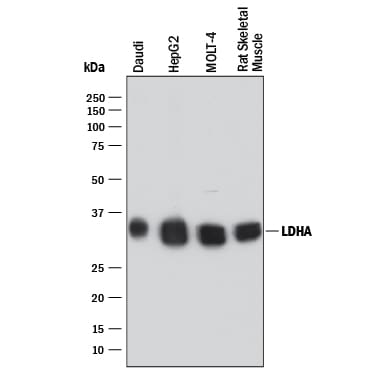
Detection of Human and Rat Lactate Dehydrogenase A/LDHA by Western Blot.
Western blot shows lysates of Daudi human Burkitt's lymphoma cell line, HepG2 human hepatocellular carcinoma cell line, MOLT-4 human acute lymphoblastic leukemia cell line, and rat skeletal muscle tissue. PVDF membrane was probed with 0.2 µg/mL of Rabbit Anti-Human/Rat Lactate Dehydrogenase A/LDHA Monoclonal Antibody (Catalog # MAB9158) followed by HRP-conjugated Anti-Rabbit IgG Secondary Antibody (Catalog # HAF008). A specific band was detected for Lactate Dehydrogenase A/LDHA at approximately 34-36 kDa (as indicated). This experiment was conducted under reducing conditions and using Immunoblot Buffer Group 1.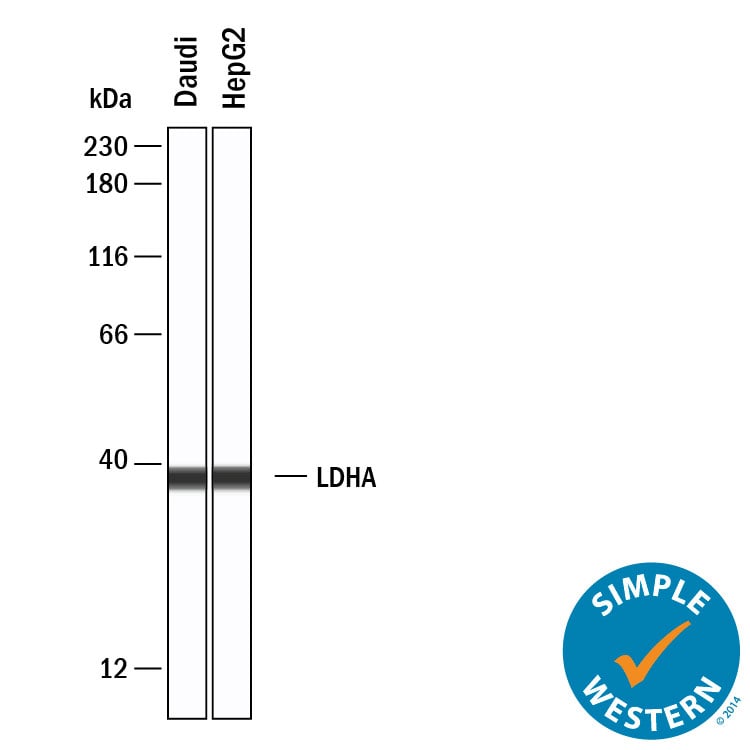
Detection of Human Lactate Dehydrogenase A/LDHA by Simple WesternTM.
Simple Western shows lysates of Daudi human Burkitt's lymphoma cell line and HepG2 human hepatocellular carcinoma cell line, loaded at 0.5 mg/ml. A specific band was detected for Lactate Dehydrogenase A/LDHA at approximately 38 kDa (as indicated) using 10 µg/mL of Rabbit Anti-Human/Rat Lactate Dehydrogenase A/LDHA Monoclonal Antibody (Catalog # MAB9158). This experiment was conducted under reducing conditions and using the 12-230kDa separation system.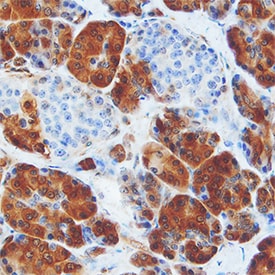
Lactate Dehydrogenase A/LDHA in Human Pancreas.
Lactate Dehydrogenase A/LDHA was detected in immersion fixed paraffin-embedded sections of human pancreas using Rabbit Anti-Human/Rat Lactate Dehydrogenase A/LDHA Monoclonal Antibody (Catalog # MAB9158) at 3 µg/mL for 1 hour at room temperature followed by incubation with the Anti-Rabbit IgG VisUCyte™ HRP Polymer Antibody (Catalog # VC003). Tissue was stained using DAB (brown) and counterstained with hematoxylin (blue). Specific staining was localized to exocrine cells. View our protocol for IHC Staining with VisUCyte HRP Polymer Detection Reagents.
Lactate Dehydrogenase A/LDHA in PC‑3 Human Cell Line.
Lactate Dehydrogenase A/LDHA was detected in immersion fixed PC-3 human prostate cancer cell line using Rabbit Anti-Human/Rat Lactate Dehydrogenase A/LDHA Monoclonal Antibody (Catalog # MAB9158) at 3 µg/mL for 3 hours at room temperature. Cells were stained using the NorthernLights™ 557-conjugated Anti-Rabbit IgG Secondary Antibody (red; Catalog # NL004) and counterstained with DAPI (blue). Specific staining was localized to cytoplasm. View our protocol for Fluorescent ICC Staining of Cells on Coverslips.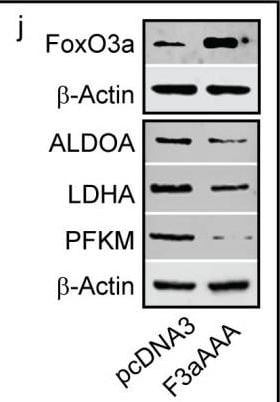
Detection of Lactate Dehydrogenase A/LDHA by Western Blot
Effect of FoxO3a on relevant enzymes involved in carbohydrate metabolism. A double set of cells was transiently transfected in suspension with F3aAAA and pcDNA3 plasmids for 48 h. FoxO3a, PFKP, LDHA, and Aldolase A expressions were assessed at the RNA and protein level in Tam-resistant MCF-7/TR (a–e), T47D/TR (f–j) and ZR-75/TR (k–o). mRNA content was normalized vs. the relative 18S rRNA content, and beta -actin was employed for loading controls (* p < 0.05, ** p < 0.005). Image collected and cropped by CiteAb from the following open publication (https://pubmed.ncbi.nlm.nih.gov/38132097), licensed under a CC-BY license. Not internally tested by R&D Systems.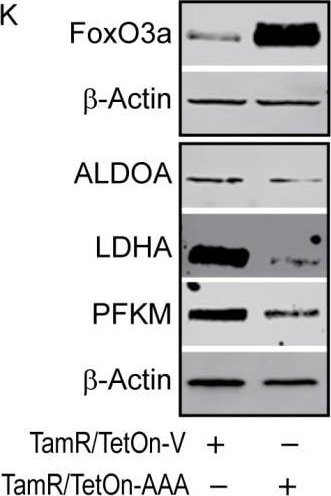
Detection of Lactate Dehydrogenase A/LDHA by Western Blot
Influence of FoxO3a expression on glycolysis of TamR breast cancer cells. TamR/TetOn-AAA and TamR/TetOn-V were plated, left to attach and then treated with Dox 1 µg/mL for 48 h to induce FoxO3a expression. (A) FoxO3a overexpression was determined by WB. GAPDH = loading control. Glucose content (B) LDH (Lactate dehydrogenase) activity in cell lysates (C) and in the growing media (D) were analyzed as described in Section 2. Data are reported as the mean ± SD of three independent experiments (at least in triplicate). Statistical significances are calculated by using Student’s t-test evaluating the differences between TamR/TetOn-AAA and TamR/TetOn-V samples (* p < 0.05). Proteins involved in Carbohydrate Metabolism differentially expressed in the comparison analysis in TamR/TetOn-AAA with respect to TamR/TetOn-V (E). The expression fold changes of reported proteins were evaluated in TamR/TetOn-AAA with respect to TamR/TetOn-V by using Ingenuity Pathway Analysis (Qiagen), fixing the cut-off to 1.6 (F). Proteomic data were confirmed by RNA and WB analysis. To this aim, a duplicate set of cells was treated with Dox 1 µg/mL for 48 h. The RNA (G–J) and protein (K) expressions of FoxO3a, AldoA, LDHA and PFKM were assessed. mRNA content was normalized vs. the relative 18S rRNA content, and beta -actin was employed as a loading control. (L–N) Analysis of genes involved in carbohydrate metabolism that correlated with FOXO3 (cBioPortal dataset) [26], Spearman and Pearson correlation coefficient with the respective p-value are reported. Image collected and cropped by CiteAb from the following open publication (https://pubmed.ncbi.nlm.nih.gov/38132097), licensed under a CC-BY license. Not internally tested by R&D Systems.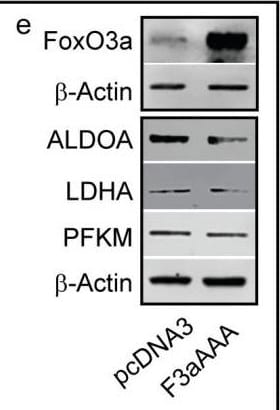
Detection of Lactate Dehydrogenase A/LDHA by Western Blot
Effect of FoxO3a on relevant enzymes involved in carbohydrate metabolism. A double set of cells was transiently transfected in suspension with F3aAAA and pcDNA3 plasmids for 48 h. FoxO3a, PFKP, LDHA, and Aldolase A expressions were assessed at the RNA and protein level in Tam-resistant MCF-7/TR (a–e), T47D/TR (f–j) and ZR-75/TR (k–o). mRNA content was normalized vs. the relative 18S rRNA content, and beta -actin was employed for loading controls (* p < 0.05, ** p < 0.005). Image collected and cropped by CiteAb from the following open publication (https://pubmed.ncbi.nlm.nih.gov/38132097), licensed under a CC-BY license. Not internally tested by R&D Systems.Applications for Lactate Dehydrogenase A/LDHA Antibody (2066C)
Immunocytochemistry
Sample: Immersion fixed PC-3 human prostate cancer cell line
Immunohistochemistry
Sample: Immersion fixed paraffin-embedded sections of human pancreas
Simple Western
Sample: Daudi human Burkitt's lymphoma cell line and HepG2 human hepatocellular carcinoma cell line
Western Blot
Sample: Daudi human Burkitt's lymphoma cell line, HepG2 human hepatocellular carcinoma cell line, MOLT‑4 human acute lymphoblastic leukemia cell line, and rat skeletal muscle tissue
Formulation, Preparation, and Storage
Purification
Reconstitution
Reconstitute at 0.5 mg/mL in sterile PBS. For liquid material, refer to CoA for concentration.
Formulation
Shipping
Stability & Storage
- 12 months from date of receipt, -20 to -70 °C as supplied.
- 1 month, 2 to 8 °C under sterile conditions after reconstitution.
- 6 months, -20 to -70 °C under sterile conditions after reconstitution.
Calculators
Background: Lactate Dehydrogenase A/LDHA
Alternate Names
Gene Symbol
UniProt
Additional Lactate Dehydrogenase A/LDHA Products
Product Documents for Lactate Dehydrogenase A/LDHA Antibody (2066C)
Certificate of Analysis
To download a Certificate of Analysis, please enter a lot or batch number in the search box below.
Note: Certificate of Analysis not available for kit components.
Product Specific Notices for Lactate Dehydrogenase A/LDHA Antibody (2066C)
For research use only
Related Research Areas
Citations for Lactate Dehydrogenase A/LDHA Antibody (2066C)
 Powered by Bioz
Customer Reviews for Lactate Dehydrogenase A/LDHA Antibody (2066C)
There are currently no reviews for this product. Be the first to review Lactate Dehydrogenase A/LDHA Antibody (2066C) and earn rewards!
Have you used Lactate Dehydrogenase A/LDHA Antibody (2066C)?
Submit a review and receive an Amazon gift card!
$25/€18/£15/$25CAN/¥2500 for a review with an image
$10/€7/£6/$10CAN/¥1110 for a review without an image
Submit a review
Protocols
Find general support by application which include: protocols, troubleshooting, illustrated assays, videos and webinars.
- Antigen Retrieval Protocol (PIER)
- Antigen Retrieval for Frozen Sections Protocol
- Appropriate Fixation of IHC/ICC Samples
- Cellular Response to Hypoxia Protocols
- Chromogenic IHC Staining of Formalin-Fixed Paraffin-Embedded (FFPE) Tissue Protocol
- Chromogenic Immunohistochemistry Staining of Frozen Tissue
- ClariTSA™ Fluorophore Kits
- Detection & Visualization of Antibody Binding
- Fluorescent IHC Staining of Frozen Tissue Protocol
- Graphic Protocol for Heat-induced Epitope Retrieval
- Graphic Protocol for the Preparation and Fluorescent IHC Staining of Frozen Tissue Sections
- Graphic Protocol for the Preparation and Fluorescent IHC Staining of Paraffin-embedded Tissue Sections
- Graphic Protocol for the Preparation of Gelatin-coated Slides for Histological Tissue Sections
- ICC Cell Smear Protocol for Suspension Cells
- ICC Immunocytochemistry Protocol Videos
- ICC for Adherent Cells
- IHC Sample Preparation (Frozen sections vs Paraffin)
- Immunocytochemistry (ICC) Protocol
- Immunocytochemistry Troubleshooting
- Immunofluorescence of Organoids Embedded in Cultrex Basement Membrane Extract
- Immunofluorescent IHC Staining of Formalin-Fixed Paraffin-Embedded (FFPE) Tissue Protocol
- Immunohistochemistry (IHC) and Immunocytochemistry (ICC) Protocols
- Immunohistochemistry Frozen Troubleshooting
- Immunohistochemistry Paraffin Troubleshooting
- Preparing Samples for IHC/ICC Experiments
- Preventing Non-Specific Staining (Non-Specific Binding)
- Primary Antibody Selection & Optimization
- Protocol for Heat-Induced Epitope Retrieval (HIER)
- Protocol for Making a 4% Formaldehyde Solution in PBS
- Protocol for VisUCyte™ HRP Polymer Detection Reagent
- Protocol for the Fluorescent ICC Staining of Cell Smears - Graphic
- Protocol for the Fluorescent ICC Staining of Cultured Cells on Coverslips - Graphic
- Protocol for the Preparation & Fixation of Cells on Coverslips
- Protocol for the Preparation and Chromogenic IHC Staining of Frozen Tissue Sections
- Protocol for the Preparation and Chromogenic IHC Staining of Frozen Tissue Sections - Graphic
- Protocol for the Preparation and Chromogenic IHC Staining of Paraffin-embedded Tissue Sections
- Protocol for the Preparation and Chromogenic IHC Staining of Paraffin-embedded Tissue Sections - Graphic
- Protocol for the Preparation and Fluorescent ICC Staining of Cells on Coverslips
- Protocol for the Preparation and Fluorescent ICC Staining of Non-adherent Cells
- Protocol for the Preparation and Fluorescent ICC Staining of Stem Cells on Coverslips
- Protocol for the Preparation and Fluorescent IHC Staining of Frozen Tissue Sections
- Protocol for the Preparation and Fluorescent IHC Staining of Paraffin-embedded Tissue Sections
- Protocol for the Preparation of Gelatin-coated Slides for Histological Tissue Sections
- Protocol for the Preparation of a Cell Smear for Non-adherent Cell ICC - Graphic
- R&D Systems Quality Control Western Blot Protocol
- TUNEL and Active Caspase-3 Detection by IHC/ICC Protocol
- The Importance of IHC/ICC Controls
- Troubleshooting Guide: Immunohistochemistry
- Troubleshooting Guide: Western Blot Figures
- Western Blot Conditions
- Western Blot Protocol
- Western Blot Protocol for Cell Lysates
- Western Blot Troubleshooting
- Western Blot Troubleshooting Guide
- View all Protocols, Troubleshooting, Illustrated assays and Webinars