
Stem cell factor (SCF), also known as c-kit ligand (KL), mast cell growth factor (MGF), and steel factor (SLF), is a widely expressed 28‑40 kDa type I transmembrane glycoprotein (1). It promotes the survival, differentiation, and mobilization of multiple cell types including myeloid, erythroid, megakaryocytic, lymphoid, germ cell, and melanocyte progenitors (1‑7). SCF is a primary growth and activation factor for mast cells and eosinophils (8). Mature human SCF consists of a 189 amino acid (aa) extracellular domain (ECD), a 23 aa transmembrane segment, and a 36 aa cytoplasmic tail (9). The ECD shows both N-linked and O-linked glycosylation (10). Proteolytic cleavage at two alternate sites in the extracellular juxtamembrane region releases a 25 kDa soluble molecule which is comparable to the only form produced by Steel-dickie mutant mice (11, 12). An alternately spliced isoform of human SCF lacks 28 aa that encompasses the primary proteolytic recognition site (13). Within the ECD of the short isoform (corresponding to this recombinant protein), human SCF shares 75%‑83% aa sequence identity with canine, feline, mouse, and rat SCF. Rat SCF is active on mouse and human cells, but human SCF is only weakly active on mouse cells (9). Noncovalent dimers of transmembrane or soluble SCF interact with the receptor tyrosine kinase SCF R/c-kit to trigger receptor dimerization and signaling (14). SCF assists in the recovery of cardiac function following myocardial infarction by increasing the number of cardiomyocytes and vascular channels (15).
Human SCF/c-kit Ligand Antibody
R&D Systems | Catalog # AB-255-NA


Scientific images may be resized, cropped, or adjusted for brightness or contrast for presentation purposes. These updates are limited to presentation and do not affect the underlying scientific interpretation of the data. Where available, additional source data may be provided upon request.
Key Product Details
Species Reactivity
Validated:
Cited:
Applications
Validated:
Cited:
Label
Antibody Source
Product Specifications
Immunogen
Glu26-Ala189
Accession # P21583
Specificity
Clonality
Host
Isotype
Endotoxin Level
Scientific Data Images for Human SCF/c-kit Ligand Antibody
Cell Proliferation Induced by SCF/c‑kit Ligand and Neutralization by Human SCF/c‑kit Ligand Antibody.
Recombinant Human SCF/c-kit Ligand (Catalog # 255-SC) stimulates proliferation in the TF-1 human erythroleukemic cell line in a dose-dependent manner (orange line). Proliferation elicited by Recombinant Human SCF/c-kit Ligand (10 ng/mL) is neutralized (green line) by increasing concentrations of Goat Anti-Human SCF/c-kit Ligand Polyclonal Antibody (Catalog # AB-255-NA). The ND50 is typically 0.4-2 µg/mL.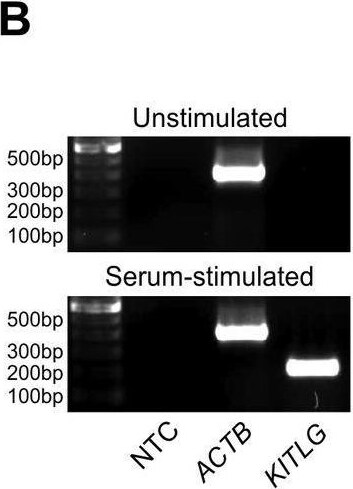
Detection of SCF/c-kit Ligand by Western Blot
IGF1 and GSK3i stimulate Kitl/KITLG transcription. Results obtained in murine and human smooth muscle cells (A-E), human LX-2 stellate cells (F-G) and human GIST-T1 cells (H-I) are shown. A, Hoffman modulation contrast image of primary human gastric smooth muscle cells. B, KITLG mRNA (total: soluble+membrane-bound) was readily detectable in primary human smooth muscle cells (passage 3) maintained with Smooth Muscle Growth Medium-2 containing insulin, hFGF-B, hEGF and 5% FBS (Lonza) but not in 24-h growth factor- and serum-deficient basal medium. C, Both IGF1 (100 ng/mL) and the GSK3 alpha / beta inhibitor SB415286 (30 µM) stimulated Kitl expression in murine gastric tunicamuscularis organotypic cultures (n=3/group). D-E, SB415286 stimulated endogenous Kitl expression in murine primary gastric smooth muscle cells (D; n=3/group) and KITLG transcriptional activity in the same cell type transfected with a KITLG promoter (-2120 bp to +407 bp)-pGL3 luciferase construct (E; n=3/group). IGF1 (100 ng/mL; n=3/group) and SB415286 (30 µM; n=6/group) also increased endogenous KITLG mRNA expression in LX-2 (F) and GIST-T1 cells (H) and stimulated KITLG promoter activity in a time-dependent fashion (LX-2: n=6-9/group; G; GIST-T1: n=3-11/group; I). Groups marked by asterisk are different from the control group, and groups not sharing the same superscript letter are different from each other (P<0.05 by post-hoc multiple comparisons). Image collected and cropped by CiteAb from the following open publication (https://pubmed.ncbi.nlm.nih.gov/24116170), licensed under a CC-BY license. Not internally tested by R&D Systems.Applications for Human SCF/c-kit Ligand Antibody
Western Blot
Sample: Recombinant Human SCF/c-kit Ligand (Catalog # 255-SC)
Neutralization
Formulation, Preparation, and Storage
Purification
Reconstitution
Reconstitute at 1 mg/mL in sterile PBS.
Formulation
Shipping
Stability & Storage
- 12 months from date of receipt, -20 to -70 °C as supplied.
- 1 month, 2 to 8 °C under sterile conditions after reconstitution.
- 6 months, -20 to -70 °C under sterile conditions after reconstitution.
Calculators
Background: SCF/c-kit Ligand
References
- Ashman, L.K. (1999) Int. J. Biochem. Cell Biol. 31:1037.
- Sette, C. et al. (2000) Int. J. Dev. Biol. 44:599.
- Yoshida, H. et al. (2001) J. Invest. Dermatol. Symp. Proc. 6:1.
- Erlandsson, A. et al. (2004) Exp. Cell Res. 301:201.
- Kapur, R. et al. (2002) Blood 100:1287.
- Wang, C.-H. et al. (2007) Arterioscler. Thromb. Vasc. Biol. 27:540.
- Bashamboo, A. et al. (2006) J. Cell Sci. 119:3039.
- Reber, L. et al. (2006) Eur. J. Pharmacol. 533:327.
- Martin, F.H. et al. (1990) Cell 63:203.
- Arakawa, T. et al. (1991) J. Biol. Chem. 266:18942.
- Majumdar, M.K. et al. (1994) J. Biol. Chem. 269:1237.
- Brannan, C.I. et al. (1991) Proc. Natl. Acad. Sci. 88:4671.
- Anderson, D.M. et al. (1991) Cell Growth Differ. 2:373.
- Lemmon, M.A. et al. (1997) J. Biol. Chem. 272:6311.
- Kanellakis, P. et al. (2006) Cardiovasc. Res. 70:117.
Long Name
Alternate Names
Gene Symbol
UniProt
Additional SCF/c-kit Ligand Products
Product Documents for Human SCF/c-kit Ligand Antibody
Certificate of Analysis
To download a Certificate of Analysis, please enter a lot or batch number in the search box below.
Note: Certificate of Analysis not available for kit components.
Product Specific Notices for Human SCF/c-kit Ligand Antibody
For research use only
Related Research Areas
Citations for Human SCF/c-kit Ligand Antibody
 Powered by Bioz
Customer Reviews for Human SCF/c-kit Ligand Antibody
There are currently no reviews for this product. Be the first to review Human SCF/c-kit Ligand Antibody and earn rewards!
Have you used Human SCF/c-kit Ligand Antibody?
Submit a review and receive an Amazon gift card!
$25/€18/£15/$25CAN/¥2500 for a review with an image
$10/€7/£6/$10CAN/¥1110 for a review without an image
Submit a review
Protocols
Find general support by application which include: protocols, troubleshooting, illustrated assays, videos and webinars.
- Cellular Response to Hypoxia Protocols
- R&D Systems Quality Control Western Blot Protocol
- Troubleshooting Guide: Western Blot Figures
- Western Blot Conditions
- Western Blot Protocol
- Western Blot Protocol for Cell Lysates
- Western Blot Troubleshooting
- Western Blot Troubleshooting Guide
- View all Protocols, Troubleshooting, Illustrated assays and Webinars

