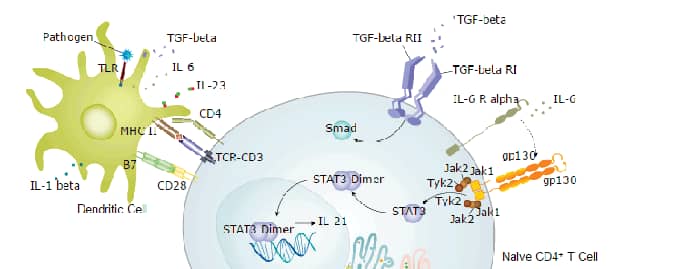
The Toll-like family of molecules are type I transmembrane proteins that serve as pattern recognition receptors for microbial pathogens. There are at least eleven mouse and ten human TLRs that activate the innate immune system following exposure to a variety of microbial species (1, 2). TLRs contain a large number of leucine-rich repeats (LRRs) and a cytoplasmic tail with one Toll/IL-1 receptor (TIR) domain. Mature human TLR1 consists of a 556 amino acid (aa) extracellular domain (ECD) with 20 LRRs, a 21 aa transmembrane segment, and a 185 aa cytoplasmic domain (3, 4). Within the ECD, human TLR1 shares 63% aa sequence identity with human TLR6 and 20%‑43% aa sequence identitity with human TLR2, -3, -4, -5, -7, -8, -9, and -10. It shares 73% and 71% aa sequence identity with mouse and rat TLR1, respectively. TLR1 is expressed on the surface of macrophages, dendritic cells, and tonsillar epithelial cells in ligand-independent association with TLR2 (5‑8). TLR2 additionally associates with TLR6 to form a functional complex with specificity for distinct but related microbial ligands (9‑11). TLR1 and TLR2 cooperate in the recognition of bacterial and protozoal triacylated lipopeptides and glycosylphosphatidylinositols (6, 10‑12). Ligand binding induces TLR1 localization to lipid rafts followed by receptor internalization and activation of NF kappa B (7, 11, 13).


Key Product Details
Species Reactivity
Applications
Label
Antibody Source
Product Specifications
Immunogen
Ser22-Asn578
Accession # AAC34137
Specificity
Clonality
Host
Isotype
Applications for Human TLR1 Antibody
CyTOF-ready
Flow Cytometry
Sample: Human whole blood monocytes
Western Blot
Sample: Recombinant Human TLR1 Fc Chimera (Catalog # 1484-TR)
Flow Cytometry Panel Builder
Bio-Techne Knows Flow Cytometry
Save time and reduce costly mistakes by quickly finding compatible reagents using the Panel Builder Tool.
Advanced Features
- Spectra Viewer - Custom analysis of spectra from multiple fluorochromes
- Spillover Popups - Visualize the spectra of individual fluorochromes
- Antigen Density Selector - Match fluorochrome brightness with antigen density

Formulation, Preparation, and Storage
Purification
Reconstitution
Reconstitute at 0.2 mg/mL in sterile PBS. For liquid material, refer to CoA for concentration.
Formulation
Shipping
Stability & Storage
- 12 months from date of receipt, -20 to -70 °C as supplied.
- 1 month, 2 to 8 °C under sterile conditions after reconstitution.
- 6 months, -20 to -70 °C under sterile conditions after reconstitution.
Calculators
Background: TLR1
References
- Miyake, K. (2007) Semin. Immunol. 19:3.
- Hopkins, P.A. and S. Sriskandan (2005) Clin. Exp. Immunol. 140:395.
- Rock, F.L. et al. (1998) Proc. Natl. Acad. Sci. 95:588.
- Matsushima, N. et al. (2007) BMC Genomics 8:124.
- Ochoa, M.-T. et al. (2003) Immunology 108:10.
- Takeuchi, O. et al. (2002) J. Immunol. 169:10.
- Triantafilou, M. et al. (2006) J. Biol. Chem. 281:31002.
- Sandor, F. et al. (2003) J. Cell Biol. 162:1099.
- Nakao, Y. et al. (2005) J. Immunol. 174:1566.
- Ozinsky, A. et al. (2000) Proc. Natl. Acad. Sci. 97:13766.
- Lee, J.Y. et al. (2004) J. Biol. Chem. 279:16971.
- Krishnegowda, G. et al. (2005) J. Biol. Chem. 280:8606.
- Nishiya, T. and A.L. DeFranco (2004) J. Biol. Chem. 279:19008.
Long Name
Alternate Names
Gene Symbol
UniProt
Additional TLR1 Products
Product Documents for Human TLR1 Antibody
Certificate of Analysis
To download a Certificate of Analysis, please enter a lot or batch number in the search box below.
Note: Certificate of Analysis not available for kit components.
Product Specific Notices for Human TLR1 Antibody
For research use only
Customer Reviews for Human TLR1 Antibody
There are currently no reviews for this product. Be the first to review Human TLR1 Antibody and earn rewards!
Have you used Human TLR1 Antibody?
Submit a review and receive an Amazon gift card!
$25/€18/£15/$25CAN/¥2500 for a review with an image
$10/€7/£6/$10CAN/¥1110 for a review without an image
Submit a review
Protocols
Find general support by application which include: protocols, troubleshooting, illustrated assays, videos and webinars.
- 7-Amino Actinomycin D (7-AAD) Cell Viability Flow Cytometry Protocol
- Cellular Response to Hypoxia Protocols
- Extracellular Membrane Flow Cytometry Protocol
- Flow Cytometry Protocol for Cell Surface Markers
- Flow Cytometry Protocol for Staining Membrane Associated Proteins
- Flow Cytometry Staining Protocols
- Flow Cytometry Troubleshooting Guide
- Intracellular Flow Cytometry Protocol Using Alcohol (Methanol)
- Intracellular Flow Cytometry Protocol Using Detergents
- Intracellular Nuclear Staining Flow Cytometry Protocol Using Detergents
- Intracellular Staining Flow Cytometry Protocol Using Alcohol Permeabilization
- Intracellular Staining Flow Cytometry Protocol Using Detergents to Permeabilize Cells
- Propidium Iodide Cell Viability Flow Cytometry Protocol
- Protocol for Liperfluo
- Protocol for the Characterization of Human Th22 Cells
- Protocol for the Characterization of Human Th9 Cells
- Protocol: Annexin V and PI Staining by Flow Cytometry
- Protocol: Annexin V and PI Staining for Apoptosis by Flow Cytometry
- R&D Systems Quality Control Western Blot Protocol
- Troubleshooting Guide: Fluorokine Flow Cytometry Kits
- Troubleshooting Guide: Western Blot Figures
- Western Blot Conditions
- Western Blot Protocol
- Western Blot Protocol for Cell Lysates
- Western Blot Troubleshooting
- Western Blot Troubleshooting Guide
- View all Protocols, Troubleshooting, Illustrated assays and Webinars
FAQs for Human TLR1 Antibody
-
Q: I have 2 vials of pure lyophilized TLR1 antibody (catalog# AF1484) and I want to label the antibodies with PE Flourochromes. I am not sure how many kits to order from Lightning Antibody Labeling Kits and if any antibody purification or concentration kit is required.
A: For our PE Lightning Link Conjugation kits, I would recommend purchasing the kit 703-0010 (suitable for conjugating 3 x 60ug of antibody). This is the kit that can conjugate the closest amount of antibody to the full quantity you have per vial. The next size up is suitable for conjugating 600ug of antibody per reaction, but is priced much higher than the 60ug reactions. For your reference, the 600ug kits are available as 703-0015 (1 x 600ug) or 703-0003 (5 x 600ug).