
Caenorhabditis elegans UNC5 (UNC = behaviorally uncoordinated) and its mammalian homologues (including rat UNC5H1 and H2, mouse UNC5H2 and H3 (also known as rostral cerebellar malformation, RCM), and human UNC5H3 and H4) are transmembrane proteins belonging to the immunoglobulin (Ig) superfamily. All UNC5 family members have two Ig and two thrombospondin type 1 domains in their extracellular regions, as well as a conserved ZU-5 domain, a DCC (Deleted in Colorectal Cancer)-binding domain (DB) and a C-terminal death domain (DD) in their cytoplasmic regions (1, 2). UNC5 family proteins are receptors for the Netrin/UNC6 (netr: Sanskrit for “one who guides”) family of secreted axon guidance cues that are Laminin-related proteins. Netrin family proteins can act as chemoattractants for some axons and as chemorepellents for others. Besides UNC5, Netrin family proteins also bind to the DCC family of type I transmembrane receptors that share sequence similarity with proteins of the NCAM family, and adenosine A2b receptor, a G protein-coupled seven-transmembrane receptor belonging to the adenosine receptor family (3, 4). In vitro, Netrin binding to DCC family receptors in the absence of UNC5 is associated with axon attraction. However, the DCC-mediated attraction to Netrin is converted to repulsion by binding of UNC5 to the DCC-Netrin complex. In vivo, the mechanisms of Netrin-dependent axon attraction and repulsion are more complex and may include UNC5-mediated repulsion that is independent of DCC (1, 5). Besides their roles in axon guidance and neuronal migration, the UNC5 and DCC families also act as dependence receptors and exert pro-apoptotic effects in the absence of Netrin (6). Human UNC5H3 cDNA encodes a 931 amino acid (aa) type I membrane protein with a putative 39 aa signal peptide and 337 aa extracellular domain. The extracellular domain of human UNC5H3 shares approximately 98%, 73%, and 66% aa sequence similarity with mouse UNC5H3, rat UNC5H2, and human UNC5H4, respectively.
Human UNC5H3 Antibody
R&D Systems | Catalog # AF1005

Key Product Details
Species Reactivity
Validated:
Cited:
Applications
Validated:
Cited:
Label
Antibody Source
Product Specifications
Immunogen
Ala40-Asp376
Accession # O95185
Specificity
Clonality
Host
Isotype
Scientific Data Images for Human UNC5H3 Antibody
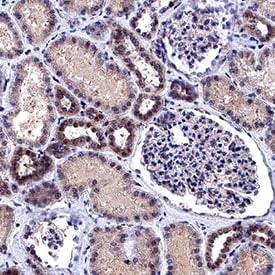
UNC5H3 in Human Kidney.
UNC5H3 was detected in immersion fixed paraffin-embedded sections of human kidney using Goat Anti-Human UNC5H3 Antigen Affinity-purified Polyclonal Antibody (Catalog # AF1005) at 3 µg/mL for 1 hour at room temperature followed by incubation with the Anti-Goat IgG VisUCyte™ HRP Polymer Antibody (VC004). Before incubation with the primary antibody, tissue was subjected to heat-induced epitope retrieval using Antigen Retrieval Reagent-Basic (CTS013). Tissue was stained using DAB (brown) and counterstained with hematoxylin (blue). Specific staining was localized to cytoplasm in convoluted tubules. Staining was performed using our protocol for IHC Staining with VisUCyte HRP Polymer Detection Reagents.Applications for Human UNC5H3 Antibody
Immunohistochemistry
Sample: Immersion fixed paraffin-embedded sections of human kidney
Western Blot
Sample: Recombinant Human UNC5H3 Fc Chimera (Catalog # 1005-UN)
Formulation, Preparation, and Storage
Purification
Reconstitution
Reconstitute at 0.2 mg/mL in sterile PBS. For liquid material, refer to CoA for concentration.
Formulation
Shipping
Stability & Storage
- 12 months from date of receipt, -20 to -70 °C as supplied.
- 1 month, 2 to 8 °C under sterile conditions after reconstitution.
- 6 months, -20 to -70 °C under sterile conditions after reconstitution.
Calculators
Background: UNC5H3
References
- Hong, K. et al. (1999) Cell 97:927.
- Leonardo, E.D. et al. (1997) Nature 386:833.
- Culotti, J.B. and D.C. Merz (1998) Curr. Opin. Cell Biol. 10:609.
- Corset, V. (2000) Nature 407:747.
- Merz, D.C. (2001) Genetics 158:1071.
- Llambi, F. et al. (2001) EMBO J. 20:2715.
Long Name
Alternate Names
Entrez Gene IDs
Gene Symbol
UniProt
Additional UNC5H3 Products
Product Documents for Human UNC5H3 Antibody
Certificate of Analysis
To download a Certificate of Analysis, please enter a lot or batch number in the search box below.
Note: Certificate of Analysis not available for kit components.
Product Specific Notices for Human UNC5H3 Antibody
This product or the use of this product is covered by U.S. Patents owned by The Regents of the University of California. This product is for research use only and is not to be used for commercial purposes. Use of this product to produce products for sale or for diagnostic, therapeutic or drug discovery purposes is prohibited. In order to obtain a license to use this product for such purposes, contact The Regents of the University of California.
U.S. Patent # 5,939,271, 6,277,585, and other U.S. and international patents pending.
For research use only
Related Research Areas
Citations for Human UNC5H3 Antibody
 Powered by Bioz
Customer Reviews for Human UNC5H3 Antibody
There are currently no reviews for this product. Be the first to review Human UNC5H3 Antibody and earn rewards!
Have you used Human UNC5H3 Antibody?
Submit a review and receive an Amazon gift card!
$25/€18/£15/$25CAN/¥2500 for a review with an image
$10/€7/£6/$10CAN/¥1110 for a review without an image
Submit a review
Protocols
Find general support by application which include: protocols, troubleshooting, illustrated assays, videos and webinars.
- Antigen Retrieval Protocol (PIER)
- Antigen Retrieval for Frozen Sections Protocol
- Appropriate Fixation of IHC/ICC Samples
- Cellular Response to Hypoxia Protocols
- Chromogenic IHC Staining of Formalin-Fixed Paraffin-Embedded (FFPE) Tissue Protocol
- Chromogenic Immunohistochemistry Staining of Frozen Tissue
- ClariTSA™ Fluorophore Kits
- Detection & Visualization of Antibody Binding
- Fluorescent IHC Staining of Frozen Tissue Protocol
- Graphic Protocol for Heat-induced Epitope Retrieval
- Graphic Protocol for the Preparation and Fluorescent IHC Staining of Frozen Tissue Sections
- Graphic Protocol for the Preparation and Fluorescent IHC Staining of Paraffin-embedded Tissue Sections
- Graphic Protocol for the Preparation of Gelatin-coated Slides for Histological Tissue Sections
- IHC Sample Preparation (Frozen sections vs Paraffin)
- Immunofluorescent IHC Staining of Formalin-Fixed Paraffin-Embedded (FFPE) Tissue Protocol
- Immunohistochemistry (IHC) and Immunocytochemistry (ICC) Protocols
- Immunohistochemistry Frozen Troubleshooting
- Immunohistochemistry Paraffin Troubleshooting
- Preparing Samples for IHC/ICC Experiments
- Preventing Non-Specific Staining (Non-Specific Binding)
- Primary Antibody Selection & Optimization
- Protocol for Heat-Induced Epitope Retrieval (HIER)
- Protocol for Making a 4% Formaldehyde Solution in PBS
- Protocol for VisUCyte™ HRP Polymer Detection Reagent
- Protocol for the Preparation & Fixation of Cells on Coverslips
- Protocol for the Preparation and Chromogenic IHC Staining of Frozen Tissue Sections
- Protocol for the Preparation and Chromogenic IHC Staining of Frozen Tissue Sections - Graphic
- Protocol for the Preparation and Chromogenic IHC Staining of Paraffin-embedded Tissue Sections
- Protocol for the Preparation and Chromogenic IHC Staining of Paraffin-embedded Tissue Sections - Graphic
- Protocol for the Preparation and Fluorescent IHC Staining of Frozen Tissue Sections
- Protocol for the Preparation and Fluorescent IHC Staining of Paraffin-embedded Tissue Sections
- Protocol for the Preparation of Gelatin-coated Slides for Histological Tissue Sections
- R&D Systems Quality Control Western Blot Protocol
- TUNEL and Active Caspase-3 Detection by IHC/ICC Protocol
- The Importance of IHC/ICC Controls
- Troubleshooting Guide: Immunohistochemistry
- Troubleshooting Guide: Western Blot Figures
- Western Blot Conditions
- Western Blot Protocol
- Western Blot Protocol for Cell Lysates
- Western Blot Troubleshooting
- Western Blot Troubleshooting Guide
- View all Protocols, Troubleshooting, Illustrated assays and Webinars