

Mouse CCL3/MIP‑1 alpha Antibody

R&D Systems | Catalog # AB-450-NA

R&D Systems
Loading...

Key Product Details

Validated by

Biological Validation

Species Reactivity

Validated:

Mouse

Cited:

Mouse

Applications

Validated:

Western Blot, Neutralization

Cited:

Western Blot, Neutralization, In vivo assay

Label

Unconjugated

Antibody Source

Polyclonal Goat IgG
Loading...

Product Specifications

Immunogen

E. coli-derived recombinant mouse CCL3/MIP-1 alpha (R&D Systems, Catalog # 450-MA)
Ala24-Ala92
Accession # Q5QNW0

Specificity

Detects mouse CCL3/MIP-1 alpha in direct ELISAs and Western blots. In Western blots, less than 5% cross-reactivity with recombinant human (rh) MIP-1 beta, rhMIP-1 alpha, and recombinant mouse MIP-1 beta is observed.

Clonality

Polyclonal

Host

Goat

Isotype

IgG

Endotoxin Level

<0.10 EU per 1 μg of the antibody by the LAL method.

Scientific Data Images for Mouse CCL3/MIP‑1 alpha Antibody

Chemotaxis Induced by CCL3/MIP‑1 alpha  and Neutrali-zation by Mouse CCL3/MIP‑1 alpha  Antibody.

Chemotaxis Induced by CCL3/MIP‑1 alpha and Neutrali-zation by Mouse CCL3/MIP‑1 alpha Antibody.

Recombinant Mouse CCL3/MIP-1a (Catalog # 450-MA) chemoattracts BaF3 mouse pro-B cell line transfected with human CCR5 in a dose-dependent manner (orange line). The amount of cells that migrated through to the lower chemotaxis chamber was measured by Resazurin (Catalog # AR002). Chemotaxis elicited by Recombinant Mouse CCL3/MIP-1a (10 ng/mL) is neutralized (green line) by increasing concentrations of Goat Anti-Mouse CCL3/MIP-1a Polyclonal Antibody (Catalog # AB-450-NA). The ND50 is typically 0.3-1 µg/mL.

Detection of Mouse CCL3/MIP-1 alpha by Immunocytochemistry/ Immunofluorescence

Detection of Mouse CCL3/MIP-1 alpha by Immunocytochemistry/ Immunofluorescence

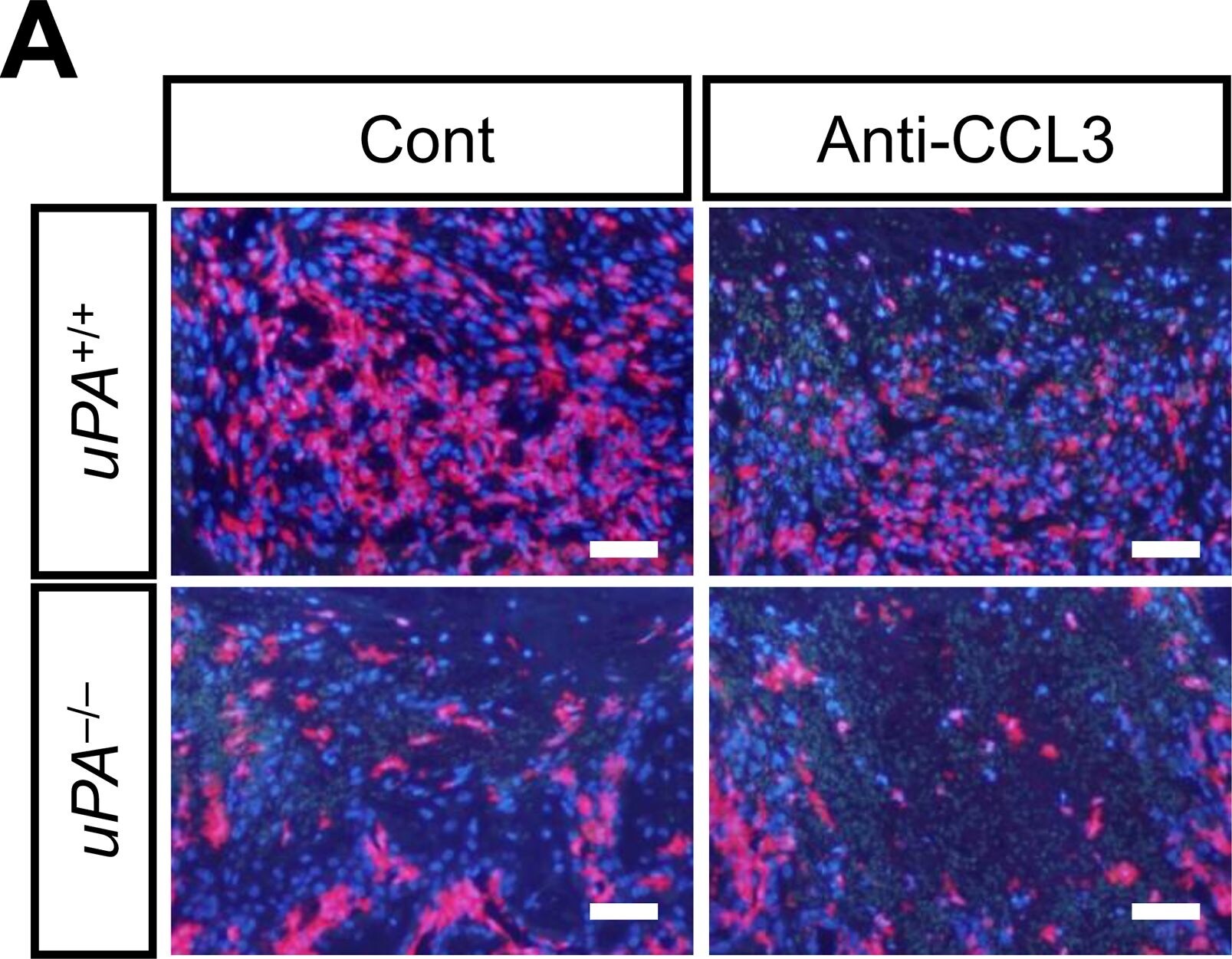
Effects of neutralizing anti-CCL3 antibody on the number of macrophages at the damaged site and the decrease in area of bone defect on day 4 in uPA+/+ and uPA-/- mice.(A) Microphotographs of immunostaining for F4/80 at the damaged site on day 4 after a femoral bone defect in uPA+/+ and uPA-/- mice treated with normal IgG (Cont) or neutralizing anti-CCL3 antibody (Anti-CCL3). The results represent experiments performed on 5 mice in each group. Scale bars indicate 50 μm. (B) Quantification of the number of F4/80-positive cells per 0.1 mm2 in the microscopic fields in the damaged site on day 4 after a femoral bone defect in uPA+/+ and uPA-/- mice treated with normal IgG or neutralizing anti-CCL3 antibody. The data represent the mean ± SEM of 5 mice. (C) Quantification of the bone defect area as assessed by qCT on days 1 and 4 in uPA+/+ and uPA-/- mice treated with normal IgG or neutralizing anti-CCL3 antibody. The data represent the mean ± SEM from 5 mice. **P < 0.01 and *P < 0.05 (Tukey’s test). Image collected and cropped by CiteAb from the following open publication (https://dx.plos.org/10.1371/journal.pone.0123982), licensed under a CC-BY license. Not internally tested by R&D Systems.
Detection of Mouse CCL3/MIP-1 alpha by Immunocytochemistry/ Immunofluorescence

Detection of Mouse CCL3/MIP-1 alpha by Immunocytochemistry/ Immunofluorescence

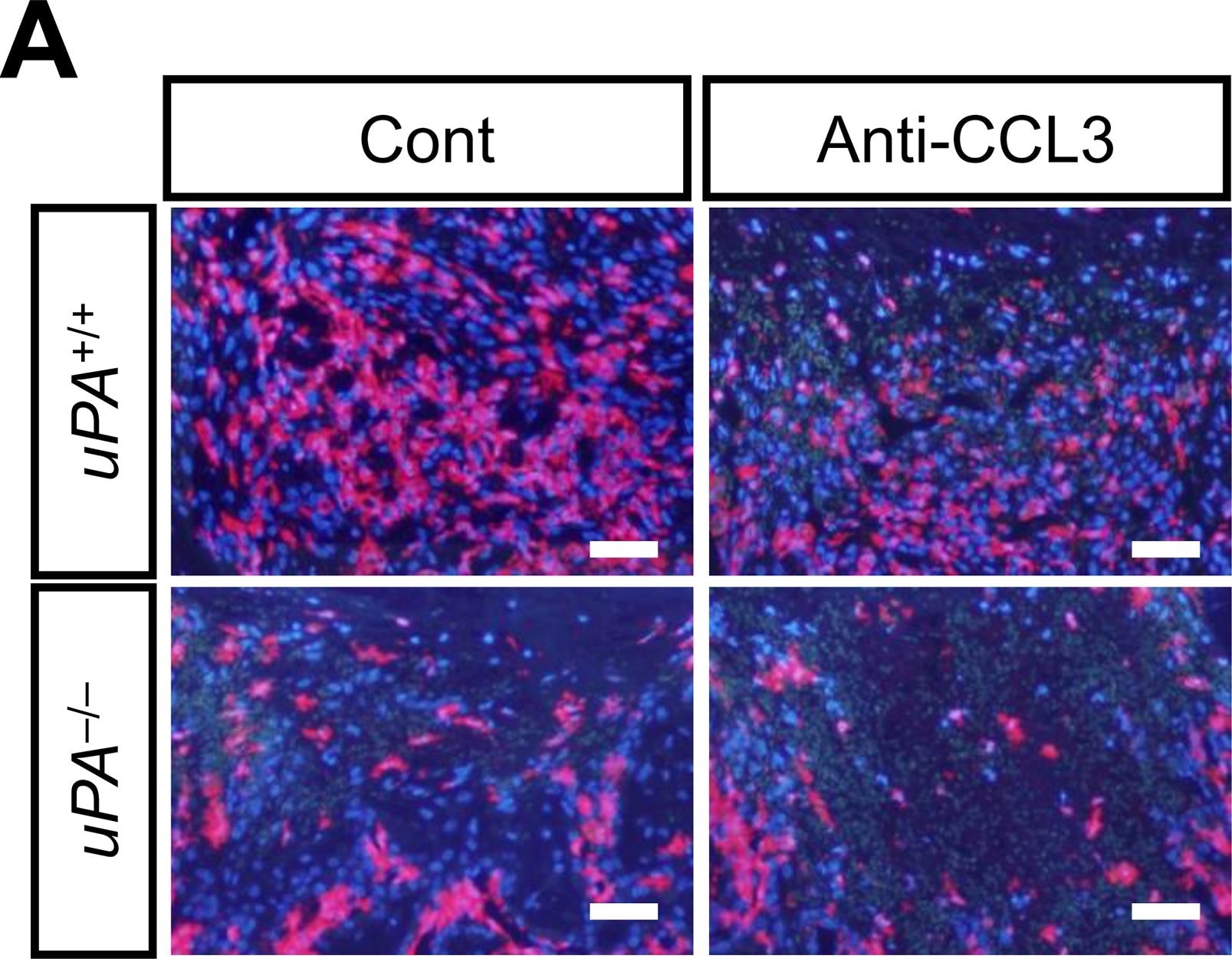
Effects of neutralizing anti-CCL3 antibody on the number of macrophages at the damaged site and the decrease in area of bone defect on day 4 in uPA+/+ and uPA-/- mice.(A) Microphotographs of immunostaining for F4/80 at the damaged site on day 4 after a femoral bone defect in uPA+/+ and uPA-/- mice treated with normal IgG (Cont) or neutralizing anti-CCL3 antibody (Anti-CCL3). The results represent experiments performed on 5 mice in each group. Scale bars indicate 50 μm. (B) Quantification of the number of F4/80-positive cells per 0.1 mm2 in the microscopic fields in the damaged site on day 4 after a femoral bone defect in uPA+/+ and uPA-/- mice treated with normal IgG or neutralizing anti-CCL3 antibody. The data represent the mean ± SEM of 5 mice. (C) Quantification of the bone defect area as assessed by qCT on days 1 and 4 in uPA+/+ and uPA-/- mice treated with normal IgG or neutralizing anti-CCL3 antibody. The data represent the mean ± SEM from 5 mice. **P < 0.01 and *P < 0.05 (Tukey’s test). Image collected and cropped by CiteAb from the following open publication (https://dx.plos.org/10.1371/journal.pone.0123982), licensed under a CC-BY license. Not internally tested by R&D Systems.

Applications for Mouse CCL3/MIP‑1 alpha Antibody

Application
Recommended Usage

Western Blot

1 µg/mL
Sample: Recombinant Mouse CCL3/MIP‑1 alpha Isoform LD78a (Catalog # 450-MA)

Neutralization

Measured by its ability to neutralize CCL3/MIP‑1 alpha -induced chemotaxis in BaF3 mouse pro‑B cell line transfected with human CCR5. The Neutralization Dose (ND50) is typically 0.3-1 µg/mL in the presence of 10 ng/mL Recombinant Mouse CCL3/MIP‑1 alpha Isoform LD78a.

Formulation, Preparation, and Storage

Purification

Protein A or G purified

Reconstitution

Reconstitute at 1 mg/mL in sterile PBS.


Loading...

Formulation

Lyophilized from a 0.2 μm filtered solution in PBS with Trehalose.

Shipping

The product is shipped at ambient temperature. Upon receipt, store it immediately at the temperature recommended below.

Stability & Storage

Use a manual defrost freezer and avoid repeated freeze-thaw cycles.
  • 12 months from date of receipt, -20 to -70 °C as supplied.
  • 1 month, 2 to 8 °C under sterile conditions after reconstitution.
  • 6 months, -20 to -70 °C under sterile conditions after reconstitution.

Calculators

The reconstitution calculator allows you to quickly calculate the volume of a reagent to reconstitute your vial. Simply enter the mass of reagent and the target concentration and the calculator will determine the rest.

=
÷

Background: CCL3/MIP-1 alpha

The macrophage inflammatory proteins 1 alpha and 1 beta, two closely related but distinct proteins, were originally co-purified from medium conditioned by a LPS-stimulated murine macrophage cell line. Mature mouse MIP-1 alpha shares approximately 77% and 70% amino acid identity with human MIP-1 alpha and mouse MIP-1 beta, respectively.
MIP‑1 proteins are expressed primarily in T cells, B cells, and monocytes after antigen or mitogen stimulation. The MIP-1 proteins are members of the beta (C-C) subfamily of chemokines.

Both MIP-1 alpha and MIP-1 beta are monocyte chemoattractants in vitro. Additionally, the MIP-1 proteins have been reported to have chemoattractant and adhesive effects on lymphocytes, with MIP-1 alpha and MIP-1 beta preferentially attracting CD8+ and CD4+ T cells, respectively. MIP-1 alpha has also been shown to attract B cells as well as eosinophils. MIP-1 proteins have been reported to have multiple effects on hematopoietic precursor cells and MIP-1 alpha  has been identified as a stem cell inhibitory factor that can inhibit the proliferation of hematopoietic stem cells in vitro as well as in vivo. In the same assays, MIP-1 beta was reported to be much less active. The functional receptor for MIP-1 alpha has been identified as CCR1 and CCR5.

References

  1. Menten, P. et al. (2002) Cytokine Growth Factor Rev. 13:455.

Alternate Names

G0S19-1, LD78a, MIP-1 alpha, MIP1 alpha, MIP1A, PAT 464.1, SCYA3, SIS-beta

Entrez Gene IDs

6348 (Human); 20302 (Mouse); 25542 (Rat); 448787 (Canine); 102136134 (Cynomolgus Monkey)

Gene Symbol

CCL3

UniProt

Additional CCL3/MIP-1 alpha Products

Product Documents for Mouse CCL3/MIP‑1 alpha Antibody

Certificate of Analysis

To download a Certificate of Analysis, please enter a lot or batch number in the search box below.

Note: Certificate of Analysis not available for kit components.

Product Specific Notices for Mouse CCL3/MIP‑1 alpha Antibody

For research use only

Citations for Mouse CCL3/MIP‑1 alpha Antibody

Customer Reviews for Mouse CCL3/MIP‑1 alpha Antibody

There are currently no reviews for this product. Be the first to review Mouse CCL3/MIP‑1 alpha Antibody and earn rewards!

Have you used Mouse CCL3/MIP‑1 alpha Antibody?

Submit a review and receive an Amazon gift card!

$25/€18/£15/$25CAN/¥2500 Yen for a review with an image

$10/€7/£6/$10CAN/¥1110 Yen for a review without an image

Submit a review
Amazon Gift Card

FAQs

No product specific FAQs exist for this product.

View all FAQs for Antibodies
