
Mouse MARC, a member of the beta subfamily of chemokines, was initially identified as a transcript that is induced in a mouse mast cell line after Fc epsilon RI triggering by IgE plus antigen. Sequence comparisons suggest that MARC may be the mouse homologue of the human MCP-3 gene. Mouse MARC/MCP-3 expression has also been detected during murine experimental allergic encephalomyelitis in the spinal cord, and in LPS-stimulated murine WEHI -3 cells and Swiss 3T3 cells where MARC expression is glucocorticoid-attenuated. Except for one amino acid subsititution, mouse MARC is identical to mouse FIC, the product of a growth factor‑activated gene. The mouse MARC cDNA encodes a 97 amino acid residue precursor protein with a 23 amino acid residue signal peptide that is cleaved to yield a 74 amino acid residue mature protein. Mouse CCR2, a mouse chemokine receptor, has been shown to bind JE/MCP-1 with high affinity and MARC/MCP-3 with lower affinity. The E. coli-expressed mouse MARC/MCP-3 produced at R&D Systems has been shown to be a monocyte and T-lymphocyte chemoattractant.
Mouse CCL7/MCP-3/MARC Antibody
R&D Systems | Catalog # AF-456-NA

Scientific images may be resized, cropped, or adjusted for brightness or contrast for presentation purposes. These updates are limited to presentation and do not affect the underlying scientific interpretation of the data. Where available, additional source data may be provided upon request.
Key Product Details
Species Reactivity
Validated:
Cited:
Applications
Validated:
Cited:
Label
Antibody Source
Product Specifications
Immunogen
Gln24-Pro97
Accession # Q03366
Specificity
Clonality
Host
Isotype
Endotoxin Level
Scientific Data Images for Mouse CCL7/MCP-3/MARC Antibody
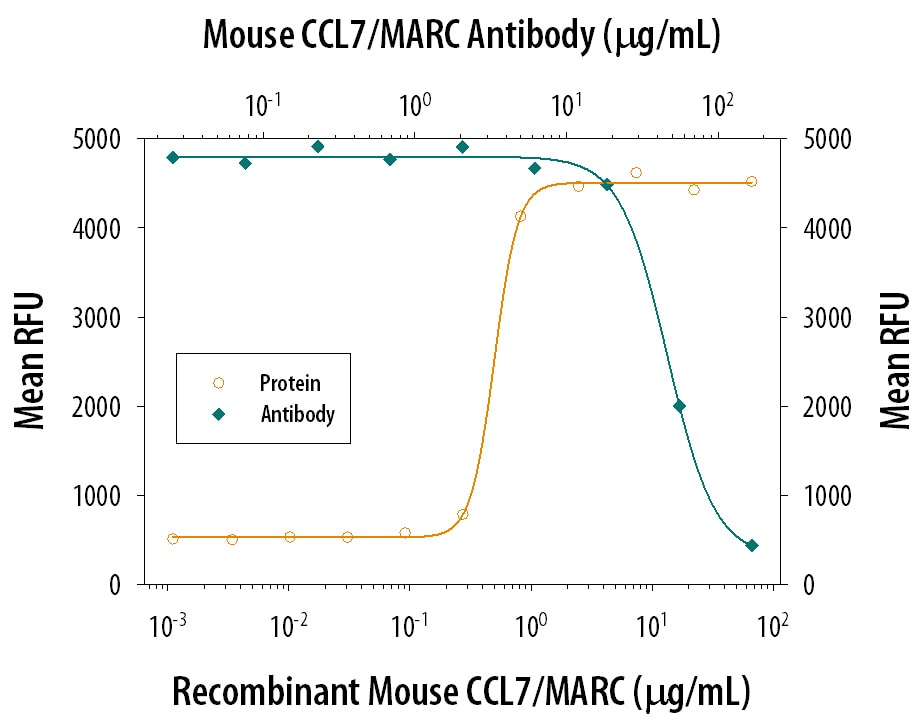
Chemotaxis Induced by CCL7/MARC and Neutralization by Mouse CCL7/MARC Antibody.
Recombinant Mouse CCL7/ MARC (Catalog # 456-MC) chemoattracts the BaF3 mouse pro-B cell line transfected with human CCR2A in a dose-dependent manner (orange line). The amount of cells that migrated through to the lower chemotaxis chamber was measured by Resazurin (Catalog # AR002). Chemotaxis elicited by Recombinant Mouse CCL7/ MARC (2 µg/mL) is neutralized (green line) by increasing concentrations of Mouse CCL7/MARC Antigen Affinity-purified Polyclonal Antibody (Catalog # AF-456-NA). The ND50 is typically 7.5-45 µg/mL.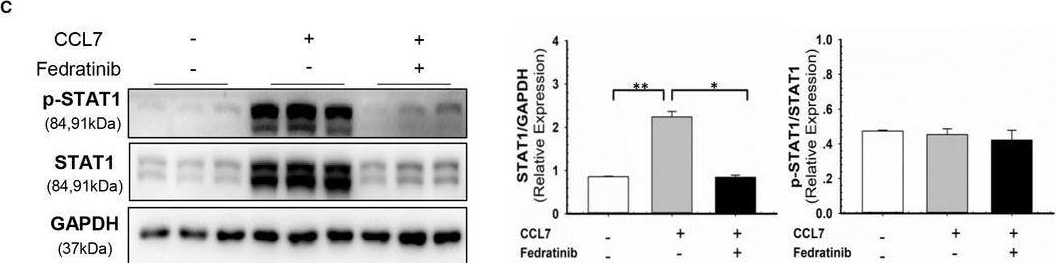
Detection of CCL7/MCP-3/MARC by Western Blot
CCL7‐activated JAK2/STAT1 signal in macrophages. (A) Protein abundance of JAK2 and STAT1 in abdominal aortas of saline (n = 4) and Ang II‐infused (n = 4) mice. (B) Protein abundance of JAK2, p‐JAK2, STAT1, p‐STAT1 and p‐JAK2/JAK2, p‐STAT1/STAT1 ratio in BMDMs incubated with rmCCL7 (100 ng/ml). (C) Protein abundance of STAT1, p‐STAT1 and p‐STAT1/STAT1 ratio in BMDM incubated with rmCCL7(100 ng/ml) and pre‐treated 1 hour with JAK2 inhibitor Fedratinib (1 μM). Values were represented as mean ± SEM; Student's t test was used for data analysis in (A, B). One Way ANOVA was used for data analysis in(C). *P < .05; **P < .01; ***P < .001, respectively Image collected and cropped by CiteAb from the following open publication (https://pubmed.ncbi.nlm.nih.gov/34189838), licensed under a CC-BY license. Not internally tested by R&D Systems.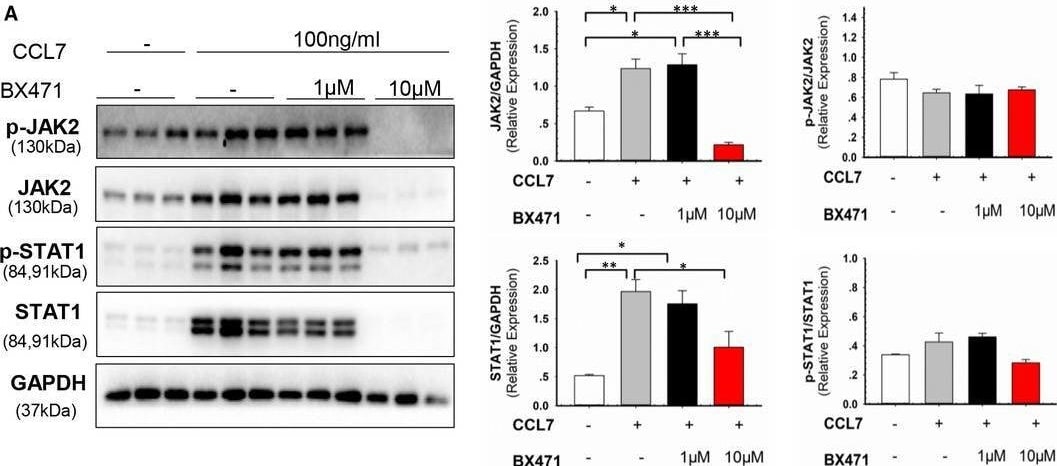
Detection of CCL7/MCP-3/MARC by Western Blot
CCL7‐CCR1 interaction regulated macrophage phenotype through JAK2 /STAT1 pathway. (A) Protein abundance of JAK2, p‐JAK2, STAT1, p‐STAT1 and p‐JAK2/JAK2, p‐STAT1/STAT1 ratio in BMDMs incubated with rmCCL7 (100 ng/ml) and pre‐treated 1 hour with CCR1 antagonist‐BX471(1 μM and 10 μM). (B) M1 markers (iNOS, IL‐6, IL‐12A, IL‐12B, TNF‐ alpha ) mRNA level in BMDMs incubated with rmCCL7 alone or in combination with JAK2 inhibitor‐Fedratinib (1 μM) and STAT1 inhibitor‐Fludarabine (1 μM). (C) Pathological mechanism diagram of CCL7 in Ang II‐induced AAA. Values were represented as mean ± SEM; One Way ANOVA was used for data analysis in (A‐B) *P < .05; **P < .01; ***P < .001, respectively Image collected and cropped by CiteAb from the following open publication (https://pubmed.ncbi.nlm.nih.gov/34189838), licensed under a CC-BY license. Not internally tested by R&D Systems.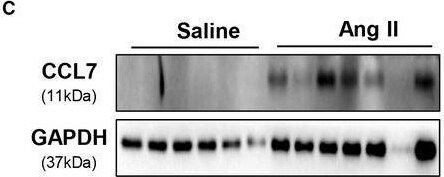
Detection of CCL7/MCP-3/MARC by Western Blot
CCL7 expression and macrophages infiltration increased in Ang II‐infused abdominal aortas. (A) Representative abdominal aorta images with ultrasound examination, the maximum abdominal aorta diameter (luminal diameter) and the maximum abdominal aorta area (luminal area). A grid on the scale represented 0.5 mm. (B) qRT‐PCR for CCL7 mRNA expression in saline (n = 6) and Ang II (n = 7) infused mice. (C) Protein levels of CCL7 in saline (n = 6) and Ang II (n = 7) infused abdominal aortas. (D) Plasma concentrations of CCL7 in saline (n = 6) and Ang II (n = 9) infused mice. (E) Representative images of macrophage infiltration in aneurysmal lesions as revealed by CD68 immunostaining. Black arrows indicated CD68‐positive location, scale bars represented 200 μm (left) and 50 μm (right images). Values were represented as mean ± SEM; Student's t test was used for data analysis in (A‐E). *P < .05; **P < .01; ***P < .001, respectively Image collected and cropped by CiteAb from the following open publication (https://pubmed.ncbi.nlm.nih.gov/34189838), licensed under a CC-BY license. Not internally tested by R&D Systems.Applications for Mouse CCL7/MCP-3/MARC Antibody
Western Blot
Sample: Recombinant Mouse CCL7/MCP‑3/MARC (Catalog # 456-MC)
Neutralization
Formulation, Preparation, and Storage
Purification
Reconstitution
Reconstitute at 0.2 mg/mL in sterile PBS. For liquid material, refer to CoA for concentration.
Formulation
Shipping
Stability & Storage
- 12 months from date of receipt, -20 to -70 °C as supplied.
- 1 month, 2 to 8 °C under sterile conditions after reconstitution.
- 6 months, -20 to -70 °C under sterile conditions after reconstitution.
Calculators
Background: CCL7/MCP-3/MARC
References
- Kulmburg, P.A. et al. (1992) J. Exp. Med. 176:1773.
- Thirion, S. et al. (1994) Biochem. Biophys. Res. Commun. 201:493.
- Smith, J.B. and H.R. Herschman (1995) J. Biol. Chem. 270:16756.
- Kurihara, T. and R. Bravo (1996) J. Biol. Chem. 271:11603.
Alternate Names
Gene Symbol
UniProt
Additional CCL7/MCP-3/MARC Products
Product Documents for Mouse CCL7/MCP-3/MARC Antibody
Certificate of Analysis
To download a Certificate of Analysis, please enter a lot or batch number in the search box below.
Note: Certificate of Analysis not available for kit components.
Product Specific Notices for Mouse CCL7/MCP-3/MARC Antibody
For research use only
Related Research Areas
Citations for Mouse CCL7/MCP-3/MARC Antibody
 Powered by Bioz
Customer Reviews for Mouse CCL7/MCP-3/MARC Antibody
There are currently no reviews for this product. Be the first to review Mouse CCL7/MCP-3/MARC Antibody and earn rewards!
Have you used Mouse CCL7/MCP-3/MARC Antibody?
Submit a review and receive an Amazon gift card!
$25/€18/£15/$25CAN/¥2500 for a review with an image
$10/€7/£6/$10CAN/¥1110 for a review without an image
Submit a review
Protocols
Find general support by application which include: protocols, troubleshooting, illustrated assays, videos and webinars.
- Cellular Response to Hypoxia Protocols
- R&D Systems Quality Control Western Blot Protocol
- Troubleshooting Guide: Western Blot Figures
- Western Blot Conditions
- Western Blot Protocol
- Western Blot Protocol for Cell Lysates
- Western Blot Troubleshooting
- Western Blot Troubleshooting Guide
- View all Protocols, Troubleshooting, Illustrated assays and Webinars
Associated Pathways
