
Dkk-3 (Dickkopf-related protein 3; also REIC) is a 65-70 kDa secreted glycoprotein member of the Dickkopf family of molecules. It is expressed by multiple cell types, including neurons, endothelial cells, keratinocytes and zona glomerulosa cells of the adrenal. Dkk-3 is reported to be a positive regulator of Wnt signaling. It is suggested to bind exclusively to Wnt-inhibiting Kremen proteins, thereby blocking their expression on the cell surface. This makes LRP available for Wnt binding and signaling. Dkk-3 is also reported to induce the development of DC from monocytes. Mature mouse Dkk-3 is 328 amino acids (aa) in length (aa 22-349). It contains one coiled-coil region (aa 39-84), two consecutive Dkk-type Cys-rich regions (aa 147-195 and 208-284), and one phosphoserine site at Ser298. Over aa 22-349, mouse shares 83% and 92% aa identity with human and rat Dkk-3, respectively.

Scientific images may be resized, cropped, or adjusted for brightness or contrast for presentation purposes. These updates are limited to presentation and do not affect the underlying scientific interpretation of the data. Where available, additional source data may be provided upon request.
Key Product Details
Species Reactivity
Validated:
Cited:
Applications
Validated:
Cited:
Label
Antibody Source
Product Specifications
Immunogen
Met1-Ile349
Accession # Q9QUN9
Specificity
Clonality
Host
Isotype
Scientific Data Images for Mouse Dkk-3 Antibody
Detection of Mouse Dkk-3 by Western Blot
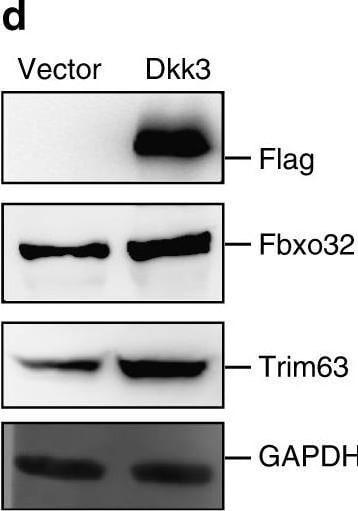
Over-expression of Dkk3-induced atrophy in cultured myotubes. a Representative images of myotubes over-expressing Dkk3. Primary myotubes were infected by adenovirus-encoding Dkk3 or control vector. Seventy two hours after infection, the myotubes over-expressing Dkk3 were significantly thinner than those infected by control vector. Green indicated myosin heavy chain (MYHC) immunofluorescent staining. Blue indicated DAPI staining of nuclei; Merge indicated merged images of MYHC and DAPI. Scale bars, 50 μm. b Quantification of the average diameters of the myotubes over-expressing Dkk3 or vector control. Error bars indicated s.d. and were based on three independent experiments. The diameters of 900 myotubes were measured in each experiment. ** indicated p < 0.01. cFbxo32 and Trim63 expression levels increased after Dkk3 over-expression. Vector indicated myotubes infected with adenovirus-encoding vector control. Dkk3 indicated myotubes infected with adenovirus-encoding Dkk3. Error bars indicated s.d. and were based on three independent experiments. ** indicated p < 0.01. d Over-expression of Dkk3 increased the protein levels of Fbxo32 and Trim63. Immunoblotting assays were performed with whole-cell extracts from myotubes over-expressing Dkk3 or vector control. Dkk3 was tagged with Flag tag. GAPDH served as internal control. All p-values were based on two-tailed t-test Image collected and cropped by CiteAb from the following open publication (https://pubmed.ncbi.nlm.nih.gov/29717119), licensed under a CC-BY license. Not internally tested by R&D Systems.Applications for Mouse Dkk-3 Antibody
Western Blot
Sample: Recombinant Mouse Dkk‑3
Formulation, Preparation, and Storage
Purification
Reconstitution
Reconstitute at 0.2 mg/mL in sterile PBS. For liquid material, refer to CoA for concentration.
Formulation
Shipping
Stability & Storage
- 12 months from date of receipt, -20 to -70 °C as supplied.
- 1 month, 2 to 8 °C under sterile conditions after reconstitution.
- 6 months, -20 to -70 °C under sterile conditions after reconstitution.
Calculators
Background: Dkk-3
Long Name
Alternate Names
Gene Symbol
UniProt
Additional Dkk-3 Products
Product Documents for Mouse Dkk-3 Antibody
Certificate of Analysis
To download a Certificate of Analysis, please enter a lot or batch number in the search box below.
Note: Certificate of Analysis not available for kit components.
Product Specific Notices for Mouse Dkk-3 Antibody
For research use only
Related Research Areas
Citations for Mouse Dkk-3 Antibody
 Powered by Bioz
Customer Reviews for Mouse Dkk-3 Antibody
There are currently no reviews for this product. Be the first to review Mouse Dkk-3 Antibody and earn rewards!
Have you used Mouse Dkk-3 Antibody?
Submit a review and receive an Amazon gift card!
$25/€18/£15/$25CAN/¥2500 for a review with an image
$10/€7/£6/$10CAN/¥1110 for a review without an image
Submit a review
Protocols
Find general support by application which include: protocols, troubleshooting, illustrated assays, videos and webinars.
- Cellular Response to Hypoxia Protocols
- R&D Systems Quality Control Western Blot Protocol
- Troubleshooting Guide: Western Blot Figures
- Western Blot Conditions
- Western Blot Protocol
- Western Blot Protocol for Cell Lysates
- Western Blot Troubleshooting
- Western Blot Troubleshooting Guide
- View all Protocols, Troubleshooting, Illustrated assays and Webinars