

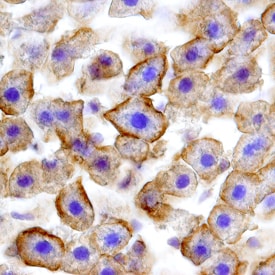

Fas, also known as APO-1, CD95, and TNFRSF6, belongs to the death receptor family, which is a subfamily of the TNF receptor superfamily (1). Death receptors contain a cytoplasmic death domain (DD), which is required for transducing apoptotic signals. Engagement of Fas by its ligand (FasL) or agonistic anti-Fas antibodies induces dimerization and oligomerization of preformed Fas trimers. The activated receptor recruits the adaptor molecule FADD to form the Death-Inducing Signaling Complex (DISC) that also contains caspases. Upon activation, the caspases initiate a signaling cascade that induces the characteristic apoptotic phenotypes (2). Fas is highly expressed in epithelial cells, hepatocytes, activated mature lymphocytes, virus-transformed lymphocytes and other tumor cells. Fas expression has also been detected in mouse thymus, liver, heart, lung, kidney and ovary. FasL is a member of the TNF family of type 2 membrane proteins. FasL is predominantly expressed by activated T-lymphocytes, NK cells, and in tissues with immune-privileged sites (3).
Fas plays a role in the down-regulation of the immune reaction and has been shown to be an essential mediator of activation-induced death of activated T lymphocytes. Fas-mediated cell death has also been shown to be important for the deletion of activated or autoreactive B-lymphocytes. Both human and mice with genetic defects in Fas accumulate abnormal lymphocytes and develop systemic autoimmunity (4). Besides the perforin/granzyme-based mechanism, the Fas-FasL system has been identified as the alternate pathway for CTL-mediated cytotoxicity (5). FasL has also been shown to function in immunological privileged sites by killing infiltrating Fas-bearing lymphocytes and inflammatory cells (6). Rat Fas cDNA encodes a 324 amino acid residue type 1 membrane protein. The extracellular domain of rat Fas shares 54.1% and 66.7% amino acid sequence identity with that of human and mouse Fas, respectively.
 Powered by Bioz



