
Immunology of Infectious Disease
Research into the immunology of infectious disease aims to understand how the cells of the immune system detect, interact, and respond to invading pathogens. Infectious diseases may be underscored by a variety of organisms including unicellular-prokaryotes (bacteria), unicellular-eukaryotes (yeast, protozoan), multicellular-eukaryotes (helminths), and viruses. The immunological response to infectious pathogens involves both innate and adaptive mechanisms. The initial innate immune response to infectious pathogens is often considered to be generic, mostly mediated by the recognition of pathogen-associated molecular patterns (PAMPS). In contrast, the protracted adaptive immune response is very specific and involves cellular and antibody dependent mechanisms.
Current State of Global Infectious Diseases
The World Health Organization (WHO) has ranked infectious diseases as the second global leading cause of fatalities. Among infectious diseases, those caused by animal to human transmission or zoonotic infections represent 60% of emerging infections worldwide. Emerging zoonotic infections are due to the appearance of new pathogens and exemplified by West Nile virus, H1N1 influenza, H5N1 avian influenza, SARS-CoV, MERS-CoV and the most recent identified coronavirus strain SARS-CoV-2. Coronaviruses are enveloped positive-sense RNA viruses associated with upper respiratory infections and fatal pneumonia. SARS-CoV-2 is the identified causative agent of the coronavirus-associated acute respiratory disease called coronavirus disease 19 (COVID-19), which originated in Wuhan, capital of Hubei province, People's Republic of China at the end of 2019. The WHO estimates that global excess mortality associated with COVID-19 was 14.91 million in the 24 months between 1 January 2020 and 31 December 2021.
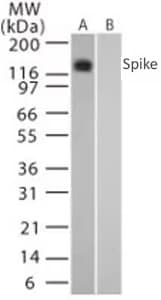
SARS-CoV Spike Protein [NB100-56578]: Western blot analysis of SARS Spike Protein in (A) transfected and (B) untransfected mouse melanoma cell lysate.
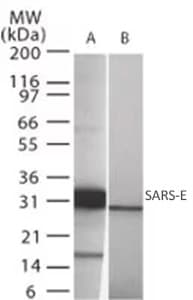
SARS Envelope Protein [NB100-56562]: Western Blot analysis of SARS-E in (A) recombinant fusion protein containing amino acids 59-70 and (B) fusion partner without these amino acids, using this antibody.
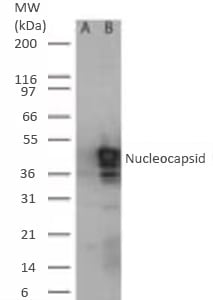
SARS Nucleocapsid Protein [NB100-56683]: Western blot analysis of SARS Nucleocapsid in (A) untransfected mouse melanoma cell lysate and (B) transfected cell lysate using this antibody at a 1:2000 dilution.
- Coronaviridae Study Group of the International Committee on Taxonomy of Viruses. (2020). The species Severe acute respiratory syndrome-related coronavirus: classifying 2019-nCoV and naming it SARS-CoV-2. Nature Microbiology.
- Fehr, A. R., & Perlman, S. (2015). Coronaviruses: An overview of their replication and pathogenesis. In Coronaviruses: Methods and Protocols.
- Thakur, A., Mikkelsen, H., & Jungersen, G. (2019). Intracellular pathogens: Host immunity and microbial persistence strategies. Journal of Immunology Research.