
Angiogenesis
Angiogenesis, or the process of new blood vessel formation, is a natural event that occurs under both normal and pathological conditions. In the normal state, two distinct processes can be seen. One process utilizes endothelial progenitor cells. These are usually derived from bone marrow and initiate endothelial growth and vascular tube formation. The second process utilizes existing vasculature to generate new vessels, and is highly dependent on endothelial cell activation and protease secretion. Multiple factors contribute to angiogenesis, including soluble growth and differentiative factors, extracellular matrix components, membrane-bound receptors, and intracellular signaling molecules. R&D Systems has an extensive and diverse offering of reagents for studying angiogenesis and its natural counterpart, anti-angiogenesis.
Angiogenesis in Cancer
Under pathological conditions, many of the same steps involved in normal vessel formation are repeated, but the structures formed are often functionally abnormal, possibly due to an imbalance in the angiogenic process. The survival of cancer cells critically depends on vasculature and blood supply which provide essential nutrients and oxygen to support the typically accelerated tumor growth. Additionally, vascular structures (e.g., new vessels, pre-existing vessels and vessel-like structures) allow cancer cells to travel to distant tissues and organs supporting cancer spread. Formation of new vasculature, or angiogenesis, is therefore a process that contributes to tumor growth and metastasis and is particularly critical for solid tumors.
The “angiogenic switch” refers to the activation of molecular pathways that direct the formation of new vessels within a tumor. Specific genetic changes in tumor cells underscore the activation of angiogenic programs by tilting the balance between the activity of angiogenic activators and inhibitors.
Angiogenic Switch
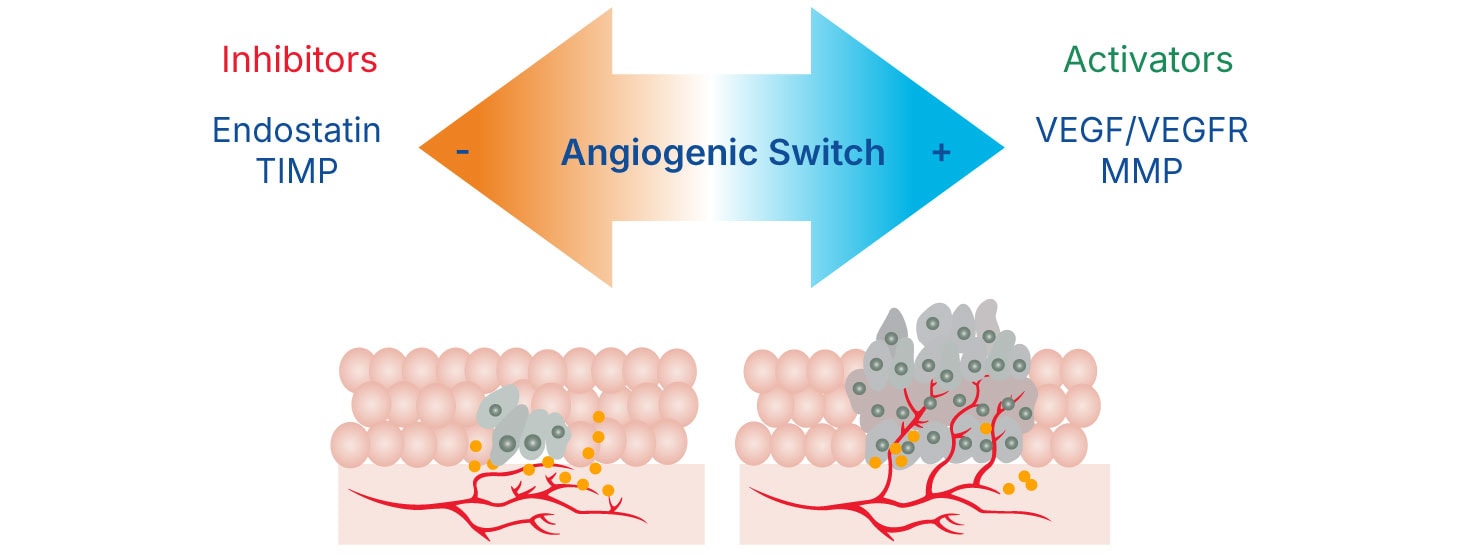
A shift in the balance between the activities of angiogenesis inhibitors and activators underscores the angiogenic switch which allows solid tumors to sustain their growth beyond 2-3 mm diameter.
Within the angiogenesis cascade, different molecular factors play key roles in the establishment of new vessels. For example, VEGF is a critical angiogenic growth factor which stimulates the proliferation and survival of endothelial cells. In the tumor microenvironment, VEGF expression may be stimulated by hypoxia via the stabilization and activity of HIF transcription factors. Release of VEGF stimulates the concomitant secretion of proteases (e.g., Metalloproteinases- MMP-9) by endothelial cells of mature vessels which degrade the extracellular basement membrane and facilitate the movement and proliferation of endothelial cells. Under the influence of VEGF and other growth factors as well as adhesion molecules (e.g., Integrins) endothelial cells proliferate and migrate to give rise to new vessels.
Featured Products
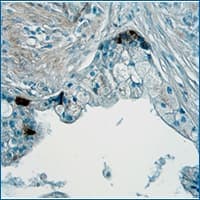
Angiopoietin-1 was detected in immersion fixed paraffin-embedded sections of human prostate cancer tissue using 15 µg/mL Goat Anti-Human/Mouse Angiopoietin-1 Antigen Affinity-purified Polyclonal Antibody (Catalog # AF923) overnight at 4 °C. Tissue was stained with the Anti-Goat HRP-DAB Cell & Tissue Staining Kit (brown) and counterstained with Hematoxylin (blue).
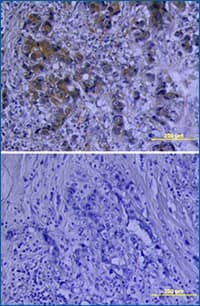
VEGF was detected in immersion fixed paraffin-embedded sections of human breast cancer tissue using Human VEGF 165 Polyclonal Antibody (Catalog # AB-293-NA) at 15 µg/mL overnight at 4 °C. Tissue was stained using the Anti-Goat HRP-DAB Cell & Tissue Staining Kit (brown) and counterstained with Hematoxylin (blue). Lower panel shows a lack of labeling if primary antibodies are omitted and tissue is stained only with secondary antibody followed by incubation with detection reagents.
Endogenous Modulators of Angiogenesis
Angiogenic Activators | |||||||
|---|---|---|---|---|---|---|---|
| Oncoproteins | Myc | Ras | Her2 | ||||
| Growth Factors | VEGF-A | FGF-2 | PDGF-BB | PDGF-C | PDGF-D | EGF | Angiopoietin-1 |
| Cytokines | IL-1 alpha | IL-1 beta | IL-8/CXCL8 | TNF-beta | |||
| Microenvironmental factors | Hypoxia | ||||||
| Transcription factors | HIF-1 alpha | HIF-2 alpha | |||||
Angiogenic Inhibitors | ||||||||
|---|---|---|---|---|---|---|---|---|
| Cytokines | IFN-alpha | IL-4 | IL-10 | IL-12 | ||||
| Other Modulators | Thrombospondin-1 | Chitinase-3-like 1 | sFRP-4 | Angiopoietin-2 | TIMP-1 | TIMP-2 | TIMP-3 | TIMP-4 |
Small Molecule Inhibitors of Angiogenesis | |||
|---|---|---|---|
| Anti-angiogenics | EGFR Inhibitors | FGFR Inhibitors | HIF Inhibitors |
| MMP Inhibitors | PDGFR Inhibitors | Protein Kinase G Inhibitors | VEGFR Inhibitors |
Intracellular Signaling Molecules in Angiogenesis
Angiogenesis in Cancer Product Guide
This guide provides a background to angiogenesis in cancer and highlights products that can be used to investigate angiogenesis therapeutic targets including growth factors, transcription factors, adhesion, extracellular matrix remodeling and key signaling pathways.
Resources for Angiogenesis Research
- Human Angiogenesis Antibody Array
- Mouse Angiogenesis Antibody Array
- Angiogenesis Assay
- Atherosclerosis Disease Progression Poster
- New! GMP rhVEGF165 for Therapeutic Manufacturing
- Interactive Pathway: TGF-beta Signaling Pathways
- Interactive Pathway: VEGF - VEGF R2 Signaling Pathways
- Interactive Pathway: Platelet Activation Overview
- Platelet Activation Granule Release
- Ephrin Ligands and Eph Receptors
- HIF Transcription Factors
- Adhesion Molecules