
ADAM9, also known as MDC9 or meltrin gamma, is a member of the ADAM family that contains a disintegrin and metalloprotease-like domain (1). Like other membrane-anchored ADAMs, ADAM9 consists of a pro domain with a cysteine switch and furin cleavage sequence, a catalytic domain with the zinc-binding site and Met-turn expected for reprolysins, a disintegrin-like domain, a cysteine-rich domain, an EGF-like domain, a transmembrane domain, and the cytoplasmic domain. ADAM9 is able to cleave peptides corresponding to cleavage sites of tumor necrosis factor-alpha (TNF-alpha ), the p75 TNF receptor, the beta -amyloid protein precursor, and the c-kit ligand-1, implying that it may participate in shedding of these membrane proteins (2). In fact, ADAM9 has been shown to shed membrane-anchored heparin-binding EGF-like growth factor (3). In addition, it also cleaves oxidized insulin beta -chain and fibronectin (2,4). Besides its catalytic activity, ADAM9 functions as an adhesion molecule through binding of its disintegrin domain to integrins such as alpha v beta 5 and alpha 6 beta 1 (5, 6). The cytoplasmic domain of ADAM9 interacts with Src homology 3 (SH3)‑containing proteins and protein kinase C, and may mediate different signaling pathways (3, 7). ADAM9 is widely expressed in tissues (8).
Human ADAM9 Ectodomain Antibody
R&D Systems | Catalog # AF939

Scientific images may be resized, cropped, or adjusted for brightness or contrast for presentation purposes. These updates are limited to presentation and do not affect the underlying scientific interpretation of the data. Where available, additional source data may be provided upon request.
Key Product Details
Validated by
Species Reactivity
Validated:
Cited:
Applications
Validated:
Cited:
Label
Antibody Source
Product Specifications
Immunogen
Ala206-Asp697
Accession # Q13443
Specificity
Clonality
Host
Isotype
Scientific Data Images for Human ADAM9 Ectodomain Antibody
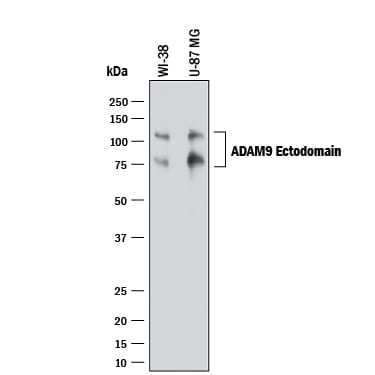
Detection of Human ADAM9 by Western Blot.
Western blot shows lysates of WI-38 human lung fibroblast cell line and U-87 MG human glioblastoma/astrocytoma cell line. PVDF membrane was probed with 1 µg/mL of Goat Anti-Human ADAM9 Ectodomain Antigen Affinity-purified Polyclonal Antibody (Catalog # AF939) followed by HRP-conjugated Anti-Goat IgG Secondary Antibody (Catalog # HAF017). Specific bands were detected for ADAM9 at approximately 110 and 80 kDa (as indicated). This experiment was conducted under reducing conditions and using Immunoblot Buffer Group 1.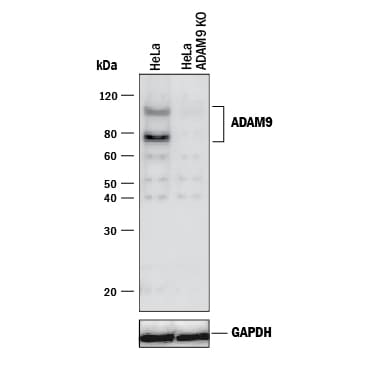
Western Blot Shows Human ADAM9 Specificity by Using Knockout Cell Line.
Western blot shows lysates of HeLa human cervical epithelial carcinoma parental cell line and ADAM9 knockout HeLa cell line (KO). PVDF membrane was probed with 1 µg/mL of Goat Anti-Human ADAM9 Ectodomain Antigen Affinity-purified Polyclonal Antibody (Catalog # AF939) followed by HRP-conjugated Anti-Sheep IgG Secondary Antibody (Catalog # HAF016). Specific bands were detected for ADAM9 at approximately 78 and 110 kDa (as indicated) in the parental HeLa cell line, but is not detectable in knockout HeLa cell line. GAPDH (Catalog # AF5718) is shown as a loading control. This experiment was conducted under reducing conditions and using Immunoblot Buffer Group 1.
Human ADAM9 ELISA Standard Curve
Recombinant Human ADAM9 (Catalog # 939-AD) was serially diluted and captured by Goat Anti-Human ADAM9 Ectodomain Antigen Affinity-purified Polyclonal Antibody (Catalog # AF939) coated on a Clear Polystyrene Microplate (Catalog # DY990). Goat Anti-Human ADAM9 Ectodomain Antigen Affinity-purified Polyclonal Antibody (Catalog # AF939) was biotinylated and incubated with the protein captured on the plate. Detection of the standard curve was achieved by incubating Streptavidin-HRP (Catalog # DY998)
Human ADAM9 ELISA Standard Curve
Recombinant Human ADAM9 (Catalog # 939-AD) was serially diluted and captured by Goat Anti-Human ADAM9 Ectodomain Antigen Affinity-purified Polyclonal Antibody (Catalog # AF939) coated on a Clear Polystyrene Microplate (Catalog # DY990). Goat Anti-Human ADAM9 Ectodomain Antigen Affinity-purified Polyclonal Antibody (Catalog # AF939) was biotinylated and incubated with the protein captured on the plate. Detection of the standard curve was achieved by incubating Streptavidin-HRP (Catalog # DY998)
Human ADAM9 ELISA Standard Curve
Recombinant Human ADAM9 (Catalog # 939-AD) was serially diluted and captured by Goat Anti-Human ADAM9 Ectodomain Antigen Affinity-purified Polyclonal Antibody (Catalog # AF939) coated on a Clear Polystyrene Microplate (Catalog # DY990). Goat Anti-Human ADAM9 Ectodomain Antigen Affinity-purified Polyclonal Antibody (Catalog # AF939) was biotinylated and incubated with the protein captured on the plate. Detection of the standard curve was achieved by incubating Streptavidin-HRP (Catalog # DY998)Applications for Human ADAM9 Ectodomain Antibody
Immunoprecipitation
Sample: Conditioned cell culture medium spiked with Recombinant Human ADAM9 (Catalog # 939‑AD), see our available Western blot detection antibodies
Knockout Validated
Western Blot
Sample: WI‑38 human lung fibroblast cell line and U‑87 MG human glioblastoma/astrocytoma cell line
Human ADAM9 Sandwich Immunoassay
Formulation, Preparation, and Storage
Purification
Reconstitution
Reconstitute at 0.2 mg/mL in sterile PBS. For liquid material, refer to CoA for concentration.
Formulation
Shipping
Stability & Storage
- 12 months from date of receipt, -20 to -70 °C as supplied.
- 1 month, 2 to 8 °C under sterile conditions after reconstitution.
- 6 months, -20 to -70 °C under sterile conditions after reconstitution.
Calculators
Background: ADAM9
References
- Moss, et al. (2001) DDT 6:417.
- Roghan, et al. (1999) J. Biol. Chem. 274:3531.
- Izumi, et al. (1998) EMBO J. 17:7260.
- Schwettmann and Tschesche (2001) Prot. Expre. & Purif. 21:65.
- Nath, et al. (2000) J. Cell Sci. 113:2319.
- Zhou, et al. (2001) Biochem. Biophys. Res. Comm. 280:574.
- Howard, et al. (1999) J. Biol. Chem. 274:31693.
- Weskamp, et al. (1996) J. Cell. Biol. 132:717.
Long Name
Alternate Names
Gene Symbol
UniProt
Additional ADAM9 Products
Product Documents for Human ADAM9 Ectodomain Antibody
Certificate of Analysis
To download a Certificate of Analysis, please enter a lot or batch number in the search box below.
Note: Certificate of Analysis not available for kit components.
Product Specific Notices for Human ADAM9 Ectodomain Antibody
For research use only
Related Research Areas
Citations for Human ADAM9 Ectodomain Antibody
 Powered by Bioz
Customer Reviews for Human ADAM9 Ectodomain Antibody
There are currently no reviews for this product. Be the first to review Human ADAM9 Ectodomain Antibody and earn rewards!
Have you used Human ADAM9 Ectodomain Antibody?
Submit a review and receive an Amazon gift card!
$25/€18/£15/$25CAN/¥2500 for a review with an image
$10/€7/£6/$10CAN/¥1110 for a review without an image
Submit a review
Protocols
Find general support by application which include: protocols, troubleshooting, illustrated assays, videos and webinars.
- Cellular Response to Hypoxia Protocols
- Immunoprecipitation Protocol
- R&D Systems Quality Control Western Blot Protocol
- Troubleshooting Guide: Western Blot Figures
- Western Blot Conditions
- Western Blot Protocol
- Western Blot Protocol for Cell Lysates
- Western Blot Troubleshooting
- Western Blot Troubleshooting Guide
- View all Protocols, Troubleshooting, Illustrated assays and Webinars
Associated Pathways
