
cIAP-1 (also known as BIR2, MIHB and HIAP-2) is a member of the inhibitor of apoptosis (IAP) family of proteins that inhibit the proteolytic activity of mature caspases. cIAP-1 has 3 BIR (baculovirus inhibitor of apoptosis) domains, a RING finger domain, and a caspase recruitment domain (CARD). cIAP-1 inhibits caspases by interaction of the BIR domain with the active caspase. Caspase activity may be restored through interactions with the Reaper like motif on mitochondrial proteins such as SMAC/Diablo or HTRA-2/Omi. cIAP-1 is reported to be cleaved by caspases in fetal rat hepatocytes treated with TGF-beta.
Human cIAP-1/HIAP-2 Antibody (681732)
R&D Systems | Catalog # MAB818

Scientific images may be resized, cropped, or adjusted for brightness or contrast for presentation purposes. These updates are limited to presentation and do not affect the underlying scientific interpretation of the data. Where available, additional source data may be provided upon request.
Key Product Details
Validated by
Knockout/Knockdown
Species Reactivity
Validated:
Human
Cited:
Human
Applications
Validated:
Knockout Validated, Western Blot, Simple Western
Cited:
Western Blot
Label
Unconjugated
Antibody Source
Monoclonal Mouse IgG1 Clone # 681732
Loading...
Product Specifications
Immunogen
E. coli-derived recombinant human cIAP-1/HIAP-2
His2-Ser618
Accession # Q13490
His2-Ser618
Accession # Q13490
Specificity
Detects human cIAP‑1/HIAP-2 in direct ELISAs and Western blots.
In direct ELISAs, 100% cross‑reactivity
with recombinant human (rh) cIAP‑2 (aa 2‑604) and no cross-reactivity with
rhBIRC6 (aa 4582‑4735), rhcIAP‑2 (aa 94‑178), rhXIAP (aa 1‑497), rhXIAP
(BIR2 domain; aa 124‑242), or rhXIAP (BIR3 domain; aa 252‑356) is observed.
Clonality
Monoclonal
Host
Mouse
Isotype
IgG1
Scientific Data Images for Human cIAP-1/HIAP-2 Antibody (681732)
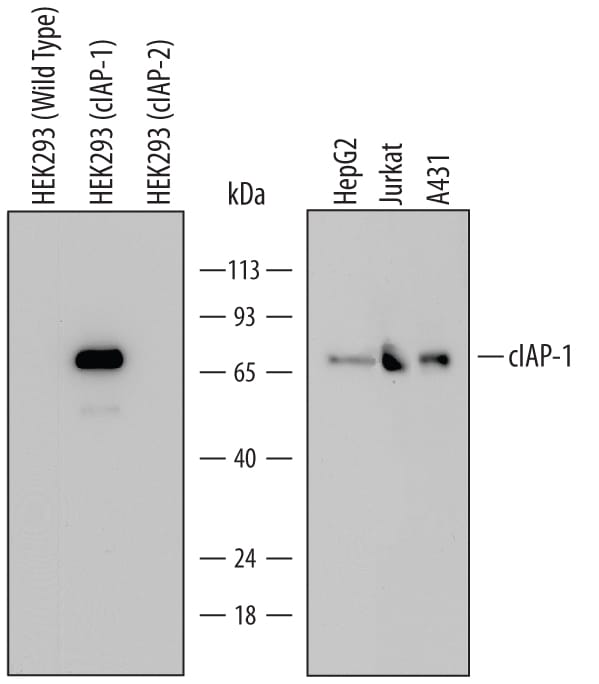
Detection of Human cIAP-1/HIAP-2 by Western Blot.
Western blot shows lysates of HEK293 human embryonic kidney cell line either mock transfected, transfected with full length human cIAP-1, or transfected with full length human cIAP-2, HepG2 human hepatocellular carcinoma cell line, Jurkat human acute T cell leukemia cell line, and A431 human epithelial carcinoma cell line. PVDF Membrane was probed with 1 µg/mL of Human cIAP-1/HIAP-2 Monoclonal Antibody (Catalog # MAB818) followed by HRP-conjugated Anti-Mouse IgG Secondary Antibody (Catalog # HAF007). A specific band was detected for cIAP-1/HIAP-2 at approximately 72 kDa (as indicated). This experiment was conducted under reducing conditions and using Immunoblot Buffer Group 2.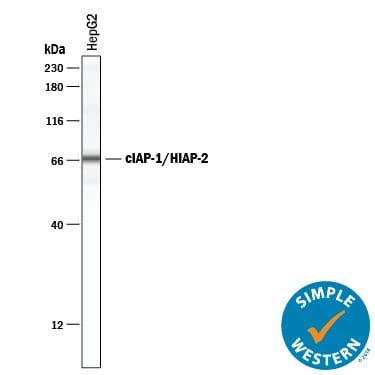
Detection of Human cIAP‑1/HIAP‑2 by Simple WesternTM.
Simple Western lane view shows lysates of HepG2 human hepatocellular carcinoma cell line, loaded at 0.2 mg/mL. A specific band was detected for cIAP‑1/HIAP‑2 at approximately 66 kDa (as indicated) using 5 µg/mL of Mouse Anti-Human cIAP‑1/HIAP‑2 Monoclonal Antibody (Catalog # MAB818). This experiment was conducted under reducing conditions and using the 12-230 kDa separation system.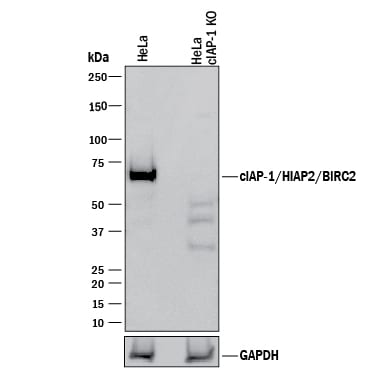
Western Blot Shows Human cIAP-1/HIAP-2 Specificity by Using Knockout Cell Line.
Western blot shows lysates of HeLa human cervical epithelial carcinoma parental cell line and cIAP-1/HIAP-2 knockout HeLa cell line (KO). PVDF membrane was probed with 1 µg/mL of Mouse Anti-Human cIAP-1/HIAP-2 Monoclonal Antibody (Catalog # MAB818) followed by HRP-conjugated Anti-Mouse IgG Secondary Antibody (Catalog # HAF018). A specific band was detected for cIAP-1/HIAP-2 at approximately 68 kDa (as indicated) in the parental HeLa cell line, but is not detectable in knockout HeLa cell line. GAPDH (Catalog # MAB5718) is shown as a loading control. This experiment was conducted under reducing conditions and using Immunoblot Buffer Group 1.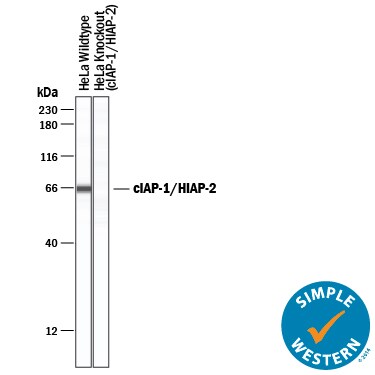
Specificity of Human cIAP‑1/HIAP‑2 by Simple WesternTM.
Simple Western lane view shows lysates of HeLa human cervical epithelial carcinoma parental cell line and cIAP‑1/HIAP‑2 knockout HeLa cell line (KO), loaded at 0.2 mg/mL. A specific band was detected for cIAP‑1/HIAP‑2 at approximately 66 kDa (as indicated) in the parental HeLa cell line, but is not detectable in knockout HeLa cell line. Mouse Anti-Human cIAP‑1/HIAP‑2 Monoclonal Antibody (Catalog # MAB818) was used at 5 µg/mL. This experiment was conducted under reducing conditions and using the 12-230 kDa separation system.Applications for Human cIAP-1/HIAP-2 Antibody (681732)
Application
Recommended Usage
Knockout Validated
cIAP‑1/HIAP‑2
is specifically detected in HeLa human cervical epithelial carcinoma parental cell line but is not detectable in
cIAP‑1/HIAP‑2 knockout HeLa cell line.
Simple Western
5 µg/mL
Sample: HepG2 human hepatocellular carcinoma cell line
Sample: HepG2 human hepatocellular carcinoma cell line
Western Blot
1 µg/mL
Sample: HEK293 human embryonic kidney cell line transfected with full length human cIAP-1, or transfected with full length human cIAP-2, HepG2 human hepatocellular carcinoma cell line, Jurkat human acute T cell leukemia cell line, and A431 human epithelial carcinoma cell line
Sample: HEK293 human embryonic kidney cell line transfected with full length human cIAP-1, or transfected with full length human cIAP-2, HepG2 human hepatocellular carcinoma cell line, Jurkat human acute T cell leukemia cell line, and A431 human epithelial carcinoma cell line
Reviewed Applications
Read 2 reviews rated 4.5 using MAB818 in the following applications:
Formulation, Preparation, and Storage
Purification
Protein A or G purified from hybridoma culture supernatant
Reconstitution
Sterile PBS to a final concentration of 0.5 mg/mL. For liquid material, refer to CoA for concentration.
Loading...
Formulation
Lyophilized from a 0.2 μm filtered solution in PBS with Trehalose. *Small pack size (SP) is supplied either lyophilized or as a 0.2 µm filtered solution in PBS.
Shipping
Lyophilized product is shipped at ambient temperature. Liquid small pack size (-SP) is shipped with polar packs. Upon receipt, store immediately at the temperature recommended below.
Stability & Storage
Use a manual defrost freezer and avoid repeated freeze-thaw cycles.
- 12 months from date of receipt, -20 to -70 °C as supplied.
- 1 month, 2 to 8 °C under sterile conditions after reconstitution.
- 6 months, -20 to -70 °C under sterile conditions after reconstitution.
Calculators
Background: cIAP-1/HIAP-2
References
- Roy, N. et al. (1997) EMBO J. 23:6914.
- Deveraux, Q. et al. (1997) Nature 388:300.
- Deveraux, Q. and J. Reed (1999) Genes & Develop. 13:239.
- Herrera, B. et al. (2002) FEBS Letters 520:93.
Long Name
Cellular Inhibitor of Apoptosis Protein 1
Alternate Names
BIRC2, cIAP1, HIAP-2, MIHB
Gene Symbol
BIRC2
UniProt
Additional cIAP-1/HIAP-2 Products
Product Documents for Human cIAP-1/HIAP-2 Antibody (681732)
Certificate of Analysis
To download a Certificate of Analysis, please enter a lot or batch number in the search box below.
Note: Certificate of Analysis not available for kit components.
Product Specific Notices for Human cIAP-1/HIAP-2 Antibody (681732)
For research use only
Related Research Areas
Citations for Human cIAP-1/HIAP-2 Antibody (681732)
 Powered by Bioz
Customer Reviews for Human cIAP-1/HIAP-2 Antibody (681732) (2)
4.5 out of 5
2 Customer Ratings
Have you used Human cIAP-1/HIAP-2 Antibody (681732)?
Submit a review and receive an Amazon gift card!
$25/€18/£15/$25CAN/¥2500 for a review with an image
$10/€7/£6/$10CAN/¥1110 for a review without an image
Submit a review
Showing
1
-
2 of
2 reviews
Showing All
Filter By:
-
Application: Western BlotSample Tested: See PMID 24256025Species: HumanVerified Customer | Posted 02/25/2015
-
Application: Western BlotSample Tested: See PMID 19364763Species: OtherVerified Customer | Posted 02/25/2015
There are no reviews that match your criteria.
Protocols
Find general support by application which include: protocols, troubleshooting, illustrated assays, videos and webinars.
- Cellular Response to Hypoxia Protocols
- R&D Systems Quality Control Western Blot Protocol
- Troubleshooting Guide: Western Blot Figures
- Western Blot Conditions
- Western Blot Protocol
- Western Blot Protocol for Cell Lysates
- Western Blot Troubleshooting
- Western Blot Troubleshooting Guide
- View all Protocols, Troubleshooting, Illustrated assays and Webinars
Loading...
Associated Pathways


