
DNAX accessory molecule-1 (DNAM-1), also known as CD226, is a 65 kDa type I transmembrane glycoprotein in the immunoglobulin superfamily (1). Mature human DNAM-1 contains a 236 amino acid (aa) extracellular domain (ECD) with two Ig-like C2-set domains and a 61 aa cytoplasmic region that contains motifs for binding PDZ domains and band 4.1 family proteins (1, 2). Within the ECD, human DNAM-1 shares 50% and 52% aa sequence identity with mouse and rat DNAM-1, respectively. DNAM-1 is expressed on multiple lymphoid and myeloid cell types and interacts with CD155/PVR and Nectin-2/CD112 (3, 4). Ligation of DNAM-1 promotes the activation of NK cells, CD8+ T cells, and mast cells (2‑6), dendritic cell maturation, megakaryocyte and activated platelet adhesion to vascular endothelial cells, and monocyte extravasation; it inhibits the formation of osteoclasts (7‑10). Platelet-endothelium interactions mediated by DNAM-1 enable the metastasis of tumor cells to the lung (11). In activated, but not in resting NK, T, and mast cells, the cis association of DNAM-1 with CD18 contributes to the tyrosine and serine phosphorylation of DNAM-1 during activation (6, 9, 12‑14).
Human DNAM-1/CD226 Antibody (102511)
R&D Systems | Catalog # MAB666

Scientific images may be resized, cropped, or adjusted for brightness or contrast for presentation purposes. These updates are limited to presentation and do not affect the underlying scientific interpretation of the data. Where available, additional source data may be provided upon request.
Key Product Details
Species Reactivity
Validated:
Cited:
Applications
Validated:
Cited:
Label
Antibody Source
Product Specifications
Immunogen
Glu19-Asn247 (predicted)
Accession # Q15762
Specificity
Clonality
Host
Isotype
Endotoxin Level
Scientific Data Images for Human DNAM-1/CD226 Antibody (102511)
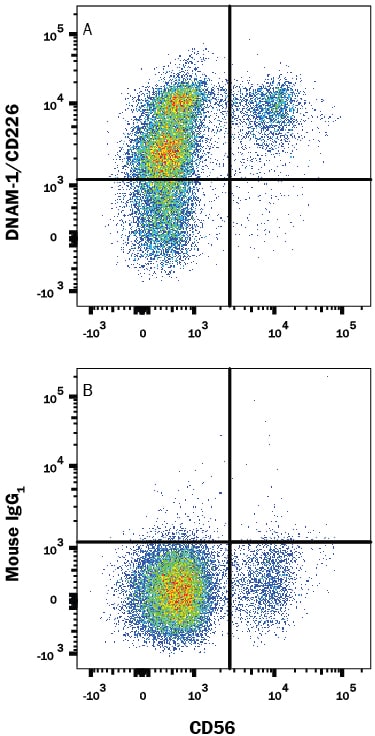
Detection of DNAM-1/CD226 in Human PBMCs by Flow Cytometry.
Human peripheral blood mononuclear cells (PBMCs) gated on CD3-cells were stained with Mouse Anti-Human NCAM-1/CD56 APC-conjugated Monoclonal Antibody (Catalog # FAB2408A) and either (A) Mouse Anti-Human DNAM-1/CD226 Monoclonal Antibody (Catalog # MAB666) or (B) Mouse IgG1Isotype Control (Catalog # MAB002) followed by Phycoerythrin-conjugated Anti-Mouse IgG Secondary Antibody (Catalog # F0102B).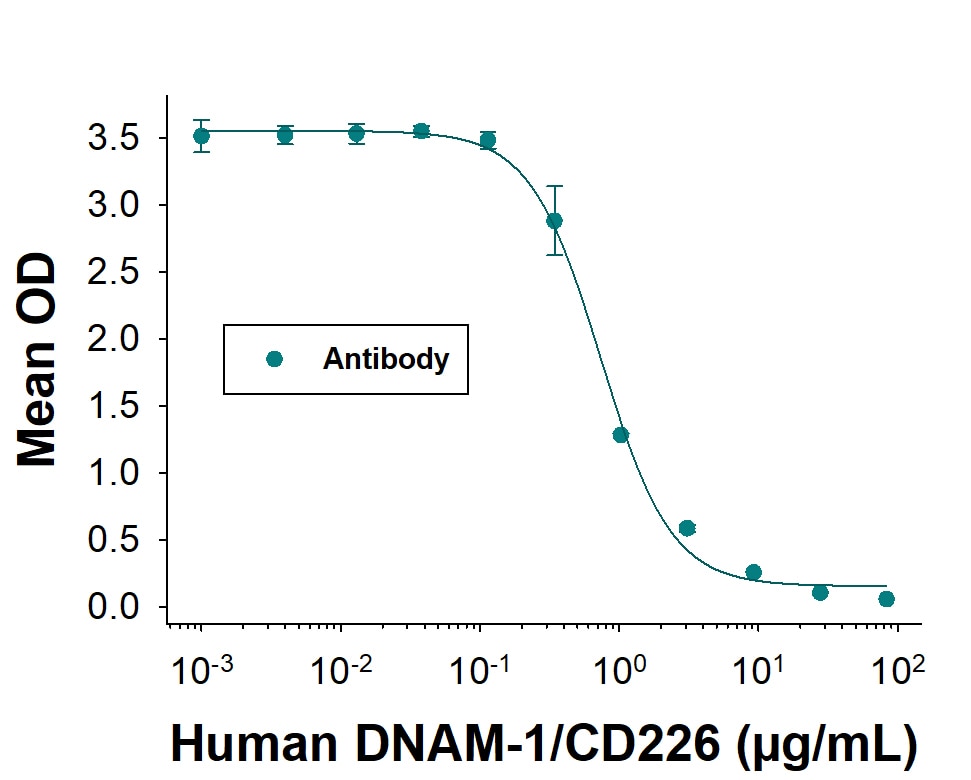
Neutralization of DNAM-1/CD226 Fc Chimera by Human DNAM-1/CD226 Antibody
In a functional ELISA, Human DNAM-1/CD226 Antibody (Catalog # MAB666) blocks the binding of Recombinant Human DNAM-1/CD226 Fc Chimera (666-DN) to Biotinylated Recombinant Human CD155/PVR Fc Chimera Avi-tag (AVI9174). The Neutralization Dose (ND50) for this effect is typically 0.300-6.00 µg/mL.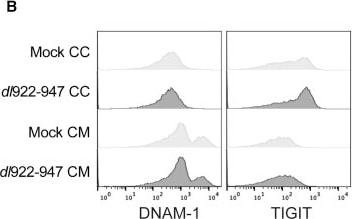
Detection of jmd9qhi05atklcvxzln0.jpg by Flow Cytometry
DNAM-1 Blockade Attenuates and TIGIT Blockade Augments NK-Mediated Cytotoxicity against Adenovirus-Infected CellsThe changes of NK receptors on pNK after exposure to adenovirus-infected TOV21G or their conditioned media were evaluated by flow cytometry. (A) Summary analyses of independent experiments (n = 5) for DNAM-1 (left) and TIGIT (right) expression. (B) Representative images of DNAM-1 (left) and TIGIT (right) expression (Mann-Whitney U tests; CC, co-culture; CM, conditioned-medium). pNK were co-cultured with dl922-947-infected cells with or without a blocking anti-DNAM-1 antibody (10 μg/mL) and assessed by time-lapse microscopy. (C) Representative data of fluorescent object counts over time for TOV21G (left) and summary data (n = 5) of TAUC for TOV21G (right) and (D) OVCAR4 (n = 3) are shown (one-way ANOVA with multiple comparisons test). (E) pNK were co-cultured with OV-infected TOV21G cells with or without a blocking anti-TIGIT antibody (20 μg/mL) and assessed by time-lapse microscopy (n = 5, each line represents a unique donor; also see Figure S8). Image collected and cropped by CiteAb from the following open publication (https://pubmed.ncbi.nlm.nih.gov/32195317), licensed under a CC-BY license. Not internally tested by R&D Systems.Applications for Human DNAM-1/CD226 Antibody (102511)
CyTOF-ready
Flow Cytometry
Sample: Human peripheral blood mononuclear cells (PBMCs) gated on CD3- cells
Western Blot
Sample: Recombinant Human DNAM-1/CD226 Fc Chimera (Catalog # 666-DN) under non-reducing conditions only
Neutralization
Reviewed Applications
Read 1 review rated 5 using MAB666 in the following applications:
Flow Cytometry Panel Builder
Bio-Techne Knows Flow Cytometry
Save time and reduce costly mistakes by quickly finding compatible reagents using the Panel Builder Tool.
Advanced Features
- Spectra Viewer - Custom analysis of spectra from multiple fluorochromes
- Spillover Popups - Visualize the spectra of individual fluorochromes
- Antigen Density Selector - Match fluorochrome brightness with antigen density

Formulation, Preparation, and Storage
Purification
Reconstitution
Reconstitute at 0.5 mg/mL in sterile PBS. For liquid material, refer to CoA for concentration.
Formulation
Shipping
Stability & Storage
- 12 months from date of receipt, -20 to -70 °C as supplied.
- 1 month, 2 to 8 °C under sterile conditions after reconstitution.
- 6 months, -20 to -70 °C under sterile conditions after reconstitution.
Calculators
Background: DNAM-1/CD226
References
- Fuchs, A. and M. Colonna (2006) Semin. Cancer Biol. 16:359.
- Shibuya, A. et al. (1996) Immunity 4:573.
- Bottino, C. et al. (2003) J. Exp. Med. 198:557.
- Tahara-Hanaoka, S. et al. (2004) Int. Immunol. 16:533.
- Dardalhon, V. et al. (2005) J. Immunol. 175:1558.
- Bachelet, I. et al. (2006) J. Biol. Chem. 281:27190.
- Reymond, N. et al. (2004) J. Exp. Med. 199:1331.
- Kakehi, S. et al. (2007) Mol. Cell. Biochem. 301:209.
- Kojima, H. et al. (2003) J. Biol. Chem. 278:36748.
- Tahara-Hanaoka, S. et al. (2006) Blood 107:1491.
- Morimoto, K. et al. (2007) Oncogene July 16 epub.
- Shibuya, K. et al. (1999) Immunity 11:615.
- Shibuya, K. et al. (2003) J. Exp. Med. 198:1829.
- Shibuya, A. et al. (1998) J. Immunol. 166:1671.
Long Name
Alternate Names
Gene Symbol
UniProt
Additional DNAM-1/CD226 Products
Product Documents for Human DNAM-1/CD226 Antibody (102511)
Certificate of Analysis
To download a Certificate of Analysis, please enter a lot or batch number in the search box below.
Note: Certificate of Analysis not available for kit components.
Product Specific Notices for Human DNAM-1/CD226 Antibody (102511)
For research use only
Citations for Human DNAM-1/CD226 Antibody (102511)
 Powered by Bioz
Customer Reviews for Human DNAM-1/CD226 Antibody (102511) (1)
Have you used Human DNAM-1/CD226 Antibody (102511)?
Submit a review and receive an Amazon gift card!
$25/€18/£15/$25CAN/¥2500 for a review with an image
$10/€7/£6/$10CAN/¥1110 for a review without an image
Submit a review
Customer Images
-
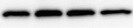
Application: Western BlotSample Tested: Mesenchymal stromal cellsSpecies: HumanVerified Customer | Posted 10/24/2021Mesenchymal stromal cellsprimary antibody dilution was 1:1000, secondary 1:4000

There are no reviews that match your criteria.
Protocols
Find general support by application which include: protocols, troubleshooting, illustrated assays, videos and webinars.
- 7-Amino Actinomycin D (7-AAD) Cell Viability Flow Cytometry Protocol
- Cellular Response to Hypoxia Protocols
- Extracellular Membrane Flow Cytometry Protocol
- Flow Cytometry Protocol for Cell Surface Markers
- Flow Cytometry Protocol for Staining Membrane Associated Proteins
- Flow Cytometry Staining Protocols
- Flow Cytometry Troubleshooting Guide
- Intracellular Flow Cytometry Protocol Using Alcohol (Methanol)
- Intracellular Flow Cytometry Protocol Using Detergents
- Intracellular Nuclear Staining Flow Cytometry Protocol Using Detergents
- Intracellular Staining Flow Cytometry Protocol Using Alcohol Permeabilization
- Intracellular Staining Flow Cytometry Protocol Using Detergents to Permeabilize Cells
- Propidium Iodide Cell Viability Flow Cytometry Protocol
- Protocol for Liperfluo
- Protocol for the Characterization of Human Th22 Cells
- Protocol for the Characterization of Human Th9 Cells
- Protocol: Annexin V and PI Staining by Flow Cytometry
- Protocol: Annexin V and PI Staining for Apoptosis by Flow Cytometry
- R&D Systems Quality Control Western Blot Protocol
- Troubleshooting Guide: Fluorokine Flow Cytometry Kits
- Troubleshooting Guide: Western Blot Figures
- Western Blot Conditions
- Western Blot Protocol
- Western Blot Protocol for Cell Lysates
- Western Blot Troubleshooting
- Western Blot Troubleshooting Guide
- View all Protocols, Troubleshooting, Illustrated assays and Webinars
Associated Pathways
