
Activin A betaA subunit Antibody
R&D Systems | Catalog # AF338

Scientific images may be resized, cropped, or adjusted for brightness or contrast for presentation purposes. These updates are limited to presentation and do not affect the underlying scientific interpretation of the data. Where available, additional source data may be provided upon request.
Key Product Details
Species Reactivity
Validated:
Cited:
Applications
Validated:
Cited:
Label
Antibody Source
Product Specifications
Immunogen
Specificity
Clonality
Host
Isotype
Endotoxin Level
Scientific Data Images for Activin A betaA subunit Antibody
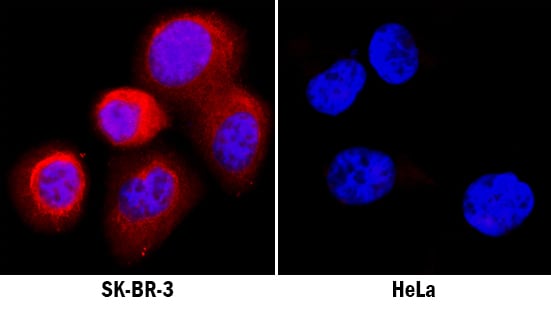
Activin A in SK-BR-3 and HeLa Human Cell Lines.
Activin A was detected in immersion fixed SK-BR-3 human breast cancer cell line (left panel, positive stain) and HeLa human cervical epithelial carcinoma cell line (right panel, negative stain) using Goat Anti-Human/Mouse/Rat Activin A beta A subunit Antigen Affinity-purified Polyclonal Antibody (Catalog # AF338) at 5 µg/mL for 3 hours at room temperature. Cells were stained using the NorthernLights™ 557-conjugated Anti-Goat IgG Secondary Antibody (red; Catalog # NL001) and counterstained with DAPI (blue). Specific staining was localized to endoplasmic reticuli. View our protocol for Fluorescent ICC Staining of Cells on Coverslips.
Activin A in Human Breast Cancer Tissue.
Activin A was detected in immersion fixed paraffin-embedded sections of human breast cancer tissue using 5 µg/mL Goat Anti-Human/Mouse/Rat Activin A beta A Subunit Antigen Affinity-purified Polyclonal Antibody (Catalog # AF338) overnight at 4 °C. Tissue was stained (red) and counterstained with hematoxylin (blue). View our protocol for Chromogenic IHC Staining of Paraffin-embedded Tissue Sections.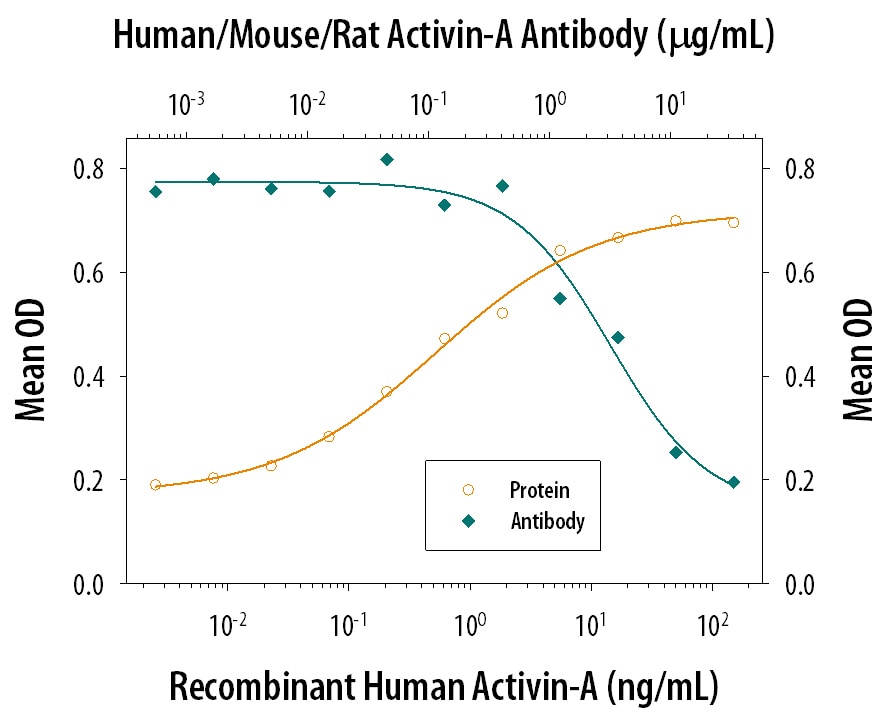
Hemoglobin Expression Induced by Activin A and Neutralization by Human/Mouse/Rat Activin A Antibody.
Recombinant Human/Mouse/Rat Activin A (Catalog # 338-AC) increases hemoglobin expression in the K562 human chronic myelogenous leukemia cell line in a dose-dependent manner (orange line), as measured by the psuedoperoxidase assay. Hemoglobin Expression elicited by Recombinant Human/Mouse/Rat Activin A (7.5 ng/mL) is neutralized (green line) by increasing concentrations of Goat Anti-Human/Mouse/Rat Activin A beta A subunit Antigen Affinity-purified Polyclonal Antibody (Catalog # AF338). The ND50 is typically 2-6 µg/mL.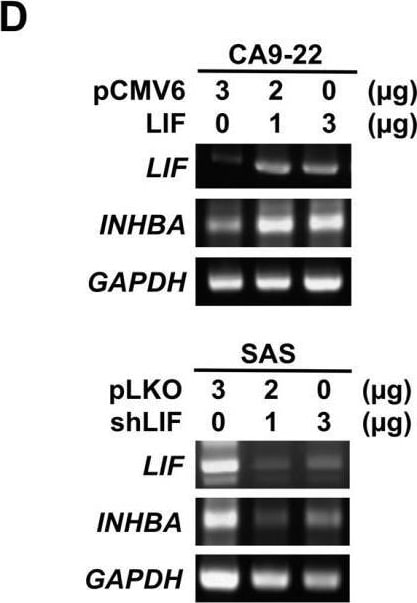
Detection of Activin A beta A subunit by Western Blot
Inhibin beta A subunit (INHBA) as the major downstream effector in LIF increases oral cancer progression. (A) Heatmap of mRNA expression profile in Cal27/pLKO and Cal27/shLIF stable clones. (B) Gene set enrichment analysis (GSEA) showed the enrichment of metastatic genes in Cal27/pLKO versus Cal27/shLIF cells. (C) Real-time PCR analysis of BUB1, BIRC5, INHBA, CD44, and UBE2C mRNA expression in Cal27/pLKO and Cal27/shLIF cells (** p < 0.01). (D) Reverse transcription PCR analysis of INHBA mRNA expression in CA9-22 and HSC3 cells transiently transfected LIF-expressed or shLIF plasmids. (E) Cal27/pLKO and Cal27/shLIF stable clones were seeded and transiently transfected with 3 µg of control plasmid or various concentrations of INHBA plasmids and incubated for 48 h, then subcultured in a Boyden chamber overnight. Cell motility toward the lower face of the filter was observed and quantified (** p < 0.01). (F) Western blot analysis of INHBA protein expression in CA9-22 cells after they were treated with rLIF. beta -actin was used as an internal control. Image collected and cropped by CiteAb from the following open publication (https://pubmed.ncbi.nlm.nih.gov/31973037), licensed under a CC-BY license. Not internally tested by R&D Systems.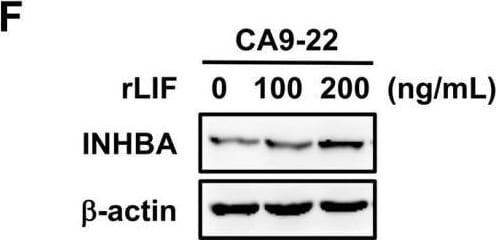
Detection of Activin A beta A subunit by Western Blot
Inhibin beta A subunit (INHBA) as the major downstream effector in LIF increases oral cancer progression. (A) Heatmap of mRNA expression profile in Cal27/pLKO and Cal27/shLIF stable clones. (B) Gene set enrichment analysis (GSEA) showed the enrichment of metastatic genes in Cal27/pLKO versus Cal27/shLIF cells. (C) Real-time PCR analysis of BUB1, BIRC5, INHBA, CD44, and UBE2C mRNA expression in Cal27/pLKO and Cal27/shLIF cells (** p < 0.01). (D) Reverse transcription PCR analysis of INHBA mRNA expression in CA9-22 and HSC3 cells transiently transfected LIF-expressed or shLIF plasmids. (E) Cal27/pLKO and Cal27/shLIF stable clones were seeded and transiently transfected with 3 µg of control plasmid or various concentrations of INHBA plasmids and incubated for 48 h, then subcultured in a Boyden chamber overnight. Cell motility toward the lower face of the filter was observed and quantified (** p < 0.01). (F) Western blot analysis of INHBA protein expression in CA9-22 cells after they were treated with rLIF. beta -actin was used as an internal control. Image collected and cropped by CiteAb from the following open publication (https://pubmed.ncbi.nlm.nih.gov/31973037), licensed under a CC-BY license. Not internally tested by R&D Systems.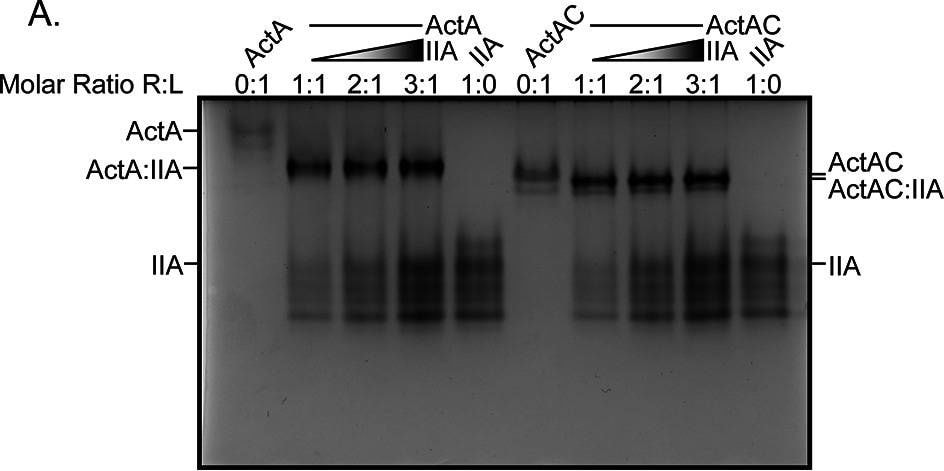
Detection of Activin A beta A subunit by Western Blot
Native gel analysis of type II receptors and ActA, ActAC, and ActC.Native PAGE analysis of ActRIIA (A) and ActRIIB (B) with activin A (ActA) and activin AC (ActAC). Binary complexes were formed by titrating receptor from 1:1 to 3:1 molar ratio against constant ligand. (C) Native PAGE analysis of 1:3 receptor: ligand molar ratio with activin C (ActC). Image collected and cropped by CiteAb from the following open publication (https://pubmed.ncbi.nlm.nih.gov/35736809), licensed under a CC-BY license. Not internally tested by R&D Systems.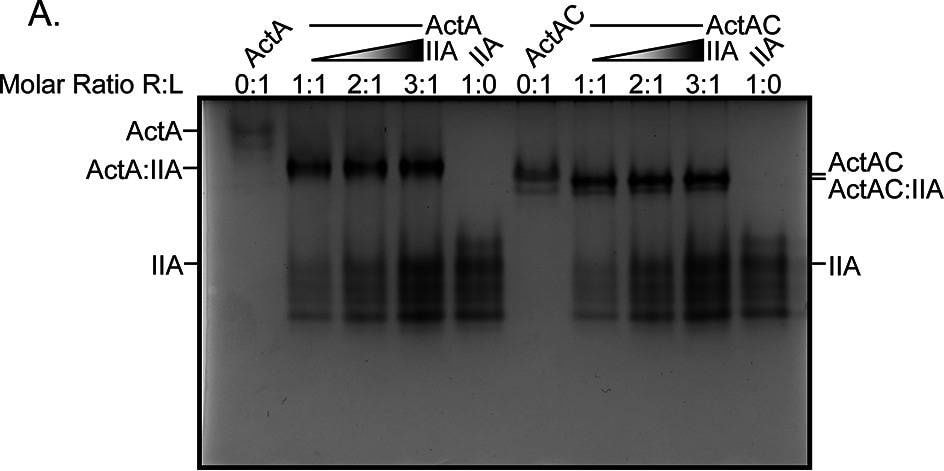
Detection of Activin A beta A subunit by Western Blot
Native gel analysis of type II receptors and ActA, ActAC, and ActC.Native PAGE analysis of ActRIIA (A) and ActRIIB (B) with activin A (ActA) and activin AC (ActAC). Binary complexes were formed by titrating receptor from 1:1 to 3:1 molar ratio against constant ligand. (C) Native PAGE analysis of 1:3 receptor: ligand molar ratio with activin C (ActC). Image collected and cropped by CiteAb from the following open publication (https://pubmed.ncbi.nlm.nih.gov/35736809), licensed under a CC-BY license. Not internally tested by R&D Systems.Applications for Activin A betaA subunit Antibody
Immunocytochemistry
Sample: Immersion fixed SK-BR-3 human breast cancer cell line
Immunohistochemistry
Sample: Immersion fixed paraffin-embedded sections of human breast cancer tissue
Western Blot
Sample: Recombinant Human/Mouse/Rat Activin A (Catalog # 338-AC)
Neutralization
Formulation, Preparation, and Storage
Purification
Reconstitution
Reconstitute at 0.2 mg/mL in sterile PBS. For liquid material, refer to CoA for concentration.
Formulation
Shipping
Stability & Storage
- 12 months from date of receipt, -20 to -70 °C as supplied.
- 1 month, 2 to 8 °C under sterile conditions after reconstitution.
- 6 months, -20 to -70 °C under sterile conditions after reconstitution.
Calculators
Background: Activin A betaA subunit
References
- Kumanov, P. et al. (2005) Reprod. Biomed. Online 10:786.
- Maeshima, A. et al. (2008) Endocr. J. 55:1.
- Rodgarkia-Dara, C. et al. (2006) Mutat. Res. 613:123.
- Werner, S. and C. Alzheimer (2006) Cytokine Growth Factor Rev. 17:157.
- Xu, P. and A.K. Hall (2006) Dev. Biol. 299:303.
- Shav-Tal, Y. and D. Zipori (2002) Stem Cells 20:493.
- Chen, Y.G. et al. (2006) Exp. Biol. Med. 231:534.
- Gray, A.M. and A.J. Mason (1990) Science 247:1328.
- Mason, A.J. et al. (1996) Mol. Endocrinol. 10:1055.
- Thompson, T.B. et al. (2004) Mol. Cell. Endocrinol. 225:9.
- Harrison, C.A. et al. (2005) Trends Endocrinol. Metab. 16:73.
- Onichtchouk, D. et al. (1999) Nature 401:480.
- Gray, P.C. et al. (2002) Mol. Cell. Endocrinol. 188:254.
- Kelber, J.A. et al. (2008) J. Biol. Chem. 283:4490.
- Phillips, D.J. et al. (1997) J. Endocrinol. 155:65.
- Schneyer, A. et al. (2003) Endocrinology 144:1671.
Gene Symbol
Additional Activin A betaA subunit Products
Product Documents for Activin A betaA subunit Antibody
Certificate of Analysis
To download a Certificate of Analysis, please enter a lot or batch number in the search box below.
Note: Certificate of Analysis not available for kit components.
Product Specific Notices for Activin A betaA subunit Antibody
For research use only
Citations for Activin A betaA subunit Antibody
 Powered by Bioz
Customer Reviews for Activin A betaA subunit Antibody
There are currently no reviews for this product. Be the first to review Activin A betaA subunit Antibody and earn rewards!
Have you used Activin A betaA subunit Antibody?
Submit a review and receive an Amazon gift card!
$25/€18/£15/$25CAN/¥2500 for a review with an image
$10/€7/£6/$10CAN/¥1110 for a review without an image
Submit a review
Protocols
Find general support by application which include: protocols, troubleshooting, illustrated assays, videos and webinars.
- Antigen Retrieval Protocol (PIER)
- Antigen Retrieval for Frozen Sections Protocol
- Appropriate Fixation of IHC/ICC Samples
- Cellular Response to Hypoxia Protocols
- Chromogenic IHC Staining of Formalin-Fixed Paraffin-Embedded (FFPE) Tissue Protocol
- Chromogenic Immunohistochemistry Staining of Frozen Tissue
- ClariTSA™ Fluorophore Kits
- Detection & Visualization of Antibody Binding
- Fluorescent IHC Staining of Frozen Tissue Protocol
- Graphic Protocol for Heat-induced Epitope Retrieval
- Graphic Protocol for the Preparation and Fluorescent IHC Staining of Frozen Tissue Sections
- Graphic Protocol for the Preparation and Fluorescent IHC Staining of Paraffin-embedded Tissue Sections
- Graphic Protocol for the Preparation of Gelatin-coated Slides for Histological Tissue Sections
- ICC Cell Smear Protocol for Suspension Cells
- ICC Immunocytochemistry Protocol Videos
- ICC for Adherent Cells
- IHC Sample Preparation (Frozen sections vs Paraffin)
- Immunocytochemistry (ICC) Protocol
- Immunocytochemistry Troubleshooting
- Immunofluorescence of Organoids Embedded in Cultrex Basement Membrane Extract
- Immunofluorescent IHC Staining of Formalin-Fixed Paraffin-Embedded (FFPE) Tissue Protocol
- Immunohistochemistry (IHC) and Immunocytochemistry (ICC) Protocols
- Immunohistochemistry Frozen Troubleshooting
- Immunohistochemistry Paraffin Troubleshooting
- Preparing Samples for IHC/ICC Experiments
- Preventing Non-Specific Staining (Non-Specific Binding)
- Primary Antibody Selection & Optimization
- Protocol for Heat-Induced Epitope Retrieval (HIER)
- Protocol for Making a 4% Formaldehyde Solution in PBS
- Protocol for VisUCyte™ HRP Polymer Detection Reagent
- Protocol for the Fluorescent ICC Staining of Cell Smears - Graphic
- Protocol for the Fluorescent ICC Staining of Cultured Cells on Coverslips - Graphic
- Protocol for the Preparation & Fixation of Cells on Coverslips
- Protocol for the Preparation and Chromogenic IHC Staining of Frozen Tissue Sections
- Protocol for the Preparation and Chromogenic IHC Staining of Frozen Tissue Sections - Graphic
- Protocol for the Preparation and Chromogenic IHC Staining of Paraffin-embedded Tissue Sections
- Protocol for the Preparation and Chromogenic IHC Staining of Paraffin-embedded Tissue Sections - Graphic
- Protocol for the Preparation and Fluorescent ICC Staining of Cells on Coverslips
- Protocol for the Preparation and Fluorescent ICC Staining of Non-adherent Cells
- Protocol for the Preparation and Fluorescent ICC Staining of Stem Cells on Coverslips
- Protocol for the Preparation and Fluorescent IHC Staining of Frozen Tissue Sections
- Protocol for the Preparation and Fluorescent IHC Staining of Paraffin-embedded Tissue Sections
- Protocol for the Preparation of Gelatin-coated Slides for Histological Tissue Sections
- Protocol for the Preparation of a Cell Smear for Non-adherent Cell ICC - Graphic
- R&D Systems Quality Control Western Blot Protocol
- TUNEL and Active Caspase-3 Detection by IHC/ICC Protocol
- The Importance of IHC/ICC Controls
- Troubleshooting Guide: Immunohistochemistry
- Troubleshooting Guide: Western Blot Figures
- Western Blot Conditions
- Western Blot Protocol
- Western Blot Protocol for Cell Lysates
- Western Blot Troubleshooting
- Western Blot Troubleshooting Guide
- View all Protocols, Troubleshooting, Illustrated assays and Webinars